Van's Air Force

The definitive Van's Aircraft support community! Buying, building or flying an RV? Join our exclusive family of mentors and enthusiasts!

140 CHT spread? Or bad info?

tom paul

Well Known Member
Sponsor
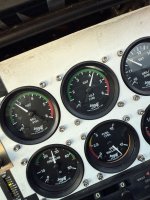
CHT Large spread.jpgHi All. The other day i notice this 140 degree spread in cruise between my only two CHT guages on cyl 3 and 4. As you can see, #4 indicated about 420 degrees and #3 about 280. This was very concerning, so when back in the hangar, I pulled the cowl right away, with the engine still hot, and did a temp reading with a temp gun. All pointing the gun at the cylinder top covers, the readings were all very close to each other at around 145-150. Is this measurement a valid check that may point to a faulty CHT gauge or sensor in #4, or should I still pursue a diagnosis of a high CHT in #4? I will say that that #4 has been hot in the past, a few years ago when I had a rough running engine that taking the temps after running helped me diagnose as a partially blocked fuel injector in #4, causing a lean, extra hot situation, but that was years ago and the engine is running very well now. Any thoughts on my next course of action?
 

Attachments

  • Screenshot 2025-05-23 at 1.05.45 PM.png
    Screenshot 2025-05-23 at 1.05.45 PM.png
    1.7 MB · Views: 27
Well if this was a recent flight at cruise, Id say 280F is too low, and 420F is higher than Id accept at cruise. Id buy a new probe and replace one …. If thing seem more mid range, replace the other too…. Or do both now. Or move the gauge end and see if low moves to #4and high to #3.
 
Well if this was a recent flight at cruise, Id say 280F is too low, and 420F is higher than Id accept at cruise. Id buy a new probe and replace one …. If thing seem more mid range, replace the other too…. Or do both now. Or move the gauge end and see if low moves to #4and high to #3.
Good thoughts. Thanks Butch.
 
No low limit i am aware of.
My comments on low and high are uncharacteristic for my o320 historically….and I never fly at cruise at 2200 rpm, fixed pitched so, 2600+ . Low thoughts are on what it takes to hopefully burn off moisture was my thoughts.
 
For the moment assume a gauge problem. Start with a probe swap between 3 and 4 as suggested previously. If the hot one moves to 3, it's the probe. You have two gauges, so if it does not move you need to try both probes on the same gauge.

Low thoughts are on what it takes to hopefully burn off moisture was my thoughts.

Cylinder head temperature has only an indirect effect on water content in the oil, i.e. it heats only a small quantity of oil entering the rocker box via the pushrod assemblies. And anyway, moisture doesn't burn off, nor is there some specific number which must be exceeded. Water will evaporate at room temperature. Higher temperature = higher vapor pressure = faster evaporation rate.
 
And anyway, moisture doesn't burn off, nor is there some specific number which must be exceeded. Water will evaporate at room temperature. Higher temperature = higher vapor pressure = faster evaporation rate.
We'll, that's true for a glass of water left out on the counter, but not for water droplets entrained in oil in an engine. Moisture in your engine isn't evaporating in an attempt to reach equilibrium with the air in your engine case. Water in your oil needs to be boiled off, the oil needs to get to 100C. Your oil temp gauge can help you determine if you're getting there, just remember that oil temp probes are not always located at the point where the oil is hottest... Even the inlet to the oil cooler is likely a few degrees low.
 
...and misprinted my operating manual!

ScreenHunter_2781 May. 24 15.35.jpg

We'll, that's true for a glass of water left out on the counter, but not for water droplets entrained in oil in an engine.

Seriously, "entrained" leads me to think the argument you're making relates to a fundamental difference between evaporation and boiling. In evaporation, the water molecules (as vapor) only escape from the surface, while boiling forms vapor well under the surface, at the temperature where vapor pressure exceeds the pressure of the surrounding liquid.

The fallacy to this argument is the belief that the oil is a deep pool in the sump, and as such must reach the boiling point in order to force a phase change in the submerged water. The reality is somewhat different; the entire content of the sump is circulated about 4 times per minute in cruise. The vast majority goes to the bearings. It squeezes out the sides of the journals and is flung, smacked, and whacked into a fine mist by the reciprocating and rotating parts, which Newton's 1st guarantees will end up as a thin layer on the crankcase walls. The point here is simple...there is no static pool of liquid oil, except in the momentary sense. It's all subject to constant surface exposure as thin films and aerosol droplets, with a complete exchange every 15 seconds or so.

BTW, the boiling temperature of water is not a fixed number unless you also specify the pressure. 100C is only true at sea level, standard day.
 
Last edited:
Unless the theremostat isn't at the point in the engine where the oil is hottest.

For sure it's not at the point where the oil is hottest. Consider the oil in the rocker boxes and squirt oil coming off the back of the pistons.
 
The fallacy to this argument is the belief that the oil is a deep pool in the sump, and as such must reach the boiling point in order to force a phase change in the submerged water. The reality is somewhat different; the entire contents of the sump is circulated about 4 times per minute in cruise. The vast majority goes to the bearings. It squeezes out the sides of the journals and is flung, smacked, and whacked into a fine mist by the reciprocating and rotating parts, which Newton's 1st guarantees will end up as a thin layer on the crankcase walls.

No amount of splashing oil and water around on it's own will turn the water to vapour though. It's still water, although with the increased surface area as mist it could evaporate faster if any significant amount of evaporation was happening. But when you're spraying oil and at water mist on an engine surface that's much hotter than the local boiling point of water, you get vapour from boiling, not evaporation.

The point here is simple...there is no static pool of liquid oil, except in the momentary sense. It's all subject to constant surface exposure as thin films and aerosol droplets, with a complete exchange every 15 seconds or so.
The entire volume isn't being recirculated that fast, as anything touching a surface will be slowed by the surface. Only the main bulk of the flow that isn't touching anything as it passes through will fly through that fast.

BTW, the boiling temperature of water is not a fixed number unless you also specify the pressure. 100C is only true at sea level, standard day.
True, at 10000' it boils down around 90C, so flying higher helps extract some of that moisture as you fly.
 
I love that this thread turned into an enlightening discussion on evaporation, the trajectory of oil in the crankcase of a running engine, and the effect of altitude on the boiling point! Good stuff. I will swap sensors and check again. I appreciate the responses!
 
My comments on low and high are uncharacteristic for my o320 historically….and I never fly at cruise at 2200 rpm, fixed pitched so, 2600+ . Low thoughts are on what it takes to hopefully burn off moisture was my thoughts.
At my age 2200 is good when I'm not in a hurry to go anywhere or to make my flight last an hour. As well its economical at 5 gph and truing out at 153+ mph. Otherwise if I'm going somewhere, its balls to the wall and that's 2600 rpm until I run lop then Im around 2550 rpm. At 14,000 ft and Im still around 300 deg on the heads and the oil temp is still 180 to 190 deg.
 
I did some diagnostics yesterday and it didn't take long to isolate the issue. As soon as I turned the master on, CHT gauge #2 (cyl 4) indicated 280 degrees. I swapped the leads at the gauges: same result. I removed the leads from the #2 gauge. It still reads 280 degrees. I think I need a new gauge. I don't want to spend much $ on a replacement since I plan to upgrade to an EIS soon (probably going to wait for Oshkosh to see that the best somewhat comprehensive but moderate panel upgrade looks like, so in the meantime, I hope to find a used but good Vans CHT gauge for little $. LMK if anyone has one sitting around.
 
I did some diagnostics yesterday and it didn't take long to isolate the issue. As soon as I turned the master on, CHT gauge #2 (cyl 4) indicated 280 degrees. I swapped the leads at the gauges: same result. I removed the leads from the #2 gauge. It still reads 280 degrees. I think I need a new gauge. I don't want to spend much $ on a replacement since I plan to upgrade to an EIS soon (probably going to wait for Oshkosh to see that the best somewhat comprehensive but moderate panel upgrade looks like, so in the meantime, I hope to find a used but good Vans CHT gauge for little $. LMK if anyone has one sitting around.
Look at the monochrome MGL gauges maybe. They're fairly economical and work well.
 
Back
Top