Van's Air Force

The definitive Van's Aircraft support community! Buying, building or flying an RV? Join our exclusive family of mentors and enthusiasts!

12iS Alternator Winding Replacement

Bob Y

Well Known Member
Friend
Patron
My B alternator stator winding has failed at 600 hrs. Hope to identify root cause when I can look at it. In researching the Rotax HMM, this looks to be a pretty messy exercise. I’d really appreciate being able to speak with anyone that has gone through this experience to learn any tips before diving in. If you’re willing, please PM me so we can talk.
 
My B alternator stator winding has failed at 600 hrs. Hope to identify root cause when I can look at it. In researching the Rotax HMM, this looks to be a pretty messy exercise. I’d really appreciate being able to speak with anyone that has gone through this experience to learn any tips before diving in. If you’re willing, please PM me so we can talk.
You're correct... not a job for the faint of heart and requires some special tooling. Highly recommend Bret Lawton at Advanced Powerplant Solutions to provide the required parts, rental tools, and shop services to assemble and pressure test the new ignition housing (new housing required to accommodate new design spray bar and their assembly service includes new water pump bearings, shaft, and seal). Also requires a new connector for your existing 'B' regulator or a complete regulator assembly with the new connector already attached. Unless you're very comfortable working on engines, I highly recommend you search for a Certified Rotax mechanic in your area to perform the actual change out of the assembly. If you're anywhere near the hose replacement cycle, now is also the time to complete that job because it's an easy task while the engine is removed from the airframe. DM sent with contact info if you want to chat.

Root cause of failure? While the new oil spray bar is a significant improvement to stator coil cooling, it's my opinion that the aggressive charging curve of the EarthX battery, especially an aging one, is the root cause of early coil failures and melting insulation at 'B' regulator connectors.

 
Last edited:
You're correct... not a job for the faint of heart and requires some special tooling. Highly recommend Bret Lawton at Advanced Powerplant Solutions to provide the required parts, rental tools, and shop services to assemble and pressure test the new ignition housing (new housing required to accommodate new design spray bar and their assembly service includes new water pump bearings, shaft, and seal). Also requires a new connector for your existing 'B' regulator or a complete regulator assembly with the new connector already attached. Unless you're very comfortable working on engines, I highly recommend you search for a Certified Rotax mechanic in your area to perform the actual change out of the assembly. If you're anywhere near the hose replacement cycle, now is also the time to complete that job because it's an easy task while the engine is removed from the airframe. DM sent with contact info if you want to chat.

Root cause of failure? While the new oil spray bar is a significant improvement to stator coil cooling, it's my opinion that the aggressive charging curve of the EarthX battery, especially an aging one, is the root cause of early coil failures and melting insulation at 'B' regulator connectors.

I concur get a Rotax trained person to help do this. As for failure modes heat is the enemy. The oil sprayer is mandatory. Also these are actually generator coils not alternators. As such unused energy has to be dissipated as heat. Thus my suggestion to fly with landing lights in wig-wag to increase draw on generator and decrease coil heat, not to mention visibility / safety in the air.
 
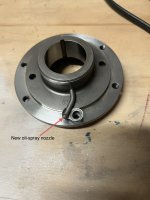
This is to share the conclusion of this problem…. B alternator windings definitely failed. Before opening the engine, very low resistance was measured between the B windings and ground, while A was infinite. While running, voltage from the B windings to ground was also measured. Since the ignition housing was off to replace the windings, I bit the bullet and spent the additional $2000+ to install the oil-spray nozzle, which my engine did not have.

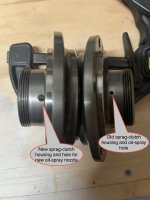
Adding the oil-spray nozzle also required replacing the sprag-clutch and ignition housings. Pressure testing post assembly verified adequate flow through the nozzle.

Thanks to Ernie, post #2, for sharing his experience replacing windings in two of his 12iS’ and procedure tips from Lockwood and Motive.Aero, and to some local friends for their assistance.

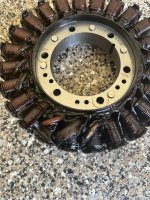
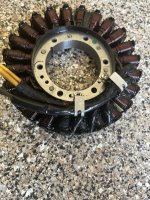
The attached photos show the old vs. new sprag-clutch housings, oil-spray nozzle and failed winding.

Some items that may be of interest to other iS owners… Ernie had failures on two of his iS’ around 600 hrs, which was exactly how many hours I had when mine failed. My symptoms were reduced battery voltage, down to around 13 V, and only a few amperes of charging current at reduced rpm. At WOT voltage would increase to around 13.5 V and charging current increased, but the failed windings were crowbaring the battery voltage.

In the end, I learned a lot more about this engine, the hard way, than I expected, and feel more confident to not have a repeat failure after adding the oil-spray nozzle. Experimental aircraft ownership is supposed to be about education, and I got more than my fair share with this experience.
 

Attachments

  • IMG_2858.jpeg
    IMG_2858.jpeg
    2.3 MB · Views: 38
  • IMG_2857.jpeg
    IMG_2857.jpeg
    2.2 MB · Views: 38
  • IMG_2841.jpeg
    IMG_2841.jpeg
    782.2 KB · Views: 36
  • IMG_2842.jpeg
    IMG_2842.jpeg
    915.7 KB · Views: 42
Last edited:
Sounds like you got it fixed, sorry it happened but you can certainly see the difference in the nozzle vs the random spray hole.
 
Back
Top