Van's Air Force

The definitive Van's Aircraft support community! Buying, building or flying an RV? Join our exclusive family of mentors and enthusiasts!

-10 vs -14 Windshield Fairing Process

iwannarv

Well Known Member
Sponsor
VANS approaches the windshield fairing layup process very differently for the -10 and the -14.

  • On the -10, fiberglass strips are cut in even widths and laid up starting from narrow to wide to build up to the radius.
  • On the -14, fiberglass strips are cut and laid up starting from wide to narrow to build up to the radius. RV14 also has a more detailed 3 pc cutting schedule to get the shape right around the corners vs the -10 just having the single widths cut and laid on top of each other.

I plan to dye my epoxy with black pigment, so for consistency I see the benefit of using the process shown on the -14 (starting with one wide dyed strip against the plexi). Trying to get each layer the exact same shade working up on the -10 process would be a bit more difficult. It would be nice if there was a template/cutting schedule to do the -10 this way, but I'm sure a template could be made after marking where the -10s radius will hit along the fuse sides and masking off the shape.

Brain trust to the best route to go about this? I have watched the VANS RV14 layup videos on the tube.
 
Last edited:
Come on…show a little backbone….do an all;-metal frame like Matt B did on his -7!! 🤣

Seriously, I’d love to hear from Scott on why they reversed the order of the layups. Narrow down in the crack and wider up at the top made intuitive sense to me when I did the -8 two decades ago….but I’ll be doing the Rocket soon, and would love the latest technological advancements to play with!
 
Hey, it's actually easier than fiberglass if you ask me!
Agreed.
It took me three try’s with the English wheel to get mine right and was still faster. Did them in T3 which made it harder to form but still quicker and easier than glass.
At the time, eons ago, there were a lot of issues with folks leaning on the glass fairing edge when they got in and out. I think folks beef that area up now, but that was my motivation to use metal,
No regrets.
Thousands of airplanes flying per plans with glass fairings, so not saying it’s better, it was just what I wanted to do.
 
I spent about two weeks on the fairing layup, and was REALLY proud of my work, being new to fiberglass.

I rolled in to Evoke for paint and the very first words out of Jonathan's mouth was "I can fix that for you", while pointing directly to the fairing.

(sigh)
 
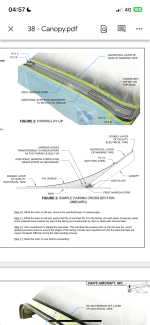
Isn’t the -14 layup narrow strips first transitioning to wider strips?

It just has one flat black ply go on first.

There is a cross section showing this on page 38-30IMG_2694.png
 
I highly recommend the EAA Fiberglass for RV class. I’m a complete novice to fiberglass (well, the whole build process, actually) and the techniques offered there built some confidence. Specifically with the windshield fairing.
 
I had the same question years ago, then I spoke with the tech person at West Systems, they mentioned it would be a stronger bond if the first layer was full width, then do what you want after that. The reasoning was that there would be no overlaps between the fiberglass and substrate. They also recommended Gflex for the first layer at a minimum, as that product bonds better to the aluminum and can better withstand movement.

Also another note: if the first layer or two is full width, you would only need to apply the dye to those layers, the rest can be plain epoxy.

That’s the route I went, but at the end of the day…either way I am sure is acceptable.

Jason
 
Come on…show a little backbone….do an all;-metal frame like Matt B did on his -7!! 🤣

Seriously, I’d love to hear from Scott on why they reversed the order of the layups. Narrow down in the crack and wider up at the top made intuitive sense to me when I did the -8 two decades ago….but I’ll be doing the Rocket soon, and would love the latest technological advancements to play with!
The recommended process in the RV-14 plans and videos is for the most part the same as what has been recommended in all of the previous models with one exception.
This exception came about when developing the plans for the RV-12.
The change was to put down a single full coverage layer of glass/resin as a first layer.

There was multiple reasons for this.

- This first layer is done using the plastic transfer method which allows for precise positioning of the edge of the cloth adjacent to the edge of the tape ... this is going to be the thin point in the layup on the canopy so it helps produce an uninterrupted and unfrayed edge that will need the least amount of finishing effort at this difficult location. It also allows for cutting a specific shape to establish the finished footprint of the fairing which was very necessary on the RV-12 and to some but lesser degree on the RV-14.

- It provides for an easy method of using resin tint dye to give a better looking finish to the fairing when viewed from the cockpit side. A builder can just use dye for the entire layup, but as mentioned in the video, that is not recommended for someone new to fiberglass work because the dye removes the translucency of the lay-up which makes it much harder to determine if the cloth is being whetted out fully or if more resin is being used than necessary.

- I think it can improve the integrity of the layup slightly, in cases were a builder has a bit more gap between the canopy/windscreen and the forward top fuselage skin.

- An additional benefit that may not be relevant to all builders, is that you can add the first layer of cloth almost as soon as you have finished applying the tinted micro filler in the gap at the base of the windscreen... by the time you have your plastic transfer lay-ups ready to apply, the filler has usually begun to set up enough that a large piece smoothed into the valley wont disturb it. If you start with skinny strips, you have to allow the micro filler to cure a lot more.

Once this full coverage first layer has been applied, the rest of the process is exactly the same.

I can't remember if it is mentioned in the videos (but I think it was)... a side benefit of using the full coverage first layer is that if a builder does not want to complete the entire lay-up process in one work session because of available time, STRESS 🤪, or they want to make sure they have good translucency from use of the tinted resin, they can finish this step with a heavy brushed coat of tinted resin and then cover everything with peelply. Once cured it will be a stable base on the entire fairing footprint with a nicely developed edge along the tape, ready to begin laminating again once the peelply is remove, and have no risk of disturbing the foundation of the entire fairing.

 
VANS approaches the windshield fairing layup process very differently for the -10 and the -14.

  • On the -10, fiberglass strips are cut in even widths and laid up starting from narrow to wide to build up to the radius.
  • On the -14, fiberglass strips are cut and laid up starting from wide to narrow to build up to the radius. RV14 also has a more detailed 3 pc cutting schedule to get the shape right around the corners vs the -10 just having the single widths cut and laid on top of each other.

I plan to dye my epoxy with black pigment, so for consistency I see the benefit of using the process shown on the -14 (starting with one wide dyed strip against the plexi). Trying to get each layer the exact same shade working up on the -10 process would be a bit more difficult. It would be nice if there was a template/cutting schedule to do the -10 this way, but I'm sure a template could be made after marking where the -10s radius will hit along the fuse sides and masking off the shape.

Brain trust to the best route to go about this? I have watched the VANS RV14 layup videos on the tube.
It actually isn't very different. There is just one slight change.... see post #13
 
Back
Top