Van's Air Force

The definitive Van's Aircraft support community! Buying, building or flying an RV? Join our exclusive family of mentors and enthusiasts!

Garmin G3X Video In

rotorbailey

Member
I want to connect an IR camera to my G3X system. I searched the Install Guide for "video" and the word does not appear.

The marketing page says that it accepts composite video through a BNC connector. Can anyone point me to more detailed information:

- What are the supported input and displayed resolutions?

- With a single 10" GDU, it will always act as PFD and I presume the video is only viewable on half of the screen or as an inset?
 
I want to connect an IR camera to my G3X system. I searched the Install Guide for "video" and the word does not appear.

The marketing page says that it accepts composite video through a BNC connector. Can anyone point me to more detailed information:

- What are the supported input and displayed resolutions?

- With a single 10" GDU, it will always act as PFD and I presume the video is only viewable on half of the screen or as an inset?

Hello,

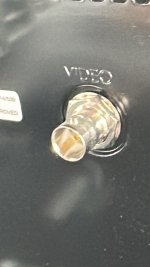
The composite video input on the BNC connector should work with just about any PAL/NTSC camera (such as the Garmin VIRB). This video input is standard on every 10.6" GDU 460/465 and 7" GDU 450/455 touch screen display.

You are correct that the video image on a PFD may be viewed in both an inset window on the full width PFD and in a split screen window on the PFD. Just touching the video inset window splits the PFD and brings up the larger video window. On an MFD, the video image may be viewed in a full width window.

The image from the camera may be viewed at its native resolution, scaled to window width, scaled to window heighth, or stretched in both width and heighth to fit the entire window.

Let us know if you have additional questions.

Thanks,
Steve
 
Steve, thanks. I'm looking at the ICI 9320 P Series (320x240) and ICI 9640 P Series (640x480) IR cameras. There is no point going for the latter unless that resolution would actually be displayed. Can you help me with:

- Are these input resolutions both supported?
- What resolution is displayed when video is in inset window on the full width PFD and in a split screen window on the PFD?
 
Steve, thanks. I'm looking at the ICI 9320 P Series (320x240) and ICI 9640 P Series (640x480) IR cameras. There is no point going for the latter unless that resolution would actually be displayed. Can you help me with:

- Are these input resolutions both supported?
- What resolution is displayed when video is in inset window on the full width PFD and in a split screen window on the PFD?

Hello Rotorbailey,

The composite video image out of the Garmin VIRB is 700 x 480, and we display that both at native resolution and stretched to fit the screen in several ways.

If you are viewing the image on a full width video page on the GDU 46X MFD, we can accommodate really large video images up to 1280 wide.

A split screen video window on the PFD without an EIS strip is 640 wide by about 650 high. The video inset window on a full width PFD is about 300 x 270. The total screen size is 1280 x 768.

Thanks,
Steve
 
How would you go from the USB connector on the camera to the BNC video in on the MFD?

Hello Evolution10,

If you are asking about the USB connector on the Garmin VIRB, the VIRB Audio-Video Cable provides an adapter cable that converts the USB connector on the VIRB to multiple signals including an RCA style composite video.

Here is an example of an RCA to BNC Adapter that would plug into the RCA connector on the VIRB Audio-Video Cable and let you use commonly available 75 ohm video coax with BNC connectors on each end. The video input connector on the GDU 4XX is BNC.

Let us know if you have additional questions.

Thanks,
Steve
 
Last edited:
Steve, thanks: that's exactly what I was looking for re displayed resolutions.

Evolution 10, these cameras are advertised as having a USB connector, but that is due to an attached module which converts composite video to digital. For this application, I would simply attach the camera's native composite video output directly to the G3X.
 
Hi guys! I realize this post is really old, but I have some questions about hooking up a thermal camera to a G3X.

I’m at Oshkosh again this year and looking at the Astronics enhanced vision systems. It seems that there ought to be an easy way to hook up a thermal camera to my G3X without spending 11k.

Any thoughts?
 
Hi guys! I realize this post is really old, but I have some questions about hooking up a thermal camera to a G3X.

I’m at Oshkosh again this year and looking at the Astronics enhanced vision systems. It seems that there ought to be an easy way to hook up a thermal camera to my G3X without spending 11k.

Any thoughts?
I have the SATIR NV628 connected to G3X, works ok.

 
Could you post a photo of what the output looks like on the G3x? I like the idea of an IR camera for nighttime.
 
Hi guys! I realize this post is really old, but I have some questions about hooking up a thermal camera to a G3X.

I’m at Oshkosh again this year and looking at the Astronics enhanced vision systems. It seems that there ought to be an easy way to hook up a thermal camera to my G3X without spending 11k.

Any thoughts?
A few years ago, I talked to the guys at Osh and tried to get my hands on a demo unit for a customer that wanted to try/purchase one to include in a G3X panel upgrade, but I never had much luck coordinating getting a unit to try. Would still love to get my hands on one to demo but don't have funds to purchase one just as a demo unit. They had 2 different units, a low res and hi res unit.
They have a booth at Osh every year but I'm not sure they are that interested in the EAB market to be honest.
 
Last edited:
Sorry, I meant the output of your IR camera on the display. Thank you for the update though!!
 
Sorry, I meant the output of your IR camera on the display. Thank you for the update though!!
I’m still doing research on the camera part of the equation. I have connected with another Oshkosh vendor, and reached out to a couple of online vendors trying to find a camera that will plug and play.

If I find something that works, I will update.
 
I’m still doing research on the camera part of the equation. I have connected with another Oshkosh vendor, and reached out to a couple of online vendors trying to find a camera that will plug and play.

If I find something that works, I will update.
Update: thermal cameras with the astm standard seem to have been eclipsed by ethernet out, and newer cameras with the astm standard seem to be unavailable.

I spoke with an engeneer who related that he had done some work fitting thermal cameras to cars and trucks.

Using a thermal camera with an ethernet connection requires the use of an encoder to convert the signal to analog. He recommended the AXIS M7104.

He further recommended a regulated 12vdc power supply as these items are power finicky, and vehicles typically produce 13.5+ volts and sometimes less than 12vdc. I found a couple small lightweight buck-& boost regulators on Amazon with varying prices depending upon amperage.

I am a A&P/pilot, not an avionics guy. I’m hoping that someone can help fill in the information gaps and point me toward a suitable thermal camera.
 
Someone could reach out to CubCrafters - don't they offer an IR camera into their G3X display as an option?
 
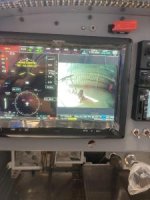
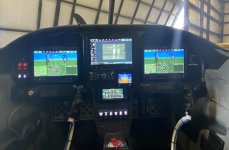
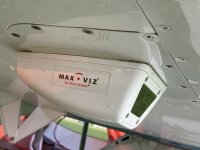
Max-Viz X1 Standard Resolution for Experimental aircraft from Astronics.com. Uses composite video (RS-170) NTSC signal which is compatible with G3X. Just add power and ground for an easy install. Mounted below wing on inspection panel. I’ve since 3D printed a small wedge to get the viewing angle better. The picture is at the camera’s native resolution on the MFD but I fly with it full screen.

I use it every night flight. Great for checking for a foul deck (lots of deer and other creatures in S Texas), for seeing small clouds that don’t show on radar and for flying the base to final turn heads down when being lasered! Hope to not need it to find the best forced landing spot at night!

IMG_2905.jpeg
 

Attachments

  • 64926049804__93977C5D-7607-439D-988F-556C0D649467.jpeg
    64926049804__93977C5D-7607-439D-988F-556C0D649467.jpeg
    1.1 MB · Views: 25
Last edited:
Max-Viz X1 Standard Resolution for Experimental aircraft from Astronics.com. Uses composite video (RS-170) NTSC signal which is compatible with G3X. Just add power and ground for an easy install. Mounted below wing on inspection panel. I’ve since 3D printed a small wedge to get the viewing angle better. The picture is at the camera’s native resolution on the MFD but I fly with it full screen.

I use it every night flight. Great for checking for a foul deck (lots of deer and other creatures in S Texas), for seeing small clouds that don’t show on radar and for flying the base to final turn heads down when being lasered! Hope to not need it to find the best forced landing spot at night!

View attachment 94254
They are really proud of their camera! They want 11k for the experimental version and 15k for the certified version.


I’m trying to find something a little cheaper….
 
Someone could reach out to CubCrafters - don't they offer an IR camera into their G3X display as an option?

This is the flight school which installed the Tenum 640 in their Cub..
 
Most operators stopped installing the Astronics IR cameras in their single-seat aerial fire tankers. Besides being costly with a dedicated cockpit display, the pilots didn’t find them useful and hence hardly used them. Who would have thought? It would seem an IR camera would be great for seeing through smoke or finding hot spots. But most scooper pilots are seasoned and know better than to have their heads down in the cockpit when flying around mountains following a lead-in plane. It just wasn’t safe or practical. Maybe better for larger aircraft with multi-pilot crews. So the newer non-IR equipped SEAT birds are lighter and owner’s bank account is slightly heavier. A side benefit of this is the gubmit’ likes the lighter airframes when choosing aircraft because they get more bang for the buck.
 
Most operators stopped installing the Astronics IR cameras in their single-seat aerial fire tankers. Besides being costly with a dedicated cockpit display, the pilots didn’t find them useful and hence hardly used them. Who would have thought? It would seem an IR camera would be great for seeing through smoke or finding hot spots. But most scooper pilots are seasoned and know better than to have their heads down in the cockpit when flying around mountains following a lead-in plane. It just wasn’t safe or practical. Maybe better for larger aircraft with multi-pilot crews. So the newer non-IR equipped SEAT birds are lighter and owner’s bank account is slightly heavier. A side benefit of this is the gubmit’ likes the lighter airframes when choosing aircraft because they get more bang for the buck
I routinely fly under Atlanta class B airspace, ie low altitude. Throw in a single engine and a night flight and in a emergency the options quickly deteriorate to somewhere between slim and none.

I want to find a thermal camera that could at least help me find a field vs a forrest.

Do I want to pay 11k for a camera? There has to be something that can do the job for less
 
Came across this when I was thinking of doing the same. IR cameras are cheap these days, no reason it has to be $11K 🤮🤮🤮

Did a simple search on AliExpress and I think this is exactly what everyone here is looking for. https://www.aliexpress.us/item/3256806996850478.html

$193 - 256 x 192
$396 - 384 x 288
$599 - 640 x 512

They have CVBS video out so it should be a plug and play install. If anyone does get this, let us know how it worked.
 
Came across this when I was thinking of doing the same. IR cameras are cheap these days, no reason it has to be $11K 🤮🤮🤮

Did a simple search on AliExpress and I think this is exactly what everyone here is looking for. https://www.aliexpress.us/item/3256806996850478.html

$193 - 256 x 192
$396 - 384 x 288
$599 - 640 x 512

They have CVBS video out so it should be a plug and play install. If anyone does get this, let us know how it worked.
Another member has already purchased the axisflying drone thermal camera. They have developed a phone app that can connect and control the camera via wifi or bluetooth.

A thermal camera is a specialized type of infrared (IR) camera, but they capture and process infrared radiation in different ways
. All thermal cameras are infrared cameras, but not all infrared cameras are thermal cameras.

[td]IR Provides clear images in low-light conditions but can be blinded by dense fog, smoke, or foliage, or by bright lights like car headlights.[/td][td]Thermal Can see through total darkness, light fog, and smoke. Is not affected by bright[/td]

They have 3D printed a case with the germanium lens and this can operate either hard wired or wireless. The prototype is set up to mount ‘GoPro’ style to the tie-down ring as a proof of concept.

I am working on a couple options for mounting the AxisFlying thermal camera hard wired to either the lower engine cowl and the fuselage to gear leg fairing. We are waiting to see if the moving prop affects the camera.
 
Back
Top