Van's Air Force

The definitive Van's Aircraft support community! Buying, building or flying an RV? Join our exclusive family of mentors and enthusiasts!

Another pmag question

"First time builder" is a tough label. We have folks who need a manual for a screwdriver, while we see other first timers collect Lindys.

Let's assume we're speaking for the first group. To get 90% of the good with maximum simplicity, probably a non-impulse Slick paired with the Lycoming-branded version of the Surefly. They would share the same aviation harness and plugs, the wiring requirement is very simple, and the local A&P will be comfortable. The Lycoming EI has a sealed timing advance schedule specific to the engine model, one less thing for the new guy to worry about. Both have corporate infrastructure for support, a detail often overlooked. Our game has products which may be orphaned when a principal retires or dies.

We're all aware of Champion's intent to introduce a self-generating mag. If/when it happens, it may be an obvious choice.

BTW, don't get the idea that I hate a P-mag. Some aspects of the design are really dumb, and admittedly, I have no patience for fanboys. However, everything could be fixed with a little effort, and who knows, Hartzell may be looking at it right now. P-mag has thrived in the marketplace for two reasons. One, self-generation may have limited practical value in its current iteration, but it's a very powerful sales feature. Two, Brad and his crew did a truly marvelous job supporting the product, something I admire very much. I hope they made a pot of money when they sold, because they deserved it.
 
Last edited:
I used a Pmag on one side based on anecdotal evidence that it would start better and Lycoming sold them that way.
I don’t have enough experience to say if it does but starts well. Most of what I know about airplanes is what I read on VAF. Anecdotally I see just as many or more issues with the other electronic ignitions.

If I did it again I probably would have copied you.

What is your recommendation for a first time builder?
That's the way Superior came and, yes, it starts way easier. Knock on wood.
danny
 
"First time builder" is a tough label. We have folks who need a manual for a screwdriver, while we see other first timers collect Lindys.

Let's assume we're speaking for the first group. To get 90% of the good with maximum simplicity, probably a non-impulse Slick paired with the Lycoming-branded version of the Surefly. They would share the same aviation harness and plugs, the wiring requirement is very simple, and the local A&P will be comfortable. The Lycoming EI has a sealed timing advance schedule specific to the engine model, one less thing for the new guy to worry about. Both have corporate infrastructure for support, a detail often overlooked. Our game has products which may be orphaned when a principal retires or dies.

We're all aware of Champion's intent to introduce a self-generating mag. If/when it happens, it may be an obvious choice.

BTW, don't get the idea that I hate a P-mag. Some aspects of the design are really dumb, and admittedly, I have no patience for fanboys. However, everything could be fixed with a little effort, and who knows, Hartzell may be looking at it right now. P-mag has thrived in the marketplace for two reasons. One, self-generation may have limited practical value in its current iteration, but it's a very powerful sales feature. Two, Brad and his crew did a truly marvelous job supporting the product, something I admire very much. I hope they made a pot of money when they sold, because they deserved it.

I guess I have the worst of both worlds. A pre 2022 Pmag and an Impulse coupled Slick.

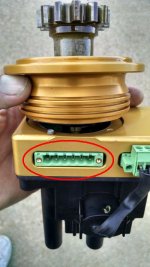
While we are on the screwdriver: Those Phoenix rising clamp screw connections are ubiquitous in high reliability industrial control and data acquisition systems. I do have significant experience with them and if the wires are stripped to the proper length, wire strands not splayed and strain relieved like Pmag instructs they are very reliable. My MGL RDAC that is mounted on the engine mount uses them. No issues. IMG_4076.jpeg
 
Last edited:
Those Phoenix rising clamp screw connections are ubiquitous in high reliability industrial control and data acquisition systems.

Yes, I know. More than 50 years ago I was twisting similar screws 120 or so at a time, connecting tower crane panel boxes. Still have the long screwdriver.

Here's the thing...Phoenix Contact doesn't market them for automotive use. That entire industry uses high quality sealed plug connectors.

I do have significant experience with them and if the wires are stripped to the proper length, wire strands not splayed and strain relieved like Pmag instructs they are very reliable.

You mentioned one of the key issues, in many ways similar to why the auto industry switched to constant tension clamps on hoses. In a dynamic environment, individual wire strands can migrate, resulting in loss of clamp force in a screw tightened joint. A constant tension joint is better, because as the wire or rubber or (insert substrate here) changes in dimension, the clamp does also, maintaining the original clamp force.

Is the P-mag a 5.08 pitch, or one of the smaller ones?

Header Block 400w.jpg
 
Yes, I know. More than 50 years ago I was twisting similar screws 120 or so at a time, connecting tower crane panel boxes. Still have the long screwdriver.

Here's the thing...Phoenix Contact doesn't market them for automotive use. That entire industry uses high quality sealed plug connectors.


You mentioned one of the key issues, in many ways similar to why the auto industry switched to constant tension clamps on hoses. In a dynamic environment, individual wire strands can migrate, resulting in loss of clamp force in a screw tightened joint. A constant tension joint is better, because as the wire or rubber or (insert substrate here) changes in dimension, the clamp does also, maintaining the original clamp force.

Is the P-mag a 5.08 pitch, or one of the smaller ones?

View attachment 122826

I must confess that I had have an Emag anomaly due to getting that connector wet. I rinsed off the engine an didn’t cover the mag. When I started it there was no tach output until I dried it out.
 
You want simple trouble free then go with dual Bendix mags. Want to spice it up a bit, 1 Bendix and SDS CPI 1.
Option A is what is on my RV8 after a lifetime of other "spice"! (including P-mags)
Brad even bought me breakfast a number of years ago at OSH, quietly remembering our adventures in the early days.
 
I must confess that I had have an Emag anomaly due to getting that connector wet. I rinsed off the engine an didn’t cover the mag. When I started it there was no tach output until I dried it out.

There’s another issue with getting Pmags wet - the housing that contains the PCboard is vented to the atmosphere through a course screen window. I had issues with my Pmags and when Brad opened them up, my boards were corroded with a green fuzz to the point I needed new boards. So if you are going to degrease your engine during maintenance, make sure to remove or bag the ignitions.
 
"Easier to install" - Yes it is a fact. Facts are stubborn. Again wires running over your engine with pickups inside the pulley that have to be aligned, gapped that could if something fouls the spinner, ring gear could wipe out sensors. I did have a alternator belt fail on a Piper Twin... The generator seized and belt smoked and came off with force. If EI sensors were there they would likely be damaged, gone. I don't need cockpit displays on on the fly adjustment. I just want an ignition out of sight out of mind.

You keep returning to “…wires running over the engine…” in these discussions as if it is a bad thing. Understanding that you have made your product choice and are sticking with the familiar, don’t pollute the information stream with failure modes that only exist in your imagination. Properly installed aircraft wiring will last the life of the airframe with zero maintenance. It is a non wear non calendar interval item. Further, my crank sensor is “properly installed” and not subject to failure due to a thrown or broken belt. Or a bird strike. Short of damage incurred by a catastrophic failure of the engine or hostile fire, that sensor is going to keep on doing its thing - with zero maintenance. Your Piper twin experience is a great “war story” I’m sure, but not relevant in context. Don’t invent failure scenarios that don’t actually play out in the real world. In the real world we only need to look to our garages - where our cars have featured this same distributed ignition architecture that you fear so much for the last 3 decades or more - yet provide a level of reliability that approaches 100%. With this analog, we have billions of hours of reliable operation to draw from, and to cling to the “…wires all over the engine” boogieman is intellectually dishonest. As you say: “facts are stubborn”.

"Cost is system reliability." That is a strawman. What reliability issue with P-Mag? They are very reliable. This red herring distracts from the self power and ease of installation. I wrote a book on bearing wear above, please read it. That is a maintenance item I grant you. This is a known wear item and addressed with maintenance. Yes it is more than hall effect sensors off the pulley. Got it. Noted. Than you follow up with self power and ease of installation is not important? Your opinion. I find it very important.

You ask “What reliability issue with Pmag?”, then spend the rest of the paragraph describing the reliability issues with PMag. One has only to do a search on this and other forums to uncover the many and varied reliability issues with Pmags so we don’t need to go into that here. Let’s just agree that compared to a modern car ignition, Pmags reliability is demonstrably, objectively, “lacking”.

Your argument and others is Self Power and Ease of installation are NOT important so the P-Mag has no advantages? That is Illogical. Yes there are other solutions, but the P-Mag is the only one that does what it does and does it well…

The PMag has some good qualities that offer compelling advantages. The ease of installation is a big feature and has sold a bunch of units on that basis alone. That’s what sold me 20 years ago. From a practical sense however, that’s only an advantage if viewed through a narrow lens. Open the aperture to overall system performance and that feature looses ground. We’ve discussed the “self powered” thing ad nauseam and it’s clear that your need to have the power originate within the ignition housing is paramount, while I’m more flexible. I just want the sparks at the plugs and I know how to do that without having it resident inside the ignition itself.

Your comment that the PMag “…does it well…” is debatable if subjective standards are applied. If one is willing to accept some significant concessions because it’s an “airplane”, then one can justify almost anything. Objectively, the standard of performance for something as simple as an aircraft ignition should be a very high bar. Frankly, an aircraft mission profile is far less complex than that of a modern automobile so should be AT LEAST as reliable. Does a PMag meet the reliability standard of the Honda in your garage? We both know the answer to that. Where we differ in defining “…does it well…” lies here. I expect new car reliability in my ignition and perhaps you don’t. Fair enough.

And Like Dan (and others), I have no ill will against PMag as a concept or Brad as a person. Both are excellent. But I’m also a product of 40 years of aerospace work. Maintenance, engineering, flight test, etc, and view products through a fairly clinical engineering lens. In aerospace we MUST call balls and strikes or we fail. But those balls and strikes have to be real - not imaginary.
 
In case anyone missed it - I did create a poll to get a rough idea of the failure rate - see it here if you re running an Emag/Pmag.
 
Is there a seal around the connector header? And how about the pitch?

I don’t have access now to it to answer. It’s been very stable for 4 years and 195 hrs of half hour flights. I wired it so I can inspect the the shaft without de-mating the connectors.

Looking back my decision to use a Pmag was based on advertising. It just seemed so mainstream.
 
Last edited:
Im probably never going to fly above 9000ft again.
I couldn’t figure out reading the manual or talking to Brad was if it was worth it to connect the cheesy vacuum sensor or leave the Pmag sensing ambient ?
 
In case anyone missed it - I did create a poll to get a rough idea of the failure rate - see it here if you re running an Emag/Pmag.
That was interesting. 25% of respondents had bearing issues. Confirmed my suspicions, but even I thought it would be less than 25%.
 
You keep returning to “…wires running over the engine…”
What ever man... Look yes I have installed a half dozen EI's in as many planes over the decade or two. I have seen it all.
  • Yes you have more wires and wire runs, more connections. Bad connections, corrosion, vibration, chaffing, all possible & do happen.
  • You have magnets glued into the pulley that can, do, have fallen out. Whoops! Source of issues.
  • You have hall effect sensors with Goldilocks spacing, not too little, too much just right. Source of issues.
  • Hall effect seniors have to be on ridged secure brackets that don't move or flex. Source of issues. (pain depending on engine case)
  • As mentioned a few times anything that gets caught in there, say a alternator belt, might shut your engine down.
  • Not withstanding back up battery, main bus surges, transients can and has caused known EI grief. A possible source of issues.
  • Are 2 EI's driven off same main bus "independent" even w/ backup Bat? There are ways to isolate, but more devices, wires, connections (weight).
  • Self switching back up, power issues. Architecture I recommend constant isolated parallel Power for with 2 electrically dependent EI's (or use one Magneto or one P-Mag for the 2nd ignition. That gives you best of both worlds and most of the gains. I have no worries about dual P-Mags.
  • For true independence you can NOT share anything, power, sensors, wiring, CB, on and on. Typically steps are taken to isolate but stuff happens.
  • Customer Service and Will They Be Around? P-Mag's customer service was Five ⭐. I don't think Hartzell will discontinue and stop supporting it. Hartzell, prices up a little and turn times up a little from what I read but nothing unreasonable fingers crossed. You will NOT get the one on one owner founder of company service with Hartzell but I feel hopeful. If not I will dump the P-Mag and go elsewhere. As far as other brands, do your own soul searching. Ross is great I hear, but different country (shipping) and one man band. Light Speed, Klaus I like him, but he has rubbed people wrong I hear. Other brands? I don't know. I look at the other factors with boutique aircraft products my life depends on, and that is the customer service. Will they be around and will they support the product and customers?

If you think ANY EI is failure proof or far superior, you are fooling yourself. If we can be hyper critical of the most popular and arguably the most proven reliable EI on the market, P-Mag, we can look critically at other EI's. No offense intended. The group think is strong. It is not a contest only preference.

I would submit the SELF POWER and EASE OF INSTALLATION (less wires, in fact NO wires needed once engine is running) does have some PROS or advantages over other EI's.

I could make a EI from scratch on my work bench, electrically dependent (like LightSpeed, SDS, Electro Air granted not as good), from parts online from JEGS, Mouser and DigiKey. However I could not make a P-Mag. No one copies P-mag because it's hard to do.

If you have electrically dependent EI KEEPING ONE MAG is a brilliant design, configuration. Why magnetos are freaking reliable and work like a farm tractor. You can fly with MASTER and other switches you have for EI power OFF. Priceless.

They ALL EI's work similarly technically, and the end result is the same or similar performance and operational gains. KISS Keep It Simple Stud. Less is more. Less wires, less connections, less other switches, relays, batteries lowers weight, complexity and weight. Statistically this is GOODNESS.

My P-Mag is MAGNETO LIKE and driven off the accessory case just like a MAGNETO. 😊 ❤️ (y)

borat-borat-very-nice.gif
 
Last edited:
No point replying to more fallacies, but for others reading, there is another p-mag failure thread:


One thing to point out is that p-mags also depend on wires, the difference is that they are internal and *ALL* of them are subject to heat and vibration:

Called Hartzell and spoke with Tyler Burrows and sent him the mag. He had it send back within 3-4 days covered under warranty. Said their was a loose wire or a wire inside that either was not done correctly from the factory or had come loose. Either way he fixed and sent it back quick.

With other systems you must install some sort of trigger on the engine, but everything else is optional if you want it on the engine or not. In my install I have coils mounted where the mags would have been, so I just have 2 feet of wires between the coils and brain, and 4 feet of wires between the pickup and brain. Wires are contiguous without connectors, in armored loom, and guided by adel clamps. One nice thing with external coils is that I can pick them up at napa. I don't need to mail anything back to have it repaired which is important if you have a failure while away from home.
 
Back
Top