Van's Air Force

The definitive Van's Aircraft support community! Buying, building or flying an RV? Join our exclusive family of mentors and enthusiasts!

manifold pressure issues, need advice

MacCool

Well Known Member
Patron
RV-9A IO-320-D1A with CS prop, second flight after condition inspection. Normal run up and climb out, gauges normal, engine running fine, normal power. I pulled the power back to 25/2500 (cruise climb), noted that the engine sounded a bit quiet and airspeed was falling off. Engine sounded completely normal and responded to throttle.. As I turned back for the airport I did all the usual stuff for a partial power situation, no change. I landed normally taxied to the compass rose and repeated the run up (mag check, throttle response, propeller) all non-illuminating to me. I had my mechanic look it over carefully yesterday. Pmags were fine, timing normal, no wobble, no throttle or fuel issues, no evidence of induction leak. I flew it this morning, orbiting the airport. Starting and taxi were normal. Run up was normal, engine and throttle response on takeoff were normal. At 1000 ft I pulled the power back to get it to 25 inches (cruise climb). The engine changed pitch but the MP gauge (AFS 5400) showed it was stuck on 29 inches no matter where I set the throttle...even pulled back to idle on final approach. After shutdown, the MP pressure read 30 (altimeter was 29.93)

I am NOT an airplane mechanic. My mechanic doesn't think this is an induction leak (he checked at CI and re-checked yesterday). Is it reasonable for me to assume this is a sensor failure? I haven't looked at it but I'd guess this is a Kavlico sensor P4055-30A-E4A or similar and my inclination is to just replace it after confirming. Any other things I should be considering?

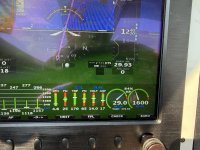
taxiing back to the hangar..
1783013214673.jpeg
 
Last edited:
It might be a defective sensor, but first look for an air leak in the tubing from the induction manifold to the sensor. These installations usually have a small diameter restrictor port near the induction manifold, so a leak at the sensor will have little effect on the engine. Then check the restrictor hole - it may be plugged with carbon gunk.
 
No - a leak or MP line broken off would cause the sender to report the ambient pressure; which at altitude is going to be less than the 29 or 30 reported by the OP (about 1" per 1000ft less).
He said that on the ground it read 30 inches if at sea level that is right, he said that the altimeter was 29.92 so it should read 30inches
 
He said that on the ground it read 30 inches if at sea level that is right, he said that the altimeter was 29.92 so it should read 30inches
Look at the screen grab - His elevation is 1240ft MSL, Baro 29.93 --> Map indicating 29.0., RPM 1600. taxiing.

edit: If the MAP line was open to the ambient air (broken off, big leak), the MAP would be 28.4"-ish because of the altitude (1240ft.).
 
Last edited:
I'd want to revisit everything done during the inspection.

I dont understand saying the engine sounded quiet followed by sounding normal.

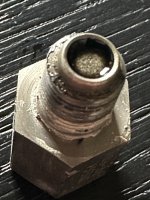
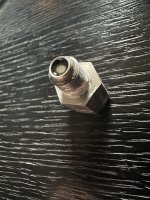
@bjdecker - I am totally lost at the picture and snubber comment.

Is the MP sensor disconnected?

Why not a video showing startup and run up?

What was done during the inspection???
 
I'd want to revisit everything done during the inspection.

I dont understand saying the engine sounded quiet followed by sounding normal.

@bjdecker - I am totally lost at the picture and snubber comment.

Is the MP sensor disconnected?

Why not a video showing startup and run up?

What was done during the inspection??
That was a pic of the Omega Engineering PS3G that Garmin recommends to dampen/snub the pressure impulses from the MAP/primer port on the cylinder head. It tends to load up with residue from the intake and then clog, providing inaccurate readings of the MAP. It's installed just "in front" of the MAP transducer.
 
  • Like
Reactions: RNB
I'd want to revisit everything done during the inspection.

I dont understand saying the engine sounded quiet followed by sounding normal.

@bjdecker - I am totally lost at the picture and snubber comment.

Is the MP sensor disconnected?

Why not a video showing startup and run up?

What was done during the inspection???
The engine sounded a bit quiet because I pulled the throttle back trying to get from full power to an MP of 25. It sounded normal in that it was not coughing/spitting/running rough.
 
It might be a defective sensor, but first look for an air leak in the tubing from the induction manifold to the sensor. These installations usually have a small diameter restrictor port near the induction manifold, so a leak at the sensor will have little effect on the engine. Then check the restrictor hole - it may be plugged with carbon gunk.
Good tip. So...check the tubing, check the snubber, clean the snubber if necessary before going right to sensor replacement.
 
Leaks, etc. not withstanding -- the MAP will show pressure of the airmass at your present altitude.

e.g.
If you are at sea level and the baro is 29.92", then the MAP should read 29.92".
If you are at 1240ft MSL, the MAP should read 28.4".
If you're field elevation is 5K FT MSL, the MAP will read ~24".

Further, If the engine is turning - even a little bit - it's creating a vacuum (lower pressure) and the MAP will show a lower number accordingly -- even with a HUGE air leak, the MAP cannot show a higher pressure than the ambient air - even when adjusted for a higher barometric pressure and lower temperature.
 
After I climb from takeoff, pulling back the throttle doesn’t result in a normal decrease in MP. On the flight this morning, pulling the throttle back to idle on final still left me at 29 inches displayed on the EFIS. Does this suggest that it’s more likely to be an obstruction than a leak, if it’s not a defective sensor?
 
It sounds like the sensor isn't connected to the MP line or the hose is wide open and not connected to manifold. If there was no issue before the condition inspection and now there is, I'd be looking for a disconnected hose. Follow the line from where it connects at the engine to every branch eventually getting to the EFIS sensor. It has to T some where to get to the electronic ignition and to the EFIS sensor. Possibly during the inspection a hose was accidentally pulled off a fitting. If the line was plugged I would assume it was being an issue before the inspection. If it was partly plugged it should be responding more than 29 at idle on final. Start with the simple - the MAP hose has to be leak free. If no leaks, look for a blockage. But again, if it isn't moving down at all from atmosphere, it sounds like the hose from connected to the MAP sensor is wide open somewhere. No hose leaks, no blockage, then start looking at the sensor.

I had this when installing an engine monitor. Felt like a fool when I found the nice TS hose was connected to the sensor but hanging free prior to the pass-through firewall fitting.
 
Not an induction leak IMO. It would have to be huge to produce 29” at part throttle and would get extremely lean and run like crap, if it ran at all. I would be looking at senso as the issue. Yes, if you have a really tiny (like .008”) restrictor, you could have a leak in the line between restrictor and the sensor. That should have little impact at mid power, but should be noticeable at idle. It would read ambient pressure at all times.
 
Last edited:
After I climb from takeoff, pulling back the throttle doesn’t result in a normal decrease in MP. On the flight this morning, pulling the throttle back to idle on final still left me at 29 inches displayed on the EFIS. Does this suggest that it’s more likely to be an obstruction than a leak, if it’s not a defective sensor?
If you pull the throttle back an inch and the engine slows down to where it normally does when you pull bak an inch and ff drops to where it normally does, then, yes, it is an indication error, as you have proven the actual mp dropped. If the actual mp didn’t drop, due to aleak, you would get lean and run poorly. In no scenario can you have an engine idling at normal idle rpms AND have an actual 29” of map. Just not possible. You have an indication problem. Probably the sensor, but other good suggestions on certain leakage on the sensor line, assuming a very small restrictor. If you have no restrictor, then the sensor is the problem.
 
Last edited:
Leaks, etc. not withstanding -- the MAP will show pressure of the airmass at your present altitude.

e.g.
If you are at sea level and the baro is 29.92", then the MAP should read 29.92".
If you are at 1240ft MSL, the MAP should read 28.4".
If you're field elevation is 5K FT MSL, the MAP will read ~24".

Further, If the engine is turning - even a little bit - it's creating a vacuum (lower pressure) and the MAP will show a lower number accordingly -- even with a HUGE air leak, the MAP cannot show a higher pressure than the ambient air - even when adjusted for a higher barometric pressure and lower temperature.
In my experience, these sensors are rarely bang on. Usually almost a full inch off. So seeing 29” when atmo is 28.4 could easily be normal for his sensor. A d not diagnosticly relevant
 
I appreciate the very useful input here. I am handicapped by my lack of understanding of how the manifold pressure monitoring is installed and configured and how it works....not something I've ever had to think about. Getting a break from the extended family holiday mayhem, I spent some time this morning with a few AI's to get a better grasp on the subject and let me have a clearer understanding of this discussion. It appears that given the symptoms, this is most likely a big leak and the sensor is open to air, not the intake manifold. Especially likely since this happened shortly after a condition inspection. All three of the AI's that I was reviewing are in complete agreement with each other and have added some clarity to my grasp of the discussion here. I'll get out to the hangar today if possible, pull the cowl and see if I can find any unattached tubing.

One thing...theoretically I might be seeing a lean condition on the cylinder where the pressure tubing is connected (#3)? I'm not really seeing any rough running at higher throttle setting, although it does show an uneven idle while taxiing (which I attributed to it being a hot day). I didn't notice any abnormal EGT's.

This has been interesting and enlightening, thank you very much.
 
One thing...theoretically I might be seeing a lean condition on the cylinder where the pressure tubing is connected (#3)? I'm not really seeing any rough running at higher throttle setting, although it does show an uneven idle while taxiing (which I attributed to it being a hot day). I didn't notice any abnormal EGT's.

This has been interesting and enlightening, thank you very much.
It is one big intake plenum. If you had a massive leak at the number 3 cylinder, say the hose broke, MP rises across the whole system, not just at #3. Fuel is metered at the servo. because you are now pulling in air from the leak source, less air is flowing through the servo and therefore it commands less fuel across the board; everything would get lean at the same level. At WOT there is almost no vacumm, so the air sucked in via the leak is smal, so not much leaning. Idle is high vacuum and pulls a LOT of air in via the leak and you get REALLY lean. You can't realistically have a massive leak on your MAP hose and not notice the changes in engine running. Again, if the leak is after a very small restrictor, that is different. The restrictor results in a very small leak to the plenum, yet a massive leak to the sensor.
 
I had some time so I pulled the cowl and plenum cover./ Engine off, today the EFIS reports manifold pressure of 30.1 with barometric pressure at 29.92 (airport elevation 1232ft). I looked at the MAP hose from the snubber to the firewall, including the T's to the Pmags. I was a little suspicious because my mechanic pulled both Pmags to check wobble, but all those hoses and connections look fine. No dripping, no cracks, nice pliable hoses and good secured connections. Never did find the sensor so I presume that it's behind the panel, didn't take the time today to check it out and look at the hose/connections.
 
Back
Top