


Van's Air Force

The definitive Van's Aircraft support community! Buying, building or flying an RV? Join our exclusive family of mentors and enthusiasts!

Obstructed tank vent

Dugaru

Well Known Member
Sponsor
Friend
I noticed one of my fuel tanks was gurgling quite a bit and filling slowly. I suspected a blocked vent, but the outlet near the firewall looked okay: I could see that nothing was covering the little mesh screen that had been installed over the end of the vent tube, presumably to keep out insects etc.

But then I looked closer. The screens had been attached with some sort of goo/rtv/sealant. Apparently, over time that material degraded and flowed into the mesh, giving the vent opening a serious case of atherosclerosis! This problem wasn’t easily visible when the screen was installed over the dark tube interior, but it was easy enough to see when held up to the light (see attached photo).

Lessons:
1. Innovations to increase safety can create their own problems.
2. Inspect vents carefully, preferably with a flashlight.
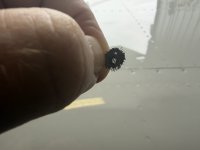
 

Attachments

  • IMG_0896.jpeg
    IMG_0896.jpeg
    1.2 MB · Views: 102
I am puzzled that a blocked vent would lead to ‘filling slowly’. The open gas cap area is huge compared to the vent size, the air should easily exit there. ??
I can’t fault your physics. All I can say is that it gurgled a lot and you had to top it off slowly or you wouldn’t fill it. Still gurgles but seems to fill faster now. Perhaps not? I suppose it’s possible I serendipitously found a potentially dangerous condition after misdiagnosing the actual problem. 🤣
 
I had the little screens on there originally but took them off as the vent hole is barely larger than the screen gauge, plus it's difficult to proseal it on without having the goo obstruct (possibly what happened here). One data point anyway.
 
the slow fill and gurgling is the time it takes for fuel to flow in and around the baffle system. normal
One tank seems worse than the other. If a line guy tops it off without waiting, it will be shorted by almost 3 gallons. Normal variation?
 
Since I am my own line guy, I can put in 1 to 1 and 1/2 more gallons if I give it time and the plane is on pretty level surface. But it takes 2 minutes to fully settle, though I haven’t ever timed it. 😊🙈
 
I’ve done a bit more experimenting and observing, and the difference with the vent opening cleared is that the audible gurgling now continues after the fuel cap is replaced. Never heard that previously.
 
One tank seems worse than the other. If a line guy tops it off without waiting, it will be shorted by almost 3 gallons. Normal variation?
Yea, because they are in a hurry and won't wait for the tank to settle.

Since I am my own line guy, I can put in 1 to 1 and 1/2 more gallons if I give it time and the plane is on pretty level surface. But it takes 2 minutes to fully settle, though I haven’t ever timed it. 😊🙈
I'm my own line guy too. I stop about 1/2" down from the tank filler cap flange.....and watch the fuel level drop down a bit...then top off. Takes maybe 5 - 10 seconds.

If anyone's tank takes "minutes" to settle, I am going to suggest the fill / vent holes between tank ribs (NOT vent line or the holes where the vent line runs through...those are entirely different) were not drilled during the build, or they are undersized from what is called out on the plans. Or, they ended up being partly or totally covered by proseal.
 
Trying to get my head around this one -- I am almost 100% certain the vent being clogged isn't the source of the low/uneven fill rates and the gurgling. Perhaps there's something deeper in the tank amiss -- rib/baffling holes being plugged with debris?

Run a borescope into the tank and see what those baffle holes look like.
 
Trying to get my head around this one -- I am almost 100% certain the vent being clogged isn't the source of the low/uneven fill rates and the gurgling. Perhaps there's something deeper in the tank amiss -- rib/baffling holes being plugged with debris?

Run a borescope into the tank and see what those baffle holes look like.
Hard to see how these holes are important when filling the tank. As the gas gets close to full, it should flow unimpeded over the ribs. It’s only in a low fuel situation where the ribs would act as dams without the holes.
 
Hard to see how these holes are important when filling the tank. As the gas gets close to full, it should flow unimpeded over the ribs. It’s only in a low fuel situation where the ribs would act as dams without the holes.
The air coming out has to go somewhere. If the 1/4" vent holes at the top edge of the rib are plugged, air gets trapped between ribs
 
So for the original question, here is a simple, bullet proof vent modification kit for the RV-14 and RV-10 that eliminates the mud dauber and ice problem. It is very light as well.

Easy one AN fitting install: https://aceaviationsupply.com/products/essential-fuel-tank-vent

Carl
MUCH cheaper option: make safety wire loop, ~3/4"-1" diameter, about two turns. Squash the loop into approximately a straight line. Press the safety wire into the vent opening. It should fill the opening enough to: 1) NOT fall out, and 2) keep mud daubers out of the vent and, 3) MOST IMPORTANTLY, allow air to pass through.

That will be $150 for the pair. ;) Hey, it's cheaper than the one listed above.

 
Last edited:
so, by saying that the gurgling is from fuel thru the holes in the baffles? i built my own tank and baffles to prevent sloshing .how small are these holes?1/4''? my tanks dont slosh but ''chambers'' equalize in a second, like instantly.
 
Hard to see how these holes are important when filling the tank. As the gas gets close to full, it should flow unimpeded over the ribs. It’s only in a low fuel situation where the ribs would act as dams without the holes.
Have another look at the ribs used in the tanks - note the typical lightening holes are absent.
 
Back
Top