



vinzer
Well Known Member
For some time I had a dilemma about which ignition system to install in place of my PMAG.
Until now, my first RV-10 has been equipped with a PMAG on one side and a classic Slick magneto on the other. Over time, I went through several ignition configurations: dual Slicks, then dual Lasars, then one Lasar with one Slick, and finally the current setup with a left-side PMAG and right-side Slick.
What I personally never liked about the PMAG is that it is a completely closed system. You really do not know what is happening inside or exactly what ignition timing the engine is running at. As an avionics developer and manufacturer, I naturally like to have some level of visibility and control over what is happening, especially when it comes to something as important as ignition timing. I understand that this may be critical only for me, while others may say Ehh who cares.
While working on a couple of side avionics installation projects, I had the chance to install SDS EFI CPI-6 systems for clients. I liked the design and the overall approach SDS EFI took with their ignition system.
This thread is not intended as an advertisement for SDS products. I simply want to share my own experience, the issues I ran into, and the solution I came up with.
I finally pulled the trigger and bought a CPI-2 system from them. For now, I decided to use only a single-side coil setup, even though I purchased the dual version. The main reason is that my panel is already very crowded. I test a lot of avionics in my aircraft, because every product I design has to fly in that panel, so every square inch of panel space is very valuable almost like expensive real estate. Just joking, of course, but only partly.
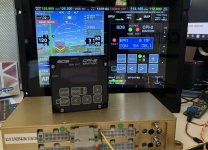
The SDS CPI-2 control head is actually a small unit and only requires about a 3-inch opening, but in my case even that space was not available. Eventually I will redesign the panel when my second RV-10 is built and flying, but for now I needed another solution.
And I found one.
I realized that I already fly with three large 10-inch touchscreen EFIS displays, so there was no reason I could not integrate the SDS control interface directly into my EFIS.
SDS EFI is a closed system and, understandably, they do not provide public information for integration with other avionics. That makes sense, because they do not want critical engine-control components to become dependent on other equipment. But we are flying experimental aircraft, so I decided to carefully give it a try. My project is completely unofficial!
The result is that I was able to integrate the SDS control head interface into my avionics system and emulate the display/control functionality directly on the EFIS. So now I can fully control ECU of the ignition system from the touch display as it would be from their control head
And guess what it works great.
Now it is time to fly it and test it properly.
Until now, my first RV-10 has been equipped with a PMAG on one side and a classic Slick magneto on the other. Over time, I went through several ignition configurations: dual Slicks, then dual Lasars, then one Lasar with one Slick, and finally the current setup with a left-side PMAG and right-side Slick.
What I personally never liked about the PMAG is that it is a completely closed system. You really do not know what is happening inside or exactly what ignition timing the engine is running at. As an avionics developer and manufacturer, I naturally like to have some level of visibility and control over what is happening, especially when it comes to something as important as ignition timing. I understand that this may be critical only for me, while others may say Ehh who cares.
While working on a couple of side avionics installation projects, I had the chance to install SDS EFI CPI-6 systems for clients. I liked the design and the overall approach SDS EFI took with their ignition system.
This thread is not intended as an advertisement for SDS products. I simply want to share my own experience, the issues I ran into, and the solution I came up with.
I finally pulled the trigger and bought a CPI-2 system from them. For now, I decided to use only a single-side coil setup, even though I purchased the dual version. The main reason is that my panel is already very crowded. I test a lot of avionics in my aircraft, because every product I design has to fly in that panel, so every square inch of panel space is very valuable almost like expensive real estate. Just joking, of course, but only partly.
The SDS CPI-2 control head is actually a small unit and only requires about a 3-inch opening, but in my case even that space was not available. Eventually I will redesign the panel when my second RV-10 is built and flying, but for now I needed another solution.
And I found one.
I realized that I already fly with three large 10-inch touchscreen EFIS displays, so there was no reason I could not integrate the SDS control interface directly into my EFIS.
SDS EFI is a closed system and, understandably, they do not provide public information for integration with other avionics. That makes sense, because they do not want critical engine-control components to become dependent on other equipment. But we are flying experimental aircraft, so I decided to carefully give it a try. My project is completely unofficial!
The result is that I was able to integrate the SDS control head interface into my avionics system and emulate the display/control functionality directly on the EFIS. So now I can fully control ECU of the ignition system from the touch display as it would be from their control head
And guess what it works great.
Now it is time to fly it and test it properly.


