Van's Air Force

The definitive Van's Aircraft support community! Buying, building or flying an RV? Join our exclusive family of mentors and enthusiasts!

Baffle bracket

Low Tailwheel rider

Member
Patron
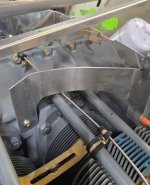
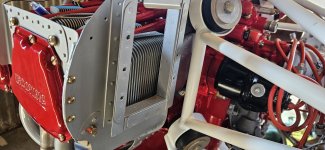
Elected to place my oil cooler on the rear baffle, left side. "Beefing" up corners with angle and a doubler around the cutout for the cooler face. I would like to add a bracket to support the inboard corner of the baffle. (This is a baffle kit from Van's.) Would be similar to the bracket Van's provides from the top engine spline to the overlap of the center rear baffle pieces. My question is regarding a suitable anchor place for the bracket I will fabricate which will be attached to the baffle corner I want to support.
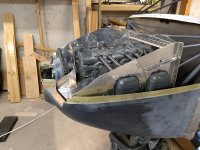
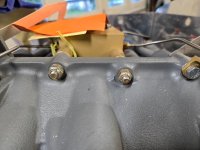
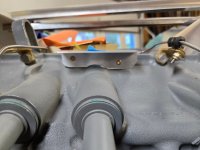
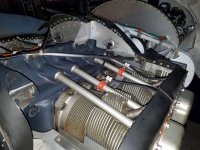
Any issue with going to the engine mount as an anchor? I've seen some using the pushrod tube with cushion clamp...not keen on that. Is their any issue with relative motion between the engine and baffles also being attached to the engine mount via a bracket? Lots of words, here's a couple pics showing my two ideas as options. The bracket is not the one I intend to use, but gives you an idea of what I'm trying to figure out and execute. Thanks for all thoughts and input. Dave
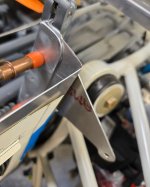
baffle bracket to engine mount.jpgbaffle bracket to pushrod tube.jpg
 
1000000027.jpgI added an angle bracket along the rear baffle. I found this suggestion on this forum. This stiffens things up quite a lot. I also added a doubler to the left rear baffle. This is on a Tailwind, but I'm using the Vans baffle and Vans oil cooler. I only have 160 hours, but so far so good. I would not mount to the engine mount.
 
Skelrad has the right idea - there or over to the engine case … there is a tapped boss between cylinders that works well. Cylinder heads actually move around quite a bit, so I like the engine boss - but many people go to the cylinder heads. I would NOT recommend going to the engine mount - the relative motion between the engine and mount is huge - you’ll tear you baffles off pretty fast if you go that route….
 
Ref rzbiill post from 2011 updated 2025, perhaps what OP is referencing when he says "I added an angle bracket along the rear baffle. I found this suggestion on this forum.”

IMO rzbill is an elegant solution and no corner reinforcement required.


Definitely a bad/terrible idea to connect engine baffle to engine mount weldment, too much movement between engine/baffle assembly and engine mount weldment… rubber engine mounts between engine and engine mount weldment.

By analogy, I view the rear/side baffle intersection as a hinge with the mass of the oil cooler flexing said “hinge” due to engine vibration, ref attached images.
 

Attachments

  • door bar_Original.jpeg
    door bar_Original.jpeg
    52.8 KB · Views: 9
  • door brace2_Original.jpeg
    door brace2_Original.jpeg
    59.9 KB · Views: 9
Last edited:
maybe you're set on placing the oil cooler on the baffles as Van's promotes... but that is a bad idea, as they later found out themselves (ref the -14/-10 installation KAI).
Baffles are certainly not designed to support the mass of an oil cooler assy, and even when reinforced will crack given enough time. This installation also increases the mass of the engine itself, helping oscillation and vibrations retention once they appear.

A far better way is to install said oil cooler on the firewall (or engine mount as a 2nd choice) by using a couple of angle brackets, and a 2-3" Scat or Sceet hose from the rear baffle to the cooler.
There are plenty of examples of that type of installation on this distinguished forum, which you'll find using the search function.
 
Appreciate the replies and insights. I need to ponder things now! Tangential question... what's the benefit of picking up both parallel flanges of the oil cooler (front and back flanges) with long bolts and spacers versus using just one flange and single shorter bolt ? Disclaimer: Engineer by education many years ago, pilot by trade :cool:
 
maybe you're set on placing the oil cooler on the baffles as Van's promotes... but that is a bad idea, as they later found out themselves (ref the -14/-10 installation KAI).
Baffles are certainly not designed to support the mass of an oil cooler assy, and even when reinforced will crack given enough time. This installation also increases the mass of the engine itself, helping oscillation and vibrations retention once they appear.

A far better way is to install said oil cooler on the firewall (or engine mount as a 2nd choice) by using a couple of angle brackets, and a 2-3" Scat or Sceet hose from the rear baffle to the cooler.
There are plenty of examples of that type of installation on this distinguished forum, which you'll find using the search function.
You’re not wrong but any change from plans adds build time exponentially. Also, I noticed a pic above with the oil cooler shutter. I have installed a few of them but they all ended up removed in the end. I find most planes don’t need them. Just adds weight, complexity, and another potential cause of high oil temps. It’s very easy to add to a flying aircraft.
 
Appreciate the replies and insights. I need to ponder things now! Tangential question... what's the benefit of picking up both parallel flanges of the oil cooler (front and back flanges) with long bolts and spacers versus using just one flange and single shorter bolt ? Disclaimer: Engineer by education many years ago, pilot by trade :cool:
I’ve actually analyzed it (I am an engineer - but not THAT kind of engineer….) but the oil cooler flanges are lightweight aluminum and you’re hanging a quart of oil off of them. I have seen cracks at the mounting holes on many worn out coolers - vibration from mounting it just by the single flange would likely destroy it pretty quickly. Using the spacer and long bolts picks up the far side of the cooler making for more of a “box” structurally, spreading the load and probably stiffening things up a bit.
 
You’re not wrong but any change from plans adds build time exponentially. Also, I noticed a pic above with the oil cooler shutter. I have installed a few of them but they all ended up removed in the end. I find most planes don’t need them. Just adds weight, complexity, and another potential cause of high oil temps. It’s very easy to add to a flying aircraft.
Agreed about the change from plans. There are pluses and minuses to each, and the baffle-mount is pretty widely used, and can be trouble-free if braced properly.

Regarding a shutter - I added one after years of putting on a fixed blocker plate in winter and taking it off in the summer, and after several hundred hours I prefer having it versus not. Where I live it's cool a lot of the time but can get into the '90s on occasion, so it's nice to be able to control whether it stays in the "optimally warm" range. Although the comment about a potential cause of high oil temps is valid - I have had the engine monitor alarm on me once or twice for high oil temps reminding me to pull the knob.
 
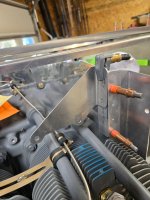
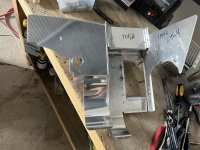
So, spent a bit of time today fabricating a 0.90 Aluminum bracket going from the threaded boss between the cylinders to the inboard corner of the rear baffle proximal to where the oil cooler will be mounted. Not quite finished with final trim, but good fit and seems to add some much needed solid support to that corner. Still pondering things...
 

Attachments

  • oil cooler bracket.jpg
    oil cooler bracket.jpg
    221.5 KB · Views: 46
So, spent a bit of time today fabricating a 0.90 Aluminum bracket going from the threaded boss between the cylinders to the inboard corner of the rear baffle proximal to where the oil cooler will be mounted. Not quite finished with final trim, but good fit and seems to add some much needed solid support to that corner. Still pondering things...
Honestly, I have to give you an “A” for originality and creativity….but I don’t know how to grade the product. Aluminum in that configuration isn’t going to be very stiff and could have all sort of oscillatory modes. Yes, 0.090 is pretty heavy duty, but its still sheet metal and with bends that is not going to be very stiff. Most people who put a brace there us a piece of 4130 steel tubing wit the ends carefully flattened. You want a straight piece to handle tension and compression, and a steel tube is going to be the stiffest in that application.
 
Honestly, I have to give you an “A” for originality and creativity….but I don’t know how to grade the product. Aluminum in that configuration isn’t going to be very stiff and could have all sort of oscillatory modes. Yes, 0.090 is pretty heavy duty, but its still sheet metal and with bends that is not going to be very stiff. Most people who put a brace there us a piece of 4130 steel tubing wit the ends carefully flattened. You want a straight piece to handle tension and compression, and a steel tube is going to be the stiffest in that application.
Agreed. Seems like stiffening it with a 90 degree bend on the top would fix that? Some work with the compound bend (probably just a notch) would be in order.

That said, a simple.063 extruded angle piece over to a top case bolt worked well for me and others around here.
 
Thanks for the reviews and comments. This forum is great for getting much needed input as I "solo" in the garage with my singular brainstorming efforts.
I like the idea of going to the case bolt with extruded angle piece. Couple of questions:

(1) Material of choice? We talking steel or is Aluminum a viable option in that configuration?
(2) How are the tabs at the attach points fabricated? I assume riveted angles, because we want to avoid putting bends in the ends of the brace piece?

Any pics specific to the attachment method to the case bolt and corner piece would be appreciated if is easy enough for someone.

Will reattack tomorrow! :unsure:

Dave
 
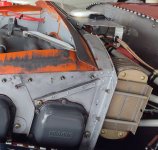
I'm glad you didn't let the naysayers talk you out of mounting the oil cooler on the baffle. My first installation had a TBO runout at 2,500 hours without so much as a hairbreadth of a crack. I repeated that installation with the new engine as well. Beefing up that corner like you originally posted is essential, and it is also important to beef up that outside junction between the cylinder #4 baffle and the oil cooler backplate. The angle I used makes the whole affair extremely rigid and supported, although you will probably have to purchase a longer case bolt like I did to accommodate it. Also be sure to allow yourself some respectable clearance between the bottom corner of the angle and your #4 fuel injector line.


1781140199004.jpeg
Original Installation


1781140108123.jpeg
Latest Installation


1781140429534.jpeg
Outer Corner Support


1781140652790.jpeg
Oil Cooler Mount

 
(1) Material of choice? We talking steel or is Aluminum a viable option in that configuration?
(2) How are the tabs at the attach points fabricated? I assume riveted angles, because we want to avoid putting bends in the ends of the brace piece?

1). 1/8" aluminum angle for crosspiece; the outer support is actually scrap made from an unused Garmin pitch servo bracket.
2). Case bolt at the engine, and 1/8" aluminum angle tabbed on the rear baffle. Fabricate and bend the angle as needed for a fit with absolutely no pre-load.
 
Continuing the thread and my plan along with my effort for today with questions. Much thanks to all and others @Scott Chastain who have posted pics. I made a template out of aluminum angle to pick up two of the case bolts holding the fuel manifold. Rational being this would preclude the need for a bend in the 1/8" aluminum angle brace at that position. Planning on putting a nutplate on the piece to allow for removal if required for any maintenance though a thru bolt may be just as easy to use.

Situation: For the angle piece using the case bolts; it appears that Lycoming used standard AN hardware for those two particular bolts which attach the fuel manifold bracket to the engine case. Here I now have to make a choice...if I can use 0.050" 4130N sheet metal to fabricate the angle piece, I can utilize the existing bolts - easy install. If I make the piece out of 1/8" Al, I will have to use longer bolts, which I assume will be okay if I use AN hardware as well. My question is... are either methods suitable, anyone see any issue with either approach? Appreciate any thoughts/input.

Getting closer everyday...Fuel manifold bracket bolts.jpgTemplate case bracket.jpg;)
 
I would say you're on the right track. Make sure you prime/paint the steel parts well to mitigate rust/corrosion. Nutplate probably not necessary unless for whatever reason it's difficult to get to both the bolt head and nut.
 
Honestly, I have to give you an “A” for originality and creativity….but I don’t know how to grade the product. Aluminum in that configuration isn’t going to be very stiff and could have all sort of oscillatory modes. Yes, 0.090 is pretty heavy duty, but its still sheet metal and with bends that is not going to be very stiff. Most people who put a brace there us a piece of 4130 steel tubing wit the ends carefully flattened. You want a straight piece to handle tension and compression, and a steel tube is going to be the stiffest in that application.
Not to mention the potential influence on cooling air movement into cyl #4
This is a good bracing location but keep it small in cross section. The steel tube Paul mentioned is the optimal choice.
 
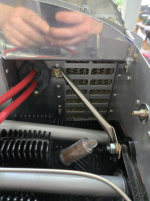
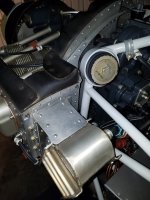
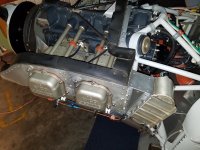
Here is how I did mine. The -4 has a cowl cheek, so the angled "wedge" ducting keeps the cooler a little lower at the back end for clearance. Well reinforced, with stainless tubing for the upper diagonal support. My baffles are scratch built, since the H2AD case is a bit different than the other O320 variants. no cracks or loose fasteners in 400 hrs.
 

Attachments

  • TOP LH.jpg
    TOP LH.jpg
    1.7 MB · Views: 14
  • oil cooler.jpg
    oil cooler.jpg
    1.6 MB · Views: 14
  • support rod.jpg
    support rod.jpg
    1.6 MB · Views: 15
Back
Top