


Van's Air Force

The definitive Van's Aircraft support community! Buying, building or flying an RV? Join our exclusive family of mentors and enthusiasts!

RV-10 Flap Reflex position is just more drag

mulde35d

Well Known Member
I am sure i will stir a hornets nest, but thought it important to share my experience. While rigging my RV-10 flaps I decided to set zero degrees at the angle that extended the upper and lower wing surface as flat. In other words, the flaps are an extension of the wings with no change in angle while laying a straight edge along the surface. From this position they could go up 3.85 degrees, also called the reflex position (-3 degrees). I understand the reflex position to change the wing chord line with an intended result of a pitch up. This would then allow for less downward lift on the tail thereby reducing drag and increasing airspeed. But thats not what happens. When the flaps are moved to reflex the nose pitches down, thereby requiring more downward lift and an increase in drag on the tail. I realize this has a lot to do with my particular aircrafts CG and configuration, but it came out pretty standard for RV-10's.

During my latest cross-country while very stable I moved the flaps from zero degrees to -3 degrees (reflex) three time and let the aircraft stabilize. Each time the airspeed decreased 1-2 knots and returned to the higher airspeed when placed back at zero.

My 2 cents, when rigging your flaps, airlerons, and wingtips. Set your flaps such that they are at zero degrees to your wings surface, then set your ailerons flush with your flaps (also zero degrees). Then make any final adjustments to your wingtips to be flush with the ailerons. Assuming your control surfaces don't have a significant amount of twist, this should provide a stable starting point for final in flight rigging with the least amount of drag for cruise flight. Obviously still follow Vans Instructions, but Van's provides very little info on flap and aileron angles, so hopefully this helps

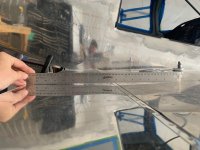
A picture of the reflex position is below. I set zero degrees at the point where the flaps and upper chamber are flush (no change in angle). Needless to say, not planning to ever use reflex on the RV-10.Wing Attach 12.jpg
 
Last edited:
I’m pretty sure that standard rigging is 0 degrees (like you) is trail. -3degrees is reflex and +10/20 etc for deployment down below trail.
There’s been a fair bit of ink spilt over the years on trail versus reflex.
The theory is that trail is indeed supposed to be faster at high altitudes and or higher weight so I think you are seeing what is to be expected.
Fwiw I haven’t seen any demonstrable difference over the years of experimenting. But I don’t have extensive test points.
I think you’d need to do a series of tests at various weights and altitudes to quantify it across loading and altitudes.

What I do tend to notice is the plane gets noticeably faster as it gets lighter. I just did 2 back to back 5h flights this week and we were a couple of knots faster at the end both times.

Great airplanes.
 
IMHO the analysis is a bit off here. It's complicated. When you move the flaps from in trail to reflex, the wing loses some lift from the last 8" of the flaps. This reduction in lift causes the plane to drop vertically (and the huge drag of the wings in the vertical direction cause the nose to rotate down). The pilot "catches" the drop with elevator, momentarily increasing tail drag. But as the plane re-establishes equilibrium, the center of lift of the wings has moved slightly forward, because the last 8" of flap isn't producing as much lift as before. This reduces the nose down torque about the cg, which means the nose up torque of the elevator is also reduced. e.g., the tail drag goes down slightly. I think I see a few more knots down low (9,000') in reflex than I do in trail. But the test is flawed, as I did not adjust the ailerons or the wingtips for an "in-trail" configuration. But the difference is pretty small. I did some in-flight testing at 15,500' (17,000 DA) (and about 400 lbs below gross) and thought in-trail was very slightly faster there. Although Vans engineering says it's okay to run in-trail at any speed (in 2008 they said it was NOT okay!) I do note that that means the flap linkage is constantly carrying some load. In reflex the flaps are up against the aft spar, and that carries the rotational load.
 
What I do tend to notice is the plane gets noticeably faster as it gets lighter. I just did 2 back to back 5h flights this week and we were a couple of knots faster at the end both times.

Great airplanes.
My 9A definitely does that - with 68 gallons on board and doing a lot of 6-7 hour legs, I can tell you the additional weight does impact the speed by a few knots until it burns off.
 
I’m pretty sure that standard rigging is 0 degrees (like you) is trail.
It’s been a minute and I don’t have the plans in front of me but pretty sure standard rigging is the reflex position. IIRC the rigging procedure was to place the flaps in the full up position (reflex) and adjust the ailerons to match. This would also match the wing tips.
 
It’s been a minute and I don’t have the plans in front of me but pretty sure standard rigging is the reflex position. IIRC the rigging procedure was to place the flaps in the full up position (reflex) and adjust the ailerons to match. This would also match the wing tips.
Yes I just used poor grammar. -3 “reflex“ is the definitive start point - against the spar.
“Trail” is 3 degrees below that and called “0”
 
My 2 cents…. When flaps are in the neutral 0 deg position, the entire aerodynamic load is on the flap linkage. As stated in a previous post, Vans originally had a speed restriction on the in-trail 0 deg position. Like Bob, I did the same test but did not see any appreciable speed change at 17K ft when in the 0 deg position.
 
As the designer of the RV-10 wing, perhaps I can weigh in here. Bob Turner's explanation covers about half of it. There should be less airfoil pitch moment and so less elevator trim drag. But even in trail, the pitching moment from the wing is pretty small - one of Van's design requirements. So the difference there is pretty small.

The other part of it is that the RV-10 airfoil was designed to achieve a modest amount of laminar flow, back to the wing spar. The reflex flap setting increases the airfoil angle of attack slightly, keeping the front portion of the airfoil at the best angle to give the laminar boundary layer the best chance of survival on both the upper and lower surface. When I designed it, I didn't know that they would put a J stiffener in the forward portion of the wing, so there is a row of rivets and probably a little surface waviness there that can prematurely trip the boundary layer. But not always. A really smoothly riveted RV-10 wing will still get laminar flow, and more likely to show the (small) speed benefit in reflex flap at low to mid altitudes. And of course, you have to keep it clean - no bugs, AND no paint stripes along the leading edge.

At high altitude, or at very heavy weight, "0" flap may be slightly better.
 
Another interesting variable at play here is if you have the ailerons rigged at -3, and you set the flaps to 0 deg., you are introducing a little bit of beneficial wing twist (washout) which for a rectangular wing produces a more favorable spanwise lift distribution so the induced drag would be less. At high speeds, the induced drag is very small though, so the reduction may not be observable. It might show up at best rate of climb though.
 
As the designer of the RV-10 wing, perhaps I can weigh in here. Bob Turner's explanation covers about half of it. There should be less airfoil pitch moment and so less elevator trim drag. But even in trail, the pitching moment from the wing is pretty small - one of Van's design requirements. So the difference there is pretty small.

The other part of it is that the RV-10 airfoil was designed to achieve a modest amount of laminar flow, back to the wing spar. The reflex flap setting increases the airfoil angle of attack slightly, keeping the front portion of the airfoil at the best angle to give the laminar boundary layer the best chance of survival on both the upper and lower surface. When I designed it, I didn't know that they would put a J stiffener in the forward portion of the wing, so there is a row of rivets and probably a little surface waviness there that can prematurely trip the boundary layer. But not always. A really smoothly riveted RV-10 wing will still get laminar flow, and more likely to show the (small) speed benefit in reflex flap at low to mid altitudes. And of course, you have to keep it clean - no bugs, AND no paint stripes along the leading edge.

At high altitude, or at very heavy weight, "0" flap may be slightly better.
Thanks for the additional info Steve.
I was aware of the laminar flow and the stripes but I hadn’t thought about the J stiffeners.
I’m not a fan of filling rivets in an aluminum plane (and it’s painted now anyway..) but do you think that filling the spar forward rivets would be worth considering or is it likely to be too hard to measure?
Heading out to airport to polish my LE :-)
 
Thanks for the additional info Steve.
I was aware of the laminar flow and the stripes but I hadn’t thought about the J stiffeners.
I’m not a fan of filling rivets in an aluminum plane (and it’s painted now anyway..) but do you think that filling the spar forward rivets would be worth considering or is it likely to be too hard to measure?
Heading out to airport to polish my LE :-)
Yes, I also have been reluctant to suggest filling rivet heads and block-sanding the wing smooth ahead of the spar. Although I am positive that it would show a small performance gain that over a long time would result in real benefit, I also fear that over a long time, it would become a maintenance PITA, if blobs of filler started popping off.
 
I have noticed that between 8-10 thousand and a medium load I will see 1-2 knots of speed added. At close to gross at the same altitudes I might lose the same amount. Reflex is sensitive with heavy loads and altitude. I look at it as another flight option. When established in cruise flight, I will add reflex and see the impact on speed. If it’s negative I remove it. It’s not like 1-2 knots will get you there any quicker but I have never heard anyone complain because they have too much speed.
 
Back
Top
