Van's Air Force

The definitive Van's Aircraft support community! Buying, building or flying an RV? Join our exclusive family of mentors and enthusiasts!

Lycoming #4 CHT Too Cold

bjdecker

Well Known Member
Ambassador
There's a title that might catch your attention.

Over the past 20+ years, on two RV-7s equipped with an IO-360-A1B6 (200HP, Angle Valve, Roller Lifters, Piston Squirters, Dual EI, 20°BTDC base timing), one parts built (Aerosport Power - Bart Lalonde) and the lycoming factory, I've consistently experienced a "cold" #4 CHT -- some 20 - 30°F colder than the rest of the cylinders.

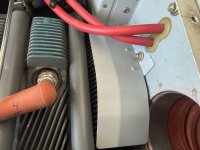
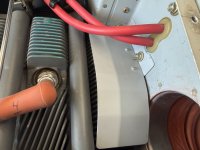
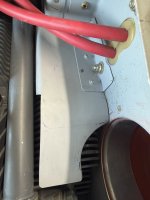
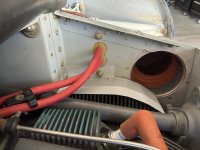
On a lark, I visited a friend of mine with a Mooney 201 (aka, M20J, 205SE, MSE) equipped with nearly the same engine as my RV-7; an IO-360-A3B6. I noticed something unique about the baffling (picture)

View attachment IMG_0658.jpeg

Mooney puts a piece of baffle plate on the top rear of the #4 cylinder, just in front of and below the inlet to the Oil cooler. My friend never sees odd CHT spreads.

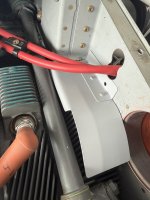
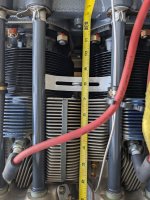
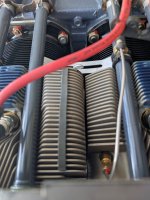
What the heck, time to do some metal bending -- I fabricated a piece of .032" to cover the same portion of the #4 cylinder, with a different attachment mechanism.

View attachment IMG_0664.jpeg
IMG_0666.jpeg
IMG_0667.jpeg

The theory is that the #4 cylinder "sees" a whole lot of airflow because of the oil cooler inlet and the rear baffle wall. The new deflector "should" keep the airflow from flowing down from the rear baffle wall and *not* interrupt the flow going to the oil cooler.

Test flight tomorrow, WX permitting.

Cheers.
 
One thing I learned from the GAMI and APS folk was from the days of solving the Bonanza front right cylinder issues, round piston in egg shaped cylinders. Unless you place around 12 thermocouples on the cylinder and capture data, you are guessing. Be careful you do not make a round cylinder change shape. And this also affects valve train geometry.

Not sure I think that experiment is a good one. YMMV.
 
I have been an A&P/I.A for nearly 50 years, working on certified airplanes and as long as the cylinder is not running hot there is no need to match the cylinder head temperatures. A cylinder that is cooler is better than it running hotter than 400 degrees. You are chasing something that doesn’t need to be chased. Cylinders that cool well are better than hot ones.

Best regards,

Bill Wuorinen
Osprey 2 amphibian N137W flying since 2001
RV-7A N237W flying since 2014
 
One thing I learned from the GAMI and APS folk was from the days of solving the Bonanza front right cylinder issues, round piston in egg shaped cylinders.
Would love to hear/understand more about this. I’m sure you have more data to support this?
 
Last edited:
Would love to hear/understand more about this. I’m sure you have more data to support this?
Think about it. Uneven cooling means things expand differently on the micro level. Unless you measure things you never know. GAMI have a reputation for using data from accurate measurements.

I am sure I have forgotten most of the finer details of what I learned about it...........and the data from almost 30 years ago is probably buried in paper files at GAMI in Ada OK. You will just have to trust my generic comments and the fact they came from George Braly & Walter Atkinson back in about 2012.
 
Recently my #4 CHT was running about 30 degrees cooler than the others (balanced within 10 degrees of each other). Did some investigating to find that both #2 and #4 CHT probes were pretty loose. #4 was also very dark brown color compared to the #2 which looked pretty clean. Cleaned up #4 probe and swapped with #2 just to make sure it was the probe. Turns out it must have been a combination of a loose and dirty probe cause now all 4 CHTs are within 10 degrees. Checked #1 & 3 and they were pretty clean and secure. Not sure how #2 & 4 got so loose, we’re talking not much more than finger tight.
 
Recently my #4 CHT was running about 30 degrees cooler than the others (balanced within 10 degrees of each other). Did some investigating to find that both #2 and #4 CHT probes were pretty loose. #4 was also very dark brown color compared to the #2 which looked pretty clean. Cleaned up #4 probe and swapped with #2 just to make sure it was the probe. Turns out it must have been a combination of a loose and dirty probe cause now all 4 CHTs are within 10 degrees. Checked #1 & 3 and they were pretty clean and secure. Not sure how #2 & 4 got so loose, we’re talking not much more than finger tight.
Some good insight here to back up what inOZ is saying. There is a chance that all or part of that cylinder is really not all that cool. Robbing airflow to improve pilot comfort in seeing even distribution could be introducing excessive heat and problems somewhere else. That cyl is very large and likely has very different airflow in various points, yet has only one temp sensor. Very dangerous to assume because that one point is cool, all others must be equally as cool. The fact that #4 tends to run a bit hotter than others on a PV engine makes me think airflow is not necessarilly better there, but something unique about the AV engine makes the particular spot where the sensor is cooler. We already see things like that with sticking valves being more common on #2 on the 390's, but no CHT anamoly anomoly there. A logical speculation is that the #2 guide is running hotter than others, yet we don't see that in the CHT data. That should scream uneven airflow / heating across heads.

What about barrel temps? We have no idea what they are. Is your #4 barrel also cooler or is it hotter than others? will that dam reduce airflow to the barrel?

Food for thought. My 320 has seen a lot of winter flying where CHTs never get above 280 - 290. 1600 hours and things look very nice inside the cylinders.

I would step back and do some research on what is "too cold?" You don't want to run risks solving a problem that isn't really a problem.
 
Last edited:
I have the same issue. #4 is always a lot cooler than the rest. #1 and #2 are the highest with the present air dams, and similar, so I'm wondering if I need to direct some air down to #2 and reduce it to #4 with some type of baffle/scoop between the two.

My oil cooler hose (4") takes air from near #3. #3 has a little air duct in the rear baffle and it's cooler than #1/2 now. The baffle by #4 has the 2" heat muff duct on mine.

What about barrel temps? We have no idea what they are. Is your #4 barrel also cooler or is it hotter than others? will that dam reduce airflow to the barrel?
Angle valve engines have oil squirters, so I'm guessing a large percentage of the cooling off the barrel is from oil.
 
I have the same issue. #4 is always a lot cooler than the rest. #1 and #2 are the highest with the present air dams, and similar, so I'm wondering if I need to direct some air down to #2 and reduce it to #4 with some type of baffle/scoop between the two.

My oil cooler hose (4") takes air from near #3. #3 has a little air duct in the rear baffle and it's cooler than #1/2 now. The baffle by #4 has the 2" heat muff duct on mine.


Angle valve engines have oil squirters, so I'm guessing a large percentage of the cooling off the barrel is from oil.
The barrel gets plenty of splash oil from the crank, so squirters shouldn't change anything plus the barrel is steel, so slow to give off heat. Their role is to flood the piston top with oil to cool it. It benefits greatly from the additional oil, as the heat is much higher there.
 
Nobody has shown what the height of their front air dams are. I think *that* is the place to start. First few flights, I had pretty significant higher temps on 1 and 2 than 3 and 4, so removed the air dams entirely (I used screws and nutplates during construction to make them removable on my 7). Flew for a while, and then started figuring out the proper height by using steel (or maybe aluminum?) tape on the front cylinders, until I found the right height. Turned out to be about 5/8", WAY less than the stock parts.

My cylinders all run within 3-5 degrees of each other across the board now.
 
I’ve noticed that my Cylinder Head Temperatures (CHTs) on cylinder #4 are consistently running 20 to 30°F cooler than the others (angle valve IO-360-C1C6). When I’m leaning out in cruise, the temp on #4 routinely drops below 300°F. Time on the rebuilt engine Tach: ~155

Because it's running so cool, my main concern is the potential for lead deposits forming on the valve components (stuck valves, etc.). Does this require a baffle modification similar Brian Decker's? Or modify the air dams?
 
UPDATE!!

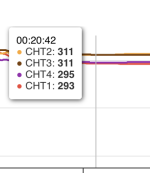
The weather gods cooperated this afternoon and I was able to find smooth air. The OAT on this flight was 17.2°C, and compared to a prior flight at same altitude, OAT, DA, and power settings, the CHTs today were lower!!

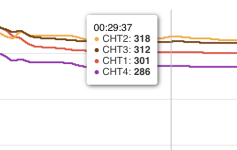
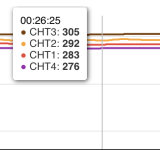
As I mentioned in the original post, CHT #4 would run about 30°F colder than the hottest of the other cylinders, and ~23°F less than the average of its cohorts.

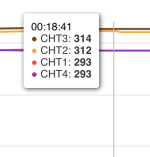
After installing the deflector, the data showed that all of the CHT's came down (!!), the delta from #4 to the hottest cylinder was now 20°F, and 15°F less than the average of its cohorts. No appreciable change to Oil Temp, TAS, etc. etc. was noted. Hottest CHT moved from #2 to #3.


Before:
Screenshot 2026-05-20 at 3.55.35 PM.png

After:
Screenshot 2026-05-20 at 3.57.39 PM.png


I'm going to call this a win.


--- break ----

Also the air dam on the front of the #2 cylinder can be modified. Raising or lowering the height of that dam will change the temperature of #4
I don't even have a riser installed in front of #2...

One thing I learned from the GAMI and APS folk was from the days of solving the Bonanza front right cylinder issues, round piston in egg shaped cylinders. Unless you place around 12 thermocouples on the cylinder and capture data, you are guessing. Be careful you do not make a round cylinder change shape. And this also affects valve train geometry.

Not sure I think that experiment is a good one. YMMV.
The aluminum alloy used in cylinder heads doesn't become malleable until something north of 480°F (alloy dependent). Then there is the nickel/steel liner - it's doesn't get squishy until >900°F.

Could have been an old wives tale, or some janky Continental engine with POS jugs - like from "Death of a Salesman."

This doesn’t strike me as even remotely problematic. Is there Lycoming or other authoritative guidance suggesting this situation is bad?
I don't like the looks of the graph on Savvy -- and now that I've seen it across multiple engines (not just mine), and seeing what Mooney did to their baffles, I don't think it's "good" to run that way.

Nobody has shown what the height of their front air dams are. I think *that* is the place to start. First few flights, I had pretty significant higher temps on 1 and 2 than 3 and 4, so removed the air dams entirely (I used screws and nutplates during construction to make them removable on my 7). Flew for a while, and then started figuring out the proper height by using steel (or maybe aluminum?) tape on the front cylinders, until I found the right height. Turned out to be about 5/8", WAY less than the stock parts.

My cylinders all run within 3-5 degrees of each other across the board now.
I have - a number of times - and they don't seem to change the dynamics of my baffle/plenum setup. For the record, I have a riser in front of #1 - 2" high only covering the head - not the barrel, and the RV-14 riser (not a riser) in front of #2 - only 1"x1" covering the fuel injector body.
 
I’ve noticed that my Cylinder Head Temperatures (CHTs) on cylinder #4 are consistently running 20 to 30°F cooler than the others (angle valve IO-360-C1C6). When I’m leaning out in cruise, the temp on #4 routinely drops below 300°F. Time on the rebuilt engine Tach: ~155

Because it's running so cool, my main concern is the potential for lead deposits forming on the valve components (stuck valves, etc.). Does this require a baffle modification similar Brian Decker's? Or modify the air dams?
And where is the data that says sticking valves are caused by lead deposits? I fly a whole bunch with chts below 300 and my valves are on the loose side.
 
The aluminum alloy used in cylinder heads doesn't become malleable until something north of 480°F (alloy dependent). Then there is the nickel/steel liner - it's doesn't get squishy until >900°F.

Could have been an old wives tale, or some janky Continental engine with POS jugs - like from "Death of a Salesman."
Reaching a plastic state (assuming that is what you meant by squishy) and thermal expansion are very different things. I am sure you know that your cylinders have a significant taper in them. They do this because the cylinder expands around.030” at normal operating temperatures. In oz was saying that sometimes this expansion can make round things egg shaped. All sorts of unexpected things can happen with expansion based upon many variables. We absolutely know that the barrel heat is uneven. Just look at any glazed cylinder, which is from barrel temps exceeding the critical limit. It is rarely the whole cylinder that is glazed, just distinct portions that are not getting enough air flow and running hotter.
 
Last edited:
Reaching a plastic state (assuming that is what you meant by squishy) and thermal expansion are very different things. I am sure you know that your cylinders have a significant taper in them. They do this because the cylinder expands around.030” at normal operating temperatures. In oz was saying that sometimes this expansion can make round things egg shaped. All sorts of unexpected things can happen with expansion based upon many variables.
Yes - but I’m blazing any new trails. We suggest baffle temp riser changes without such debate or "concern", Mooney did it on their aircraft in the 1980’s, why is this mod any different?
 
Last edited:
Yes - but I don’t think I’m blazing any new trails. We seem to suggest baffle temp riser changes without any debate or concern, and Mooney did it on their aircraft in the 1980’s…
Definitely not saying what you are doing is wrong, just discouraging making the assumption that everything in the cylinder assembly is accurately reflected in the singular cht temp reading. We simply don’t know what the barrel temp heat map looks nor how that is influenced by airflow changes. Very possible what you have done is a 100% improvement. Also possible you made part ot the barrel cooler and another part hotter. We have NO idea what is going on with barrel temps. Also, your change made the chts cooler, but hard to draw an assumption that barrel temps went down. Probably, but no one really knows.

No intentions to scare here as likely it is all good. Just wanted to be sure you are thinking beyond the basics.
 
And where is the data that says sticking valves are caused by lead deposits? I fly a whole bunch with chts below 300 and my valves are on the loose side.
Appreciate the insights, Larry. I lean heavily on Savvy and Mike Busch's write-ups for maintenance strategy, with this engine being so low-time, I'm still building knowledge and I need to start doing data analysis.
 
Appreciate the insights, Larry. I lean heavily on Savvy and Mike Busch's write-ups for maintenance strategy, with this engine being so low-time, I'm still building knowledge and I need to start doing data analysis.
Best to broaden your research. Mikes opinion is just an opinion. Just as many say it is not lead, but carbon, and is from excessive heat and not too little heat. Don’t believe we have definitive testing or science to prove a root cause in the public domain for this issue.
 
Best to broaden your research. Mikes opinion is just an opinion. Just as many say it is not lead, but carbon, and is from excessive heat and not too little heat. Don’t believe we have definitive testing or science to prove a root cause in the public domain for this issue.
I personally believe that Lycoming had some supply chain issues during & immediately after COVID - the magic bronze recipe was lost, the machining drifted .00001” or so, something…
 
I personally believe that Lycoming had some supply chain issues during & immediately after COVID - the magic bronze recipe was lost, the machining drifted .00001” or so, something…
Certainly possible, but I remain convinced it is from excessive heat in the guide. Heat shedding at the guide is done both with air and oil. Air flow across the upper head qnd oil flow into the rocker box are quite variable based upon many different factors and believe it is these differences that explains why the problem is so variable in nature and so hard to attribute to specific variables.

I think the alloys in the guide is all about wear and not sticking. The sticking comes from deposits shrinking the guide ID. Guide material shouldn’t really impact the formation of deposits, but i am not a chemist.

Again, sadly it is just each of us arguing opinions as lycoming either still hasn’t figured it out or is refusing to tell us, as there is no way to fix it without a design change or significantly shrinking tolerances. Both would be highly disruptive to their current model of 0 development + astronomical prices = insane profit
 
Last edited:
#2 and #4 CHT probes were pretty loose.
I had this experience on #4 (parallel valve engine). It would indicate up to 50° cooler than #2 (generally my hottest by a few degrees).

Then I discovered the CHT probe was really loose in the socket, and tightened it up. Now it's in line with the others (15 deg total spread).
 
UPDATE - Data, Pictures.

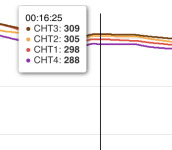
Just to recap - the IO-360-A1B6 (200HP, AV) had a fairly wide temperature distribution and cold #4 (+30°F colder than the rest) - It wasn't timing, or fuel flow, or CHT probe installation -- just good old fashioned air flow management -- or mis-management.

The before --

Screenshot 2026-05-26 at 8.39.42 AM.png

Modification #1:

IMG_0667.jpeg

Upon posting this It was suggested that the world was going to go "pear shaped", dogs & cats living together, all of my molecules would explode at the speed of light....yadda yadda.

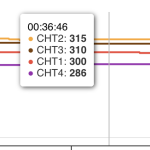
The result from modification #1:

Screenshot 2026-05-26 at 8.47.50 AM.png

"Veddy interesting" -- All the temps came down, and the spreads tightened; From a data consistency perspective, the OAT was the same, DA was the same as the original flight. So directionally, we're going the right way...methinks....

Modification #2:

IMG_0674.jpeg

I wanted #4 to increase a bit more, so I put a little more deflection on the #4 (the curved leading edge).

...and the result:

Screenshot 2026-05-26 at 8.52.29 AM.png

#3 is now the hottest cylinder, #4 came up a few degrees - spread looks much better.

And the final modification:

IMG_0683.jpeg

A "mouse hole" on the deflector in front of the oil cooler inlet - just to keep things interesting.

And the result?

Screenshot 2026-05-26 at 8.38.28 AM.png

So - barring any other interesting behaviors cropping up, I am going to call this done.

And go back to worrying about all of my molecules exploding at the speed of light...
 
You might have improved things by building pressure as a result of taking some away from the oil cooler scat hose. And I have found blanking that off a bit helps the CHTs a bit without adversely affecting oil cooling.

The data you have shown is a small (few degF) drop all round. So was this a function of the days atmospherics and the height, MAP/RPM/FF etc? Mind you they were never hot to begin with.
 
You might have improved things by building pressure as a result of taking some away from the oil cooler scat hose. And I have found blanking that off a bit helps the CHTs a bit without adversely affecting oil cooling.

The data you have shown is a small (few degF) drop all round. So was this a function of the days atmospherics and the height, MAP/RPM/FF etc? Mind you they were never hot to begin with.
The relative spread and "grouping" between cylinders has always been the same, regardless of OAT and atmospherics. For this testing, I was fortunate enough to have the same OAT and DA between days, so the absolute values and relative "grouping" shown in the data directly correlate to the addition of the deflector/top side baffle.

Based on the work that Mooney (Lopresti) did for the M20J, and other anecdotal reports of "Cold #4" with this engine (including my own experiences with other similarly equipped RV's), I think the modification is a keeper...at least for me.

I know the CHT's aren't hot - and even when I run best power mixture, they don't get above ~330°F. I attribute that to inlet shaping, baffle placement/sealing + plenum, and 20°advance (this changes with power however).
 
I like this idea and had one of my own shortly before this thread popped up. My largest temp differential is between #2 and #4 (I think this is typical) on an angle valve engine. Angle valve engines sometimes have issues with coked oil in the exhaust valve guides. The exhaust and exhaust valves are on the rear of the cylinder (R side of the images). I wanted to make a baffle that spans from the boss on the case to the baffling on the outside, and directs air into the fins on the front (#2) cylinder, which would also decrease the airflow to the #4 cylinder. Maybe a slight bend on top to direct the air.

cyl-2-4 measurement.jpgcyl-2-4.jpg

Of note, it's an angle valve engine, and my CHTs are basically always cool. On a hot day in a slow climb off a high elevation airport, I can make #2 just barely hit 380 sometimes, but 300-320 is more typical. My concern is more about delta between cylinders than absolute CHTs.
 
Back
Top