Van's Air Force

The definitive Van's Aircraft support community! Buying, building or flying an RV? Join our exclusive family of mentors and enthusiasts!

Chasing "heavy wing" (Was "N612EF: First flight report")

LettersFromFlyoverCountry

Well Known Member
Sponsor
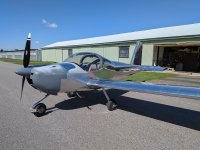
N612EF had its first flight this morning. Because KSGS doesn't allow experimentals in Phase I to return, DAR Tony Kirk gave me a corridor down the Mississippi to near Red Wing, at which point I could turn north into the test area and then, finally, head for Lake Elmo (21D) where it will be based during testing.

It exhibited a very heavy right wing, which you can see in this video when I'd take my hand off the yoke.


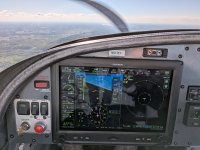
But the big issue was the ADAHRS went south on climbout and was worthless (you can see that in the video too). We had calibrated it at the compass rose a year or so ago with me just using the towbar to move the plane around during the process. So, not sure what's going on there and will have to recalibrate it.

Possibly related is the ball stayed center on straight and level but when I would intentionally slip and the ball would slide left, right rudder, not left rudder, would center it. Again, ADAHRS related?

The engine performed like a champ. Cruising at the eco stop resulted in a higher RPM than I would have liked so I had to throttle back to stay around 4500 RPM or so, sipping 3.1 gph.

I thought I had disabled the ESP (Electronic Stability & Protection) system but I guess I hadn't. At one point the plane pitched up quite sharply (but not violently) on its own. I also thought I'd turned off the autopilot.

So lots to do.

FlightRadar24 data is here

https://www.flightradar24.com/data/aircraft/n612ef#3f94c9c0

G3X Data here
PXL_20260507_151537009.jpg
PXL_20260507_143459920.jpg
 
Last edited:
For the ADAHRS, this is a familiar scenario to a number of us and based on what I understand about the timing of your orders there is a good chance this is a known issue. There was a run of ADAHRS units that had vibration filtering that gets confused in some airframes with Rotax engines. Either Garmin or Van's provided replacement units. Tony would be familiar with this so worth checking with him.

You have some background with RV so you are probably familiar with the conventional wisdom on heavy wings. I had a heavy wing as well. I stuck with the early advice from RV to consider that a lower priority in testing, fly the airplane in a number of conditions and work through the P1. I did give the flaperon TE a light squeeze, and verified flatness of the top skin past the rear spar, but that did not make a difference. What did finally make a difference was verifying the 'height' of the flaperon rod ends. Those rod ends have KAI dimensions, but the measuring process leaves some room to be imprecise. I drew and printed a small jig that rests against the skin, while also going through the bearing. This jig allows for setting all 4 bearings exactly the same. I had 1/2 or 1 turn differences between a couple bearings that would be nearly impossible to measure by eyeball, but when set the same per the jig my heavy wing went away immediately.
 
For the ADAHRS, this is a familiar scenario to a number of us and based on what I understand about the timing of your orders there is a good chance this is a known issue. There was a run of ADAHRS units that had vibration filtering that gets confused in some airframes with Rotax engines. Either Garmin or Van's provided replacement units. Tony would be familiar with this so worth checking with him.
I think this may be referring to Garmin Service Alert 2144 Rev B.


See also SB-00028:

And here's a potentially related thread.

But most importantly, congratulations on your first flight!!!
 
Last edited:
I think this may be referring to Garmin Service Alert 2144 Rev B.


See also SB-00028:

And here's a potentially related thread.

But most importantly, congratulations on your first flight!!!

Van's really should have posted the serial numbers. The "shipping between [date]" given the chaos of the supply chain at the time is insufficient. Shipped when? From Van's to Stein? From Stein to me? I fell outside the date range for at least one of those but the serial numbers will tell the tale.
 
For the ADAHRS, this is a familiar scenario to a number of us and based on what I understand about the timing of your orders there is a good chance this is a known issue. There was a run of ADAHRS units that had vibration filtering that gets confused in some airframes with Rotax engines. Either Garmin or Van's provided replacement units. Tony would be familiar with this so worth checking with him.

You have some background with RV so you are probably familiar with the conventional wisdom on heavy wings. I had a heavy wing as well. I stuck with the early advice from RV to consider that a lower priority in testing, fly the airplane in a number of conditions and work through the P1. I did give the flaperon TE a light squeeze, and verified flatness of the top skin past the rear spar, but that did not make a difference. What did finally make a difference was verifying the 'height' of the flaperon rod ends. Those rod ends have KAI dimensions, but the measuring process leaves some room to be imprecise. I drew and printed a small jig that rests against the skin, while also going through the bearing. This jig allows for setting all 4 bearings exactly the same. I had 1/2 or 1 turn differences between a couple bearings that would be nearly impossible to measure by eyeball, but when set the same per the jig my heavy wing went away immediately.
Confirmed that my SN is well outside the range.

I'll go back out and recalibrate everything. For clarification, it's Tubes Down, Connectors forward, yes?

I'll also do an engine vibration test.
 
Congratulations Bob! Hopefully you have plenty of good WX to get your PAP Test Flights done.

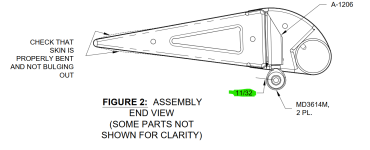
The plans call for setting the Flaperon rod end bearing 11/32" height above the surface, measured at the center of the REB hole. That's a pretty tough thing to measure accurately with the bearing moving around.

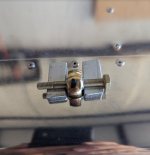
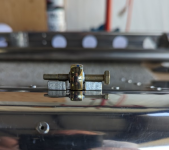
I found an easy way to set the height of the REB is to use 1/4" spacer blocks on both sides of a longer AN3 bolt inserted into the REB.
11/32" -3/32" (half the bolt diameter) = 8/32" (1/4"). Longer spacers are better than short ones because of local flexing of the thin skin. Also remember you were instructed to use Loctite on the REB threads, so it should take a little effort to turn, see KAI 18-06.

1778181094934.png

1778181135120.png

1778181173529.png

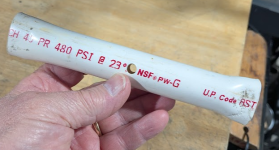
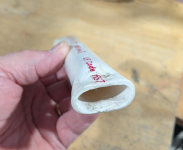
I made a REB turning tool from a piece of SCH 40 tubing. Heat and flatten the ends. Turn it with a screwdriver in the little hole.

1778182562384.png 1778182608041.png

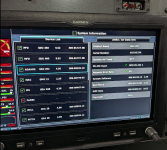
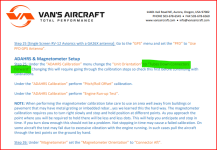
The ADAHRS Serial number is displayed on the System Information page, you don't need to remove the baggage floor panel to find it.

1778181773908.png

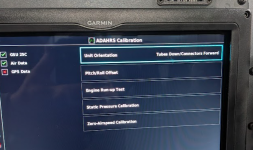
And the unit orientation is set on the ADAHRS page. You'll have to re-run the calibration tests if you change the orientation in this menu.

1778181887722.png
 
Confirmed that my SN is well outside the range.

I'll go back out and recalibrate everything. For clarification, it's Tubes Down, Connectors forward, yes?

I'll also do an engine vibration test.
Bob - It’s a long shot, but you might check to confirm that your magnetometer is correctly mounted. I had some intermittent strange behavior from the AI, and it would eventually blank out and reboot during my first two flights. In addition, the in-flight wind indicator did not appear on the screen. I thought it was a bad ADAHRS, but after troubleshooting with Garmin tech support for several days, we determined that the magnetometer was mounted upside down. Easy fix (other than access), and it resolved all of the issues. The guy at Garmin was suspicious of the magnetometer because of the missing wind info.
 
Bob, about the Garmin auto pilot and ESP.
Local flying club has the same issue. When you boot up the panel ESP is ON, even when the AP is off. This can be confusing, to say the least. In that plane, you either (1) go about 1 or 2 layers down in the mini efis menu and turn ESP off, or (2) pull the AP CB, to turn ESP off. I think there is some way to have it boot up off, but not sure how to arrange that. It’s not my plane. When giving dual I pull the CB, because the Club members don’t know how to turn it off either!
 
N612EF had its first flight this morning. Because KSGS doesn't allow experimentals in Phase I to return, DAR Tony Kirk gave me a corridor down the Mississippi to near Red Wing, at which point I could turn north into the test area and then, finally, head for Lake Elmo (21D) where it will be based during testing.

It exhibited a very heavy right wing, which you can see in this video when I'd take my hand off the yoke.


But the big issue was the ADAHRS went south on climbout and was worthless (you can see that in the video too). We had calibrated it at the compass rose a year or so ago with me just using the towbar to move the plane around during the process. So, not sure what's going on there and will have to recalibrate it.

Possibly related is the ball stayed center on straight and level but when I would intentionally slip and the ball would slide left, right rudder, not left rudder, would center it. Again, ADAHRS related?

The engine performed like a champ. Cruising at the eco stop resulted in a higher RPM than I would have liked so I had to throttle back to stay around 4500 RPM or so, sipping 3.1 gph.

I thought I had disabled the ESP (Electronic Stability & Protection) system but I guess I hadn't. At one point the plane pitched up quite sharply (but not violently) on its own. I also thought I'd turned off the autopilot.

So lots to do.

FlightRadar24 data is here

https://www.flightradar24.com/data/aircraft/n612ef#3f94c9c0

G3X Data here
View attachment 116908
View attachment 116909
Hey Bob!

Congratulations on taking your first flight!

Your ADAHRS issue looks exactly like the acoustic noise issue outlined in the service Bulletin. I have definitely seen a few cases of this outside of the listed date range, so I think its absolutely worth digging into.

To that end I did do some digging.

I looked up the serial number of your unit and you have -50 GSU within the affected serial number range per the Garmin service bulletin. Your unit is affected.

Last time I tried to get an SB kit out of Van's they said they no longer made them and had none to supply, but if you shoot me a text we can coordinate an exchange with Garmin. They have a -55 variant of the GSU to solve this issue for the RV12's that we should easily be able to get swapped out for you.
 
Hey Bob!

Congratulations on taking your first flight!

Your ADAHRS issue looks exactly like the acoustic noise issue outlined in the service Bulletin. I have definitely seen a few cases of this outside of the listed date range, so I think its absolutely worth digging into.

To that end I did do some digging.

I looked up the serial number of your unit and you have -50 GSU within the affected serial number range per the Garmin service bulletin. Your unit is affected.

Last time I tried to get an SB kit out of Van's they said they no longer made them and had none to supply, but if you shoot me a text we can coordinate an exchange with Garmin. They have a -55 variant of the GSU to solve this issue for the RV12's that we should easily be able to get swapped out for you.
Can you confirm you're showing 5Q2004283?. Will shoot you a text.

I just knew you'd jump in here to save my a"*. Again.
 
Last edited:
And the unit orientation is set on the ADAHRS page. You'll have to re-run the calibration tests if you change the orientation in this menu.

_------------------

Because of the way the rudder was interacting with the ball (opposite of what you'd expect) I kind of think there's a second problem involved and probably a misconfiguration .

Looking at the plans (I haven't opened up the floor yet), it looks like the GSU25 orientation is "Tubes Down/Connectors Forward". Can you confirm that?

Mine was configured "Tubes Down/Connectors Aft". I’m pretty sure that would explain the “opposite” rudder indication. Will be rerunning the entire ADAHRS configuration steps.

Also, I'm seeing Magnetometer greyed out on LRU configuration but perhaps that's probably because it needs calibrating again
 
Last edited:
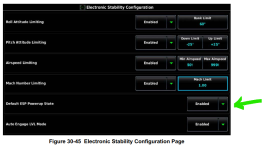
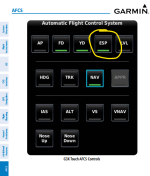
ESP can be defaulted to off at start up by changing the setting in the ESP config menu.

1778186933551.png

Or temporally during the flight by touching MENU button twice then Flight Controls and turning off ESP. This menu can also be brought up by touching the AFCS "Scoreboard" area.

1778187129413.png
 
ESP can be defaulted to off at start up by changing the setting in the ESP config menu.

View attachment 116936

Or temporally during the flight by touching MENU button twice then Flight Controls and turning off ESP. This menu can also be brought up by touching the AFCS "Scoreboard" area.

View attachment 116937
I haven't tried this myself yet, but I've read that you can also disable ESP by pressing and holding the autopilot disconnect button for more than 5 seconds.

 
For the ADAHRS, this is a familiar scenario to a number of us and based on what I understand about the timing of your orders there is a good chance this is a known issue. There was a run of ADAHRS units that had vibration filtering that gets confused in some airframes with Rotax engines. Either Garmin or Van's provided replacement units. Tony would be familiar with this so worth checking with him.

You have some background with RV so you are probably familiar with the conventional wisdom on heavy wings. I had a heavy wing as well. I stuck with the early advice from RV to consider that a lower priority in testing, fly the airplane in a number of conditions and work through the P1. I did give the flaperon TE a light squeeze, and verified flatness of the top skin past the rear spar, but that did not make a difference. What did finally make a difference was verifying the 'height' of the flaperon rod ends. Those rod ends have KAI dimensions, but the measuring process leaves some room to be imprecise. I drew and printed a small jig that rests against the skin, while also going through the bearing. This jig allows for setting all 4 bearings exactly the same. I had 1/2 or 1 turn differences between a couple bearings that would be nearly impossible to measure by eyeball, but when set the same per the jig my heavy wing went away immediately.
Would you be willing to share the print file for the jig?
 
Would you be willing to share the print file for the jig?

Tony's spacer idea is simpler and probably better if you have the spacer material laying around, especially while building when you have the flap on a bench upside down. The jig is probably a little easier to use one handed on an installed flaperon while troubleshooting a heavy wing.

Plus some people, like me, just can't resist printing up a useful little gizmo even if something simpler gets the job done! :ROFLMAO:
 
Congratulations, Bob, on your first flight! You've come this far, I'm sure you'll get this all sorted out. I greatly admire your perseverance!
 
Last edited:
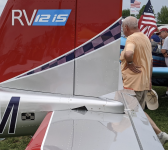
Since ESP was on, unbeknownst to me, and since the ADAHRS thought I was rolling left when I wasn't, I'm beginning to wonder if my heavy wing is actually ESP. The unit is going back to Garmin under the service bulletin so I guess we'll wait on all of it.
 
Last edited:
N612EF had its first flight this morning. Because KSGS doesn't allow experimentals in Phase I to return, DAR Tony Kirk gave me a corridor down the Mississippi to near Red Wing, at which point I could turn north into the test area and then, finally, head for Lake Elmo (21D) where it will be based during testing.

It exhibited a very heavy right wing, which you can see in this video when I'd take my hand off the yoke.


But the big issue was the ADAHRS went south on climbout and was worthless (you can see that in the video too). We had calibrated it at the compass rose a year or so ago with me just using the towbar to move the plane around during the process. So, not sure what's going on there and will have to recalibrate it.

Possibly related is the ball stayed center on straight and level but when I would intentionally slip and the ball would slide left, right rudder, not left rudder, would center it. Again, ADAHRS related?

The engine performed like a champ. Cruising at the eco stop resulted in a higher RPM than I would have liked so I had to throttle back to stay around 4500 RPM or so, sipping 3.1 gph.

I thought I had disabled the ESP (Electronic Stability & Protection) system but I guess I hadn't. At one point the plane pitched up quite sharply (but not violently) on its own. I also thought I'd turned off the autopilot.

So lots to do.

FlightRadar24 data is here

https://www.flightradar24.com/data/aircraft/n612ef#3f94c9c0

G3X Data here

View attachment 116908
View attachment 116909
Congratulations, Bob! Happy for you!
 
INVESTIGATION UPDATE 1

I removed the ADAHRS unit and will bring it down to SteinAir on Wednesday morning. Josh offered to mediate with Garmin. Hopefully, it won't cost me too much. We'll see.

Moving on to the flaperons, the straight edge re-check didn't find anything that bothers me.

PXL_20260510_161355784.jpg

The measurement on the opposite side between the flaperon and wing with the one side equal was right on target.

I could only eyeball the four rod end bearings until I gin up a tool. I would say they were closer to 9/32" than 11/32", but, like I said, at this point I can only eyeball things with a ruler. All of the REB seemed to be consistent in length although it's possible the outboard REB on the left wing might be slightly different. We'll see.

Since it's going to be awhile with Garmin, I can't think of any reason not to take the flaperons off and definitively reset all rod end bearings.

Other than the fact, of course, that I'm not in my hangar.

By the way, Bob Avery used to sell a gussied up version of Tony's tool. I used to own it I wonder whatever happened to it.
 
Last edited:
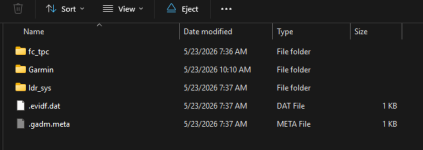
INVESTIGATION UPDATE 2

Garmin agreed to restore the warranty on the ADAHRS unit given the circumstances and while I wait for the new unit to arrive, I continue to check and doublecheck everything that might explain the heavy roll tendency exhibited on its one and only flight so far.

As indicated upthread, I doublechecked that the flaperon does not have any bulges.

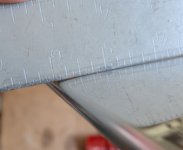
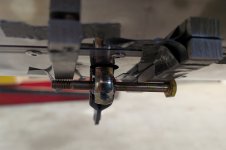
Today, I used the "Tony method" to doublecheck that the distance between the flaperon skin and the center of the rod end bearing is correct. I don't believe I found a "smoking gun", although I made some adjustments.

PXL_20260517_150109193.jpg

On the left flaperon, I found the outboard REB to be perfect (I'm usually happy to see when I built or assembled something properly, but not when I'm looking for something wrong.) The middle bracket required only a half turn IN (see photo).

On the right flaperon, the middle bracket REB was turned OUT one half turn as was the outboard bracket, although for that one it was really borderline.

Is a half turn likely to make a difference? We'll see.

Originally, I was going to take the flaperon off and do this on a bench, but then, after some consternation, I realized you have to take both wings off. Nope, not doing that.

Continuing to check things, with the left flaperon in trail, I checked the distance between the trailing edge of the wing and the flaperon trailing edge and it was within the 1/4" to 1/2" range specified in the Production Acceptance Procedures.

At this point, I don't want to change a bunch of stuff before test flying it again, so once the ADAHRS is back in place and the baggage bulkhead wall and floor restored, I'll go through the ADAHRS calibration procedures again and then take it up for a look-see.

I should mention that because the plane is not painted, there is no wing seal in place. Instead, I've closed the gap with duct tape.

Will update as further news warrants.
 
Last edited:
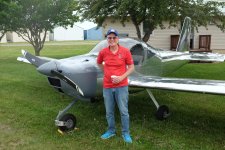
Bob - I had a heavy wing also on my first several flights. Flaperon bearings all were good, so I used the method described in Section 5 of the KAI to slightly pinch the trailing edge of the opposite (upgoing) wing. I didn’t think I did very much, but on the next flight the pinched side became heavy. After that I added a bit more pinch to the light side incrementally and continued test flying until it flew level. If you use that method, do it a tiny bit at a time. I suspect that will fix the problem.
 
INVESTIGATION UPDATE 3

The new ADAHRS was installed and calibrated yesterday so took the plane up for, really, it's first flight test. The right wing is still heavy but it doesn't see quite as bad after I adjusted rod end bearing on the flaperon. With that out of the way, I can now do a little trailing edge squeezing to see what impact, if any. It's been interesting to read the comments upstream, some from people who said squeezing the TE didn't do much and others who said it solved the problem. Same plane. Proven design. Different results. Fascinating, really.

The new ADAHRS performed flawlessly. I felt it was unfairly indicating a slight yaw but I also want to run the calibration steps again before I try anything. I don't hear a lot about RV-12iSers having rudder tabs but maybe I haven't been paying attention.

The engine is performing magnificently. I wish I could settle on how I want the dual G3Xs to display. Currently I'm using split screen on the pilot side with traffic showing. And on the passenger side I've got a sectional and engine data (I've also got engine data on the PFD).

I haven't been able to update the Garmin databases. For some reason it's not recognizing the database update on the card.
 
INVESTIGATION UPDATE 3

The new ADAHRS performed flawlessly. I felt it was unfairly indicating a slight yaw but I also want to run the calibration steps again before I try anything. I don't hear a lot about RV-12iSers having rudder tabs but maybe I haven't been paying attention.

I have the rudder tab installed. I would be surprised if this is uncommon, at least among people who spend any real time at cruise vs maneuvers.

The engine is performing magnificently. I wish I could settle on how I want the dual G3Xs to display. Currently I'm using split screen on the pilot side with traffic showing. And on the passenger side I've got a sectional and engine data (I've also got engine data on the PFD).

Personally, I'm often changing the setup based on immediate priorities. The more you use it the more fluid you will get with the setup and it will probably become natural to dial the current priority info to half of the PFD, with secondary info over on the MFD. Sometimes traffic is more important to me than the map or terrain, other times the opposite. Consider thinking flexibly about these rather than a favorite.

I haven't been able to update the Garmin databases. For some reason it's not recognizing the database update on the card.
Following the guidance to use only an 8G or smaller card, properly formatted? The system is picky about that.
 
Following the guidance to use only an 8G or smaller card, properly formatted?

Small correction: The guidance is actually to use a 32GB or smaller card, and also FAT32 format.

The real issue is that there are a bunch of different storage technologies that all look like the same physical object, but not all of which are compatible... kind of like vinyl records that require 33 vs 45 vs 78 RPM to work.

The original-spec "SD" cards, and later SDHC ("high capacity") cards are both supported by the GDU 4xx display. What it doesn't support are SDXC ("extended") or SDUC ("ultra") cards.

As it happens, the maximum size of an SDHC card is 32GB, so where that's where the guidance comes from... if you avoid cards bigger than 32GB you should avoid the types that aren't compatible.
 
Small correction: The guidance is actually to use a 32GB or smaller card, and also FAT32 format.


The original-spec "SD" cards, and later SDHC ("high capacity") cards are both supported by the GDU 4xx display. What it doesn't support are SDXC ("extended") or SDUC ("ultra") cards.

Good to know. The 8GB guidance comes from Van's in the PAP, the expanded info actually from Garmin makes sense.
 
I don't hear a lot about RV-12iSers having rudder tabs but maybe I haven't been paying attention.
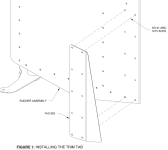
The reason for not hearing too much about it is that it's been standard (included in kits and instructions) for a while now. See this post from rvbuilder2002 (Scott McDaniels)

The rudder trim tab wasn't standard in the earlier kits.

A while after it's introduction as an optional part, enough service experience was gained to determine that the designed bend angle was ideal for most all RV-12's and those that it wasn't, required just a very small adjustment, so it was added as a standard part to the kit.

Screenshot 2026-05-22 at 8.10.21 PM.png

Ordering. Can I see a pix of your installation?
Not my plane, but here's a picture I took at KOSH.

Screenshot 2026-05-22 at 8.23.28 PM.png
 
Ordering. Can I see a pix of your installation?
RV-12is covered it, as simple as that. It was included in my kit and I did not need any adjustment from the default angle.

Sounds like it was not included in your kit, but it's a simple matter of some match drilling and a handful of LP4-3.
 
Bob - I had a heavy wing also on my first several flights. Flaperon bearings all were good, so I used the method described in Section 5 of the KAI to slightly pinch the trailing edge of the opposite (upgoing) wing. I didn’t think I did very much, but on the next flight the pinched side became heavy. After that I added a bit more pinch to the light side incrementally and continued test flying until it flew level. If you use that method, do it a tiny bit at a time. I suspect that will fix the problem.
An additional recommendation if you use that method is that you actually check the shape with a straight edge as described in section 5, and verify that it is correct.
Just squeezing trailing edges and keep alternating until the roll trim is correct can result in trailing edges that are over squeezed.
It may fly and trim, but this will have an influence on the control forces and it won’t fly like it is supposed to
 
RV-12is covered it, as simple as that. It was included in my kit and I did not need any adjustment from the default angle.

Sounds like it was not included in your kit, but it's a simple matter of some match drilling and a handful of LP4-3.
No, my emp kit was the old design. Same with wings. The iS kit came out with my fuselage.
 
An additional recommendation if you use that method is that you actually check the shape with a straight edge as described in section 5, and verify that it is correct.
Just squeezing trailing edges and keep alternating until the roll trim is correct can result in trailing edges that are over squeezed.
It may fly and trim, but this will have an influence on the control forces and it won’t fly like it is supposed to
Yes, as indicated earlier the straight edge check showed everything was proper. I’m generally agnostic about squeezing trailing edges other than perhaps some light pinching to see effect.
 
Reformatted the correct SD cards (including the one I used to update the system) and redownloaded DBs from Garmin and still no joy. Odd, because the unit is writing flight data to the card. Will consult with G3xpert
Screenshot 2026-05-23 110523.png
 
INVESTIGATION UPDATE 4

Second test flight (third flight overall). What a wonderful little airplane!
Flew it from Lake Elmo to Menominee, Wis., and back (no landing at KLUM). Did a full power climb to 10,000 and then tooled around up there calibrating AOA (I think I'm going to kill that alarm)

On the way out, I still noticed a heavy wing, even after finger squeezing the most outboard trailing edge. After being done at 10K, I did a power descent to 2500 and, oddly enough, did not have a roll. Not sure why that is but I think I'm going to stop chasing this until I install the rudder trim tab.

Not for nothing, but I 've made two of my best landings in airplanes on the last two flights.

FlightRadar 24 Playback
 
The heavy wing problem seems to be solved. New problem: the avionics shop (run by a fellow eaa chapter member) can't get a reading on the transponder check. Oddly, I see all the data on Flight Aware .

There is no test button on the config menu for the transponder. Manual says it's automatically in test mode for one power cycle. Huh?
 
New problem: the avionics shop (run by a fellow eaa chapter member) can't get a reading on the transponder check. Oddly, I see all the data on Flight Aware .

There is no test button on the config menu for the transponder. Manual says it's automatically in test mode for one power cycle. Huh?

Bob, take a look at section 32.1.4 in the current G3X installation manual (revision AZ):

To allow the transponder to be operated in ALT mode while on the ground, for the purposes of performing periodic testing in accordance with the requirements of 14 CFR Part 91.413, a special transponder ground maintenance test mode is provided.

To access ground maintenance mode in a G3X Touch™ avionics system with GDU 4XX displays:

1.Access the Transponder page, press the Menu key.

2.Select Enable Maintenance Test to force the transponder into ALT mode.
 
For the ADAHRS, this is a familiar scenario to a number of us and based on what I understand about the timing of your orders there is a good chance this is a known issue. There was a run of ADAHRS units that had vibration filtering that gets confused in some airframes with Rotax engines. Either Garmin or Van's provided replacement units. Tony would be familiar with this so worth checking with him.

You have some background with RV so you are probably familiar with the conventional wisdom on heavy wings. I had a heavy wing as well. I stuck with the early advice from RV to consider that a lower priority in testing, fly the airplane in a number of conditions and work through the P1. I did give the flaperon TE a light squeeze, and verified flatness of the top skin past the rear spar, but that did not make a difference. What did finally make a difference was verifying the 'height' of the flaperon rod ends. Those rod ends have KAI dimensions, but the measuring process leaves some room to be imprecise. I drew and printed a small jig that rests against the skin, while also going through the bearing. This jig allows for setting all 4 bearings exactly the same. I had 1/2 or 1 turn differences between a couple bearings that would be nearly impossible to measure by eyeball, but when set the same per the jig my heavy wing went away immediately.
could you post a pic of your jig. i never did get it adjusted satisfactory?
 
Back
Top