Van's Air Force

The definitive Van's Aircraft support community! Buying, building or flying an RV? Join our exclusive family of mentors and enthusiasts!

Bleeding brakes the easy way

sf3543

Well Known Member
Patron
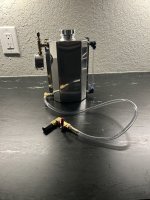
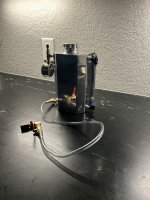
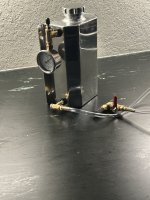
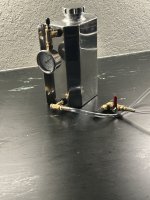
Bleeding brakes can be a challenging and messy job; however, I have been using a system for years that works so well it's almost hard to believe. I first saw this method being used by Jay Pratt, and I shamelessly made my own version.
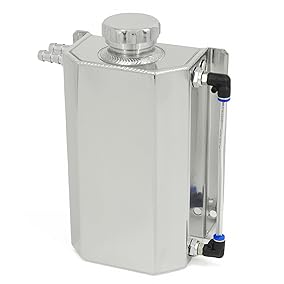
My older version had a bigger and ungainly tank, so I decided to make a new one that was a little smaller and easier to use. This one incorporates a larger fill opening, a level sight gauge and smaller tubing. I plan to add a backboard with a handle at the top and a base at the bottom for it to set on.
To use it, fill it about 1/3 to 1/2 full with fluid and use the Schrader valve to put in 15 PSI.
Bleed the air out of the tubing til all the bubbles are gone.
Hook up the Cleveland Bleeder Adapter.
Loosen the bleeder fitting and open the valve.
It typically takes only a few seconds to bleed a brake line.
If working alone, I put a barb fitting with some vinyl tubing in the breather hole of the reservoir so I can see if I am over filling. After a few uses you will get used to how it works and rarely over fill.
I personally like the Cleveland Brake Adapter but you could also attach some vinyl tubing to the valve and connect that to the bleeder fitting. That fitting is available from Spruce.
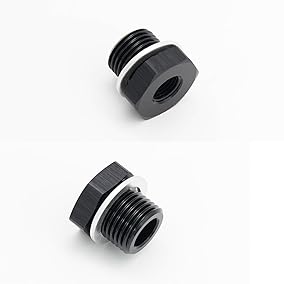
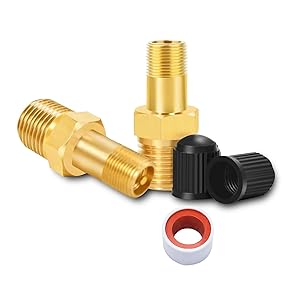
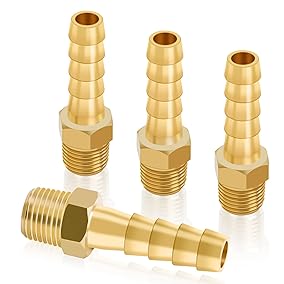
All the other parts came from Amazon. Total cost for everything is about $100.
I'm not sure if I will retain the sight gauge that came with the tank, but I have tested it to 25 PSI with no problems. Since I only use 15 PSI to bleed brakes this should work out fine. If not, all I need is two plugs to plug the bungs.
Anyway, this is the best, easiest and fastest way to bleed brakes I have come across.
Hopefully this helps someone looking for a new tool project.

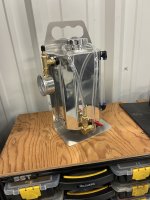
Made a few changes, moved pick up to bottom of tank, added a foot and handle.
 

Attachments
  • IMG_4504.jpeg
    IMG_4504.jpeg
    1.9 MB · Views: 468
  • IMG_4505.jpeg
    IMG_4505.jpeg
    2.1 MB · Views: 449
  • IMG_4506.jpeg
    IMG_4506.jpeg
    2.2 MB · Views: 437
  • IMG_4526.jpeg
    IMG_4526.jpeg
    1.8 MB · Views: 84
Last edited:
I just bleed the brakes on my RV-3B. Used a simple oil can with silicone hose over slave cylinder bleed nipple. Make sure you slowly pump the oil can to get clean (no bubbles) fluid coming out of the hose and open nipple to get brake fluid dripping out before attaching hose to nipple.
Because my master cylinders have built-in reservoir I threaded a 1/8" NPT fitting into fill hole and a long PVC line to that.
Cost: about $5 for the oil can if you already have the hose. https://www.amazon.com/dp/B0FT2JGF3H?ref=ppx_yo2ov_dt_b_fed_asin_title&th=1

I guess there's a lot of ways to skin this cat, but unless you have a continuous down slope from reservoir to slave cylinder, you definitely have to fill from bottom up. Did it from reservoir down on the left brake and had to re-do it from bottom up to get rid of the soft pedal (air trapped in line).
 
That thing is purdy. Looks like something on a spacer ship. Totally agree bleeding is easier bottom up.

For cheap guys like me, this bleeder worked great. I did add a cheap plastic valve to open the circuit. If you know Mr Howe, he might sell you his EZ gadget for the reservoir. It sets the head space in the reservoir.
 
I just bleed the brakes on my RV-3B. Used a simple oil can with silicone hose over slave cylinder bleed nipple. Make sure you slowly pump the oil can to get clean (no bubbles) fluid coming out of the hose and open nipple to get brake fluid dripping out before attaching hose to nipple.
Because my master cylinders have built-in reservoir I threaded a 1/8" NPT fitting into fill hole and a long PVC line to that.
Cost: about $5 for the oil can if you already have the hose. https://www.amazon.com/dp/B0FT2JGF3H?ref=ppx_yo2ov_dt_b_fed_asin_title&th=1

I guess there's a lot of ways to skin this cat, but unless you have a continuous down slope from reservoir to slave cylinder, you definitely have to fill from bottom up. Did it from reservoir down on the left brake and had to re-do it from bottom up to get rid of the soft pedal (air trapped in line).
Same. Add a grease gun fitting to your hose and you have a built in check valve that snaps right onto the zerk. But hey, you’ll have to spend another $2 !
Also, if you have stock clear tubing from the reservoir to master, you can watch them fill up and into the reservoir, inspect for bubbles, and then just top off the reservoir. No need for an overflow on the reservoir.
Clean, easy, cheap….
 
I use a pressurized bleeder from Motive just like Larry’s that I bought probably 20 years ago for an old sports car. Just changed the fittings to work with the RV brakes and reservoir. Bleed from the bottom. One man job, 10 minutes.
 
Pressure pot (homemade) from the bottom up using the Cleveland adapter that attaches to the caliper's bleeder. Sometimes you must have volume and pressure to force those bubbles out. Brakes on left and right seats are one example.. and yes the little oil can sometimes works
 
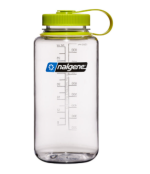
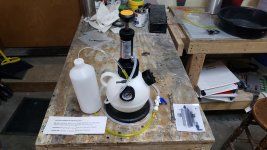
Made a pressure pot for this purpose out of a $0.50 thrift store 32oz Wide Mouth Nalgene Bottle. Drilled a hole on one side of the top to pull in a rubber valve stem (You can use it with or without the Schrader valve in place). On the other side of the top, I drilled a slightly undersize hole for the clear vinyl tubing that will be used. Cut the tubing at an angle, soften it in some hot water, and it will pull right through the hole and seal against it.
1777227232393.png
 
Made a pressure pot for this purpose out of a $0.50 thrift store 32oz Wide Mouth Nalgene Bottle. Drilled a hole on one side of the top to pull in a rubber valve stem (You can use it with or without the Schrader valve in place). On the other side of the top, I drilled a slightly undersize hole for the clear vinyl tubing that will be used. Cut the tubing at an angle, soften it in some hot water, and it will pull right through the hole and seal against it.
View attachment 116110
Wow! We need a VAF award for stuff like that. My hero.
 
Same. Add a grease gun fitting to your hose and you have a built in check valve that snaps right onto the zerk. But hey, you’ll have to spend another $2 !
Please let me know where to get a grease gun fitting (coupling) for $2. I looked, but no luck.

Finn
 
Please let me know where to get a grease gun fitting (coupling) for $2. I looked, but no luck.

Finn
NAPA has them for under $5 but here’s a two pack. You also need a 1/8 barb fitting for the tube, so, let’s say $5 bucks all in?
Anyway, cheap was the point…..
it makes it a little less messy with the internal check valve.
 
Make sure you purge air at the grease gun fitting or you get to push a bubble all the way to the reservoir.
 
Make sure you purge air at the grease gun fitting or you get to push a bubble all the way to the reservoir.
I don’t mess with the brake system with partial fluid in it. Not sure there is a scenario that makes sense to do that.
I drain the system, so there isn’t any bubble to push through, just fresh fluid pushing air, or perhaps a small amount of residual fluid that gets taken up by the reservoir.
Anyway, it’s never an issue.
 
Make sure you purge air at the grease gun fitting or you get to push a bubble all the way to the reservoir.
Right, that's why I liked the short hose -- but a bit hard holding the hose onto the nipple with one hand and holding and pumping the can with the other.
Tip of my nipples sit about 3.5" above the ground, so would need 1/8NPT to barb elbow and make sure enough fluid has been pumped through hose, elbow and coupler, nipple dripping fluid as one is connecting the coupler. Of course not a problem if starting fresh.

(I'll probably have to redo it in the not too distant future because I used Valvoline Synthetic ATF I had on hand without replacing O-rings.)
 
(I'll probably have to redo it in the not too distant future because I used Valvoline Synthetic ATF I had on hand without replacing O-rings.)
I think you will find the O rings, Vitron or otherwise, will not have any compatibility issues. I switched to Mobile 1 full synthetic and Vitron listed synthetic ATF.
Yes, the grease fitting makes it an easier and less messy job. You can also fill a bit, stop, and check things out. Since my lines from the reservoir to the masters are clear, I can follow the progress. When the lines are full, I top off the reservoir.
I don’t have bubbles using this set up.
 
Right, that's why I liked the short hose -- but a bit hard holding the hose onto the nipple with one hand and holding and pumping the can with the other.
Tip of my nipples sit about 3.5" above the ground, so would need 1/8NPT to barb elbow and make sure enough fluid has been pumped through hose, elbow and coupler, nipple dripping fluid as one is connecting the coupler. Of course not a problem if starting fresh.

(I'll probably have to redo it in the not too distant future because I used Valvoline Synthetic ATF I had on hand without replacing O-rings.)
Std Orings are nitrile rubber. Fully compatible with atf synthetic or mineral.
 
I never had a problem pressing clear tubing over the bleeder and then having it slip off. A pull tie on the end of the tube for better fit.
Then just use this....
pump.jpg
 
Last edited:

I never had a problem pressing clear tubing over the bleeder and then having it slip off.
Then just use this....
View attachment 116214
Me either, for years, until one day it did. For a few bucks and a couple of parts it was an easy upgrade.
I bet there are dozens of these “how to bleed brakes” posts and a lot of over thinking what should be a simple job.
 
Me either, for years, until one day it did. For a few bucks and a couple of parts it was an easy upgrade.
I bet there are dozens of these “how to bleed brakes” posts and a lot of over thinking what should be a simple job.
What i like about clear hose on the bleeder is that i can very easily determine that i have bled all the air out of the line before i open the bleeder. This is not a factor for you, as youare draining first, but applies to those of us that don’t.

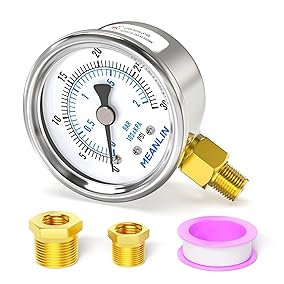
My bleeder rig is an old salsa jar that connects to my compression tester for precise air pressure. One outlet for fluid and one for the air fitting. Zero cost and very effective.
 
What i like about clear hose on the bleeder is that i can very easily determine that i have bled all the air out of the line before i open the bleeder. This is not a factor for you, as youare draining first, but applies to those of us that don’t.
Why would you be adding fluid to an existing line? I am just curious.
 
Why would you be adding fluid to an existing line? I am just curious.
Many times i bleed brakes for folks because they are not firm. I suppose it is not much more work to drain them first. Just never thought of doing it that way. Just too much engrained habit from the auto world where that would require re bleeding the MC; a major hassle.
 
Many times i bleed brakes for folks because they are not firm. I suppose it is not much more work to drain them first. Just never thought of doing it that way. Just too much engrained habit from the auto world where that would require re bleeding the MC; a major hassle.
I used to only use 8-10 psi and really struggled to get the air out. Once i went to 15 psi, that all changed and never have to bleed more than once.
 
That thing is purdy. Looks like something on a spacer ship. Totally agree bleeding is easier bottom up.

For cheap guys like me, this bleeder worked great. I did add a cheap plastic valve to open the circuit. If you know Mr Howe, he might sell you his EZ gadget for the reservoir. It sets the head space in the reservoir.
Larry I assume you have the matco breaks. What size valve did you get with that bleeder?
 
Larry I assume you have the matco breaks. What size valve did you get with that bleeder?
No actually. Beringer. They have an odd size bleeder. The grease type connections don't fit. I had to use a tight hose. I bought some clear (yellow) radio control fuel line. It fit nice and tight. The valve is just a cheap plastic valve from the local aviation supply (ACE). It allows me to open the circuit till all the air is purged right to the tip before slipping it over the bleeder.
Here's the whole set up.
20240409_131241.jpg
 
Bleeding brakes can be a challenging and messy job; however, I have been using a system for years that works so well it's almost hard to believe. I first saw this method being used by Jay Pratt, and I shamelessly made my own version.
My older version had a bigger and ungainly tank, so I decided to make a new one that was a little smaller and easier to use. This one incorporates a larger fill opening, a level sight gauge and smaller tubing. I plan to add a backboard with a handle at the top and a base at the bottom for it to set on.
To use it, fill it about 1/3 to 1/2 full with fluid and use the Schrader valve to put in 15 PSI.
Bleed the air out of the tubing til all the bubbles are gone.
Hook up the Cleveland Bleeder Adapter.
Loosen the bleeder fitting and open the valve.
It typically takes only a few seconds to bleed a brake line.
If working alone, I put a barb fitting with some vinyl tubing in the breather hole of the reservoir so I can see if I am over filling. After a few uses you will get used to how it works and rarely over fill.
I personally like the Cleveland Brake Adapter but you could also attach some vinyl tubing to the valve and connect that to the bleeder fitting. That fitting is available from Spruce.
All the other parts came from Amazon. Total cost for everything is about $100.
I'm not sure if I will retain the sight gauge that came with the tank, but I have tested it to 25 PSI with no problems. Since I only use 15 PSI to bleed brakes this should work out fine. If not, all I need is two plugs to plug the bungs.
Anyway, this is the best, easiest and fastest way to bleed brakes I have come across.
Hopefully this helps someone looking for a new tool project.
Steve,

That is sweet! Do you have parts list to build?
 
Steve,

That is sweet! Do you have parts list

Steve,

That is sweet! Do you have parts list to build?
I used basic stuff all from Amazon except for the Cleveland adapter and some 1/4" ID tubing bought locally.
Whatever tank you get will decide on some of the fittings. Your tank will need at least two bungs, one for the delivery hose and one for the air input. Possibly a third if you put a pressure gage on a separate bung, not to mention a filler. This tank has a nice sized filler cap.
Going the amazon route you end up with some extra fittings while you could buy them all locally in units of one each.
I ended up moving the pick up to the bottom of the tank with a 90 fitting and adding a back plate with a base. This doesn't require unusable fluid in the tank.
Make sure you only put about a third full of fluid since you need the tank space for air capacity.
I realize all the old oil can and other methods work just fine, and I have used them for years, but this is fun to build and does work really well.
If you don't want to spend the extra for the Cleveland adapter, you could likely use a piece of tubing to fit on the bleed valve or even a grease gun fitting, but I haven't tried them since I am happy with what I have.
Good luck and have fun!


I used basic stuff all from Amazon except for the Cleveland adapter and some 1/4" ID tubing bought locally.
Whatever tank you get will decide on some of the fittings. Your tank will need at least two bungs, one for the delivery hose and one for the air input. Possibly a third if you put a pressure gage on a separate bung, not to mention a filler. This tank has a nice sized filler cap.
Going the amazon route you end up with some extra fittings while you could buy them all locally in units of one each.
I ended up moving the pick up to the bottom of the tank with a 90 fitting and adding a back plate with a base. This doesn't require unusable fluid in the tank.
Make sure you only put about a third full of fluid since you need the tank space for air capacity.
I realize all the old oil can and other methods work just fine, and I have used them for years, but this is fun to build and does work really well.
If you don't want to spend the extra for the Cleveland adapter, you could likely use a piece of tubing to fit on the bleed valve or even a grease gun fitting, but I haven't tried them since I am happy with what I have.
Good luck and have fun!


Bleeding brakes can be a challenging and messy job; however, I have been using a system for years that works so well it's almost hard to believe. I first saw this method being used by Jay Pratt, and I shamelessly made my own version.
My older version had a bigger and ungainly tank, so I decided to make a new one that was a little smaller and easier to use. This one incorporates a larger fill opening, a level sight gauge and smaller tubing. I plan to add a backboard with a handle at the top and a base at the bottom for it to set on.
To use it, fill it about 1/3 to 1/2 full with fluid and use the Schrader valve to put in 15 PSI.
Bleed the air out of the tubing til all the bubbles are gone.
Hook up the Cleveland Bleeder Adapter.
Loosen the bleeder fitting and open the valve.
It typically takes only a few seconds to bleed a brake line.
If working alone, I put a barb fitting with some vinyl tubing in the breather hole of the reservoir so I can see if I am over filling. After a few uses you will get used to how it works and rarely over fill.
I personally like the Cleveland Brake Adapter but you could also attach some vinyl tubing to the valve and connect that to the bleeder fitting. That fitting is available from Spruce.
All the other parts came from Amazon. Total cost for everything is about $100.
I'm not sure if I will retain the sight gauge that came with the tank, but I have tested it to 25 PSI with no problems. Since I only use 15 PSI to bleed brakes this should work out fine. If not, all I need is two plugs to plug the bungs.
Anyway, this is the best, easiest and fastest way to bleed brakes I have come across.
Hopefully this helps someone looking for a new tool project.

Made a few changes, moved pick up to bottom of tank, added a foot and handle.
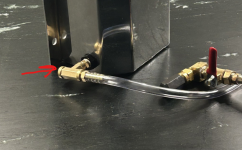
What did you use to plug the open end of this T? 1779794918776.png
 
What did you use to plug the open end of this T? View attachment 118692
I just used a 1/8” plug that I had on hand. Forgot to mention that.
I did make a change to this set up though and moved that fitting to the bottom of the tank in order to get all the fluid available. Added a handle and a foot to raise it up for the fitting.
I added a picture to the original post
 
Back
Top