Van's Air Force

The definitive Van's Aircraft support community! Buying, building or flying an RV? Join our exclusive family of mentors and enthusiasts!

Location for grounding block

bertschb

Where's my engine????
Sponsor
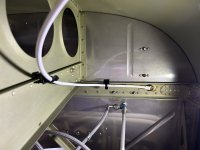
I'm thinking of mounting my grounding block (forest of tabs) but I don't have my engine yet. I'm not sure if the location I'm considering will cause any interference issues when it comes time for the engine install (assuming I get my engine before I croak).

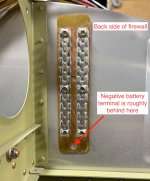
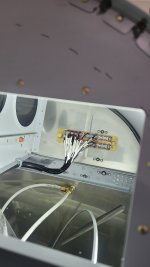
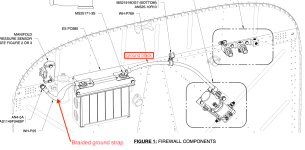
This is what I'm thinking of. The photo below is looking forward from the back side of the firewall. The main grounding block bolt would be directly behind the negative battery terminal. I have the optional access panels on the upper forward fuselage skin so I'll have access to the grounds.

Thoughts???

IMG_6284.jpeg
 
Suggestion.

Cut the forest of tabs in half such that you have one mounting hole on each half. Mount the half with the ground bolt hole on the cabin side of the firewall. On that same bolt (on the cabin side) add a ring terminal on a piece of #10 wire to connect to the other half of the forest of tabs. Mount this other half on the bulkhead just aft of the panel (or other covenant location). Using another ground lug bolt attached the other end of the #10 wire. You now have a much easier location for grounds for now and later. I put the larger load grounds on the block that is on the firewall.

Carl
 
Check plans where the battery negative cable bolts through the firewall. Use that same anchor bolt to mount the forest of tabs strip to the inside of the firewall.
Good suggestion Carl, to split the tab (linked by #10 wire) to a more convenient location on the sub panel, spreads out the usual congested maze of negative leads around those tabs.
 
If you don't have a duplicate, buy two more. One opposite on the Forward side. The other optional if you want to go with Carl's suggestion. Double check the location of that battery terminal. You don't want to fight with a tiny ground cable. Personally I would put the double sided 24 each right under the firewall flange horizontally and another 24 per Carl's suggestion somewhere more convenient. The ground strap is flexible so it should be easy to remove from the battery.
I don't know the 14, but cutting the front off my battery box and adding hinges was one of the best mods on the airplane. I used wide material and added about 1/4" of depth. If a battery is loose, a piece of baffle material fills the gap and acts as an insulator to keep contacts from touching the firewall.
 
OK, moving to plan B...

The upper forward fuselage access panels I have are actually one bay inboard of where I was planning to mount the grounding block (picture in post #1) so that aint gonna work.

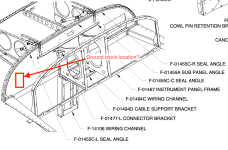
If I relocate my CO detector that is currently on the aft pilot side sub panel, there is room for the grounding block in that location. Easy to access in this location!

Screenshot 2026-04-23 at 5.44.59 PM.png
 
Last edited:
Really? Which ones? I have a lot of devices needing grounds, but the overwhelming majority are not firewall forward. They are for all my avionics and grounded on the forest on the sub panel. I would not try to route them all through the firewall.
 
Brian:
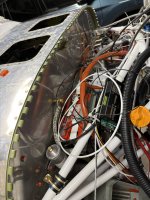
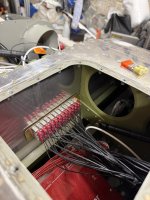
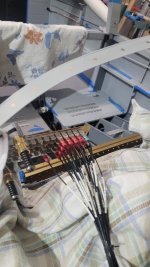
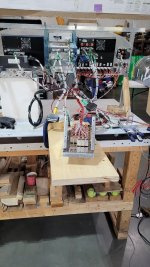
Here are some shots of my 14A in progress, with actual equipment in place. It looks a bit of a mess because I've got wires run, and extra lengths because I haven't started terminations, because I'm checking fits of everything I can. So they are not all secured down, just have temporary zip ties, so I can still ponder moving wires around at this point. My MK-30 controller is close to the battery, and it looks like I can only mount the adel clamps facing forward, otherwise getting the battery out is going to be tough.

IMG_1108.jpegIMG_1109.jpeg

I have mine horizontal to your location, I put a hole for the pass through bolt in a location that the #2 grounding strap was easy to mount to which was further left then the designed ground bolt location. Thus on the inside I also get access through the access hole, and not over in the right bay, which would be harder to reach like you are finding out.


I do like the idea of a few fwf tabs, but I've counted 5 grounds (the #2 battery strap, #10 from the MK-30, 2x#18 L&R pmag, and #12 from my PPS), so plan is to put those all on ring terminal connectors and tie to the bolt or if needed one of the three "empty" screws/bolts on the right side (bottom left of the photo fwf)
 
Last edited:
I misread Brian's question. I don't know how many grounds I'll need FWF.
I think that might be Brian's point, that there aren't many fwf ground connections, and could local ground as well pretty easy to many locations, as long as the engine strap is done well (i.e. sanded, dielectric paste, checked at condition inspection etc.).

But that's also why I put how many I have, so at least folks have an idea on a dual pmag, monkworkz and PSS equipped plane.
 
I have mine horizontal to your location, I put a hole for the pass through bolt in a location that the #2 grounding strap was easy to mount to which was further left then the designed ground bolt location. Thus on the inside I also get access through the access hole, and not over in the right bay, which would be harder to reach like you are finding out.
That photo you shared of your grounding block location looks like there is easy access. I need to re-visit this tomorrow. I started thinking about where to mount what I think is the last item - my external voltage regulator. Don't see any good spots for that. My head hurts.
 
I don’t have an external v reg, but I ran the extra sense wire fwf, and plan to mount the box under the vpx, if I ever go in that direction.
 
@lipper03 Yes, that was my point -- I don't care for the "forest of tabs gone wild"; electrically it's not a problem tho.

Now I'll upset everyone - so here goes; If you look at the circuit breakers, fuses, and buss/circuit feed points, you'll likely see that the wire terminations are ring-terminals, #6 screws with lock-washers, etc. Everyone seems to be *very* concerned about the + / red wires coming loose, but they'll use fast-on or other termination strategies that aren't as secure or durable for the grounds --- Why? The - / black (ground, return, earth) side of the circuit is every bit as important as the supply side -- treat it accordingly.

I don't care for Fast-on's because the material will lose tension over time and lead to corrosion at the contact points. Genuine Fast-on's (TE-AMP) are "OK", but the common retail versions really suck.
 
@lipper03 Yes, that was my point -- I don't care for the "forest of tabs gone wild"; electrically it's not a problem tho.

Now I'll upset everyone - so here goes; If you look at the circuit breakers, fuses, and buss/circuit feed points, you'll likely see that the wire terminations are ring-terminals, #6 screws with lock-washers, etc. Everyone seems to be *very* concerned about the + / red wires coming loose, but they'll use fast-on or other termination strategies that aren't as secure or durable for the grounds --- Why? The - / black (ground, return, earth) side of the circuit is every bit as important as the supply side -- treat it accordingly.

I don't care for Fast-on's because the material will lose tension over time and lead to corrosion at the contact points. Genuine Fast-on's (TE-AMP) are "OK", but the common retail versions really suck.
Yeah, I know might have an issue in the future, but don't want to redo all that work now, haha. At least mine are TE-AMP, so I have a fighting chance!
 
I did nearly the same setup as Brian (lipper03) except I put the grounding block a bay over to the right. It's behind the grounding post/bolt as I wanted to make sure it was hard to get to. Mission accomplished :rolleyes:

Fortunately, it's worked very well and I've been happy with it. It's out of the way, but I've only had to get to it once and it wasn't that big of a deal. I also have no tabs FWF and haven't needed them. Note: the brass grounding bolt is shared with the forest of tabs.

Fred
 
For what it’s worth, the original instructions for the “forest of tabs”, with the bolt through the FWF, was for “glass” airplanes, not metal firewalls and fuselage.
Those with a battery aft, don’t have a tie through bolt and doesn’t seem to be an issue.
Point being, I wouldn’t let the location of the ground strap bolt dictate where you put the tabs.
My install is AFS with an ACM, which has a short ground strap to structure. Since most grounds are distributed through the power module, that’s where the tabs will go.
 
I'm not sure if the location I'm considering will cause any interference issues when it comes time for the engine install
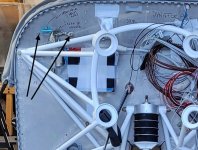
This is where I mounted mine and it caused no issues with the FWF. Once I had the holes drilled in the firewall I temporarily mounted the ground block and terminated the first couple wires. Then I removed it and clamped it to the panel frame. Made terminating the rest a lot easier and neat. The battery ground lug on the firewall is the larger bolt on left securing the ground block. I don’t have the access panels but it’s accessible through the glove box. If I ever have an issue I can unbolt it from the firewall and pull it out through the glove box.

20240703_194053.jpeg20240703_140411.jpeg20240512_174815.jpeg20241118_171057.jpeg
 
Since I'm on a roll with the dumb questions...

If I mount the ground block on the back side of the firewall under the passenger side upper forward fuselage access panel, what would be the preferred way to connect it to ground?

1- Run a second ground strap from the negative post of the battery FWF to the bolt that attaches the ground block to the firewall?
2- Run a second ground strap and attach it to the back side of the AN4-5A bolt that is used to attach the ground strap in the factory location?
3- Option 2 but run a wire instead of a ground strap?
4- ???

I definitely don't like option #1. Yes, I'm overthinking it and no, I don't know anything about electrical systems.

ground strap.png
 
Genuine Fast-on's (TE-AMP) are "OK", but the common retail versions really suck.
Good point about ring terminals vs. Fast-Ons Brian. I tried to find a grounding block that would accommodate ring terminals (dozens of them) but struck out. I am using TE-AMP Fast-Ons from Stein so at least I have that going for me...

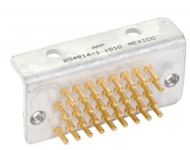
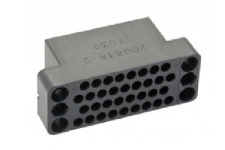
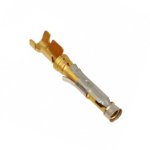
I did find this style but the pins they use look like Molex pins and there is no way I'm using them. D-Sub or Deutsch pins? Yeah. Molex style? No way.

Screenshot 2026-04-24 at 11.09.11 AM.png Screenshot 2026-04-24 at 11.10.02 AM.png
 
B,

The firewall, and the rest of the airframe frankly, is a great ground buss (low resistance, huge cross section for carrying DC current...) With that in mind, put the "forest of tabs" where it's the most convenient for serviceability, installation, repair, access -- think 3 years from now when you want to redo all your avionics :) And while were talking about it, don't make the ground wire(s) much longer than the corresponding supply (red) wires.

Good point about ring terminals vs. Fast-Ons Brian. I tried to find a grounding block that would accommodate ring terminals (dozens of them) but struck out. I am using TE-AMP Fast-Ons from Stein so at least I have that going for me...

I did find this style but the pins they use look like Molex pins and there is no way I'm using them. D-Sub or Deutsch pins? Yeah. Molex style? No way.

View attachment 115922 View attachment 115923
I made my own bar -- drilled, tapped, ring terminals, yadda yadda. Located it under and behind the radio rack ( this is where 95% of the grounds are) and then jumpered over to the firewall with a piece of 6ga wire. (same as the Alternator/Battery to primary buss feed)

The RV-7 is different as the firewall has a couple of "factory" locations for primary grounding -- center - high, right side of the recess, left ride low of the recess. The former is for the battery braid, the later is for the engine ground, or for the ginourmous concorde battery option.

And, see earlier comment(s) - there isn't much FWF that needs a ground -- unless you have SDS or other stuff. But even then, a ground wire connected to any point on the firewall is going to work very well. e.g. the Monkworkz MZ30L ground runs to the AN5 lug where the battery braid connects, Starter Relay suppression diode runs from the "S" terminal to the mounting lug for the relay, and the Car Horn relay connects to another lug used for the E-CAP ground on the firewall.

-- Break --

This got me thinking about the engine case ground; I recently fixed a friends RV-8 who had starting problems because the builder ran a dissimilar gauge wire from the sump case bolt to the right bottom motor bolt (bad...just bad...).

The fix was to run a 2GA M22759/16 wire from the LEFT case lug (above the bottom left motor mount boss), over to a point on the firewall, where one of the AA6-.063-3/4-3/4 stiffeners was located and then attached with AN4 hardware. The Left case lug is the same piece of aluminum that the starter motor and solenoid is mechanically and electrically attached to, and is the lowest resistance path to ground.

 
This got me thinking about the engine case ground; I recently fixed a friends RV-8 who had starting problems because the builder ran a dissimilar gauge wire from the sump case bolt to the right bottom motor bolt (bad...just bad...).

The fix was to run a 2GA M22759/16 wire from the LEFT case lug (above the bottom left motor mount boss), over to a point on the firewall, where one of the AA6-.063-3/4-3/4 stiffeners was located and then attached with AN4 hardware. The Left case lug is the same piece of aluminum that the starter motor and solenoid is mechanically and electrically attached to, and is the lowest resistance path to ground.

I use the nice, big ground lug on the starter as engine ground, not a bolt on the engine case. I use #2 welding wire for this ground, as well as power to the starter.

Carl
 
Good point about ring terminals vs. Fast-Ons Brian. I tried to find a grounding block that would accommodate ring terminals (dozens of them) but struck out. I am using TE-AMP Fast-Ons from Stein so at least I have that going for me...
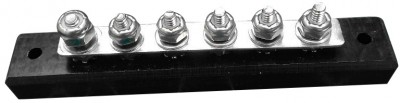
I've used these a couple of times: https://www.aircraftspruce.com/catalog/elpages/spt-termblock.php

11-13347.jpg


They're compact and work great. You can install 4 terminals per screw.

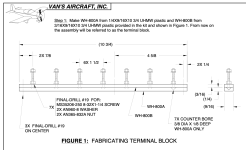
Van's also used to provide instructions on creating a ground bar. Not sure why they stopped. This is from the RV10 OP-37. The WH-800A/B parts are still available. You'll also need to add the copper bar itself (not shown for some reason).

1777058576035.png
 
I've used these a couple of times: https://www.aircraftspruce.com/catalog/elpages/spt-termblock.php

11-13347.jpg


They're compact and work great. You can install 4 terminals per screw.

Van's also used to provide instructions on creating a ground bar. Not sure why they stopped. This is from the RV10 OP-37. The WH-800A/B parts are still available. You'll also need to add the copper bar itself (not shown for some reason).

View attachment 115930
Actually an insulated terminal block for power according the old 6 drawings. However, you certainly could make it into a ground block as you suggest.
 
Actually an insulated terminal block for power according the old 6 drawings. However, you certainly could make it into a ground block as you suggest.
Ha so it is. I never really looked at the routing of the wires to the panel. Only the two end holes are used for ground studs in OP-37.

If I were going to use it I'd change the spacing to be 1/2" and add a copper bar and end up with something like the SPT bar with a few more studs on it.
 
Good point about ring terminals vs. Fast-Ons Brian. I tried to find a grounding block that would accommodate ring terminals (dozens of them) but struck out. I am using TE-AMP Fast-Ons from Stein so at least I have that going for me...

I did find this style but the pins they use look like Molex pins and there is no way I'm using them. D-Sub or Deutsch pins? Yeah. Molex style? No way.

View attachment 115922 View attachment 115923
I used this style grounding block when I re-did the panel in my -6. The pins are not Molex, they are a nice gold socket with a nickel retainer that are much more secure than a Molex connector. They do require a double crimp (crimp the conductor, then the jacket) but are very easy to work with if you have the correct crimper. It makes adding grounds very easy, as once the wire is terminated you can just insert it into the back of the connector and it snaps into place without having to remove the connector from the ground block.

66100-9.jpg
 
I use the nice, big ground lug on the starter as engine ground, not a bolt on the engine case. I use #2 welding wire for this ground, as well as power to the starter.

Carl
do you mean just one of the spare “ears” on the starter? Where do you run it back to?
 
do you mean just one of the spare “ears” on the starter? Where do you run it back to?
On the starters I’m familiar with there is a bolt on the starter for ground. If not, then you could use the starter mounting bolt.

The #2 welding cable ground goes under the big bolt on the forest of tabs. The tabs are on the cabin side of the firewall, the bolt goes through the firewall. I mount my batteries aft of the firewall but that makes no difference in all this.

Carl
 
On the starters I’m familiar with there is a bolt on the starter for ground. If not, then you could use the starter mounting bolt.

The #2 welding cable ground goes under the big bolt on the forest of tabs. The tabs are on the cabin side of the firewall, the bolt goes through the firewall. I mount my batteries aft of the firewall but that makes no difference in all this.

Carl
The starter I purchased seems not to have a ground lug at all. I was planning a welding cable from the back of the accessory case to the negative terminal on one of the batteries.
 

Attachments

  • IMG_2244.jpeg
    IMG_2244.jpeg
    89.2 KB · Views: 8
  • IMG_2245.jpeg
    IMG_2245.jpeg
    130.9 KB · Views: 8
Since I'm on a roll with the dumb questions...

If I mount the ground block on the back side of the firewall under the passenger side upper forward fuselage access panel, what would be the preferred way to connect it to ground?

1- Run a second ground strap from the negative post of the battery FWF to the bolt that attaches the ground block to the firewall?
2- Run a second ground strap and attach it to the back side of the AN4-5A bolt that is used to attach the ground strap in the factory location?
3- Option 2 but run a wire instead of a ground strap?
4- ???

I definitely don't like option #1. Yes, I'm overthinking it and no, I don't know anything about electrical systems.

View attachment 115921
Here’s my setup. The cable is bolted to a brass pass through stud at the stock battery ground nutplate at the firewall. The other end of the cable is connected to the bolt on the front side of a 48 forest of tabs mounted on the cockpit side of the instrument subpanel in front of the copilot.
 

Attachments

  • IMG_2524.jpeg
    IMG_2524.jpeg
    2.4 MB · Views: 38
Here’s my setup. The cable is bolted to a brass pass through stud at the stock battery ground nutplate at the firewall. The other end of the cable is connected to the bolt on the front side of a 48 forest of tabs mounted on the cockpit side of the instrument subpanel in front of the copilot.
What does that wire do that all that aluminum structure doesn’t?
I am at this stage myself and just can’t see that it has any benefit.
 
What does that wire do that all that aluminum structure doesn’t?
I am at this stage myself and just can’t see that it has any benefit.
It's one of the options recommended in Aircraft Wiring Guide. For the cost of a couple of feet of 8GA wire, reducing ground path resistance by a few milliohms on instrumentation and avionics seemed worthwhile.
 
Here’s my setup. The cable is bolted to a brass pass through stud at the stock battery ground nutplate at the firewall. The other end of the cable is connected to the bolt on the front side of a 48 forest of tabs mounted on the cockpit side of the instrument subpanel in front of the copilot.
I assume you're using the back of the bolt sticking through the nutplate? I have done the same temporarily, but wondered if this was a good long-term solution. I'm honestly not sure. I understand the nutplate could be removed, if needed, and just a bolt used there.
 
I assume you're using the back of the bolt sticking through the nutplate? I have done the same temporarily, but wondered if this was a good long-term solution. I'm honestly not sure. I understand the nutplate could be removed, if needed, and just a bolt used there.
Basically. I cut the head off a brass bolt to make it into a stud with one half in front of the firewall and one half behind.
 
Back
Top