Van's Air Force

The definitive Van's Aircraft support community! Buying, building or flying an RV? Join our exclusive family of mentors and enthusiasts!

Roll (and Pitch) Oscillation - 1 minute Period

N890GF

Well Known Member
Patron
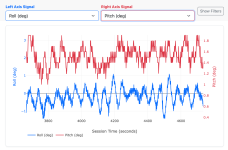
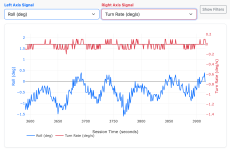
I went on a long cross country yesterday and spent most of the flight on autopilot at 8500ft MSL. I have a Dynon Skyview HDX with dual axis autopilot and I seem to be experiencing a slow oscillation in roll primarily and but it also seems to be in pitch at the same frequency. The amplitude of the roll oscillation is from about +1 to -1 deg with some variability. The pitch oscillation is from +1.8 to +1.2 deg (see the screenshot).

I flew the first leg of my trip with the default gains and sensitivities from Dynon. however on the return leg I increased the sensitivity and the roll gain to see if it would stop the slow oscillations but it did not. I did not touch any of the other settings (including cross track gains). I've confirmed my control system is tight with no slop in the controls at all. One thing to note is that I do have the spring bias electric roll trim installed, but it is set to neutral at the moment as it flies straight hands off.

My question to the hive mind is what might be the best thing to adjust and in which direction? I've read the Dynon inflight tuning guide, but i don't see any guidance on this particular error correction.
 

Attachments

  • Screenshot 2026-04-19 at 6.52.29 PM.png
    Screenshot 2026-04-19 at 6.52.29 PM.png
    163.5 KB · Views: 39
  • Screenshot 2026-04-19 at 6.54.51 PM.png
    Screenshot 2026-04-19 at 6.54.51 PM.png
    149.9 KB · Views: 40
If i am reading that right, the peaks are about 50 seconds apart. To me , your gains are too low; what they call lazy. When they are lazy, slowly drifting back and forth across the target, gains are too low. When they are twitchy, quickly correcting, then overshooting then correcting back, the gains are too high. You are looking for the goldylocks spot between those two.
 
One other thing I noticed was a much small amplitude oscillation in roll that was about half a hertz. The control column was moving slightly and I could see the ailerons moving as well. So it’s like there’s a higher frequency gain issue as well as the slower oscillation. The problem is that I don’t think the data captured it because the recording frequency is only 1hz. I didn’t capture the moment with the blackbox logs which are 16hz. I’m hoping to replicate it soon and capture the logs specifically
 
Dynon publishes the correct procedure in the Dynon Autopilot Tuning Guide. It is a free download on their site. Do the steps...in order. They strongly recommend following the guide procedure for best results. My experience with several systems backs this up.
 
Dynon publishes the correct procedure in the Dynon Autopilot Tuning Guide. It is a free download on their site. Do the steps...in order. They strongly recommend following the guide procedure for best results. My experience with several systems backs this up.
Yup, I've got the tuning guide and used it to get to what i'm at today. The challenge in my mind was that this low frequency oscillation is essentially imperceptible in flight, and I only noticed it after looking at the data logs. I will definitely go back and retune the XTE gains
 
Yup, I've got the tuning guide and used it to get to what i'm at today. The challenge in my mind was that this low frequency oscillation is essentially imperceptible in flight, and I only noticed it after looking at the data logs. I will definitely go back and retune the XTE gains
First off let me say that I'm certainly not an expert in this area. However, some low level oscillation is probably to be expected. The question is more about the magnitude of the oscillation. Generically speaking there is certainly some amount error before a correction will be made. The question is probably more about whether you have minimized this wander. Most feedback loops integrate (average) the error over time and as the error gets large enough a correction will be made. Again I'm speaking generically. No idea how this specific system works. I would just try adjusting the parameters a little bit at a time in one direction and then look at the results. If they are improving keep going. If it is getting worse then try the other direction. Look for minimums.

I took a look at the Dynon guide and it certainly isn't all that helpful.
 
I have less experience with this particular system than others, but I have a fair amount of insight into certified autopilot applications... I can tell you that an imperceptible +/- 1º oscillation with a 60-second period is so far from the "fail" threshold for certification that it wouldn't even be brought up in meetings.
 
I have less experience with this particular system than others, but I have a fair amount of insight into certified autopilot applications... I can tell you that an imperceptible +/- 1º oscillation with a 60-second period is so far from the "fail" threshold for certification that it wouldn't even be brought up in meetings.

Yeah I agree, but my aerospace engineering brain wants to understand it and improve it 🙂
 
Seems pretty good to me. These are the signal to the servo not the actual position. The rate of turn, is oscillating back and fourth one LSB. My RV8 has a phugoid period near 1 minute. The control system is going to see that and correct for it.
 
Last edited:
Any chance you were in some aerodynamic wave that made this a real reaction to outside conditions?
 
Any chance you were in some aerodynamic wave that made this a real reaction to outside conditions?

I don’t think so. It was 60 miles of smooth air at 8500. It’s definitely a tuning or mechanical issue in the plane. Once the weather clears I’m going to test again
 
I have less experience with this particular system than others, but I have a fair amount of insight into certified autopilot applications... I can tell you that an imperceptible +/- 1º oscillation with a 60-second period is so far from the "fail" threshold for certification that it wouldn't even be brought up in meetings.
^this

I’m afraid you’re over thinking this one George. That said, nothing wrong with thinking and tinkering, I just doubt you’ll see much practical improvement.
 
May have missed it but is this something new to the AP that has previously performed better or is this an effort to achieve a more stable AP response initially. I would agree with earlier replys that the gain may be set to low. Not a Dynon but I found on a Trio Pilot that the static pressure stability is extremely important to the AP pitch stability. I temporarily let the static just read from the fuselage ( in an RV9) and it was impossible to get stable pitch. Once hooked up the the outside static ports the stability was solid. Bottom line is that ANY leak in static might be your issue if at first, gain just doesn't settle it out. Just FYI.
 
First off let me say that I'm certainly not an expert in this area. However, some low level oscillation is probably to be expected. The question is more about the magnitude of the oscillation. Generically speaking there is certainly some amount error before a correction will be made. The question is probably more about whether you have minimized this wander. Most feedback loops integrate (average) the error over time and as the error gets large enough a correction will be made. Again I'm speaking generically. No idea how this specific system works. I would just try adjusting the parameters a little bit at a time in one direction and then look at the results. If they are improving keep going. If it is getting worse then try the other direction. Look for minimums.

I took a look at the Dynon guide and it certainly isn't all that helpful.
I was just thinking about this a little more. If you increase the gain a little you may just see the frequency of the oscillation increase a little (due to the faster integration time based on the fixed sampling rate) and the magnitude not really change. If that turns out to be the case then you will be within the minimum adjustment range. At that point you will have to decide what you think is better a slower oscillation or a faster oscillation. The average error still being the same. If the magnitude changes then that is a different story.
 
What are we looking at in those plots exactly? Is that the servo input?
Seems like we need an output plot in Cross track/altitude error

What are
 
What are we looking at in those plots exactly? Is that the servo input?
Seems like we need an output plot in Cross track/altitude error

What are
It’s the Dynon recorded roll and pitch values, and turn rate, although that’s less useful in this context it seems. Cross track error data is not high enough resolution. I think it’s in nautical miles. I did plot the path, and when scrubbing through the flight, it seems like the flight path was oscillating back and forth
 
I don’t think so. It was 60 miles of smooth air at 8500. It’s definitely a tuning or mechanical issue in the plane. Once the weather clears I’m going to test again

Wave is smooth. We’ve been misled to thinking otherwise. Rotors are bumpy, entering and exiting wave is bumpy, but surfing the wave itself is smooth. You’re probably right to be able to discount outside environmental concerns as you observed them, we didn’t, merely putting this in to clear a misconception regarding wave.

What are we looking at in those plots exactly? Is that the servo input?
Seems like we need an output plot in Cross track/altitude error

What are

And speed. What might have been altitude error could be getting put into speed.

Though I am in the @clarenceoveur and @mburch camp. Lotta diminishing returns with chance at being counterproductive.
 
Back
Top