


Van's Air Force
You are using an out of date browser. It may not display this or other websites correctly.
You should upgrade or use an alternative browser.
You should upgrade or use an alternative browser.
Wheel camber
- Thread starter JohnStirling
- Start date

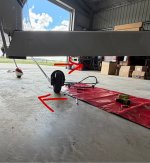
Cool! Thanks.  I thought that might be the case.
Is there a scientific reason for this?
I thought that might be the case.Is there a scientific reason for this?
Only if you call flying a 'science'Cool! Thanks.
Is there a scientific reason for this?


Construction Manual section 10.When the weight of the airplane is off the gear, the wheels naturally camber inward.
Sadly - I am not a builder - but thanks - I will take a lookConstruction Manual section 10.

John, I wouldn't sweat it. And I'm not sure if you'll find the answer you want in the construction manual. On a taildragger, the gear leg is match drilled to the engine mount at the factory, so there's really not a whole lot you can do to change the geometry. I haven't worked on the nose dragger gear, so I can only speculate. But I'm doubtful that it can easily be changed on the -A models as well. Some owners will periodically rotate the tires on the wheels as needed to even out wear (inboard becomes outboard side), so that's a viable option for you.
Right, it seems to be a common theme with Van's: once they drill the hole for you, or you drill the hole yourself, well, that's it. There is no adjustment. On the 7A, the main wheel strut towers and the struts themselves are already drilled. You ream them to final size, but don't really affect the geometry. You just hope that the hardware has been produced to the tolerances that are needed: caster, camber, toe-in/toe-out they are all non-adjustable and set by the production process of the factory.
Another area that comes to mind is the aft wing spar hole. We set the wings for incidence and fore/aft sweep and of course edge distance. Then you drill the hole, hope that it is square, and the wing is set - no adjustment. If that hole is mis-drilled, how in the world would you fix it?
Well, that is the nature of our world of Experimental/Home Built.
Cheers and Blue Skies!
Another area that comes to mind is the aft wing spar hole. We set the wings for incidence and fore/aft sweep and of course edge distance. Then you drill the hole, hope that it is square, and the wing is set - no adjustment. If that hole is mis-drilled, how in the world would you fix it?
Well, that is the nature of our world of Experimental/Home Built.
Cheers and Blue Skies!
Lots of ways to fix misalignment. I watched a artist with a MIG weld the gear socket holes on a 6A main gear, the holes were then redrilled for proper alignment. On a taildragger it mis possible to weld a "patch" over the holes in the socket. The patch is predrilled and thje gear leg is jigged in place so it can't move.Right, it seems to be a common theme with Van's: once they drill the hole for you, or you drill the hole yourself, well, that's it. There is no adjustment. On the 7A, the main wheel strut towers and the struts themselves are already drilled. You ream them to final size, but don't really affect the geometry. You just hope that the hardware has been produced to the tolerances that are needed: caster, camber, toe-in/toe-out they are all non-adjustable and set by the production process of the factory.
Another area that comes to mind is the aft wing spar hole. We set the wings for incidence and fore/aft sweep and of course edge distance. Then you drill the hole, hope that it is square, and the wing is set - no adjustment. If that hole is mis-drilled, how in the world would you fix it?
Well, that is the nature of our world of Experimental/Home Built.
Cheers and Blue Skies!
some small tack welds with the gear in place, then remove the gear for finish welding. Difficul to do with mount in place but it can be done. Reaming for a taper pin is another option.
depenmding o0n amount of misalignment the holes can be oversized for a oversize AN5 bolt or even an AN6 bolt.
Cool! Thanks.
Is there a scientific reason for this?
Load the aircraft to gross weight and check the camber. It’ll probably be much closer to zero. The gear flexes with load, and at light weights, you’ll have negative camber where the tire leans outward. With more weight, the gear will flex to a more neutral position.
