


Van's Air Force

The definitive Van's Aircraft support community! Buying, building or flying an RV? Join our exclusive family of mentors and enthusiasts!

Nosegear play

tom_AZ

Well Known Member
Patron
Posting in the -10 forum, because that's what I have, but I don't know the gear design of other -A models, so my question may be more broadly applicable.

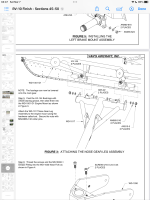
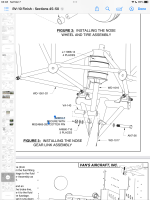
My annual C.I. was just completed. During that inspection, with the nosewheel elevated, there was some noticeable play when re-mounting the nosewheel following a tire change, break-out force test, etc... I'm attaching two screenshots from the KAI, showing the relevant areas. The play is at the bushings, p/ns VA-143 and VA-144. The amount play at the bushings themselves is relatively small, but detectable when force is applied to the strut. Given the length of the nose strut, that translates to roughly 1/4" of play at the end of the strut. This has not been noticed before, but that may not mean it wasn't there. With weight on the nosewheel, it of course can't be detected. Time to order new bushings, or is this normal?
IMG_0354.PNGIMG_0355.PNG
 
Tom, mine is worn (1300 hours) to a similar degree as yours, and based on posts here on VAF, I think it is common. I will try new bushings, but it is possible that the ears or the engine mount are worn. Are you familiar with Service Bulleting 19-09-09? Van's has an improved nose gear available, for a price. And, I recall reading that Vans also has a redesigned engine mount for the RV-10, though that information doesn't seem to be published anywhere.
 
Tom, mine is worn (1300 hours) to a similar degree as yours, and based on posts here on VAF, I think it is common. I will try new bushings, but it is possible that the ears or the engine mount are worn. Are you familiar with Service Bulleting 19-09-09? Van's has an improved nose gear available, for a price. And, I recall reading that Vans also has a redesigned engine mount for the RV-10, though that information doesn't seem to be published anywhere.
Thanks very much. The slop seems to be at the bushings, as best I can tell. Yes, I am familiar with the SB, and comply with it each year.

You mention that you have 1300 hours on your airframe. Have you noticed this progressing, e.g. confident it wasn’t there initially?
 
Thanks very much. The slop seems to be at the bushings, as best I can tell. Yes, I am familiar with the SB, and comply with it each year.

You mention that you have 1300 hours on your airframe. Have you noticed this progressing, e.g. confident it wasn’t there initially?
Do you grease them regularly?
 
Scott (Rockitdoc), 14A, posted about that very thing a while back. We found play in mine too. Both less tha 20 hours each. I contacted Vans. Mine is a 7A Elastomeric. The only solution they offered was new bushings and they had no engineering time available to research further. I really felt it was something every Elastomeric owner should check. Fast forward, Scott retorqued his and eliminated most of the play. Mine turned out to be play in the pad adjustment. No play in the bushings. However, I still feel this should have garnered more attention from Vans. They didn't seem concerned.
 
I have/had a similar problem on my elastomer nose gear 7a. About the same amount of play when the nose gear is lifted off the ground as the poster noted. Two problems noted. One the powder coat on the bushing holder was preventing the bushing from doing its job. The clamping pressure was on the powder coat not on the sides of the bushing. Once I sanded off the powder coat, it reduced the movement some. I then measured the outer diameter of the bushing. It was undersized by what seems like quite a bit. I ordered a new bushing but have not had a chance to install it yet. Is it a big deal that under no load the nose gear has some play in it? Not sure
 
This thread got me thinking... the 14A has a similar setup. What's a good interval to regrease these bushings? It's not currently on our annual checklist and maybe that's a mistake?
 
This thread got me thinking... the 14A has a similar setup. What's a good interval to regrease these bushings? It's not currently on our annual checklist and maybe that's a mistake?
My 10 has 450 hours. I recently had to remove those bushings to drop the center arm to install a shim. There was still grease in my bushings, so it should last. However, it will dry out if you don't get some oil in there every year to re-hydrate the grease. I do that at CI.
 
Thanks all. Responding to multiple posts...

Larry--No, I don't grease them regularly (that's code for "at all"). Doing so would basically seem to require dropping the nose gear. I don't have that on my C.I. checklist, haven't seen it on any others that I've perused, and have never had an A&P (I think I've used 5 different ones since purchasing the plane to re-look at what I've done, conduct the formal inspection, perform any additional actions needed and sign-off the C.I.) suggest doing so. Granted, that doesn't mean that it shouldn't be there... I also see your second post where you hit those areas with oil. That's certainly easy enough.

I haven't disassembled the bushing areas to look at whether it's really a bushing issue or lug issue. The latter does seem more likely, but I don't know which, or perhaps both, may be playing a role in my case. If it's the lug, am I left with replacing the nose strut and motor mount as the only solution or might enlarged holes be reamed and an additional bushing pressed into place (or perhaps reaming out both the lug and bushing, then using a larger bolt)?

I see comments about torque. I don't typically think of torquing down cotter-pinned castellated nuts, in part given the need to align castellations with the bolt hole. What torque do you target? I also see the comment about powder coating on the bushing holder potentially inhibiting contact with the bushing itself. Interesting--I wasn't thinking that getting clamping pressure on the bushing was an objective. Certainly not obvious from the KAI. I have no idea how resistant to turning the bolt heads may be, but I may find out later today...

Andy--thanks for the link to the related post. I had not seen that.
 
I see comments about torque. I don't typically think of torquing down cotter-pinned castellated nuts, in part given the need to align castellations with the bolt hole. What torque do you target?
Torquing these down is impoortant. You need the bushing to remain securely affixed so that the gear leg assy rotates about it. If you let the bushing rotate, you will get major wear at the bushing ID / bolt area. The castelated nut is NOT 0there because the bolt rotates! Not sure why they use them there, as this is a bearing application; Maybe belt and suspenders.
 
Back
Top
