Van's Air Force

The definitive Van's Aircraft support community! Buying, building or flying an RV? Join our exclusive family of mentors and enthusiasts!

Experimental Engines Based on Lycoming -- Airworthiness Directives and Service Bulletins

jherzog

Well Known Member
Sponsor
MY RV has an IO-320-D2A engine built by Aero Sport Power ("ASP"), with a manufacture date of 9/21/2006. A few questions:

1. Am I correct in my understanding that FAA ADs only apply to Lycoming-built engines, and do not apply to my Lycoming-based experimental engine built by ASP?

2. Even if Lycoming ADs don't apply to my ASP engine, it would seem prudent to at least review and investigate Lycoming ADs for IO-320 engines that apply my engine's manufacture date. Is that what other owners of Lycoming-based experimental engines do?

3. I cannot find any service bulletins or the like on ASP's website, and they have not responded to my emails. Is there any repository of ASP service bulletins out there?
 
I believe you are asking if the Lycoming AD's apply to experimentals. I'm happy to sign off experimental airframes after service bulletin compliance, but the Lycoming AD's are still high up on my personal comfort level. Legally I don't know but an "incident" would be big pucker factor
 
Rather than give you my opinion, I’ll just end you to a reference…..

EAA has a pretty good write-up on what A&P’s (who are used to working on certified aircraft) should know about E-AB’s here:


If you scroll down to near the bottom, you’ll find this paragraph:

  • ADs. Airworthiness directives continue to be a point of contention for experimental aircraft owners. Because of the fundamental freedoms associated with building and operating in this category, no one wants additional regulation. The FAA document AC 39-7D, Airworthiness Directives, reads, “ADs only apply to type-certificated aircraft, including ADs issued for an engine, propeller, and appliance.” But because ADs are issued to correct an unsafe condition in an aircraft, aircraft engine, propeller, or appliance, my recommendation is to comply with all ADs. My reasoning, and the reasoning you can use with the owner, is that the aircraft, whether experimental or not, should be “in a condition for safe operation.”
 
Most will say "no, they don't apply" , however, there is a conflict when reading AC39-7D. There is language in the document that relates to AD compliance on TC'd aircraft, and also some AD's with include non-TC'd aircraft specifically named. Its worthwhile to read this document before making an across the board statement. As an AP/IA, I inspect certified and experimental, and as mentioned above, have a comfort level issues with engine related AD's especially if they are called out as stated in AC39-7D..always interested to hear other AP/IA thoughts on this.
 

Attachments

ADs. Airworthiness directives continue to be a point of contention for experimental aircraft owners. Because of the fundamental freedoms associated with building and operating in this category, no one wants additional regulation. The FAA document AC 39-7D, Airworthiness Directives, reads, “ADs only apply to type-certificated aircraft, including ADs issued for an engine, propeller, and appliance.” But because ADs are issued to correct an unsafe condition in an aircraft, aircraft engine, propeller, or appliance, my recommendation is to comply with all ADs. My reasoning, and the reasoning you can use with the owner, is that the aircraft, whether experimental or not, should be “in a condition for safe operation.”
That quote is very wrong, and worse than just taken out of context. It's only the last half the sentence, and cutting off the first half completely flips the entire meaning.

The full sentence is
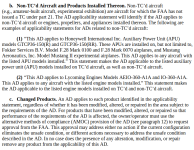
"Unless stated otherwise (see subparagraph 9b of this AC), ADs only apply to type-certificated (TC) aircraft, including ADs issued for an engine, propeller, and appliance."

In other words, the FAA is clearly reserving the right to write ADs that apply to experimental aircraft. They even proceed to write example ADs below to show how they would theoretically write ADs for experimentals. They even specify that you can't skip an AD just because you made mods to the related equipment.

I don't know how many ADs are out there that are actually applicable to Experimentals, but the language itself is clear, and they do exist. For example, one of the infamous hartzell prop ADs specifically lists the Vans RV6, RV7, and RV8 in the applicability section: https://www.govinfo.gov/content/pkg/FR-2009-10-27/pdf/E9-25290.pdf

Screenshot from 2026-03-05 13-57-58.png
 
Last edited:
Can anyone better answer the OPs first and third question?
I'm curious as a now defunct Mattituck engine owner.
 
I’ll leave the word play and reg interpretation to others.
You can look at the log book ASP supplied and its list of engine components used for the build. You can see if you have affected parts.
My ASP is ok by date but the 0-320 in the Bucker fell smack in the middle and has those bushings. I am complying through filter and screen inspections. So far, so good…. The Bucker is Experimental Exhibition but the engine is certified. Regardless, I check all AD’s and comply with them.
 
Can anyone better answer the OPs first and third question?
I'm curious as a now defunct Mattituck engine owner.

This AD says it applies to Superior, Lycoming, and Continental IO-360 series engines.
Hard to say how this would apply to Mattituck or ASP, neither of them are listed as options to search for as the manufacturer in the FAA database. It seems to me that they are not really engine manufacturers. They are modifying and "building" engines with parts manufactured by other companies.

However, per part (C) of my earlier screenshot above, just because it's been modified into a stroker IO-370 doesn't mean you no longer have to comply with the relevant ADs.

I think in reality it's a little fuzzy how this gets applied. Vague regulations make it easier for them to prosecute whoever they want.
 
Last edited:
Can anyone better answer the OPs first and third question?
I'm curious as a now defunct Mattituck engine owner.
Question 1: the AD will provide a list of applicable engines, model AND serial number. If the AD only applies to a specific builder it will say so. They are very specific.
Questions 3: if the engine builder has not listed service bulletins for your engine you adhere to the FAA AD that applies to your engine.
Edit: remember this, any "grey" areas can be used against you if there is an "incident".. FAA and insurance companies come to mind
 
It depends. If the clone is using parts that can legally be used for use on certified engines, and those parts are inclusive in the AD, then the AD might oughta be complied with (although technically it may not be legal requirement). You gotta ask your engine manufacturer/builder about that.

I had to deal with this issue when I bought a Superior XPIO-360. The cranshaft installed in it was a PMA part, even though the engine was experimental. That particular cranshaft's serial number fell within the range of serial numbers named in the AD. I decided out of an abundance of caution to comply.
 
Last edited:
Here's another article which seems wrong: https://www.kitplanes.com/ask-the-dar-29/
"The only thing that is truly mandatory is an airworthiness directive. And an airworthiness directive cannot be issued against an amateur-built aircraft."
...
"ADs may be directed to certain components of amateur-built aircraft, just not the aircraft itself."

Seems like the DAR is technically wrong but practically correct. Probably the FAA never has issued an AD against an experimental itself but AC39-7D clearly reserves the right to do so.

Question 1: the AD will provide a list of applicable engines, model AND serial number. If the AD only applies to a specific builder it will say so. They are very specific.
No it does not always specify serial number. See the AD I linked above already where it does not: https://drs.faa.gov/browse/excelExternalWindow/9ABB90815ACE4DEF86257547005DCD89.0001

Questions 3: if the engine builder has not listed service bulletins for your engine you adhere to the FAA AD that applies to your engine
ADs are not service bulletins. Service Bulletins are issued by manufacturers and are not mandatory unless the FAA issues an AD making them mandatory.

Here's a service bulletin issued by Lycoming which specifically calls out that the applicable parts could be installed in engines "assembled" by ASP or Mattituck:

It depends. If the clone is using parts PMA's for use on certified engines, then the AD might oughta be complied with (although technically it may not be legal requirement). You gotta ask your engine manufacturer/builder about that.

I had to deal with this issue when I bought a Superior XPIO-360. The cranshaft installed in it was a PMA part, even though the engine was experimental. That particular cranshaft's serial number fell within the range of serial numbers named in the AD. I decided out of an abundance of caution to comply.
When I look at ADs that apply to superior in the FAA AD search, I don't see any XIO configurations listed, so I think they do not legally apply anymore (but obviously would still be prudent).
 
Last edited:
When I look at ADs that apply to superior in the FAA AD search, I don't see any XIO configurations listed, so I think they do not legally apply anymore (but obviously would still be prudent).

The XPs were purpose built experimental engines. But I believe almost all of the parts are PMA's for Lycoming and Superior Certified.
 
Give AeroSport a call. Supply your engine serial number & they can pull that engine file & advise if you have any AD exposure.
They have used Lycoming, ECI, & Superior engine parts in builds depending on what was available at the time or what you specified in the build.
 
MY RV has an IO-320-D2A engine built by Aero Sport Power ("ASP"), with a manufacture date of 9/21/2006. A few questions:

1. Am I correct in my understanding that FAA ADs only apply to Lycoming-built engines, and do not apply to my Lycoming-based experimental engine built by ASP?

2. Even if Lycoming ADs don't apply to my ASP engine, it would seem prudent to at least review and investigate Lycoming ADs for IO-320 engines that apply my engine's manufacture date. Is that what other owners of Lycoming-based experimental engines do?

3. I cannot find any service bulletins or the like on ASP's website, and they have not responded to my emails. Is there any repository of ASP service bulletins out there?
My O-320-D2A engine is an experimental build by Aero Sport Power in 2004 -- really good engines! I would read the AD over, and look for any affected component(s), which generally reference affected serial numbers and/or date codes that you can check on your engine. For example, Superior Millennium had a small batch of cylinders that were not properly heat treated and issued and AD, so I checked my cylinders serial numbers and found the AD didn't apply to my engine. I also check for any accessory AD or SB separately, which can generally be found on the manufacturers website.
 
Last edited:
Does anyone here think that your insurance underwriter might have a push back on a claim that could be construed as a result of noncompliance with an AD or an SB? Even though it’s an EAB? Do they have a leg to stand on? Maybe not, but do you really want to litigate against an insurance company……. that has more money than just about anyone?
 
Give AeroSport a call. Supply your engine serial number & they can pull that engine file & advise if you have any AD exposure.
They have used Lycoming, ECI, & Superior engine parts in builds depending on what was available at the time or what you specified in the build.
Complete parts lists of the build are in the original Log Book supplied with the engine.
 
It depends. If the clone is using parts that can legally be used for use on certified engines, and those parts are inclusive in the AD, then the AD might oughta be complied with (although technically it may not be legal requirement). You gotta ask your engine manufacturer/builder about that.

I had to deal with this issue when I bought a Superior XPIO-360. The cranshaft installed in it was a PMA part, even though the engine was experimental. That particular cranshaft's serial number fell within the range of serial numbers named in the AD. I decided out of an abundance of caution to comply.
I did the same. I'm not always alone when I fly and the safety of my passengers is as important as my own.
danny
 
I am sorry too jump on this so late. I'm searching for some clarity on the applicability of AD's in regards to a certificated engine installed on an experimental.

I read through AC39-7D and it's still not 100% clear.

Example:

"
9. APPLICABILITY OF ADs. Each AD contains an applicability statement specifying the

product (aircraft, aircraft engine, propeller, or appliance) to which it applies. Unless stated

otherwise (see subparagraph 9b of this AC), ADs only apply to type-certificated (TC) aircraft,

including ADs issued for an engine, propeller, and appliance.


Then as previously noted:

"
(2) “This AD applies to Lycoming Engines Models AEIO-360-A1A and IO-360-A1A.

This AD applies to any aircraft with the listed engine models installed.” This statement makes

the AD applicable to the listed engine models installed on TC’d and non-TC’d aircraft."


The reason this has become an issue for myself is in getting my operating limits amended for my aircraft so I can do the CI.
The FAA inspector is saying the I have to have all AD's complied with in order for them to issue the new operating limitations.

Does this sound correct?

Thanks
 
I am sorry too jump on this so late. I'm searching for some clarity on the applicability of AD's in regards to a certificated engine installed on an experimental.

I read through AC39-7D and it's still not 100% clear.

Example:

"
9. APPLICABILITY OF ADs. Each AD contains an applicability statement specifying the

product (aircraft, aircraft engine, propeller, or appliance) to which it applies. Unless stated

otherwise (see subparagraph 9b of this AC), ADs only apply to type-certificated (TC) aircraft,

including ADs issued for an engine, propeller, and appliance.


Then as previously noted:

"
(2) “This AD applies to Lycoming Engines Models AEIO-360-A1A and IO-360-A1A.

This AD applies to any aircraft with the listed engine models installed.” This statement makes

the AD applicable to the listed engine models installed on TC’d and non-TC’d aircraft."


The reason this has become an issue for myself is in getting my operating limits amended for my aircraft so I can do the CI.
The FAA inspector is saying the I have to have all AD's complied with in order for them to issue the new operating limitations.

Does this sound correct?

Thanks
The airworthiness directive itself trumps the advisory circular which is non regulatory. ACs are published by the FAA to help with reg interpretation and obviously they made an error in that one..
 
I am sorry too jump on this so late. I'm searching for some clarity on the applicability of AD's in regards to a certificated engine installed on an experimental.

I read through AC39-7D and it's still not 100% clear.

Example:

"
9. APPLICABILITY OF ADs. Each AD contains an applicability statement specifying the

product (aircraft, aircraft engine, propeller, or appliance) to which it applies. Unless stated

otherwise (see subparagraph 9b of this AC), ADs only apply to type-certificated (TC) aircraft,

including ADs issued for an engine, propeller, and appliance.


Then as previously noted:

"
(2) “This AD applies to Lycoming Engines Models AEIO-360-A1A and IO-360-A1A.

This AD applies to any aircraft with the listed engine models installed.” This statement makes

the AD applicable to the listed engine models installed on TC’d and non-TC’d aircraft."


The reason this has become an issue for myself is in getting my operating limits amended for my aircraft so I can do the CI.
The FAA inspector is saying the I have to have all AD's complied with in order for them to issue the new operating limitations.

Does this sound correct?

Thanks
Aren’t you overlooking the first part of the sentence that you extracted from the AC, and highlighted in Red below (and that I highlighted in your post above)?

"Unless stated otherwise (see subparagraph 9b of this AC), ADs only apply to type-certificated (TC) aircraft,
including ADs issued for an engine, propeller, and appliance."
And subparagraph 9b(2) from the AC shows the example you quoted in the second part of your post.
 
Last edited:
Yes:

Just trying to put together a plan to have a mechanic validate the AD's are complied with and get through the OP limits update.

V/R
 
Back
Top