Van's Air Force

The definitive Van's Aircraft support community! Buying, building or flying an RV? Join our exclusive family of mentors and enthusiasts!

Elevator pitch trim harness

gregsrv14

Active Member
Friend
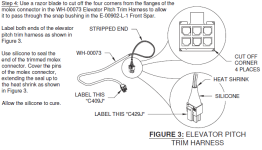
I am confused about these instructions on page 9-25 (RV-14):

It says to "Use silicone to seal the end of the trimmed molex connector" and to "Cover the pins of the molex connector". This must mean the backside of the connector, where the wires go into it. To keep out moisture, dust, etc.? But Molex connectors are not waterproof...

It also says "extending the seal up to the heat shrink as shown in Figure 3". In the inset, it looks like they're covering maybe 1" with silicone, which would make sense if it were the opposite end since there is about 7" from the connector to the heat shrink on the "stripped" end.

It's becoming very tempting to replace the Molex connectors with Deutsch connectors...


1771897876725.png1771901594743.png
 
I am confused about these instructions on page 9-25 (RV-14):

It says to "Use silicone to seal the end of the trimmed molex connector" and to "Cover the pins of the molex connector". This must mean the backside of the connector, where the wires go into it. To keep out moisture, dust, etc.? But Molex connectors are not waterproof...

It also says "extending the seal up to the heat shrink as shown in Figure 3". In the inset, it looks like they're covering maybe 1" with silicone, which would make sense if it were the opposite end since there is about 7" from the connector to the heat shrink on the "stripped" end.

It's becoming very tempting to replace the Molex connectors with Deutsch connectors...
Don't use the Molex connector for this application. Many have had issues. Use the DTM type Deutsch connector. It's a much better moisture resistant connector than trying to modify after the fact a Molex connector.
 
You could also very carefully drill out the “dividers”” in the molex connector and basically treat it like a snap bushing (of course you are only using the half that snaps into place) , and then just pass the wire through it. Make the connections with d-subs and shrink tubing and then secure. I did fill up the modified snap bushing with silicone to keep moisture from passing down through it. So far, I don’t see any issues doing it this way. I suppose it’s not quite as handy when it comes time to remove the trim servo but I’m hoping it won’t have to be done that often.
 
To answer your first question, yes, fill the topside with silicone to keep the majority of the water out. The stock micro-Molex here is of course the most convenient to use. So far (only 50 hours) I've not had trouble with it. However at the trim servo, where you have to assemble the micro-Molex connector yourself, I had a pin migrate out after just a few hours of flying. I replaced this connector with a mini-Molex (white). Still not an environmental connector, but easier to work with and not much bigger/heavier than the micro-Molex. I wanted to maintain the quick-connect vs a splice since the elevator and trim servo were going to be removed by the paint shop (where the plane is now).
 
Ok, I decided to go with Deutsch connectors. The wires from the Ray Allen actuator are 24AWG. Where do I get Deutsch connectors for 24 AWG wire?

What crimping tool or AFM8 positioner would I then need to use?
 
Yeah the mini is only a 20-22. You could bend over and twist the 24 gauge to get a better fit. For my Deutsch connection kits I went with the JR ready, and got all three positions (P20-DTM, P16-DT, P12-DTP) for their ST-2169 crimp tool.
 
As an FYI I kept the molex and minimolex that came with stock wiring harnesses and plan to only change out when/if needed. New stuff I've wired, I've done Deutsch connections. Not sure if that's the right move, but seemed like a decent path forward.
 
SteinAir sells a budget crimp tool for D-Sub machined contacts.

As mentioned in post 6 it’s fine to strip extra length of awg 24 and fold it over to crimp into a standard density D-Sub size 20 machined contact which is officially good for 20 to 22 awg.
2 x awg 24 is somewhere between awg 22 and awg 20 in terms or cross-sectional area.
IMO don’t twist the strands, at least not aggressively, YMMV.

 
Last edited:
Ok, I decided to go with Deutsch connectors. The wires from the Ray Allen actuator are 24AWG. Where do I get Deutsch connectors for 24 AWG wire?

What crimping tool or AFM8 positioner would I then need to use?
I was also concerned with the spec vs what was used (24 awg) I used the JR Ready squeezer and performed the following using 26 awg as worst case:

1) Strip the required ~ 1/4 in for the 26 awg and test
2) Strip as in 1 but tin and solder the stripped end:
3) Strip the required ~ 1/2 in and fold it back and squeeze and test

Article 1 above passed all 5 pull and tug tests so felt using the 24 awg from Ray Allen was safe. The Deutsch are really far superior connectors and almost bulletproof to mess up. Preferred not to use the tin and soldier method or the fold back method. Maybe others have tried these?
 
SteinAir sells a budget crimp tool for D-Sub machined contacts.

As mentioned in post 6 it’s fine to strip extra length of awg 24 and fold it over to crimp into a standard density D-Sub size 20 machined contact which is officially good for 20 to 22 awg.
2 x awg 24 is somewhere between awg 22 and awg 20 in terms or cross-sectional area.
IMO don’t twist the strands, YMMV.

Why not twist the strands?
 
Ok, I decided to go with Deutsch connectors. The wires from the Ray Allen actuator are 24AWG. Where do I get Deutsch connectors for 24 AWG wire?

What crimping tool or AFM8 positioner would I then need to use?

I've had success with a K1S positioner in an AFM8 to crimp machined DTM pins - at least the size 20 pins.
 
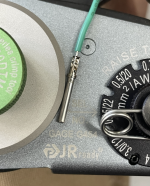
I had my Duetsch DTM tooling out today and decided to repeat the 26 awg experiment. Crimp and even after a hard pull stayed tight. FYI

Screenshot 2026-03-02 192404.png
 
Why not twist the strands?
I was imagining folks aggressively twisting and causing high points where strands overlap which seems intuitively to me not a good thing. Just my opinion, an opinion is what one has when they don’t have facts and data, hence YMMV.
 
I had my Duetsch DTM tooling out today and decided to repeat the 26 awg experiment. Crimp and even after a hard pull stayed tight. FYI

View attachment 111398
I had my Duetsch DTM tooling out today and decided to repeat the 26 awg experiment. Crimp and even after a hard pull stayed tight. FYI

View attachment 111398
You had said that you "Preferred not to use the tin and soldier method or the fold back method" - did you do either or both here?

Am I right to assume that you put a 26 AWG wire into a size 22 pin?
 
You had said that you "Preferred not to use the tin and soldier method or the fold back method" - did you do either or both here?

Am I right to assume that you put a 26 AWG wire into a size 22 pin?
I tested and both worked (pull test) but was not sure long term if ok so I went with the tried-and-true protocol.

Yes, the picture shows 26 awg wire in a size 20 pin. with the crimper in the 22 position. (This is a correction to clarify) Pulled test article and would not budge. I stripped the insulation a little further back than normal so I could see if I broke the wire or pulled it out of the pin. The 24 awg wire actually used also easily met the pull test with the same set-up.
 
Last edited:
Back
Top