Van's Air Force

The definitive Van's Aircraft support community! Buying, building or flying an RV? Join our exclusive family of mentors and enthusiasts!

Sudden EGT spike on all 4 cylinders

Jake14

Well Known Member
Patron
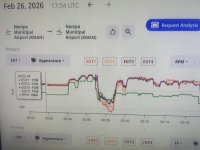
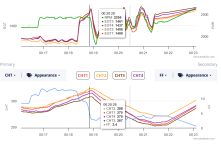
While doing light aerobatics (3-4G) at around 2400 RPM, full rich mixture, 5k altitude, I suddenly got a high EGT warning with all 4 cylinders above 1500 and some around 1580. No controls were moved just before or during the incident (at approx 18 min on the first graph). Never seen EGT's that high. Reducing RPM only helped slightly. EGTs were still mostly above 1400. Nursed it back to the airport and at very low power the EGT's came down, but when I tried a typical 1800RPM runup on the ground they still shot up over 1400. Shut down.
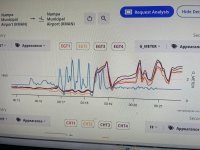
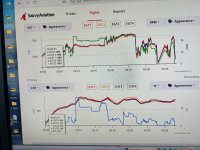
Tried a typical static (1800rpm) runup the next day (graph 2) Everything seemed ok, EGT's on a single mag around 1350. Decided to do a couple of laps around the pattern but tried a full power runup first. As soon as I pushed in the power (around 7 min), the engine sputtered and almost quit. I pulled the power and it kept running (roughtly) around 900 rpm Trying to increase power only resulted in sputtering and coughing. Managed to taxi back to the tie-down at 900rpm. Glad I didn't take off :-)
I'm thinking I've got a failed fuel servo which will only run the idle circuit, but the sequence of symptoms was a bit puzzling since the time from first indication (the high EGT's) to total failure took about 15 min tach time.
Plotted another graph of the incident vs. g-loading (graph 3) looks like the incident coincided with a pull-up.
 

Attachments

  • IMG_4971.jpeg
    IMG_4971.jpeg
    3.1 MB · Views: 69
  • IMG_4983.jpeg
    IMG_4983.jpeg
    3.5 MB · Views: 67
  • IMG_4978.jpeg
    IMG_4978.jpeg
    4.4 MB · Views: 67
You know you can share a link to particular flights in Savvy so people can directly view and analyze the data, right? 1772397676816.png
 
What was your fuel pressure? Did you turn on the boost pump during the event?
A mechanical fuel pump failure is my first guess or contaminant in the spider bouncing around.
Wild guess.
 
What was your fuel pressure? Did you turn on the boost pump during the event?
A mechanical fuel pump failure is my first guess or contaminant in the spider bouncing around.
Wild guess.
Gotta admit I didn't turn on the boost pump when it happened although I should have. I did the next day and it made no difference

Here's the links to the flight and the static runup the next day (Thanks RV7A !)

 
All 4 increasing simultaneously = Lean mixture. Look for sources of extra air (e.g. loose fuel servo?) or less fuel (e.g. clogged filter, faulty servo, etc.)
 
Gotta admit I didn't turn on the boost pump when it happened although I should have. I did the next day and it made no difference

Here's the links to the flight and the static runup the next day (Thanks RV7A !)

Just an observation but MP held steady and fuel flow went from 12.5 to 9.4 GPH during the event. A 25% decrease in fuel flow at the same MP and RPM looks like a leaning condition occurred. Why have no idea. Glad you are back on the ground.

Screenshot 2026-03-02 085113.pngScreenshot 2026-03-02 085140.png
 
No, but both tanks were sumped before the flight so I don't think it could be water contamination...
I would certainly try it on the other tank. I don't know your build configuration however if you have a flop tube it could have a issue or the pickup could be obstructed. The fact that this started when pulling G’s leads me to think something moved restricting fuel flow. It may or may not be unique to one tank.
 
Generally speaking, the most common cause for all 4 EGTs to rise 150-200* (typically high 1500's) is one mag or ign system stopped firing. Running on one plug greatly retards the advance and retarding raises egt and drops CHT marginally. twin plug engines don't like running on one plug, especially up near peak torque.

However, running on one ignition should not prevent full power application. Power will be down 10-20%, but should run fine, albeit slightlty rough. I think you are on the right track with the servo, but I would also look at the ignition. Also worth inspecting the spider, as some issues in there, such as piston sticking can cause leaning across all 4 cylinders.,
 
Last edited:
Generally speaking, the most common cause for all 4 EGTs to rise 150-200* (typically high 1500's) is one mag or ign system stopped firing. Running on one plug greatly retards the advance and retarding raises egt and drops CHT marginally.

However, running on one ignition should not prevent full power application. Power will be down 10-20%, but should run fine, albeit slightlty rough. I think you are on the right track with the servo, but I would also look at the ignition. Also worth inspecting the spider, as some issues in there, such as piston sticking can cause leaning across all 4 cylinders.,
Have you ever determined your peak EGT at high power? Lets say your peak is 1500 on the highest cylinder while operating at 2500 RPM. Then lets say during this event you recorded highest EGT at 1550. That tells you that the problem was NOT a fuel issue. Leaning will raise EGTs to the peak, then go down. This would point you towards ignition as the problem.
 
Have you ever determined your peak EGT at high power? Lets say your peak is 1500 on the highest cylinder while operating at 2500 RPM. Then lets say during this event you recorded highest EGT at 1550. That tells you that the problem was NOT a fuel issue. Leaning will raise EGTs to the peak, then go down. This would point you towards ignition as the problem.
I do remember switching mags after it happened, with no change in EGT's. The fact that the following day the 1800 rpm run-ups and mag check worked ok, but when I tried to apply full power it sputtered and wouldn't run seemed to rule out ignition issues. The engine will still run (roughly) at low rpm (~900) so maybe the servo idle circuit is ok but the higher power functionality is toast?

Since it happened on a pull-up, does anyone know if applying 3-4 g's to the spider would move the piston (if the spring were broken) in the lean or rich direction?

I'm about ready to order a new servo (3.8k)

Thanks for all the advice :-)
 
I'm about ready to order a new servo (3.8k)
What servo is it? How many hours? How many years in operation?

Don at AFP can rebuild the servo and spider but I would exhaust all possibilities before doing that unless it is due anyway. TBO or 12 years for a Silverhawk, as an example.

No need to buy a new servo.
 
What servo is it? How many hours? How many years in operation?

Don at AFP can rebuild the servo and spider but I would exhaust all possibilities before doing that unless it is due anyway. TBO or 12 years for a Silverhawk, as an example.

No need to buy a new servo.

oops, already did it..AvStar (1200 TBO) with 9years/1000hrs SNEW. I figured it was pretty close to needing a rebuild anyway and the replacement is a drop-in and they include the spider and 4 injectors. But I guess you're right, I could have saved some money getting it rebuilt.
Just wondering if aerobatics would shorten the TBO, I usually do some every flight.
 
oops, already did it..AvStar (1200 TBO) with 9years/1000hrs SNEW. I figured it was pretty close to needing a rebuild anyway and the replacement is a drop-in and they include the spider and 4 injectors. But I guess you're right, I could have saved some money getting it rebuilt.
Just wondering if aerobatics would shorten the TBO, I usually do some every flight.
They charge a great deal more than AFP does for their equipment or Silverhawk EXP’s overhauls, so your AVstar rebuild isn’t that far off from new.

I can’t imagine aerobatics having anything to do with a servos TBO.

Anxious to hear if that solves the issue.
 
They charge a great deal more than AFP does for their equipment or Silverhawk EXP’s overhauls, so your AVstar rebuild isn’t that far off from new.

I can’t imagine aerobatics having anything to do with a servos TBO.

Anxious to hear if that solves the issue.
will report back when done...thanks for the help all
 
I do remember switching mags after it happened, with no change in EGT's. The fact that the following day the 1800 rpm run-ups and mag check worked ok, but when I tried to apply full power it sputtered and wouldn't run seemed to rule out ignition issues. The engine will still run (roughly) at low rpm (~900) so maybe the servo idle circuit is ok but the higher power functionality is toast?

Since it happened on a pull-up, does anyone know if applying 3-4 g's to the spider would move the piston (if the spring were broken) in the lean or rich direction?

I'm about ready to order a new servo (3.8k)

Thanks for all the advice :-)
The piston is pushed UP against the spring in higher flow rates, so a broken spring would do the opposite- too rich at idle. The piston is very light, so unlikely pulled down by G’s. The piston can stick in its bore however. The fact that the leanness happened suddenly at high flow, kind of rules that out. If it were me, i would still inspect the spider before dropping $3k. Would also check the fuel delivery system as well. Both of those are equally as likely to be the problem compared to the servo.
 
Have you even pulled the cowl to see it maybe the linkage may have moved or fallen off. I you check under the cowl yet? Pictures always help.
 
Have you even pulled the cowl to see it maybe the linkage may have moved or fallen off. I you check under the cowl yet? Pictures always help.
I pulled the cowl and checked the mixture and throttle linkages stop to stop. Both were fine. The day after the incident I taxied and did a typical 1800rpm run-up and mag check. The throttle and mixture worked fine in priming and shutting down the engine. I'm confident the linkages are ok. The part which persuaded me to replace the servo was when the engine refused to run at any power above idle after a successful mag check. In other words, something happened between the mag check when the engine ran successfully at 1800 rpm and immediately after when I decided to try a full power run-up and it wouldn't run above 900 rpm. See the second Savvy graph in post #4, above. Plot EGT and RPM. Something breaks at 6:54 when I try to go to full power
 
Last edited:
In other words, something happened between the mag check when the engine ran successfully at 1800 rpm and immediately after when I decided to try a full power run-up and it wouldn't run above 900 rpm. See the second Savvy graph in post #4, above. Plot EGT and RPM. Something breaks at 6:54 when I try to go to full power
That is classic intermittency. IMHO, that points away from the servo. My efforts would be spent on issues with fuel delivery. Servo shouldn't have lots of intermittent issues like that. Not saying that it can't, only that it is atypical.
 
New test point 3/3/26

Tried to repeat the static runup of 2/26 (see second Savvy file on post #4)
Checked the snorkel looking for obstructions. I could feel 2" beyond the 4 servo impact tubes and all was clear. Ran the (Andair) boost pump before starting (throttle and mixture full in), and it showed 24 psi after a couple of seconds, so ok. The fuel pressure is taken at the mechanical pump outlet and the only thing between it and the servo is the red cube.
Started up and taxied to the runup area just like on 2/26. No problems.
Did the 1800rpm runup and mag checks. No issues.
This time unlike 2/26, the full power runup went to 2650rpm which is my usual wot takeoff climb rpm
Just as I started to throttle back, the "problem" reappeared (I don't know if the throttle movement triggered it), sputtering and shaking as the rpm dropped. The problem remained during the taxi back to tiedown.

Here's today's Savvy file to compare to the 2/26 data in post #4
 
Last edited:
New test point 3/3/26

Tried to repeat the static runup of 2/26 (see second Savvy file on post #4)
Checked the snorkel looking for obstructions. I could feel 2" beyond the 4 servo impact tubes and all was clear. Ran the (Andair) boost pump before starting (throttle and mixture full in), and it showed 24 psi after a couple of seconds, so ok. The fuel pressure is taken at the mechanical pump outlet and the only thing between it and the servo is the red cube.
Started up and taxied to the runup area just like on 2/26. No problems.
Did the 1800rpm runup and mag checks. No issues.
This time unlike 2/26, the full power runup went to 2650rpm which is my usual wot takeoff climb rpm
Just as I started to throttle back, the "problem" reappeared (I don't know if the throttle movement triggered it), sputtering and shaking as the rpm dropped. The problem remained during the taxi back to tiedown.

Here's today's Savvy file to compare to the 2/26 data in post #4
Same tanks? Flop tubes?

I think the leading theory is you're going lean due to fuel starvation. Could be a chunk of debris bouncing around near a tank inlet, or within the system, collapsed flex hose, etc.

It affects all cylinders, so the only thing you can eliminate is individual injectors. Based on my personal experiences I would be looking at filters/screens (did you scope the tank for debris?), then rotten flex hoses.
 
New test point 3/3/26

Tried to repeat the static runup of 2/26 (see second Savvy file on post #4)
Checked the snorkel looking for obstructions. I could feel 2" beyond the 4 servo impact tubes and all was clear. Ran the (Andair) boost pump before starting (throttle and mixture full in), and it showed 24 psi after a couple of seconds, so ok. The fuel pressure is taken at the mechanical pump outlet and the only thing between it and the servo is the red cube.
Started up and taxied to the runup area just like on 2/26. No problems.
Did the 1800rpm runup and mag checks. No issues.
This time unlike 2/26, the full power runup went to 2650rpm which is my usual wot takeoff climb rpm
Just as I started to throttle back, the "problem" reappeared (I don't know if the throttle movement triggered it), sputtering and shaking as the rpm dropped. The problem remained during the taxi back to tiedown.

Here's today's Savvy file to compare to the 2/26 data in post #4
Again, that kind of intermittent behavior is not typical of a servo problem. They generally work or they don’t. Sounds more like fuel delivery. Pressure is irrelevant, only flow volume matters with this kind of problem. You can have normal pressure with limited flow volume.
 
Bit of a chance I am wrong here, but you almost certainly have an intake/induction leak, and weirdly one that can come and go. At WOT it will be less apparent.

This sounds identical to a former APS Class student with a brand new IO390 in a Mooney. The seal ring where the intake tube plugs into the sump/plenum chamber had a chunk missing out of it. First 30 hours were fine, all of a sudden pretty much similar symptoms.

My suggestion is you need to look, and this is not just a gaze around, a LOOK at every single piece of the intake system from the gasket behind the FCU to the plenum, intake tubes and although it would normally only affect one cylinder, but a big enough leak at one could be allowing a reverse flow leak to others. A crack in the casting that opens up with heat...... something out of the ordinary is possible here. And by the way in recent years Lycoming have had massive QC issue with sump castings so do not rule anything out. I have a sump that we have used for R&D stuff that made 200 hours before a crack opened up (IO540). Sounds crazy....until you see it in front of you.

Good luck!
 
Bit of a chance I am wrong here, but you almost certainly have an intake/induction leak, and weirdly one that can come and go. At WOT it will be less apparent.

This sounds identical to a former APS Class student with a brand new IO390 in a Mooney. The seal ring where the intake tube plugs into the sump/plenum chamber had a chunk missing out of it. First 30 hours were fine, all of a sudden pretty much similar symptoms.

My suggestion is you need to look, and this is not just a gaze around, a LOOK at every single piece of the intake system from the gasket behind the FCU to the plenum, intake tubes and although it would normally only affect one cylinder, but a big enough leak at one could be allowing a reverse flow leak to others. A crack in the casting that opens up with heat...... something out of the ordinary is possible here. And by the way in recent years Lycoming have had massive QC issue with sump castings so do not rule anything out. I have a sump that we have used for R&D stuff that made 200 hours before a crack opened up (IO540). Sounds crazy....until you see it in front of you.

Good luck!
Certainly worth checking, but you need a massive leak to create the symptoms described. Leaks like that would create the most severe symptoms at idle and it seems idle is the one area not seriuously affected. Also, it would be exceptionally rare to have a leak that bad that could come and go at a moments notice. All things are possible, but pretty low probability on an induction leak IMHO.
 
Induction leak --

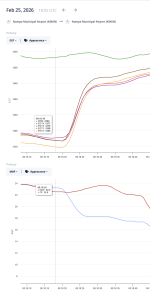
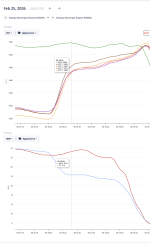
Set the chart to 4, thence Chart 1 - EGT, Chart 2 - FF & Fuel Pressure, Chart 3 - RPM & MAP. Excerpt from Chart 3 attached...

Screenshot 2026-03-04 at 9.04.46 AM.png

The MAP should decrease when you close the throttle -- instead it increases to ambient pressure...
 
Has a basic fuel flow check been done to ensure adequate fuel supply is reaching the servo? Easy stuff first!
 
Induction leak --

Set the chart to 4, thence Chart 1 - EGT, Chart 2 - FF & Fuel Pressure, Chart 3 - RPM & MAP. Excerpt from Chart 3 attached...

View attachment 111490

The MAP should decrease when you close the throttle -- instead it increases to ambient pressure...
MAP drop happens the same time as the throttle reduction. MAP immediately rebounds, yet RPM continues to drop. How can you have an induction leak that only happens for a second? Why did the RPM not recover when the MAP did? I just can't imagine how a leak that large could repair itself. Also, FF drops to 2.5 along with the RPM drop. That looks a lot like an interuption in fuel flow as the cause. Its a bit chicken or the egg, but flow interuption makes more sense than a mysterious intake leak or the throttler blade closing itself.
 
Last edited:
MAP drop happens the same time as the throttle reduction. MAP immediately rebounds, yet RPM continues to drop. How can you have an induction leak that only happens for a second? I just can't imagine how a leak that large could repair itself. Also, FF drops to 2.5 along with the RPM drop. That looks a lot like an interuption in fuel flow as the cause. Its a bit chicken or the egg, but flow interuption makes more sense than a mysterious intake leak.
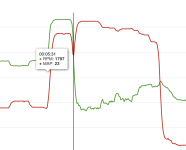
The MAP decrease begins at 05:27, the RPM and FF also decrease at 05:27 -- this is expected behavior when the throttle is closed.
At 05:31 - the MAP begins to rise at 1" per second (data sampling artifact).

Note, the ambient pressure was 27.446 InHg (field elevation 2530, OAT 66°, 30.11" Baro) -- which, shocker, corresponds to the MAP at 05:39"

Continuing to look at the data, you can see the FF is still dropping because the servo is doing its job metering fuel based on the throttle position and the pressure seen at the 4 tubes and venturi in front of the throttle butterfly...

Screenshot 2026-03-04 at 12.04.10 PM.png

The MAP "leak" finally resolves at 07:11 - and the engine drops to idle MAP.

We're looking at pressure, not mass flow - it's not a "large" leak

This could be a cracked AN823 elbow at the MAP line itself, or blown out seal on one or more of the induction runners, a ruptured seal between the servo and sump.

Pretty simple to find -- pressurize the induction system with the output from a vacuum cleaner and spray soapy water on everything -- look for the bubbles.
 
  • Like
Reactions: BES
The MAP decrease begins at 05:27, the RPM and FF also decrease at 05:27 -- this is expected behavior when the throttle is closed.
At 05:31 - the MAP begins to rise at 1" per second (data sampling artifact).

Note, the ambient pressure was 27.446 InHg (field elevation 2530, OAT 66°, 30.11" Baro) -- which, shocker, corresponds to the MAP at 05:39"

Continuing to look at the data, you can see the FF is still dropping because the servo is doing its job metering fuel based on the throttle position and the pressure seen at the 4 tubes and venturi in front of the throttle butterfly...

View attachment 111505

The MAP "leak" finally resolves at 07:11 - and the engine drops to idle MAP.

We're looking at pressure, not mass flow - it's not a "large" leak

This could be a cracked AN823 elbow at the MAP line itself, or blown out seal on one or more of the induction runners, a ruptured seal between the servo and sump.

Pretty simple to find -- pressurize the induction system with the output from a vacuum cleaner and spray soapy water on everything -- look for the bubbles.
I thought the OP was flying along at 75% power and the RPM, just fell off. He speculaterd that his high G pullup may have caused it. I assumed he wouldn't go to idle on such a maneuver. Maybe I missed something. If he closed the throttle, that is a different matter and not what i was assuming in creating my feedback.
 
Last edited:
Pretty simple to find -- pressurize the induction system with the output from a vacuum cleaner and spray soapy water on everything -- look for the bubbles.
How would you do that testing when the supposed leak is intermittent and the engine often runs just fine? I still struggle to envision how a large induction leak appears and disappears at random.
 
I thought the OP was flying along at 75% power and the RPM, just fell off. He speculaterd that his high G pullup may have caused it. Maybe I missed something. If he closed the throttle, that is a different matter and not what i was assuming in creating my feedback.
You didn't look at the most recent data in Post #22...
 
This time unlike 2/26, the full power runup went to 2650rpm which is my usual wot takeoff climb rpm
Just as I started to throttle back, the "problem" reappeared (I don't know if the throttle movement triggered it), sputtering and shaking as the rpm dropped. The problem remained during the taxi back to tiedown.
did the problem appear just as you started to move the throttle or after it was pulled all the way back?
 
How would you do that testing when the supposed leak is intermittent and the engine often runs just fine? I still struggle to envision how a large induction leak appears and disappears at random.

Also, go back to the original flight data (post #4, first Savvy Link) -- 18:18, Rising MAP, falling FF -- looks like something opened up and is leaking (sucking)

You can see him sawing the throttle in and out from 16:40 through 18:18 as he's maneuvering (overlay the G-meter data at the same time).
 
Also, go back to the original flight data (post #4, first Savvy Link) -- 18:18, Rising MAP, falling FF -- looks like something opened up and is leaking (sucking)

You can see him sawing the throttle in and out from 16:40 through 18:18 as he's maneuvering (overlay the G-meter data at the same time).
I am now looking at that. Rpm drops moderately and both map and ff plummit. Smells like fuel starvation. Notice that map drops to about 10” at that time; that is a strong vacuum. Though one could argue that you can’t get that level of vacuum with the throttle wide open, so maybe there is an issue with linkage or a loose lever, allowing the blade to close. You won’t get that low of a map with a massive induction leak. Also notice all the whipsawing of everything. That is fuel flow going erratic imo.

We can agree to disagree, but i do not read those charts as an induction leak. Could be a few things, but erratic fuel flow is my top contender.

I just don’t believe you can pull that low of a map with a massive intake leak, just as you can’t with a wide open throttle.
 
I thought the OP was flying along at 75% power and the RPM, just fell off. He speculaterd that his high G pullup may have caused it. I assumed he wouldn't go to idle on such a maneuver. Maybe I missed something. If he closed the throttle, that is a different matter and not what i was assuming in creating my feedback.
Yes, I was doing 3-4g aerobatics and the first indication I had that anything was wrong was the "check EGT" warning which I have set to 1400. When I looked at the gauge, it was already over 1500. I pulled the throttle back about 5 seconds later.
 
So, this is your chart from the first flight. You can see all the waves in the RPM from your high G manavuers. You can see that as you are humming along, the FF sharply drops off to 10, causing your lean condition and the resulting rise in EGTs. This happens before your RPM fallos off and hence my fuel delivery theory. Shortly after, the problem becomes worse and the FF drops to 2.5, causing the RPM to drop to 1800 and the EGTS to plummit. Then the engine goes through a series of gyrations trying to run on 4-5 GPH for a few seconds and then I assume everything after that is you nursing the engine. To my read, that is a fuel delivery failure. A lot of the variables have cause and effect relationships here, so one can draw several conclusions from this, but my belief is fuel starvation.


Screenshot 2026-03-05 080838.png
 
Last edited:
So, this is your chart from the first flight. You can see all the waves in the RPM from your high G manavuers. You can see that as you are humming along, the FF sharply drops off to 10, causing your lean condition and the resulting rise in EGTs. This happens before your RPM fallos off and hence my fuel delivery theory. Shortly after, the problem becomes worse and the FF drops to 2.5, causing the RPM to drop to 1800 and the EGTS to plummit. Then the engine goes through a series of gyrations trying to run on 4-5 GPH for a few seconds and then I assume everything after that is you nursing the engine. To my read, that is a fuel delivery failure. A lot of the variables have cause and effect relationships here, so one can draw several conclusions from this, but my belief is fuel starvation.


View attachment 111601
I should add that your FF indication is suspect. Note that at the end of this graph, everything has rebounded and the engine is running OK and stable yet your FF falls to 0. This indicates the FF indication is unreliable and therefore my conclusions drawn from it are unreliable. Though it is also possible that the obstruction was in the red cube and fuel forced through its bypass. That would account for the low flow and the unreliable indication.
 
Though it is also possible that the obstruction was in the red cube and fuel forced through its bypass. That would account for the low flow and the unreliable indication.
This would be the area I’d examine. The fuel flow and fuel flow indication are not consistent. I’d remove the red cube for inspection. While it is out I’d run the engine to confirm.

Carl
 
I should add that your FF indication is suspect. Note that at the end of this graph, everything has rebounded and the engine is running OK and stable yet your FF falls to 0. This indicates the FF indication is unreliable and therefore my conclusions drawn from it are unreliable. Though it is also possible that the obstruction was in the red cube and fuel forced through its bypass. That would account for the low flow and the unreliable indication.

If you look at other parameters, you can see similar strangeness -- Check out the ALTITUDE and OAT values, considering that the average terrain around Nampa, ID is 2500ft MSL...

There is a data "drop out" at 21:55 to 23:13 -- The AF-5500 records 0 in the data stream, which Savvy interpolates/integrates and draws a line from the last value to the next, looks like a sharks tooth.
 
Back
Top