

Van's Air Force
You are using an out of date browser. It may not display this or other websites correctly.
You should upgrade or use an alternative browser.
You should upgrade or use an alternative browser.
Jack recommendations
- Thread starter TReneau
- Start date


I wrapped the gear leg at the bottom with a couple wraps of duct tape and then installed a gear clamp with the screw on the bottom side of the leg. Then I used a small hydraulic floor jack under the screw of the clamp to lift the plane on one side then the other to rotate/change a tire. Worked fine on my 2 RV-4's and my RV-7 for many tire rotations and changes. No tail weight required. The clamp fit under the wheel pant so it was never removed, just checked for tightness before each lift.

Home made jacks made from Harbor Freight tall bottle jacks have served me well. I use “jack pads made from a bolt and a pipe cap that screws into the tie down ring receptacle and fits over the ends of the top of the jack. It’s very stable. I don’t have any need to weigh or tie
down the tail as the jack pad points are forward of the CG.
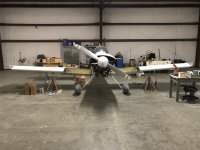
down the tail as the jack pad points are forward of the CG.
Tom,Looking for recommendations for a good set of jacks for an RV-4. Also curious what methods others are using to secure the tail down. Mine wanted to come up with the mains last time I changed a tire. Thanks.
Are you needing to lift both mains at the same time?
Jon
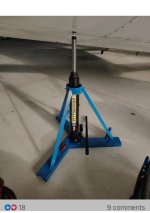
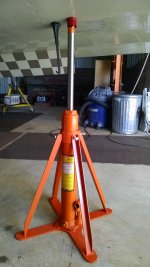
https://www.ebay.com/itm/124177700540 for the jack stand. It is cleverly disguised as a pipe stand.
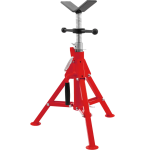
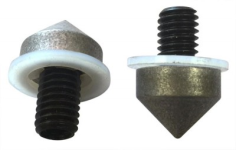
This is the 20" version. Some versions are too high. Cut the "V" off the top and drill into the top of the threaded part to make a dimple to catch whatever you use to screw into the wing tie down. I use these on the wings. They come from aircraft spruce P/N 05-12379.
This is the 20" version. Some versions are too high. Cut the "V" off the top and drill into the top of the threaded part to make a dimple to catch whatever you use to screw into the wing tie down. I use these on the wings. They come from aircraft spruce P/N 05-12379.

I can find the ram jack, but not the stand. Where is this from?
welded from spare parts.I can find the ram jack, but not the stand. Where is this from?

I don't use any jacks under the wing.. I pull the hex nut, insert my 1/2 drive Snap on breaker bar (handle fits perfectly in the axle tube), but any similar size bar/tube will work. Put small floor jack under the breaker bar, lift it and slide wheel/bearing off over the bar, set axle on block of wood. Put back together in reverse. People have been using this method for years .
Dangwelded from spare parts.

Oh, come on! Perfect project to learn a new skill, if you don't know how already!  I had a friend who was hesitant to jump into his 4570 welded steel fuselage for his Steen Skybolt. Decided that the best way to learn was to build a steel bookshelf! It got pretty huge! Interesting to look at his initial welds and how his skills improved over the course of the non-flying bookcase! His welding on the fuselage was excellent, from his developed skill! You might find, as I have, there are suddenly many things that need to be welded up or heated that, without my welding tanks (old but still good technology!), would have had to farm out!
I had a friend who was hesitant to jump into his 4570 welded steel fuselage for his Steen Skybolt. Decided that the best way to learn was to build a steel bookshelf! It got pretty huge! Interesting to look at his initial welds and how his skills improved over the course of the non-flying bookcase! His welding on the fuselage was excellent, from his developed skill! You might find, as I have, there are suddenly many things that need to be welded up or heated that, without my welding tanks (old but still good technology!), would have had to farm out!
You know, I've always wanted to learn to weld. But right now, I'm just trying to get a plane in the air.Oh, come on! Perfect project to learn a new skill, if you don't know how already!

Didn’t learn to weld until I‘d built six planes and maintained many others…so feel no pressure Bob!You know, I've always wanted to learn to weld. But right now, I'm just trying to get a plane in the air.


A Harbor Freight ram really should have a deep cup at the jack point. Pointy or rounded things in a depression on the tip of the ram is a future hole in the wing, because the depression is rarely deep enough. Just a matter of time.
If jacking with the longerons level, it will probably need some kind of tiedown at the tail. Mine certainly does. I've been tying the tailwheel to the stand and loading the base with heavy stuff, but one of these days I'll set a ring in the floor. You know, as soon as I get one of those rountoit things everyone talks about.
Can't weld? Getting stands welded at a shop wouldn't be expensive if you did the fab work.
If jacking with the longerons level, it will probably need some kind of tiedown at the tail. Mine certainly does. I've been tying the tailwheel to the stand and loading the base with heavy stuff, but one of these days I'll set a ring in the floor. You know, as soon as I get one of those rountoit things everyone talks about.
Can't weld? Getting stands welded at a shop wouldn't be expensive if you did the fab work.
Last edited:

Hey Dan, don’t worry about putting the rings in the floor - I hav e three of them I poured in place when we built the hangar and shop - really fancy things - and they are ALL in the “wrong” place to be useful…..
https://www.ebay.com/itm/124177700540 for the jack stand. It is cleverly disguised as a pipe stand.
View attachment 111250View attachment 111251
This is the 20" version. Some versions are too high. Cut the "V" off the top and drill into the top of the threaded part to make a dimple to catch whatever you use to screw into the wing tie down. I use these on the wings. They come from aircraft spruce P/N 05-12379.
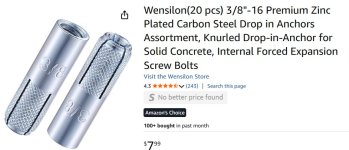
Once you cut the top off, do you know what the outside diamater of the post is?
I have used a friends device for his Aztec and Bonanza gear swings I quite like, thats a simple 2 ft section of 55 gal drum on casters, filled with concrete. It has a ring and and extendable pole with pin holes AKA jackstand tube . No matter where in the hangar the plane is, roll it under the tail and strap to it. The pinable jackpost makes tail sag impossible if your working on the inside of the plane while jacked. When not in use, roll to the corner.
The outside diameter without the treads is 1 1/8". The blocky threads are about 1/8" making the overall diameter 1 3/8". The cones are 3/4" diameter. I drilled a socket in the top of the post using successively larger bits with each going in less than the previous one. The largest bit I used was 3/4" but drilled in just enough to countersink the edges of the hole to almost match the diameter of the cone. The cone then sets in the socket almost up to the shoulder.Once you cut the top off, do you know what the outside diamater of the post is?
The other option for the tail stand/weight issue is just leave the tail on the floor and only jack one wing up at a time. Work on one wheel, finish it, lower it and then go do the other side. Tail doesn't lift up at all. Or at least it doesn't on an RV-8. And I'm slightly nose heavy.
