Van's Air Force

The definitive Van's Aircraft support community! Buying, building or flying an RV? Join our exclusive family of mentors and enthusiasts!

Nose Wheel Valve Stem Moving

I went to air my tires up today and when I took the pants off the nose wheel I found that the valve stem had moved. It used to poke out one of the holes in the rim at an angle and now is pointing straight down inside the center of the wheel. I couldn't get to it to put air in it. I'm thinking about taking needle nose plyers and trying to pull it back out but not sure if that will work or not. What would've caused the stem to move like that?
 
In my experience with bicycles this happens when tire pressure is low although my experience is left right vs up down. My theory is the tire walks on the rim like an inch worm when pressure is low. Deflate, break the bead, and rotate the tire is what I do with a bicycle tire. You’ll have to lift the tire off the ground.
 
I went to air my tires up today and when I took the pants off the nose wheel I found that the valve stem had moved. It used to poke out one of the holes in the rim at an angle and now is pointing straight down inside the center of the wheel. I couldn't get to it to put air in it. I'm thinking about taking needle nose plyers and trying to pull it back out but not sure if that will work or not. What would've caused the stem to move like that?
No. Take the weight off and bleed all the air out. Then position the stem where it should be and refill while holding the stem in place. This happens when you run your tires at too low pressure. Suggest 35 psi minimum for nose wheel. I run 45-50.
 
I aired it up to 22 not very long ago and have been visually inspecting it on preflight but it may have been lower than I realized.
22 is wayyyy too low for a tubed aircraft tire. Consider yourself lucky that the tube just shifted instead of pinched and ruptured. A shifted tube is a CLEAR sign that your pressure is too low. It is screaming at you that a flat is in your near future.
 
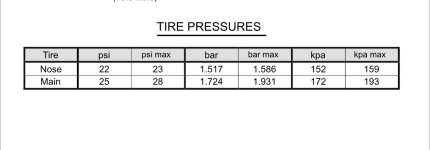
Many planes run pressure that high but Van’s has different pressures recommended for the RV-12.
View attachment 109859
Well the fact that it shifted should prove to you that van’s recommendation are not appropriate. A properly inflated tube will not shift. You do NOT want the tube moving relative to the tire! That creates a myriad of problems.
 
Well the fact that it shifted should prove to you that van’s recommendation are not appropriate. A properly inflated tube will not shift. You do NOT want the tube moving relative to the tire! That creates a myriad of problems.
Say what you want about Van’s specs. I have a -12 flown it for 1800+ hours with 22# on the nose and 25# on the mains. NEVER has a tire or tube slipped, even with hard braking.
 
I think part of my problem is that the tube in my nose tire has a straight valve stem instead of a 90. When the valve stem was sticking out of the hole in the rim like it's supposed to it was leaning up against the rim and you had to kind of pry it up off of it to get it straight enough to put air in.
 
Say what you want about Van’s specs. I have a -12 flown it for 1800+ hours with 22# on the nose and 25# on the mains. NEVER has a tire or tube slipped, even with hard braking.
Ok. Have no experience with the 12 and understand the importance of tire pressure in energy absorption. But stand behind my thoughts that allowing the tube to move relative to the tire is asking for trouble. If your stem is moving around from flight to flight, then your pressure is too low IMO.
 
IMO, the tire pressure on the RV-12 is a critical pre-flight item. Visual check is not good enough, I make it a point to put a gauge on the tubes before every flight day if at all possible. If I take the airplane somewhere overnight or longer I take a small battery powered portable inflator with me, of course this gets more complicated if you have wheel fairings installed so that scenario is sometimes the exception.

Almost all tubes have at least a very very slow leak and we run a lower pressure by design. The margin between the correct pressure, and a pressure that will allow the tube to slip is narrow. You are lucky if you did not damage the tube when it spun on the wheel, or you may find that a slow leak is now losing air a little bit faster. These tubes are expensive and showing up to a problem can ruin your plans to fly for a day, making sure you are at pressure will prevent that as well as increase awareness of any issues.

 
IMO, the tire pressure on the RV-12 is a critical pre-flight item. Visual check is not good enough, I make it a point to put a gauge on the tubes before every flight day if at all possible. If I take the airplane somewhere overnight or longer I take a small battery powered portable inflator with me, of course this gets more complicated if you have wheel fairings installed so that scenario is sometimes the exception.

Almost all tubes have at least a very very slow leak and we run a lower pressure by design. The margin between the correct pressure, and a pressure that will allow the tube to slip is narrow. You are lucky if you did not damage the tube when it spun on the wheel, or you may find that a slow leak is now losing air a little bit faster. These tubes are expensive and showing up to a problem can ruin your plans to fly for a day, making sure you are at pressure will prevent that as well as increase awareness of any issues.
I went ahead and ordered a new tube with a 90 degree stem just in case the tube is damaged. If it's not then I'll have a backup.
 
IMO, the tire pressure on the RV-12 is a critical pre-flight item. Visual check is not good enough, I make it a point to put a gauge on the tubes before every flight day if at all possible. If I take the airplane somewhere overnight or longer I take a small battery powered portable inflator with me, of course this gets more complicated if you have wheel fairings installed so that scenario is sometimes the exception.

Almost all tubes have at least a very very slow leak and we run a lower pressure by design. The margin between the correct pressure, and a pressure that will allow the tube to slip is narrow. You are lucky if you did not damage the tube when it spun on the wheel, or you may find that a slow leak is now losing air a little bit faster. These tubes are expensive and showing up to a problem can ruin your plans to fly for a day, making sure you are at pressure will prevent that as well as increase awareness of any issues.



Regarding low tire air pressure, I found it surprising when I was lowering the nose wheel air pressure to finalize the leveling of the airplane to measure the weight at the three wheels.

I got down to 10 psi and it didn’t look much different.

It convinced me that I needed to actually measure the air pressure.

Brett H
Columbus IN
 
Yes, See Scott McDaniel's post about why the RV-12 runs at such low tire pressures. They leave little margin for deflation -- and cold winter temps are enough to bring the pressures down to where the tube can slip.
 
Back
Top