Van's Air Force

The definitive Van's Aircraft support community! Buying, building or flying an RV? Join our exclusive family of mentors and enthusiasts!

Fuel Tank Priming

kirkbauer

Well Known Member
I've been priming all of my interior parts with Akzo Nobel primer, and prepping with Prekote. I'm starting my fuel tanks now and am looking for opinions on priming. I can see two options:
  1. Prime only the parts outside of the tank -- T-1005B/T-1005C shims, tank attach zees, and the exterior portion of the T-1005 tank attach bracket.
  2. In addition, try to prime the exterior portion of the fuel tank, specifically the outside portion of the end ribs and the exterior portion of the aft tank baffle.
If I attempt to do #2, I don't want to risk affecting anything with the containment of the fuel, so it would be smart to do it after the fuel tank is completed. I'm thinking I could do the Prekote and the primer after the tank is fully assembled. Alternatively, I could do the Prekote upfront and then, after assembly is complete, I could clean with acetone and then add the primer.

I'm not trying to start any primer wars, just curious how other people who have otherwise primed parts handled the fuel tanks.
 
The only thing I primed was the z brackets, just not the bottom side that touches the baffle. Once the tank is done, it can be painted then.
 
The only thing I primed was the z brackets, just not the bottom side that touches the baffle. Once the tank is done, it can be painted then.

And if I was to prime it after the tank was completed, would I do the Prekote and priming steps all after assembly is complete?

PS -- good tip on not priming the part of the z-brackets that touch the baffle.
 
If you've already sealed the tanks and proofed them to be leak free, then I wouldn't worry about it. IF there's any chance of getting some inside the tank, then either be sure about the compatibility, or wait til the tanks are sealed and proofed before exterior priming. Fuel systems are one area that even minor contamination can be a big thing.....Work safe and think ahead, because you are going to eventually be in that bird.
 
A primer that is safe and non-soluble now, with current fuels, may not be non-soluble with future fuels; who knows what we will be using 15 years from now.
 
I've been priming all of my interior parts with Akzo Nobel primer, and prepping with Prekote.
I did the exact same thing (Prekote/Akzo) but I didn't prime any part of the fuel tanks. I didn't prime anything FWF either. First time builder so take that for what it's worth - which is basically nothing :)
 
I did the exact same thing (Prekote/Akzo) but I didn't prime any part of the fuel tanks. I didn't prime anything FWF either. First time builder so take that for what it's worth - which is basically nothing :)
+1. Didn't prime either. Or the aft side of the firewall.
 
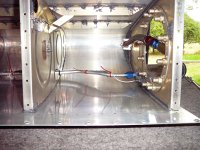
I Alodined all tank components. This helps with corrosion protection, and also improves adhesion of sealants.

P1060043.JPG

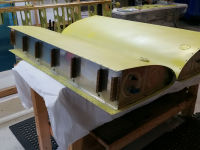
After completing tank assembly, I then primed with PreKote+AkzoNobel over the external surfaces for further protection.

IMG_20200623_124308.png
 
I alodined my tank components too. The exterior surfaces will get primer when I paint the plane. That's more for paint than anything else, though.

I never considered priming the exterior of the end ribs and rear baffle. I suppose it wouldn't hurt, but mine alodined and alclad. Seems like belt, and suspenders for a onesie at that point.
 
I would leave any surface free of primer that will get sealant applied. On my RV-9A tanks, I just did the Z brackets and forward attach angles, but left off any primer where they are attached. The extrusions are 6061 aluminum and Van's states that these should be primed, but any 2024 aluminum sheet is alclad and won't need any priming.
 
I Alodined all tank components. This helps with corrosion protection, and also improves adhesion of sealants.

View attachment 109336

After completing tank assembly, I then primed with PreKote+AkzoNobel over the external surfaces for further protection.

View attachment 109337
My plan as well. As a chemistry Nerd, I Alodine all my parts and then epoxy prime with Sherwin-Williams CM0724933 Epoxy Primer, Qualified MIL-PRF-23377K, Class C2 - that stuff is harder than Chinese arithmetic!

The plan for the tanks is to Alodine all parts, but only prime exterior when leak check complete.

-cappy
 
My plan as well. As a chemistry Nerd, I Alodine all my parts and then epoxy prime with Sherwin-Williams CM0724933 Epoxy Primer, Qualified MIL-PRF-23377K, Class C2 - that stuff is harder than Chinese arithmetic!

The plan for the tanks is to Alodine all parts, but only prime exterior when leak check complete.

-cappy
Oops. Found it. plugged in the MIL # . It's yellow right.
 
I wanted to close the loop (more or less) on this thread. Here are two things that are definitely true:
  • No primer inside the fuel tank, unless you want to get crazy and find somebody that definitely is OK to go in there
  • Definitely need to scuff or otherwise prep the areas inside the tanks where the sealant will be applied
Outside of that, it seems there are two extremes and anywhere in between, any of which are more or less OK:
  • No priming or other preparation inside or outside of the fuel tank (other than scuffing)
  • Prep and alodine all fuel tank pieces inside and out, and then also apply primer to the exterior components
What I ended up doing (not too late to change if I made any big mistakes):
  • Scuffed all interior mating surfaces, then treated only those areas with alodine -- I had some extra and it seems it will only help with the sealant adhesion. Also may be better than nothing on interior surfaces where I removed too much alclad deburring/scuffing
  • For the end ribs, I scuffed and applied alodine to the entire ribs (inside and out)
  • For the front support bracket that is half inside and half outside of the tank, I scuffed and applied alodine to the entire part (so I didn't have to worry about the inside/outside boundary)
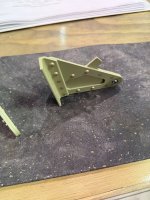
  • For the Z brackets, I prepped the entire piece, applied alodine to the flange that mates with the rear baffle, and applied primer to the rest
  • For tiny interior pieces (anti-rotation bracket, vent bracket) I did alodine on the whole thing
  • For tiny exterior pieces (shims), I prepped and primed the whole thing
So, basically, the inside of my tank will all be unscuffed alclad or scuffed plus alodine. Some of the exterior will be alodine (end ribs, front bracket) and the rest will be alclad (rear baffle, skin). When I'm all done and the tank is fully sealed and tested, I could apply primer over the external portions if I wanted to. Not sure if I will or not.
 
For those who do not want to bother with all this extra work. If you just follow Scott McDaniel’s video from Van’s on the tank sealing process. I’m sure you will have a fine non-leaking product and additionally will not need 2 quarts of pro-seal to accomplish the task.

Again, I’m a chemistry nerd and deal with French built aircraft so my project is more of art work than a rush to get airborne.

- cappy
 
Back
Top