Van's Air Force

The definitive Van's Aircraft support community! Buying, building or flying an RV? Join our exclusive family of mentors and enthusiasts!

fiberglass work

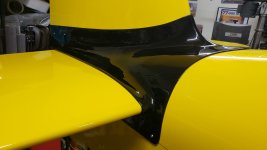
Has anyone else found poor fitting fiberglass parts—ie where to vertical stabilizer meets the tail cone? I have an unacceptable amount of bow that will require some work to smother this out and was looking for best way to accomplish this. Any thoughts?
Steve
 
Yes I had similar problems with my RV-7A. I simply cut off all of the section that mated to the front of the horizontal stabilizer and laid up my own using my actual plane as the mold. It turned out beautiful. I also had problems forming the rear portion of the sliding canopy skirt, so I made that from fiberglass as well. As I completed the project, I was veery surprised how much time I had spent on fiberglass.

I was very fortunate to have a friend that built an award willing Velocity, teach me the art of working with fiberglass.
 
None of the fiberglass parts fit very well. If you go with an aftermarket vendor, it's possible that they won't fit very well either. There's simply too much variation on individual airplanes for stuff like that to fit with out some work or if you just get lucky.
 
Same. Study the part. Mark it where fillets can be cut to make it fit.
This was abysmal. I cut it and sanded scarfs for layups then applied new fabric. Easier for me than making one from scratch.
20240210_153619.jpg
 
Same. Study the part. Mark it where fillets can be cut to make it fit.
This was abysmal. I cut it and sanded scarfs for layups then applied new fabric. Easier for me than making one from scratch.
View attachment 78416
Larry, I hope I get into the paint shop before you get that thing flying. I've got a multitude of sins for the painter to hide before I can park next to you.
 
Has anyone else found poor fitting fiberglass parts—ie where to vertical stabilizer meets the tail cone? I have an unacceptable amount of bow that will require some work to smother this out and was looking for best way to accomplish this. Any thoughts?
Steve
I found that none of the fiberglass parts fit. Not one; including the snorkel which I had to cut and reglass around the oil return line and starter solenoid. And Steve, unless you have a situation that is especially egregious, I recommend not bothering to call Van's asking for advice because they will only tell you that this is typical of all their kits for all models, and that actually the -14 parts are better than the older kits. I had to redo one of my wingtips 9 times before I finally got it to fit. I was convinced that the mold from which it was made was defective, but you'll get no sympathy from Vans. It is up to the builder to make them fit.

So, your only option is to resign yourself to LOTS of sanding, in some cases doing layups where you have to move an edge followed by LOTS of sanding, or cutting and reglassing followed by LOTS of sanding. There is no way around it. If you want it to look presentable from 3 feet away, it will simply take time. My canopy was asymmetrical which required me to move one of the edges by almost 1/2". Guess how much sanding that took.
I think the reason I found it so frustrating is that the rest of the kit, i.e. all the aluminum parts that Vans fabricates, fit so remarkably well that we come to expect everything in the kit to be of similar quality. It just ain't so for the fiberglass parts.

And if you want more bad news, wait until you get to the steps where the plans are written such that the assumption is you can see through the parts to match drill to the holes underneath. The prototype and early kits had fiberglass parts that were opaque, and that is how the plans were written. My guess is that your parts (like mine) have the grey gelcoat and are most definitely not opaque. You will have this issue on the horizontal/vertical fairing, the spinner, and the nose gear leg fairing (if you have a trike).

There is no magic bullet other than making peace with the fact that you have a lot of labor ahead of you to get the fiberglass parts to fit.
 
Interestingly my fibreglass is grey gel coat but with a bright light you can still see through it. As it happens, I used the magnets rather than light to locate holes.
 
Has anyone else found poor fitting fiberglass parts—ie where to vertical stabilizer meets the tail cone? I have an unacceptable amount of bow that will require some work to smother this out and was looking for best way to accomplish this. Any thoughts?
Steve
Yes, we have been getting a lot of feedback from 14 builders looking for a tail with a better fit and finish. So we listened and now there is a better alternative to the stock design which will reduce your work time significantly and remove the worry of spider cracks after paint (no gel coat on our parts). Feel free to PM, Call me or check out the website.

D
 
Has anyone else found poor fitting fiberglass parts—ie where to vertical stabilizer meets the tail cone? I have an unacceptable amount of bow that will require some work to smother this out and was looking for best way to accomplish this. Any thoughts?
Steve
I did fiberglass work as a full time job at Robinson Helicopter while going through A&P school.

I replaced the intersection fairing on my -7 project because it was so jacked up. I could have repaired every hole….

The replacement I received looked great until I started trying to fit it. I too found several gaps. A heat gun can heat up the fiberglass and somewhat change the way it sits.

I drilled up a series of holes to match the nut plates using a sheetmetal hole finder. I ended up wrapping the various surfaces with saran wrap. Using a trick I learned back in the day, I applied masking tape to the areas I didn’t want to fiddle with, if the could get resin on them

I applied a fiberglass/flox/resin mix and applied it thick in the areas with gaps. I installed the screws to pinch the resin mix to squeeze everything to its normal installed thickness. If a screw could possibly get resin on it I would coat them with grease before running them down.

After it cures, cleanup is easy with a die grinder. I was only concerned with the gap, not the extra thickness. If you wanted to grind down the extra thickness, a belt sander would make quick work of that.

Oh and the curves of my replacement fairing looked really clumsy. I ended up using a measuring tape, a piece of string, some masking tape, and a fine line sharpie, to redraw the curves. I ended up doing it several times before I liked it. Acetone easily wipes off the sharpie if it ain’t right. Then hit it with the die grinder to cut off the excess.

Feel free to DM me if you need additional guidance.

Edit: i’m in the Atlanta area for anyone who could use some help.

 
Last edited:
Brothers,
I too have struggled with fiberglass. My project was completely derailed by a non-fitting snorkel (designed by Satan) for over a year. Finally, I made the best move possible. I called a friend who had completed a Lancair, the equivalent of a PhD in composites. He showed me the basics of sanding, filling, scarfing and layups. Using these basic techniques, we sliced the snorkel in two, mounted each side, and then glassed the pieces together. Yes, the process can be tedious, but you can always fix mistakes. Heck, if the part is bad, you can chop it out with a claw hammer and then fix it! In the end, the fit and finish you can craft is supremely satisfying.
The ultimate secret is to find or make a friend with glass experience and then start practicing on scraps. Both the friend and the new found skill will be rewarding. BTW, if you are in the Atlanta area, Jim Anderson, Composite PhD, and I would love to help.
Peace, Love and Peel Ply,
Steve
 
Has anyone else found poor fitting fiberglass parts—ie where to vertical stabilizer meets the tail cone? I have an unacceptable amount of bow that will require some work to smother this out and was looking for best way to accomplish this. Any thoughts?
Steve
I must be the lucky one - just some modification on the empennage fairing, and shortening the oil drain that conflicts with the snorkel (far less of an effort than fabricating the brake lines). The only exception was the need to open up the cowling air inlets to match the engine baffling (about 3/8 inch per side) which I thought was surprising, considering the overall accuracy of these parts. My only prior experience with fiberglass was sloppy repairs on sailboats many years ago. For me, the fiberglass has been interesting but tedious, and confirmed my preference to construct a metal airplane.
 
Has anyone else found poor fitting fiberglass parts—ie where to vertical stabilizer meets the tail cone? I have an unacceptable amount of bow that will require some work to smother this out and was looking for best way to accomplish this. Any thoughts?
Steve

It's just another shop skill. Education and recreation. Master it and make anything.

 
Back
Top