Van's Air Force

The definitive Van's Aircraft support community! Buying, building or flying an RV? Join our exclusive family of mentors and enthusiasts!

RV-10 vs Cirrus

sglynn

Well Known Member
I finished my RV-7A this year and love it. 60+ plus hours with Dynon panel. My Cherokee sits in the hangar until I have to go pick up my kids/grand kids or take friends for a ride. But mostly I fly my RV for burgers, camping, and fun. And the Dynon avionics, AP, etc are so capable I'm spoiled.

Wife wants to keep a 4-seater for family and friends flight, but she wants me to sell the Cherokee and get a Cirrus. She wants 2-doors, cabin comfort, and the parachute. Cirrus's are totally cool but expensive, including ongoing maintenance.

Tonight I realized the RV-10 now has a BRS Chute that can be added. And building the 7A left me with tools and skills. Seems a shame not to use them again.

So, what might you say about a Cirrus versus building an RV-10A? Speed, Load, Comfort, Spouse appeal, Costs, Maintenance?

For anyone who has built a RV-10 with nice paint, great avionics and nicely appointed leather interior, what was your total hard cost? $200K?
 
I finished my RV-10 in 2012. Total cost including paint and interior was $165K. This included new engine and prop from Van?s, dual screen SkyView, GTN-650 etc. I did a slow build and painted it myself (high end PPG base and clear coat paint cost me $3.7K). I?d estimate today it would be closer to $200K.

I would never own a Cirrus over any RV. A neighbor has one - the first annual set him back $6K and that was just for planned maintenance. Add to that the gross price tag and high fuel burn the Cirrus is only for people with very fat wallets.

Shoot fire, if you are going to spend that much money get something with a turbine. I?ll stay with RVs.

Carl
 
I?m very early into my build, and I don?t have lot to offer - except that the BRS parachute is definitely an option for the RV-10. I?ve contacted BRS aerospace, they make one just for the -10, and I will be building one into my plane.

They will even sell you the install kit separately from the rocket and chute itself, so if you take a few years to build it all in, the 10 year clock on a new rocket motor and chute repack starts when you install the rocket, not when you install the wall panel that holds it.

So, if all she wants a Cirrus for is the ?chute, that?s not a reason to drop an extra $600,000.
 
I?m getting close to the end of my build. If you want a -10 equipped similarly to a cirrus and you want the BRS chute, you will not be able to do it for $200k. I dont have the chute. I put in a beautiful Garmin panel and a brand new Thunderbolt engine. I?m already north of 200, without paint. Could I have saved a few bucks here and there, sure. I could have probably wound up around 200 without paint if I was pinching pennies... but I think you?ll be closer to 250. Still WAY cheaper than a Cirrus.
 
I wonder if Van had any idea when he rolled out the -10 that his devoted cadre of builders would be comparing it with the Cirrus as much as with the 7-A's and 14-s. Given the order of magnitude price difference, that's a pretty high bar for comparison. Makes you realize what ol' Van pulled off. Mad respect.:)
 
I?m getting close to the end of my build. If you want a -10 equipped similarly to a cirrus and you want the BRS chute, you will not be able to do it for $200k. I dont have the chute. I put in a beautiful Garmin panel and a brand new Thunderbolt engine. I?m already north of 200, without paint. Could I have saved a few bucks here and there, sure. I could have probably wound up around 200 without paint if I was pinching pennies... but I think you?ll be closer to 250. Still WAY cheaper than a Cirrus.

You certainly can build a RV-10 less than $200k. Mine was significantly less than that. Although I have to admit, I got some great deals that saved me a ton of money.

Everyone makes decisions that impact cost.

Do you need a carbon fiber panel? What about the overhead console? Do you need interior panels? No, but they do make the appearance better and provide added functions.

No you need a new engine or Avionics? No, but new is probably preferred by most folks.

You can save $10k by painting it yourself.

I?m not being critical of anyone?s decision. We all have different budget and mission requirements. There are options and decisions that are available if your budget is tight.
 
I wonder if Van had any idea when he rolled out the -10 that his devoted cadre of builders would be comparing it with the Cirrus as much as with the 7-A's and 14-s. Given the order of magnitude price difference, that's a pretty high bar for comparison. Makes you realize what ol' Van pulled off. Mad respect.:)

Ditto the above. My hangar mate flew chase for my first flight in the 10 I built. I was wide open throttle (of course) he could not keep up with me. My 10 useful load is also slightly more than his SR-22. The cost to build another like mine would be about 200K, but a new SR-22 is north of 900K easily!!! My 10 is all Garmin G3X touch, GTN 650, 507 autopilot control, 10 to 1 pistons on the engine, dual LSE ignitions, etc. top end Aerosport seats, panel etc.. It's a no brainer. The 10 is the way to go.

My buddy on his last annual need to upgrade some avionics and need some other parts to the plane. His annual was 8K (mostly from the avionics). I told him I could do annuals on my 10 for 20 years and not spend that kind of money
 
When I was done with my Phase 1 testing with my -10, I was moving to my new hanger 100 miles away, and using the RV as my hauler! Back seats were out and I had that area and the baggage compartment stuffed with two tool chest's full of tools along with everything else I could fit in, including the front passenger seat. It took three trips to make the move by plane and all the benches and other stuff that wouldn't fit in the plane went via truck. My first trip with the plane my wife dropped me off at the airport and waited with the grandkids to watch the take off. I was behind a Cirrus (with only one sole on board) and I had full fuel and loaded to the max. The Cirrus took off and when clear, I did also. When I returned home my wife's first comment was how fast the RV was in comparison to the Cirrus on TO, commenting my run was less than half the length of the Cirrus! There is the RV Grin!
 
You have probably already considered this but depending on the mission only one of those two planes is going in and out of shortish turf fields.
 
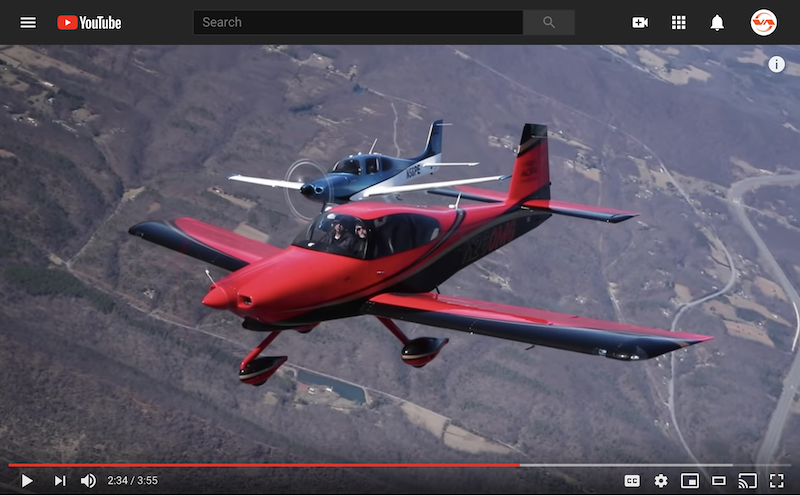
It's been a couple of days since it was published, so maybe you've already seen it - but AOPA did a bit of a fun fly-off drag race between their sweepstakes RV-10 and an SR-22 and posted a video. More details of the comparison will be in the AOPA Pilot magazine per Dave Hirschman from AOPA. Many people are asking the same sorts of questions posted earlier in this thread, of course. Click the image to watch the YouTube video.

 
Last edited:
The Cirrus took off and when clear, I did also. When I returned home my wife's first comment was how fast the RV was in comparison to the Cirrus on TO, commenting my run was less than half the length of the Cirrus! There is the RV Grin!

The wing loading on a Cirrus is around 23.5 lb/sq ft vs the RV10 of 17.5 lb/sq ft or 25% more. That's your shorter take-off and climb perfomrance; probably at the expense of some stability in wind.
 
One thing to consider regarding the SR22's BRS, the landing gear is part of the total system. Since no one has dropped a -10 with a BRS, there is no guarantee that the passengers will survive.

With the better handling of the RV-10, lower approach, and stall speeds vs. the SR22, your chances of walking away from a forced landing is pretty good, as long as you follow Bob Hoover's advice and "fly it as far into the crash as you can."
 
Gee, no mention of price, maintenance costs, fuel flow and more. It didn?t look like a tie to me.

Remember that Cirrus is a MAJOR advertiser with AOPA and get out the salt shaker.
 
Gee, no mention of price, maintenance costs, fuel flow and more. It didn?t look like a tie to me.

Remember that Cirrus is a MAJOR advertiser with AOPA and get out the salt shaker.

There are lots of unmentioned inequalities. The Cirrus (at least current ones) carry more fuel, go faster, ride better in turbulence, than the RV. On the plus side for the RV, I'd much rather maintain a Lycoming 540 than that Continental 550.

And then there's the cost difference.
 
Don't forget, there are still a LOT of people out there who refuse to even look at an E-AB, not to mention fly or own one.

AOPA has to get past that bias and that video will go a long way towards doing that. They hit the highlights and if someone is really interested, they will investigate further.

On a side note, I was once told that most winders of the AOPA sweepstakes sell the planes to pay the taxes. I'm really curious what they will value their sweepstakes -10 at.
 
There are lots of unmentioned inequalities. The Cirrus (at least current ones) carry more fuel, go faster, ride better in turbulence, than the RV. On the plus side for the RV, I'd much rather maintain a Lycoming 540 than that Continental 550.

And then there's the cost difference.


They carry more fuel because they USE more fuel.

Apples to apples, the cirrus is but a few knots faster, at the same altitudes...

Ride in turbulence is definitely true.

For the difference in price, I could pay for all the fuel and maintenance on the -10 for my lifetime, and probably my son's lifetime...

Cirrus is nice but not THAT nice!
 
They carry more fuel because they USE more fuel.

Apples to apples, the cirrus is but a few knots faster, at the same altitudes...

It would have been interesting if AOPA included an efficiency test. Climb to 10,000, set fuel flow to 12 GPH, and see which airplane is faster. OR, match cruise speeds at 170 knots and compare the fuel flows.
 
If cost was the only issue, the major GA Piston-driven manufacturers probably would have gone out of business long ago. The fact is E-AB simply isn't everyone's cup of tea. There's a large segment of the pilot population that would rather buy a used Bonanza, Comanche, or SR22 than build or buy a used 10 (if you can find one). And IMO the folks who buy new of make/model don't really care what anyone else thinks is the better plane.
 
Handling

One thing that wasn?t mentioned is that the Rv-10 is a joy to fly.
Where as the cirrus is one of the most uninspiring aeroplanes I?ve ever flown. I can see that it?s designed to go A to B, but that side stick with springs felt awful.
 
I'm sold on building another RV and this time the RV-10. My wife really likes the chute, the two doors, and the nice interior of the Cirrus. The chute is especially valuable to her as we age and fly around the grandkids. There is a handle she can pull if I have a stroke or something. (Yes we tried the spouse landing classes - NOT going to happen). I love flying my new RV-7A. Love it. But I have to use my old Cherokee to take friends and family for rides and pickup the grand kids. So RV-10 with option to add the chute seems perfect. And the cost difference is huge. $1 million for a new Cirrus. $250K for RV-10 with good options. Plus maintenance costs are lower. I've been monitoring the Cirrus Facebook page and those guys spend thousands every year for annual inspection and maintenance. Some report average of $9,000 per year, not including the eventual chute repacking. I think RV builders like doing it themselves. Maintenance is fun. I'm not into throwing the keys over the counter and saying, "I'll pick it up next week." Do to economy I'll wait till fall to make final decision, but I think I'll be ordering RV-10 kits before Christmas. Oh and I've looked at buying an RV-10. They seem to sell for more than the hard costs even with 1,000 hours on them. That is cool. So I don't have to think of building an RV-10 as an expense, just an investment.
 
We know the -10 is a joy to fly and is a great all-around airplane. But looking beyond performance and functionality, how do the -10 and SR22 compare in, well, niceness factors? A few random things like:

How does HVAC performance compare? Can you regulate temps the same front/rear cabin easily? Are there drafts? And don't tell me to fly higher to make up for non-existent AC.
How well does weatherstripping work and how much is that dependent on builder workmanship?
How do door latches compare; not just in how well they hold the door closed but how fussy are they to operate?
How are interior touchpoints? Most -10's remind me of a 50-year-old F-150 (disregarding the panel)--those trucks work fine--but are utilitarian and basic.

Cirri look like luxury cars on the inside. Sure, you can pretty up a -10 thanks to aftermarket, but then you lose useful load. And expensive.

None of these details are relevant in performance comparisons, but could be what entice a significant part of the GA owner's population and probably go far in explaining why Cirrus is the sales success it is compared to the rest of the GA (certified) fleet.
Finally, don't get me wrong: I love my RV and would never consider getting a Cirrus. But, if you're going to compare these airplanes, you need to compare ALL things--not just the things the RV is better at.
 
Last edited:
One thing I found interesting was the equal fuel load in gallons. The aircraft do not burn the same amount of fuel, so 60 gal in a SR22 is less endurance than 60 gal in an RV10. To emphasize my point, put 60 gal into a Boeing jet and it probably won't even get to the runway.

A more fair comparison would be to put 4 hours of fuel in each airplane. The more thirsty plane being required carry more weight in fuel to achieve the same endurance.
 
One thing I found interesting was the equal fuel load in gallons. The aircraft do not burn the same amount of fuel, so 60 gal in a SR22 is less endurance than 60 gal in an RV10. To emphasize my point, put 60 gal into a Boeing jet and it probably won't even get to the runway.

A more fair comparison would be to put 4 hours of fuel in each airplane. The more thirsty plane being required carry more weight in fuel to achieve the same endurance.

I suspect the Cirrus has roughly the same range on 60 gallons as the -10 at at the same airspeed. It is slightly slicker, and the -550 can deliver better BSFC.

Certainly, newer Cirri have better useful loads and the 'chute. Their interiors are generally nicer too, but you can trade dollars and useful load for that.
 
I suspect the Cirrus has roughly the same range on 60 gallons as the -10 at at the same airspeed. It is slightly slicker, and the -550 can deliver better BSFC.

cirrusreports.com Has lots of information on real world flights of SR22 operators. From what I am seeing at similar speeds to what I fly (165 KTAS average from TO to LNDG) they burn about 2-4 gph more than I do with my O-540 which cannot do LOP. From the video you can see the Cirrus is not ?slicker? or the 50hp extra would have shown up in the top speed runs.

I agree that the SR22 is more like a luxury car interior but I feel my -10 feels more open and less claustrophobic, especially to the rear pax.

Just my 2 cents.
 
From the video you can see the Cirrus is not ?slicker? or the 50hp extra would have shown up in the top speed runs.

They did acceleration tests, not top speed runs. There is a difference - an F-15 accelerates quicker (to a point) than an SR-71, but we know which one is faster. ;-)
 
No one has mentioned insurance cost. A few years back I could afford a Cirrus until I got an insurance quote. Forget it. I?m sure it?s even higher now.
 
They did acceleration tests, not top speed runs. There is a difference - an F-15 accelerates quicker (to a point) than an SR-71, but we know which one is faster. ;-)

At around the 2:07 mark of the video they state ? Virtually no difference in top speed?. This is a long drag race from 2 miles behind the photo plane which is flying at at least 100 KTS so there is time and distance to reach a stable top speed as they stated.
 
We know the -10 is a joy to fly and is a great all-around airplane. But looking beyond performance and functionality, how do the -10 and SR22 compare in, well, niceness factors? A few random things like:

How does HVAC performance compare? Can you regulate temps the same front/rear cabin easily? Are there drafts? And don't tell me to fly higher to make up for non-existent AC.
How well does weatherstripping work and how much is that dependent on builder workmanship?
How do door latches compare; not just in how well they hold the door closed but how fussy are they to operate?
How are interior touchpoints? Most -10's remind me of a 50-year-old F-150 (disregarding the panel)--those trucks work fine--but are utilitarian and basic.

Cirri look like luxury cars on the inside. Sure, you can pretty up a -10 thanks to aftermarket, but then you lose useful load. And expensive.

None of these details are relevant in performance comparisons, but could be what entice a significant part of the GA owner's population and probably go far in explaining why Cirrus is the sales success it is compared to the rest of the GA (certified) fleet.
Finally, don't get me wrong: I love my RV and would never consider getting a Cirrus. But, if you're going to compare these airplanes, you need to compare ALL things--not just the things the RV is better at.

The thing with EAB is that everything you noted is builder-specific, so the answer is both yes an no depending on the aircraft. I have seen basic RV-10s that look just like you described, and I have seen ones that easily rival the cirrus interior. Of course one will cost more than the other, but even a top-shelf 10 with the BRS, AC, leather, nice paint, full panel, etc will cost hundreds of thousands less than the cirrus. However, you have to build it. If you are looking to buy a -10, the pickings are very slim. If RV-10s were as available as the Cirrus (at the RV-10 price point), I think Cirrus would have a real problem, but they aren't and probably will never be in the same sales category.
 
Handling

One thing that wasn?t mentioned is that the Rv-10 is a joy to fly.
Where as the cirrus is one of the most uninspiring aeroplanes I?ve ever flown. I can see that it?s designed to go A to B, but that side stick with springs felt awful.
(I know this is an old thread but can’t help myself). The RV-10 is a joy to fly….

One factor rarely covered is flight characteristics. The RV-10 is easy to fly and very forgiving 1,700hrs and 14yrs). Based on listening to Trescott’s News Podcast and the grapevine in general, the Cirrus is a bit more challenging to fly and is not particularly forgiving in the approach and landing phase (I’ve never flown one). For a 4 place cruiser, the RV-10 is actually fun to fly. I’ve never quite heard anyone describe the Cirrus as fun to fly.
 
(I know this is an old thread but can’t help myself). The RV-10 is a joy to fly….

One factor rarely covered is flight characteristics. The RV-10 is easy to fly and very forgiving 1,700hrs and 14yrs). Based on listening to Trescott’s News Podcast and the grapevine in general, the Cirrus is a bit more challenging to fly and is not particularly forgiving in the approach and landing phase (I’ve never flown one). For a 4 place cruiser, the RV-10 is actually fun to fly. I’ve never quite heard anyone describe the Cirrus as fun to fly.
We've all heard of the "RV Grin". Has anyone heard of a Cirrus grin? Asking for a friend
 
I flew a fairly new SR22T with a student and found that it just wasn't that comfortable for me. I'm 6' 2" and felt a little crammed in, and with the spring loaded sidestick and the heavy handling, the airplane wasn't "fun" to fly. It's also heavy. It felt like it took an eternity to reach rotation speed as compared to the RV10 which seems like it wants to leap off the runway as soon as takeoff power is set.

The RV10 and Cirrus are so close in mission, but it's still different. The Cirrus is more for people who want a lot of reassurance while flying under IFR most of the time. With the Cirrus, enjoyment of flying is not the mission. I fly in the PNW and it strikes me that the Cirrus is basically designed for that environment with the chute (we have nothing but water, mountains or rugged forest under us) and FIKI.

Of course you can build an RV10 with a parachute, but you have basically no way to know that the parachute will not rip the airplane in two when it deploys. This is why I didn't install one. (that and because BRS for some reason wouldn't even put minimal effort into trying to sell me one).

I wanted an airplane that would be fun to fly too, so it had to be an RV10. I will accept the operational hit of no known ice and staying over places where I have an ability to land out if an engine failure as a trade.
 
I flew a fairly new SR22T with a student and found that it just wasn't that comfortable for me. I'm 6' 2" and felt a little crammed in, and with the spring loaded sidestick and the heavy handling, the airplane wasn't "fun" to fly. It's also heavy. It felt like it took an eternity to reach rotation speed as compared to the RV10 which seems like it wants to leap off the runway as soon as takeoff power is set.

The RV10 and Cirrus are so close in mission, but it's still different. The Cirrus is more for people who want a lot of reassurance while flying under IFR most of the time. With the Cirrus, enjoyment of flying is not the mission. I fly in the PNW and it strikes me that the Cirrus is basically designed for that environment with the chute (we have nothing but water, mountains or rugged forest under us) and FIKI.

Of course you can build an RV10 with a parachute, but you have basically no way to know that the parachute will not rip the airplane in two when it deploys. This is why I didn't install one. (that and because BRS for some reason wouldn't even put minimal effort into trying to sell me one).

I wanted an airplane that would be fun to fly too, so it had to be an RV10. I will accept the operational hit of no known ice and staying over places where I have an ability to land out if an engine failure as a trade.

…and you can have a fully loaded -10 and fly it for very long time and still be less than the cost of that cirrus.

The negative is you can’t schmooz with the cirrus pilots in their compound at Oshkosh…😂
 
…and you can have a fully loaded -10 and fly it for very long time and still be less than the cost of that cirrus.

The negative is you can’t schmooz with the cirrus pilots in their compound at Oshkosh…😂

Well yeah, of course that too. Those Cirrus guys might be fancy with their fiki, but they sure don't get the amenities of HBC at osh.
 
I think the Cirrus is fun to fly. The controls are heavier than an RV but not as heavy as a Cessna, and the windows are nice and big.

The angled side-stick took some getting used to. My transition training was 3 flights totaling about 5 hours, and it was only about halfway through that process that I started being able to use the joystick intuitively instead of having to think about what my hand was doing. (My very first flight lesson was in an LSA with an RV-like stick. A couple years after that, I still remember the first time I flew an RV. And a few years after that, I flew an EZ for the first time, which has a non-angled side-stick. In all those three flights, I was immediately able to use the joystick intuitively, just like playing a video game. Not so with the Cirrus). But once I got used to the joystick and wasn't thinking about it anymore, I'd say that flying the Cirrus is very comparable to flying an RV-10. Maybe it requires a little bit more muscle, but you get used to it. Sure, it doesn't handle like an RV-4, but the RV-10 doesn't either.

I've only flown the SR20, not the 22, so, only 200hp. I rented it fairly regularly from 2017 to 2023. And when I flew the Cirrus instead of an RV, it was because I wanted to take up another 2 or 3 people, so: Yes, it took a while to get off the ground, and the climb performance was not great. But I suspect that the 22 would be better (or not as bad) on those fronts.

Unfortunately the local flight school no longer has a Cirrus, so when I want to take up another 2 or 3 people, I now rent a 177RG or a 182 (or, occasionally, a 172, if I must). They are not as fun as the Cirrus!
 
A friend was deeply involved in the Cirrus parachute testing -- they buried a lot of test weights in the desert before getting a successful deployment on an actual aircraft. Does anyone know if the RV-10 has been tested with the BRS chute, or if there have been for-real deployments?
 
A friend was deeply involved in the Cirrus parachute testing -- they buried a lot of test weights in the desert before getting a successful deployment on an actual aircraft. Does anyone know if the RV-10 has been tested with the BRS chute, or if there have been for-real deployments?
Pretty sure the answer to those questions is no. My opinion, save your money and invest in training and ADM.
 
My opinion, save your money and invest in training and ADM.
I'm sure most of us have heard how Diamond demonstrates their DA-62 (twin engine) to potential buyers who have the Cirrus SR-22T on their possibilities list when the question of parachute comes up: the salesman takes the buyer a couple miles off coast then poses the question: "if the engine quit right now would you feel better with a parachute or a second engine?"
 
I'm sure most of us have heard how Diamond demonstrates their DA-62 (twin engine) to potential buyers who have the Cirrus SR-22T on their possibilities list when the question of parachute comes up: the salesman takes the buyer a couple miles off coast then poses the question: "if the engine quit right now would you feel better with a parachute or a second engine?"
Flying has risk—period. For me , and me alone, training and solid ADM trumps panaceas like chutes for routine flying everytime. YMMV…
 
I'm sure most of us have heard how Diamond demonstrates their DA-62 (twin engine) to potential buyers who have the Cirrus SR-22T on their possibilities list when the question of parachute comes up: the salesman takes the buyer a couple miles off coast then poses the question: "if the engine quit right now would you feel better with a parachute or a second engine?"
That depends a lot upon the training, disciple and proficiency of the pilot. Does one routinely practice engine-out procedures in the twin? Does one fly several hundred hours per year to stay proficient in the complicated airplane?

If the answer is no, the twin will likely end up upside down in the water, and not far from where the Cirrus splashes down slowly under the chute. Lots of twins, following an engine failure, have used the good engine only to get as far as the crash.

I say this as an airline pilot, with a turbine engine on each wing. In my world, training is near constant and taken very seriously. Don't be afraid of twins, but do budget for pilot training and proficiency.

To keep this somewhat on topic. I'll take an RV10 over a Cirrus every day.
 
Don’t get me wrong. I actually like Cirrus a lot. It’s just for me the chute isn’t a selling point nor do I find it a suitable sub for weak pilot skills and solid ADM.. That said I’m never going to knock someone for making that choice— it’s just not for me. BTW I feel the same about twins, at least any that I could afford at this point in my life. VMC roll over scares me more than any single engine aircraft with an engine failure ever could.
 
Last edited:
Don’t get me wrong. I actually like Cirrus a lot. It’s just for me the chute isn’t a selling point nor do I find it a suitable sub for weak pilot skills and solid ADM.. That said I’m never going to knock someone for making that choice— it’s just not for me. BTW I feel the same about twins, at least any that I could afford at this point in my life. VMC roll over scares me more than any single engine aircraft with an engine failure ever could.
Correct me if I'm wrong. From what I remember the original cirruses could not get a type cert without the chute because of spin recovery issues.
at any rate, for the OP don't forget to add in the cost of repack every 6-10yrs.
 
From what I remember the original cirruses could not get a type cert without the chute because of spin recovery issues.
IIRC, the presence of the chute simply let them skip the certification work associated with showing spin resistance/recovery.

I can’t imagine that the Cirrus has “spin recovery issues.” On the contrary, my guess is that it is relatively hard to get it to spin, and that it will come out of a spin if you just release the controls. Only a guess.
 
Back
Top