Van's Air Force

The definitive Van's Aircraft support community! Buying, building or flying an RV? Join our exclusive family of mentors and enthusiasts!

Panel Switch (Placards) Labels - Visibility Below Avionics Bezel Blocking Readability - Label Above, On Side or Below Switch

jackking123

Well Known Member
Patron
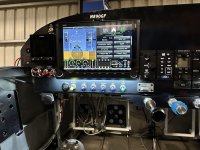
SEE PICTURE - Note Labels are photo shopped in. They look OK at this low angle, lower than if seated. Fuselage is not finished to test.

  • Does anyone know PANEL ANGLE?
  • Sight angle to lower part of panel? (guessing 30 degrees)
  • The G5, GRT EFIS and the ICOM Com have toggles below them.
  • Put label ABOVE swtich? Again concern about bezel blocking view.
  • Put labels BELOW switch? Switch will blocks the label when OFF.
  • Put labels ON SIDE of switch? That might address some of the issue, at least with IGN and TRIM switches.
  • Other Issue is at night shadow from glare shield light. This can be addressed with additional lights.

What did you all do with this situation?
 
Panel tilt forward about 8 degrees.
Make a cardboard panel & test fit it to determine sight angle.
Labeling could be above or below switch for best viewing- you determine depending on obstacles.
Not a good idea to have light colored panel if you intend to fly at night, the reflection glare off a 7 canopy would be very irritating.
 
Kinda ends up all the above. Depends on the switch. For example. P-mags. Down off (below), middle on ( beside), up test (above) then you have left and right. You should ask the DAR too. Mine are both. Off below. Function above. Then there's the controls and stick grips! Everything is supposed to be placarded so anyone will know how to use it.
20231009_155404.jpg
 
Panel tilt forward about 8 degrees.
Make a cardboard panel & test fit it to determine sight angle.
Labeling could be above or below switch for best viewing- you determine depending on obstacles.
Not a good idea to have light colored panel if you intend to fly at night, the reflection glare off a 7 canopy would be very irritating.

Ralph... Thank you for info... 8 Degree panel tilt (needed that). My fixture will allow me to tilt the panel if needed. I'll label a few with label maker and Est. Seated eye height. From that I'll be able to determine readability. IGN switches under Garmin G5 will be as shown, side. middle.
Panel color good tip. That is primer. Going darker grey top coat.
This is why I post dumb questions for smart tips. 😊
 
Kinda ends up all the above. Depends on the switch. For example. P-mags. Down off (below), middle on ( beside), up test (above) then you have left and right. You should ask the DAR too. Mine are both. Off below. Function above. Then there's the controls and stick grips! Everything is supposed to be placarded so anyone will know how to use it.
Larry thank you, with your reliable good advice. FAR wise, agree side, bottom, top OK . I looked at certified planes, Part 23 and Part 25 (air transport). They can be anywhere from Boeing to Cessna Twins.

Good tip on stick switch placard. I have one simple PTT. Typically I would not label this but will. Other 2nd PTT for right seat is in panel and will be placarded. On the stick cap (no fancy Military top gun grip bristling with switches) there is little room to placard "Push To Talk", make a circular placard and it will fit. On the other hand the PTT may be considered obvious.*

If you have no or sparse placards you will get dinged. Throttle, prop and mixture need placards. OFF position is needed (or as appropriated, etc). I do notice ON is often implied. Does not hurt to have ON as well. However you can go overboard and make it so busy it is less clear. If you look at a Boeing airliner, placards are short, minimal and simple. To all airline pilots TO/GA is known abbreviation. Even Pvt Pilots may know especially if they have a TAA (Technically Advanced Aircraft) with Autopilot and IFR GPS, that uses this nomenclature. However your typical fresh Pvt Pilot is not taught TO/GA abbreviation. I am a CFI, and that term TO/GA does not come up if we are bombing around in a non TAA (technically advanced aircraft) VFR C-152, C-172 or PA-28-XXX. However I do insist they read the definition sections in the AIM and FAR's.

Switchology is a whole field of study with PhD's and MD's. Bad ergonomics or "human factors" can / has contributed to accidents. In our simple sky scooters it should not be complex. For me I just want it useful and not an annoyance, best it can be. There are always compromises. In my case sight line will be less than optimal. I did think about it, only that there is limited space, and components I chose (or they chose me) gave me the boundary conditions, including cost.

A whole other topic for another time, DAR's or FAA airworthiness / final certification inspections run the gambit from perfunctory paper work exercise to a complete condition inspection, from my experience and experience of others I personally know. But placards are a must.


* PTT - Push To Talk may be obvious? Rudder Pedal L and R? Control Stick - "Pull Back Houses Get Smaller, Keep Pulling Back A Lot Houses Get Bigger Again". Ha ha.

"Aviation regulation 14 CFR § 27.1555, only cockpit controls that are not obvious require placards. Primary flight controls—yoke/stick and rudders—are excluded because their function is immediately obvious to the pilot and they are designed to operate intuitively, as described in FAA's Pilot Handbook of Aeronautical Knowledge."

Does the PTT qualify as obvious no placard needed? This is where a DAR or FAA inspectors comes in. Some may not notice or care. Others may really care, really notice, and really demand placards on EVERYTHING. As per TO/GA, at some point you must be a TRAINED PILOT on that aircraft. The Cessna 172 or Piper PA-28 built since 1955 and 1960 respectively, did not have standard panels as we know them. It was about 1968 and the "6 Pack" became standard. Beechcraft Bonanza did not start using a standard panels until 1982, before that it was shotgun approach. Vintage Beechcraft Bonanza Piano Key Switches all look the same for gear, flaps, which is not intuitive unless you are trained to fly an old Beech. Pretty sure that has resulted in gear up on roll up a few times.

Although the Cessna and Piper have different switch setups, hop in any Cessna to another or hop in any Piper to another, built in the last 50 yrs, you will know where the switches are. The big Piper rectangular TOGGLE switch with placards on switch, including ON and OFF, is ideal. Cutting square holes is not my thing. Modern ones are back lit. Total solution. The lit ones I think are expensive. I like simple Mil Spec toggles (which I bought years ago cheap). In E-AB's aircraft, you never know what you get. The best you can do is keep it as standard and simple as possible, with logical layout. Some electrical systems are so complex with unfamiliar switches with vague functions no one know except the builder. Placard & label we shall. PTT? I may risk it, go with it's obvious to a pilot, not needed. There are companies that make custom round switch placards, with text encircling switch.

 
Last edited:
Larry thank you, with your reliable good advice. FAR wise, agree side, bottom, top OK . I looked at certified planes, Part 23 and Part 25 (air transport). They can be anywhere from Boeing to Cessna Twins.

Good tip on stick switch placard. I have one simple PTT. Typically I would not label this but will. Other 2nd PTT for right seat is in panel and will be placarded. On the stick cap (no fancy Military top gun grip bristling with switches) there is little room to placard "Push To Talk", make a circular placard and it will fit. On the other hand the PTT may be considered obvious.*

If you have no or sparse placards you will get dinged. Throttle, prop and mixture need placards. OFF position is needed (or as appropriated, etc). I do notice ON is often implied. Does not hurt to have ON as well. However you can go overboard and make it so busy it is less clear. If you look at a Boeing airliner, placards are short, minimal and simple. On the other hand they are back lit and/or the placard is in the switch, typical push on push off switch that shutters the proper condition (on, off, auto).

Switchology is a whole field of study with PhD's and MD's. Bad ergonomics or "human factors" can / has contributed to accidents. In our simple sky scooters it should not be complex. For me I just want it useful and not an annoyance, best it can be. There are always compromises. In my case sight line will be less than optimal. I did think about it, only that there is limited space, and components I choose (or they choose me) gave me the boundry condition.

A whole other topic for another time, DAR's or FAA airworthiness / final certification inspections run the gambit from perfunctory paper work exercise to a complete condition inspection, from my experience to those others have had I personally know. But placards are a must.

* PTT - Push To Talk may be obvious? Rudder Pedal L and R? Control Stick - "Pull Back Houses Get Smaller, Keep Pulling Back A Lot Houses Get Bigger Again". Ha ha.

"Aviation regulation 14 CFR § 27.1555, only cockpit controls that are not obvious require placards. Primary flight controls—yoke/stick and rudders—are excluded because their function is immediately obvious to the pilot and they are designed to operate intuitively, as described in FAA's Pilot Handbook of Aeronautical Knowledge."
You might think of Switchology and labels in another way. Ergonomics and labeling all switches, buttons, levers, etc. are not best practices for you the builder, or even, you the owner. They are for the pilot, passenger, second owner, third owner, mechanic, avionics shop, and anyone else who has never seen your airplane until that moment but still needs to know what all of those things control. They will need to know what or how to do whatever those switches, buttons, levers, etc. do, at a time when you, the builder, and first owner, are not around to explain it to them.
 
You mean TO/GA doesn't mean put on a sheet and grab a brewsky? That explains a lot of awkward moments. 😁
 
This is what I did for my Dynon HDX panel. The angled bezel blocked my panel light so I added an LED strip below the angle directly. This is mirrored on the passenger side as well. Controlled by a dimmer knob
 

Attachments

  • IMG_5666.jpeg
    IMG_5666.jpeg
    2.6 MB · Views: 32
Back
Top