Van's Air Force

The definitive Van's Aircraft support community! Buying, building or flying an RV? Join our exclusive family of mentors and enthusiasts!

Spray Rack for Priming

Z32MadMan

Member
What have people come up with for holding parts while priming?

I build a chicken wire table that works fairly well for the larger flatter parts. I have have pondered some type of vertical setup that would allow me to spray the entire part without having to wait for them to dry and then flip. A problem with hanging that parts seems to be the amount of airflow from an HVLP spray gun swinging the parts around.

I'm hoping to streamline my priming process at much as possible.
 
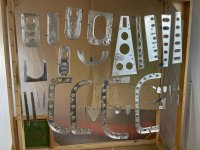
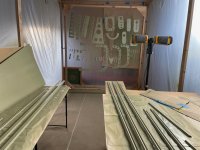
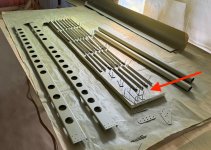
I built a rolling frame out of 2x4's. Added wire strung horizontally across the frame to hold parts. Worked great for me. I sprayed one side, flipped the frame around and sprayed the other. I put larger pieces and skins on tables.

IMG_5612.jpg

IMG_6579.jpg

IMG_6581.jpg
 
I used a cheap Wally baby gate for frame. Parts holder is a 3' piece of 1x2 and set Brad nails 2" apart. Then cut the heads off. Worked great. Every part has a hole. Spray angles down first then flip.
 
What have people come up with for holding parts while priming?

I build a chicken wire table that works fairly well for the larger flatter parts. I have have pondered some type of vertical setup that would allow me to spray the entire part without having to wait for them to dry and then flip. A problem with hanging that parts seems to be the amount of airflow from an HVLP spray gun swinging the parts around.

I'm hoping to streamline my priming process at much as possible.
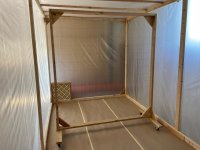
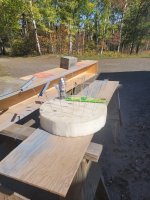
I used this method with bamboo skewers, from the dollar store, for the majority of my parts. Ribs, bulkheads etc. The different size skewers fit nicely in to the #40 and #30 holes. It’s easy to handle parts and spray 100% once you get the hang of it. Spray it, stab it in to foam block, repeat. I’ve never liked hanging parts especially when I switched to a spray gun. They really need to be secure or they’ll blow around. Saved a lot of time not having to rack parts. You’d be surprised how big a part you can spray using this method.
Resized_20210930_144024.jpeg
 
For hanging parts, make loops of safety wire and then use cheap string to tie the loops to your rack. Safety wire has minimum touch on the part and string lets you hang and tension it to reduce movement. For small tubing or parts, try an airbrush instead... Less chance of blowing them around while painting.
 
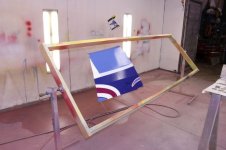
I have a grid table, but also a set of "picture frames" made out of 1x2's, a smaller version of what Dan showed. A series of holes around the perimeter. Use safety wire to hold/suspend the parts as needed so they don't swing away from the gun.
The frames are of various sizes and aspect ratios, so I can use whichever frame best fits the part(s). I can hold the frames when shooting the paint, or hang them. After shooting either hang or lean against the wall away from the action. I especially like using them for the finsh coats since I can orient the "shiney" side down after shooting to avoid settling dust.
 
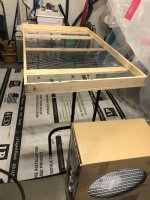
In the "booth", I used a spray table having 1/2" hardware cloth surface, and a filtered box fan exhaust below the table. I used the Stewart Eco_Prime water-based primer, so the drying time was practically zero and I could do it in the house in the winter. The 1/2" mesh was a good size to keep the small parts, too. Stringing up all the parts on frames would be very time consuming, if you're priming everything as I did (I know, I know....).
 

Attachments

  • Spray table & fan.JPG
    Spray table & fan.JPG
    1.9 MB · Views: 41
Easy to use PVC sprinkler pipe and create whatever works best for you. Also light and easy to move out of the way.
 
I built a down draft priming cabinet out of Vans crates. The counter area was chicken wire, suction provided by an old furnace fan, filtration was a couple furnace filters. I backed it up to an open door to exhaust fumes. All portable so could be stored when not in use. Parts were hung up on a ‘cloths line’ to dry after spraying. Could do a large volume of parts quickly & efficiently with this setup.
 
I found that "daisy-chaining" light parts on safety wire with a small weight at the bottom worked a treat when spraying. My weight is a piece of 1" 6061 aluminium scrap about 2" long, and it's just enough to prevent the parts flying around in the spray. Naturally it's become slightly heavier over time with overspray deposited on it!. I tried once to hook the daisy chain to my wire table, but found that I couldn't adequately rotate the parts to spray in one go. Once the painting is done, I just hang the daisy chain to dry, remove the weight, and do the next ones.
 
Back
Top