Van's Air Force

The definitive Van's Aircraft support community! Buying, building or flying an RV? Join our exclusive family of mentors and enthusiasts!

Too cold to fly?

Scott Hersha

Well Known Member
Friend
When is it too cold to fly? I know it’s cold everywhere right now, but can it be too cold to fly? I ask this question because the last time I flew my RV6, about a week ago, my oil temp never got above 133*. My oil cooler (O-360) is mounted on the firewall fed through a 3” SCAT hose from the #4 cylinder baffle. I have a cockpit controlled butterfly valve that is fully closed from about Oct 15 to about March 15. The temps here (Cincinnati) have been below freezing for almost a week and forecast to stay that way for at least another 10 days. I try to fly my plane at least once a week. In the winter time that can be a challenge. So is it better to just let the plane sit and not be flown, or to fly and not be able to get the oil above 130*? I did check the accuracy of my probe during phase one (boiling water method) and it was confirmed accurate. I wanted to fly today, but the temp this morning is -4* with a projected high of 15. I always preheat this time of year even though the inside of my hangar rarely gets below 40*. To fly or not to fly - that is the question….
 
That’s a good question - one I remember from my youth in Minnesota. Although we did fly the J-3 on skis in the winter, it was more because of the novelty of it that then the usefulness - it just took hours of effort to get an hour of flying. And yeah - the engine was so cold it didn’t really want to run at idle!

Another consideration (at least for those of us out here in the broad mountainous west) is are you prepared to survive if the worst happens and you go down somewhere away from civilization? In severe cold, you really need to be bundled up if you’re going to be out for only a couple of hours. I’ve got expedition-weight cold weather gear, but wearing it all makes it tough to fit in an RV cockpit!
 
When is it too cold to fly? I know it’s cold everywhere right now, but can it be too cold to fly? I ask this question because the last time I flew my RV6, about a week ago, my oil temp never got above 133*. My oil cooler (O-360) is mounted on the firewall fed through a 3” SCAT hose from the #4 cylinder baffle. I have a cockpit controlled butterfly valve that is fully closed from about Oct 15 to about March 15. The temps here (Cincinnati) have been below freezing for almost a week and forecast to stay that way for at least another 10 days. I try to fly my plane at least once a week. In the winter time that can be a challenge. So is it better to just let the plane sit and not be flown, or to fly and not be able to get the oil above 130*? I did check the accuracy of my probe during phase one (boiling water method) and it was confirmed accurate. I wanted to fly today, but the temp this morning is -4* with a projected high of 15. I always preheat this time of year even though the inside of my hangar rarely gets below 40*. To fly or not to fly - that is the question….
The people in Alaska do it. I bet a 10 minute call to one of the bush operators might yield some suggestions. Guessing blocking off oil cooler (more), sealing fins on the cylinders? Sounds to me like tipping the balance on the rate of heat leaving the engine.
 
The extra performance in the cold is noticeable in an RV too! For us here in MN, it's the getting in and out of the plane that's the biggest factor on a go/no.
 
Had a 57 172 that had a “winter” kit that basically blocked part of the cowl inlets…worked great. Flown year round in northern Wisconsin…
 
That’s a good question - one I remember from my youth in Minnesota. Although we did fly the J-3 on skis in the winter, it was more because of the novelty of it that then the usefulness - it just took hours of effort to get an hour of flying. And yeah - the engine was so cold it didn’t really want to run at idle!

Another consideration (at least for those of us out here in the broad mountainous west) is are you prepared to survive if the worst happens and you go down somewhere away from civilization? In severe cold, you really need to be bundled up if you’re going to be out for only a couple of hours. I’ve got expedition-weight cold weather gear, but wearing it all makes it tough to fit in an RV cockpit!
UND probably has the most cold weather experience of any of the large flight schools. My son said the limitations on cold weather flying were, as Paul stated, due to the concern about survival times for an off-airport rescue. According to the UND Aerospace Flight Safety Manual - below -23C is dual only, and there is no flying below -32C.

As to canopy cracks, the use of a radiant type hangar heater is more likely to cause a canopy to crack versus a forced air type heater due to the larger temperature differential of the canopy surface to the outside air.
 
I have a no-fly stop when the temp here in Minnesota is 20° F or colder, which is a good chunk of the winter. Daytime temps have been below zero F for about the last 7-10 days. Airplane just sits on a dehydrator 24/7, as well as a Reiff preheater and Hornet 45 cockpit heater on a Switcheon, both turned on about 4 hours before a flight. The cockpit is warm enough once the engine is warmed up, but all the in-hangar preflight stuff is just unpleasant at those temps. I've certainly flown in colder weather and would do so if I had a compelling mission, but that's uncommon. I did struggle with low oil temps too, but solved that with an Anti-splat oil cooler shutter on a Bowden cable. Canopy cracking has not been an issue over the last 5 years. I flew for the CAP several years ago...and we had a cutoff of 0°F. The 172XP that we flew had a terrible cockpit heater.
 
Lycoming SI 1505 says:

"The use of pre-heat will facilitate starting during cold weather, and is required when the engine has been allowed to drop to temperatures below +10°F/-12°C (+20°F/-6°C for –76 series engine models).

Be sure that the engine oil is in compliance with the recommended grades.....

CAUTION

THE ENGINE MAY NOT BE WARM ENOUGH FOR TAKEOFF IF THERE ARE INDICATIONS OF:

  1. ENGINE ROUGHNESS
  2. LOW, HIGH OR SURGING RPM
  3. HIGH, LOW, OR FLUCTUATING OIL PRESSURE
  4. HIGH OR LOW FUEL FLOW
  5. EXCESSIVE MANIFOLD PRESSURE"
They do not specify any "too cold temp" but offer a Tip on Cold Weather Operations. Much more to read but here is a clip.

"Engine operating temperature is another item that is not usually given enough consideration in cold weather. We usually are very cautious about high oil temperature which we know is detrimental to good engine health, while a low oil temperature is easier to accept. The desired oil temperature range for Lycoming engines is from 165˚ to 220˚ F. If the aircraft has a winterization kit, it should be installed when operating in outside air temperatures (OAT) that are below the 40˚ to 45˚ F range. If no winterization kit is supplied and the engine is not equipped with a thermostatic bypass valve, it may be necessary to improvise a means of blocking off a portion of the airflow to the oil cooler. Keeping the oil temperature above the minimum recommended temperature is a factor in engine longevity. Low operating temperatures do not vaporize the moisture that collects in the oil as the engine breathes damp air for normal combustion. When minimum recommended oil temperatures are not maintained, oil should be changed more frequently than the normally recommended 50-hour change cycle. This is necessary in order to eliminate the moisture that collects and contaminates the oil."

For me, -6C (21F) on the ground is my personal limit. Hard to get the oil temp up to 165 even at that. Just too cold in and out of the plane to be fun. Horrible winter here this year. Cold (2 weeks of around -10C/14F steady) so far, windy and lots of snow. Been here 35 years and never a winter like this. Can't wait for spring!
 
Below 40F, I have my oil cooler completely blocked and part of the front cylinder head cooling fins blocked with aluminum tape (just the flat, front facing portion of the fins on the 2 front cylinders, otherwise there's a big CHT split between the fore and aft cylinders). Below 20F my cabin heat can't really keep up so I'll only fly if it's an exceptionally nice day with bad weather for the foreseeable future. I did 1.6 hours yesterday and it was 16F on the surface and 7F at 4500'. Not super comfortable but doable. Oil temp gets up to 165F or so and CHTs are 300-320F for a WOT LOP cruise.
I'm planning on adding a second heat muff to hopefully get the cabin heat to be more effective, it's okay at around freezing, but still not what I'd call comfortable.
 
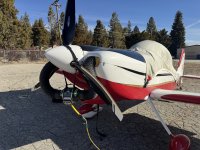
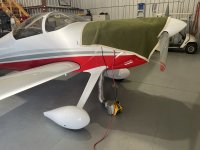
I had to run down to Big Bear Lake last weekend for a couple of nights. We keep a hangar there, but unfortunately, it’s the winter quarters for our Tundra, so the Valkyrie had to spend its time on the ramp. Fortunately, we are friends with the airport manager, and he offered this interesting little heater unit and a couple of long extension cords - the ramp guys even offered to put it on and hook it up for me while I was “down the hill”. It wasn’t terribly cold (mid-20’s overnight), but cold enough that starting coudl have Ben an issue - I was ready to use the start cart to save the battery if needed. But when I got to the airplane Sunday morning, the cowl was warm to the touch from this ”recirculator”. The airplane started fine - but the oil temperature was off-scale-low for several minutes. So as you’d expect, this does a nice job of cylinder warming, but heat rises - the sump just sat there getting cold….. Not something you’d want to rely on in extreme cold conditions, but nice for Southern California!😉

Very nice of the Big bear guys to loan us the unit though - and when they saw me out there packing up, they even drove over to pick it up and put it away!IMG_8022.jpeg
 
A search of record cold temperature shows:
NY minus 52
ME -50
MN -60
In a previous life I was flying a Twin Commanche. Overnight in Watertown NY, AM temp -45. We preheated and then got some water out of the fuel system. Airborne, turned on the heater, nothing happened. Flew to Pittsfield MA. Clothing completely inadequate.
Ten plus years later I learned about snowmobile suits electric socks etc. Part of the learning process was central NY to FL with 10 degrees for takeoff in the Pitts, totally inadequate clothing. No heater, lots of ventilation.
Now I don't fly if the temp is below 40 degrees.
 
If you preheat your oil/sump your good to go. Once your airborne you can keep an eye on oil temperature. If needed you can block the oil cooler airflow
 
I've asked similar question before with respect to my RV-10 in cooler weather. My concern is the differential expansion coefficients between the aluminum, the fiberglass cabin top and the windows and windscreen. They all have different expansion coefficients so when they are cooled rapidly I would expect some cracking and bond failures to occur as they respond to the temperature change at different rates.
I live in Canada and winter flying temperatures allow as -40F are not unheard of. I will say first that if you've never done it before you HAVE to fly at least once in the cold! Even a lowly 172 will climb at 2,000 fpm plus in the -8,000' density altitude that the colder sub zero temperatures will get you. Your lowly 150 HP engine is also now turbocharged with the very dense cold air.
To try and mitigate the rapid contraction concerns I will turn the hangar heat down to say 40F a day before, plug in the oil pan heater with the cowl blanket and then pull the airplane outside after completing the preflight inside the warm hangar. So far I've been down to a relatively warm 10F with no ill effects. I have modified the front air dams for the cylinders and I close off the air to the oil cooler with an adjustable butterfly valve in the 4" duct. Oil temps get up to 165F without any problem and my oil is already at 100F prior to startup. These engines are very happy to run in the cooler air provided some adjustments such as the ones above are made.
One very important thing is to make sure you drill a relief hole in your crankcase breather tube somewhere up higher under the cowl. Crankcase breathers put out a lot of moisture. At colder temperatures that moisture will freeze where it hits the Airstream and can freeze your breather shut. The crankcase will build up pressure and blow the front oil seal out followed by all your oil. That will ruin your day.
Otherwise cold weather flying is great!
The aircraft is crisp and cool, usually very smooth and your airplane performs like it has gotten 100hp upgrade!
 
A search of record cold temperature shows:
NY minus 52
ME -50
MN -60
Those are the extremes for sure, nonetheless sobering. -30 is not rare here (was that cold here two nights ago), but it does make one pay attention. I was snowmobiling on the North Shore of Lake Superior on Feb 2,1996, about 10 miles East of Tower, Minnesota when the temps hit that record of -60°F . We rode every day. I'm no Viking, but no stranger to cold weather over the last 40 years living here. I didn't think anything 30 years ago when I was flying CAP ELT and missing-person missions in Minnesota winter temps, but I must confess as I age that those temps require an energy that I just don't have anymore.
 
If you preheat your oil/sump your good to go. Once your airborne you can keep an eye on oil temperature. If needed you can block the oil cooler airflow
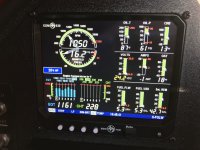
I preheat my oil and my cylinders before flight this time of the year every time I fly. My OT is 100 or above when I start my engine. I also have 100% of the air blocked from going through my oil cooler. My in flight OT still can’t make it above 135* on these very cold days. Normally the daytime highs for this area is in the mid to upper 30’s. During those normal conditions my OT will make it to about 145-150. On a 50* day, I’ll see maybe 160-165. These are all with my oil cooler butterfly fully closed.
 

Attachments

  • IMG_3241.jpeg
    IMG_3241.jpeg
    3.5 MB · Views: 72
  • IMG_3242.jpeg
    IMG_3242.jpeg
    3.2 MB · Views: 70
  • IMG_3604.jpeg
    IMG_3604.jpeg
    3.2 MB · Views: 71
Last edited:
Fuel can freeze at -40 (C or F since they are the same at that temp). Probably why the flight school limits are -32. I flew at -40 at FL21 in a Mooney Rocket before I knew the fuel might freeze but had absolutely no problem.
 
I preheat my oil and my cylinders before flight this time of the year every time I fly. My OT is 100 or above when I start my engine. I also have 100% of the air blocked from going through my oil cooler. My in flight OT still can’t make it above 135* on these very cold days. Normally the daytime highs for this area is in the mid to upper 30’s. During those normal conditions my OT will make it to about 145-150. On a 50* day, I’ll see maybe 160-165. These are all with my oil cooler butterfly fully closed.
Those temps look fine for me
 
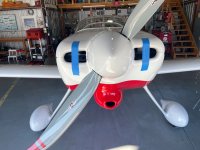
Scott - As another Ohioan, some past posts by Canadian RV'ers led to my very sophisticated "4-layers-of-painters-tape" approach to cold weather flying. As temps get lower, simply use wider tape - after awhile you sort get a feel for tape-width calibration (!). Even though my James cowl definitely overcools this time of the year, this approach results in CHTs in the 350-380F range, and oil temps in the 170F'ish range for routine flights.

All things equal I am also impressed with the durability of the four tape layers; has barely ever looked like it was out running around at 175+ mph. [And yes, the visual always draws attention at the fuel pump, not to mention comments from the occasional passenger...]
 

Attachments

  • 20260130_135958.jpg
    20260130_135958.jpg
    1.6 MB · Views: 131
I am a former northern MI flier, now in OH. It would have to be really, really cold to stop us from flying! The coldest I have flown is -5F ground temp, before windchill. It goes without saying preheat is a must. My RV has the Antisplat oil shutter but this is still not sufficient to keep oil temps over 160F in extreme cold.

What me and most of the other all season fliers do is exactly what was noted above - the same blue painters tape. 3-4 layers works perfect! I always tape over 80% of the cockpit vents, and about 25% of the cowling inlets. Then an oil temp of 170 or so can be maintained all the way down to OAT's of -10F or so.

The performance from these airplanes in cold weather is nothing short of astounding when there are no temp limits and your starting density altitude is negative 1000+ ft on the ground. I think my best time to climb from a starting elevation of 900 ft to 14k is slightly less than 9 minutes.

I will say my biggest concern for taping various inlets and vents over is the risk for CO poisoning with reduced outside air for cockpit ventilation. This has brought planes down before so use a CO detector!
 
Scott - As another Ohioan, some past posts by Canadian RV'ers led to my very sophisticated "4-layers-of-painters-tape" approach to cold weather flying. As temps get lower, simply use wider tape - after awhile you sort get a feel for tape-width calibration (!). Even though my James cowl definitely overcools this time of the year, this approach results in CHTs in the 350-380F range, and oil temps in the 170F'ish range for routine flights.

All things equal I am also impressed with the durability of the four tape layers; has barely ever looked like it was out running around at 175+ mph. [And yes, the visual always draws attention at the fuel pump, not to mention comments from the occasional passenger...]
Yes, great idea. I’m planning on flying on Sunday and I’m going to try that - 4 layers of 4” wide painters tape over my inlets. However, my problem isn’t my CHT’s - it’s my OT, but maybe if my cylinders can get a little hotter, my oil will be too.
 
It’s supposed to be really cold this weekend and I’m sure that’s right because I heard Walmart issued a warning that shoppers should wear 2 pares of pajama pants.

Seriously, I have the Antisplat shutter on my oil cooler because my plenum is extremely effective and without it, the oil doesn’t get to 180 in the summer. My next flight will be with it 50% closed and I’m not sure even that will be enough.

During the summer, the AS shutter in open position was perfect. I flew a few days ago when the ambient temp was 40 and the oil was 150F. CHT’s were in the 340’s.

One thing about cold weather flying is the plane climbs like a homesick angel.
 
Scott - As another Ohioan, some past posts by Canadian RV'ers led to my very sophisticated "4-layers-of-painters-tape" approach to cold weather flying. As temps get lower, simply use wider tape - after awhile you sort get a feel for tape-width calibration (!). Even though my James cowl definitely overcools this time of the year, this approach results in CHTs in the 350-380F range, and oil temps in the 170F'ish range for routine flights.

All things equal I am also impressed with the durability of the four tape layers; has barely ever looked like it was out running around at 175+ mph. [And yes, the visual always draws attention at the fuel pump, not to mention comments from the occasional passenger...]

Preheat and use tape. You will get at judging what is required.
 
Scott - As another Ohioan, some past posts by Canadian RV'ers led to my very sophisticated "4-layers-of-painters-tape" approach to cold weather flying. As temps get lower, simply use wider tape - after awhile you sort get a feel for tape-width calibration (!). Even though my James cowl definitely overcools this time of the year, this approach results in CHTs in the 350-380F range, and oil temps in the 170F'ish range for routine flights.

All things equal I am also impressed with the durability of the four tape layers; has barely ever looked like it was out running around at 175+ mph. [And yes, the visual always draws attention at the fuel pump, not to mention comments from the occasional passenger...]
I’m in Minnesota and fly down to zero degrees F in my RV-7A. I use the painters tape to reduce the size of the cooling inlet cheeks. It really does stay in place at 160 knots. I also completely cover the oil cooler with aluminum tape. I keep my oil level at 6 quarts in the winter as less oil stays warmer. I also keep the engine rpms up in the 2400 range when it is 5 degrees F or less on the ground. My oil temp stays in the 170 - 180 range. I have the Vetterman trombone exhaust with two heat muffs so the cabin stays warm even at zero F. My biggest concern when flying at these low temps is shock cooling my engine when coming in for a landing.

Best regards,

Bill Wuorinen
Osprey 2 amphibian N137W
RV-7A N237W
 
my phase1 testing after the engine was broke in, I did some full power runs. It was January 2010 and ground temperature was 5*F and -10* at 6500’. I was astonished at the climb rate leaving Bozeman(KBZN) was near 3000fpm. The air dead smooth, Straight and level was was showing 192-194KTAS. The wing was working, the WW200RV was grabbing the thick air. I couldn’t believe the performance out of my parallel valve IO-360. Zoom zoom.

Oh I put Aluminum tape on 2/3 of inlet face of the oil cooler to increase oil temperature up. IMG_9001.jpeg
 
I had to run down to Big Bear Lake last weekend for a couple of nights. We keep a hangar there, but unfortunately, it’s the winter quarters for our Tundra, so the Valkyrie had to spend its time on the ramp. Fortunately, we are friends with the airport manager, and he offered this interesting little heater unit and a couple of long extension cords - the ramp guys even offered to put it on and hook it up for me while I was “down the hill”. It wasn’t terribly cold (mid-20’s overnight), but cold enough that starting coudl have Ben an issue - I was ready to use the start cart to save the battery if needed. But when I got to the airplane Sunday morning, the cowl was warm to the touch from this ”recirculator”. The airplane started fine - but the oil temperature was off-scale-low for several minutes. So as you’d expect, this does a nice job of cylinder warming, but heat rises - the sump just sat there getting cold….. Not something you’d want to rely on in extreme cold conditions, but nice for Southern California!😉

Very nice of the Big bear guys to loan us the unit though - and when they saw me out there packing up, they even drove over to pick it up and put it away!View attachment 108528
I’d guess that would do a better job on the oil sump if the outlet was piped into the bottom of the cowl and the unused inlet side blocked with the foam.
 
One thing I haven't seen touched on yet is temperature ratings of the systems in the plane. Some avionics boxes are rated to -20°c (-4°f) most are better. Dig through the manuals of the components installed in your plane, and see what is limiting.

As for clothing, dress for the crash. Then you'll certainly be warm enough if nothing goes wrong. If it's 0°f outside, dress to spend several hours outside in 0°f. Then you'll be warm enough should one land somewhere unexpected.

This one has been mentioned before, but I'll reiterate it. You need a method to vent the crank case if the normal vent becomes plugged with ice. I know 3 people who have blown out crank case seals, and force landed their plane with a windshield covered in oil.
 
. I didn't think anything 30 years ago when I was flying CAP ELT and missing-person missions in Minnesota winter temps, but I must confess as I age that those temps require an energy that I just don't have anymore.
When growing up in Minnesota I would rent a tomahawk and fly on 0 degree days. Now in STL for 40 years and getting old, I still fly when in 20s but below that it is just to cold and effort to get airplane out, started, and warmed up. I fly for fun. Below 20 is not fun for me.
 
I've done a 7 hour out and back X/C where both ends were 10F. Luckily it was a sunny day to help the cabin heat. I wouldn't do that unless there was a real purpose for the trip. Otherwise, I'm probably not venturing to the airport on a day where its not gonna crack 40.
 
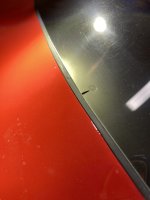
After 1500-ish hours including lots of MN winter flying, this happened last February on a 10F day. I watched the crack grow from the base of the windscreen up to about 3/8” above the fiberglass fairing.

So that was fun.

IMG_7700.jpeg
 
I have the Anti-Splat oil cooler shutter, and when temps are in the 20ies and below I cannot get oil temps above 135 even with the shutter fully closed.
1) Is it really bad to run the engine with low oil temps like that?
2) My oil cooler is on the baffle behind cylinder 4. The shutter is in front of the cooler. Do you think taping off the rear of the cooler will help?
 
I have the Anti-Splat oil cooler shutter, and when temps are in the 20ies and below I cannot get oil temps above 135 even with the shutter fully closed.
1) Is it really bad to run the engine with low oil temps like that?
2) My oil cooler is on the baffle behind cylinder 4. The shutter is in front of the cooler. Do you think taping off the rear of the cooler will help?
Only a minimal amount of oil should be flowing through the cooler at that temp, so blocking it off more shouldn't make much of a difference, unless of course your vernatherm is stuck open and sending more oil through the cooler than it should. I have an O-320 in my -6 and block off just the front of the cooler with aluminum tape. In these temps I'm usually seeing 165-170F for oil temp. This is running it WOT LOP cruise at 2500RPM.
 
I am so delighted to report this thread is completely useless to me. But boy does it make interesting reading :-o
 
One thing you have to be careful of is breather line freezing. If it blocks off it will blow the front seal out of the engine resulting in total loss of oil. In cold weather operations lag the Breather line and cut a bi pass hole a few inches from the bottom.
 
I am so delighted to report this thread is completely useless to me. But boy does it make interesting reading :-o
Now you’re just bragging……. Although, in the southern hemisphere, doesn’t the oil flow through the cooler in the opposite direction?
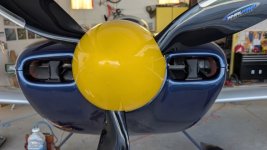
 
I mounted an angled fence on the bottom of both cowl inlets that cover about a 1/4 of the opening. Nutplates on th cowl for easy on off. Works like a charm.

Flying up in the arctic we limited our piston airplanes to -40 C.

Not a great shot but you can see it in the left side
 

Attachments

  • IMG_8622.png
    IMG_8622.png
    2.4 MB · Views: 74
Scott - As another Ohioan, some past posts by Canadian RV'ers led to my very sophisticated "4-layers-of-painters-tape" approach to cold weather flying. As temps get lower, simply use wider tape - after awhile you sort get a feel for tape-width calibration (!). Even though my James cowl definitely overcools this time of the year, this approach results in CHTs in the 350-380F range, and oil temps in the 170F'ish range for routine flights.

All things equal I am also impressed with the durability of the four tape layers; has barely ever looked like it was out running around at 175+ mph. [And yes, the visual always draws attention at the fuel pump, not to mention comments from the occasional passenger...]
I tried the blue tape mod today and I think it’s a positive modification. It was 21* in Cincinnati today (relative heat wave lately) when I took off at 1pm. I preheated my engine for 3 1/2 hours prior to engine start and my cylinders were all at 85-90*, and my OT was 105 at engine start. I have to say, it was an absolutely beautiful day to fly here. Incredible visibility and almost no wind. On initial climb, I saw CHTs that were 380-385, which is unusual this time of year. My OT made it up to 162 after about 15 minutes of flight running 70% power (O-360, carbed). After cruising for a little while my CHT’s settled at the 330-340 range, and OT stayed at 160. Fine with me. I think the blue tape made a difference, but I will test again at similar temps without the tape to make sure. But in consideration to David (Delaware, OH), I think this mod should be called the Ohio mod. I know it may have started in Canada, but David and I don’t live in Canada. 4 layers of blue painters tape works and it actually stays in place. Easy to remove when it warms up. Keep it simple……..
 

Attachments

  • E8B9B604-89CD-4C87-A284-66C82CB86621.jpeg
    E8B9B604-89CD-4C87-A284-66C82CB86621.jpeg
    2.6 MB · Views: 36
Here are a couple suggestions.
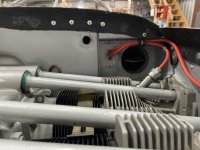
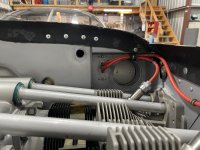
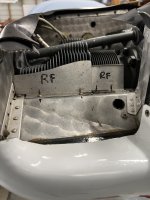
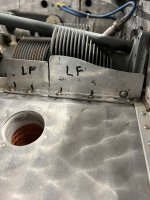
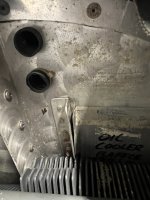
1. Make an aluminum blocking plate to place on the front of the oil cooler; makes a big difference in oil temperature.
2. I will try to attach pictures of aluminum blocking plates placed in front of the two front cylinders to raise the cylinder temperatures. Install nut plates where two screws hold each baffle plate down
 

Attachments

  • IMG_9406.jpeg
    IMG_9406.jpeg
    1.8 MB · Views: 57
  • IMG_9409.jpeg
    IMG_9409.jpeg
    1.9 MB · Views: 55
  • IMG_9408.jpeg
    IMG_9408.jpeg
    1.2 MB · Views: 55
Second nice sunny day in a row here...a new record for the year! Flew again today at -8C with my new RVplasticParts 2" winter baffles. Cyl head temps in the low 300's and oil temp 185F. Collingwood for lunch followed up by a scenic flight past Wiarton with some upper air work. Fun day!
 

Attachments

  • PXL_20260202_190240501.MP.jpeg
    PXL_20260202_190240501.MP.jpeg
    56.5 KB · Views: 63
Fuel can freeze at -40 (C or F since they are the same at that temp). Probably why the flight school limits are -32. I flew at -40 at FL21 in a Mooney Rocket before I knew the fuel might freeze but had absolutely no problem.
That's for Jet A - 100LL freezes at -58C, -72F. I don't think any of us are going to be worrying about that.
 
Back
Top