



I took N720AK up for first flight on Thursday, after 10 years, 7 months and 4 days of building. It is a surreal feeling to lift off of the ground, sitting in the same spot I've sat in so many times in the hangar, fiddling with waxed lacing tape. It's been a slow transition from seeing the plane as a collection of flimsy aluminum sheets to its current state, where I apparently trust it enough to climb in and push the "go" lever.
I can't thank my wife Jenna enough for supporting (and tolerating) the project, from our starting point in 2015 as a climbing, running, biking couple, to our current state as parents of 3 (7yo and twin 3.5yo), where time is much more precious. Builder/pilot Trevor Vita was essential as well, showing up over the summer and volunteering to help me finish, doing a ton of work and un-sticking me for this final phase. Thanks also to Dave Paule, Larry Larson, Chris Wood, and the rest of the CO builder community. And of course Vans Air Force!!
Of course, the first flight wasn't without excitement. I had so much tunnel vision on pitch + "eyes outside" that I just didn't follow my plan at all of monitoring CHT + airspeed. It took me about 2 minutes and a "CHECK PITOT HEAT" alert to realize that I had no airspeed indication. First, a picture, then my explanation of why, how I missed this on the ground and what the fix was.
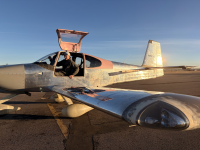
I got a pitot/static certification a few weeks ago, where the technician hooked pressure lines up to the pitot tube and the static ports and did a bunch of checks. This showed that my airspeed and altimeter were working great with no leaks... what I didn't realize is that the pressure line over the pitot was EQUALLY pressurizing the AoA port and the pitot port (which does not happen in flight).
I had noticed that I had no airspeed indication while taxiing... but I never taxied that fast, and Dynon notes that airspeed only comes alive at 20 knots. I figured I'd pay attention on take-off roll and pull the power if I still saw the issue.
Another check I did was having Trevor blow into the pitot tube. When he first did this we saw no airspeed. He tried again, covering the AoA port, and, boom, airspeed jumped up! Huh, I thought, there must be some calculation it's doing internally that causes a 0 indication in this unrealistic ground condition? That's definitely wrong. The real answer is that they share a vent hole, so blowing into the pitot line pressurized the AoA line (which was hooked up to my pitot internally)
So, 1500' into the air or so, I finally notice that I have no airspeed. I did have a groundspeed indication and decided to run my approach using groundspeed. Again, new at this, I only realized later when talking with Trevor that groundspeed up here at altitude would read higher than indicated airspeed, leading to a slow approach.
At some point, I think when I slowed down to approach speed to test the flaps, I saw my airspeed blip in at ~20 knots then go away. This was a strong clue that the AoA port was hooked up to the pitot line, and was slightly pressurized by the higher AoA.
Everything went fine with the landing, but I had less flare authority than I expected, almost certainly due to this groundspeed / airspeed mismatch.
After landing, we took the wingtip off and I disconnected both lines from the pitot and had Trevor blow into the pitot line. Sure enough, I had them switched... spooky but recoverable and another arrow in the "experience" quiver.
Here's the full video of the first flight, from taxi to parking. Thanks again for everything, all!
I can't thank my wife Jenna enough for supporting (and tolerating) the project, from our starting point in 2015 as a climbing, running, biking couple, to our current state as parents of 3 (7yo and twin 3.5yo), where time is much more precious. Builder/pilot Trevor Vita was essential as well, showing up over the summer and volunteering to help me finish, doing a ton of work and un-sticking me for this final phase. Thanks also to Dave Paule, Larry Larson, Chris Wood, and the rest of the CO builder community. And of course Vans Air Force!!
Of course, the first flight wasn't without excitement. I had so much tunnel vision on pitch + "eyes outside" that I just didn't follow my plan at all of monitoring CHT + airspeed. It took me about 2 minutes and a "CHECK PITOT HEAT" alert to realize that I had no airspeed indication. First, a picture, then my explanation of why, how I missed this on the ground and what the fix was.
Missing Airspeed
The Dynon AoA pitot has two lines coming out of it, one green, one blue. One's for pitot, one is a 45-degree offset for angle of attack calculations. I was careful about the internal runs of these green and blue tubes, but apparently I hooked them up backwards to the two uncolored aluminum tubes coming out of the pitot tube.I got a pitot/static certification a few weeks ago, where the technician hooked pressure lines up to the pitot tube and the static ports and did a bunch of checks. This showed that my airspeed and altimeter were working great with no leaks... what I didn't realize is that the pressure line over the pitot was EQUALLY pressurizing the AoA port and the pitot port (which does not happen in flight).
I had noticed that I had no airspeed indication while taxiing... but I never taxied that fast, and Dynon notes that airspeed only comes alive at 20 knots. I figured I'd pay attention on take-off roll and pull the power if I still saw the issue.
Another check I did was having Trevor blow into the pitot tube. When he first did this we saw no airspeed. He tried again, covering the AoA port, and, boom, airspeed jumped up! Huh, I thought, there must be some calculation it's doing internally that causes a 0 indication in this unrealistic ground condition? That's definitely wrong. The real answer is that they share a vent hole, so blowing into the pitot line pressurized the AoA line (which was hooked up to my pitot internally)
So, 1500' into the air or so, I finally notice that I have no airspeed. I did have a groundspeed indication and decided to run my approach using groundspeed. Again, new at this, I only realized later when talking with Trevor that groundspeed up here at altitude would read higher than indicated airspeed, leading to a slow approach.
At some point, I think when I slowed down to approach speed to test the flaps, I saw my airspeed blip in at ~20 knots then go away. This was a strong clue that the AoA port was hooked up to the pitot line, and was slightly pressurized by the higher AoA.
Everything went fine with the landing, but I had less flare authority than I expected, almost certainly due to this groundspeed / airspeed mismatch.
After landing, we took the wingtip off and I disconnected both lines from the pitot and had Trevor blow into the pitot line. Sure enough, I had them switched... spooky but recoverable and another arrow in the "experience" quiver.
Here's the full video of the first flight, from taxi to parking. Thanks again for everything, all!


 CONGRATULATIONS!!
 ? the flaps yet). Every checklist item ends with UP to make them all fit together.

