Van's Air Force

The definitive Van's Aircraft support community! Buying, building or flying an RV? Join our exclusive family of mentors and enthusiasts!

Start Circuit On

dmattmul

Well Known Member
Benefactor
Sponsor
I have read multiple times about a start circuit staying engaged and creating a bad day for the pilot. VPX has a start circuit engaged feature but has anyone done this with a discrete? Before we were limited with number of discretes with the GEA24 but now with the GAD 27 we have a lot. Thanks
 
I've designed my electrical but have not implemented it yet. I do have an extra discrete input but I wouldn't mind saving it for future use. So I was thinking that, since I'll have current monitoring, I'd be able to program my G3X system to pop up some sort of warning if the bus current is really high (ideally if it has been really high for longer than X seconds). That might allow me to detect a stuck starter without using another discrete input.

I'm not completely sure if my plan is feasible or not. But to use a discrete input to monitor the starter you could:
  • Feed the +12V from the switch into the discrete -- easy but only tells you if the switch is stuck on
  • Feed the +12V from the contactor into the discrete -- you'd be attaching a very small wire to a very large wire and you'd need circuit protection on that wire, but it will detect if the contactor itself is stuck open which I assume is the more likely scenario.
  • There are contactors (like some of the Gigavacs) that will turn on/off a signal switch in addition to the high-current relay (auxiliary leads). This lets you put a discrete through the actual relay portion of the contactor without having to worry about connecting it to the big starter wires.
 
Last edited:
The failure mode matters -- see closing comment.

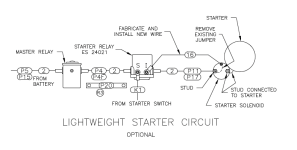
Connect the "I" terminal on the Littelfuse/ColeHersee 24021 Starter Relay (Van's ES24021) to a discrete input on the GEA 24 or GAD 27, configure for Active Hi.
This will indicate that the aforementioned starter relay is energized and sending current to the starter solenoid/motor. This assumes starter and wiring is IACW Van's OP-10 "Lightweight Starter Circuit" - excerpt attached:

Screenshot 2026-01-27 at 10.03.37 AM.png

Additionally, one could install a current sense (hall effect) on the BFW from the Starter Relay to the Starter Motor, configure for "Amps #" ,or whatever, and then set an alarm when any current is sensed (>0)

Both of these suggestions consider that voltage/current is flowing and keeping the starter engaged/hung -- it doesn't do anything for a mechanically hung up pinion with the starter or relay(s) un-energized.
 
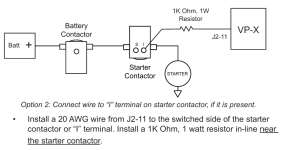
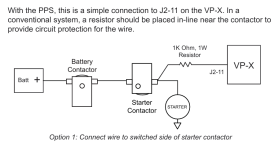
This is how VPX suggest it to be wired:

Screenshot 2026-01-27 161420.pngScreenshot 2026-01-27 161348.png

Seems going to a discrete would be as effective but as Brian mentions doesn't tell you the entire story. I would love to have a hall effect sensor on my main starter lead to differentiate between a starter that the pinion is stuck vs a hung starter solenoid vs some transient 12-volt signal going to my EFIS.
 
I just connected the "I" terminal on the starter solenoid to a discrete LED lamp on instrument panel labelled "STARTER ENGAGED"
 
Seems going to a discrete would be as effective but as Brian mentions doesn't tell you the entire story. I would love to have a hall effect sensor on my main starter lead to differentiate between a starter that the pinion is stuck vs a hung starter solenoid vs some transient 12-volt signal going to my EFIS.
Can you please clarify how the hall sensor would help diagnose a stuck pinion? Does the engaged starter generate reverse current through the cable?
 
Can you please clarify how the hall sensor would help diagnose a stuck pinion? Does the engaged starter generate reverse current through the cable?
Only if the starter motor was a PM type and the circuit back to the battery was completed -- if the starter solenoid is "open" (not energized) all you will see on the BFW is a voltage potential, but no current in the case of a hung start -- no current, no field, nothing for the hall effect to sense....

Alternative to the hall effect, would be a voltage pick off from the BFW terminal. But put a current limiter (resistor) inline -- 10Kohm or so.

Again, this is the weird corner case with a PM starter -- field wound ("inline") starters don't become generators...
 
Last edited:
Can you please clarify how the hall sensor would help diagnose a stuck pinion? Does the engaged starter generate reverse current through the cable?
I talked to B&C to discuss ~ how many amps their starter would pull with the engine running (I do not have a B&C starter but a Skytek NL) and they were not sure but guessing ~ 25 amps. (They were not even sure the amps that their own starter would pull under these conditions) This of course is with the starter engaged and powered. If the pinion was stuck and the engine running but the starter engaged but not powered, I am guessing considerably less than that, but just a guess. Of course, sensing if there was 12 volts at the starter would help.

I am still trying to troubleshoot an issue I had where I received a CAS warning that the starter was seeing 12 volts. What that means I'm still not sure. My 60-amp B&C alternator was only putting out ~45 amps and this seems typical at my 750 RPM idle. I did not advance the throttle once I saw the CAS message. My load on my main bus was ~15 amps and my voltage was ticking up albeit very slowly. When I went to shut down (about 10 secs after start-up) the prop seemed to keep turning for a few seconds longer than normal but that is very subjective. When I went to shut down, I turned off the master (which is how one turns off a EFI system) so my data recording stopped. If this happens again, I will turn off the ignitions and pull the breakers for the fuel pumps and ECU's and leave the data recording on. (Hope there is not a next time) There was no damage to the starter ring, starter, pinion or anywhere else. The plane has been flown a dozen times after the incident and no issues.
 
I have read multiple times about a start circuit staying engaged and creating a bad day for the pilot. VPX has a start circuit engaged feature but has anyone done this with a discrete? Before we were limited with number of discretes with the GEA24 but now with the GAD 27 we have a lot. Thanks
Think about the failure(s) that must be mitigated, the major issue is start solenoid welding itself together. Take a discrete from the starter fat terminal and route it to the GEA or GAD. 12v (ish) means starter engaged. 0v means it has shut off correctly. Some nations require a panel mounted warning light for exactly that purpose.
 
Back
Top