

There was a separate inventory list at the top of the big crate. Have fun!
Thanks!


There was a separate inventory list at the top of the big crate. Have fun!
ThanksLooks like around 3 feet/1meter is great. the minimum is probably about 27”.


It shocked me when I started building the 12 in that Van's only provides the exact number of hardware components needed. This includes any specialty rivets like CherryMax and some other pulled rivets. Most solid rivets do have a few extra. Drop anything you better find it because you will need it!I had a PM asking about the whether the RV-15 bins carry the EXACT number of rivets for each size or are there extras. As best I can tell, they only send the EXACT number of rivets. In the inventory, I counted the smaller groups (say, less than 20) and they were all exact. Mess one or two up and you'll have to scrounge or buy more. I can't say for sure on the larger quantities but so far I have found no extras.
I am extremely fortunate (in so many ways!) to have Paul's resources available and he has extras of nearly every size called for in the plans. If you are getting ready to build, my first suggestion is to find out who on your field has this sort of resource and start being really nice to them. Maybe ask up front if you can buy 5 or 6 of the rivets you'll be using from them. Alternatively, start developing your own collection of extra rivets, perhaps ordering when you make a larger order from Aircraft Spruce or such.
Tip, wing, left and Tip, wing, rightSpecific question.
Can you tell me what parts the W-15041-001 and W-15041-002 are? It says they are backordered but I haven't been able to find them in the plans that are available, though the part number is in the same range as some of the landing light parts.
Thanks, Louise - this is all useful. Mine arrives Monday, anxious to get started.SECTION 28 partial
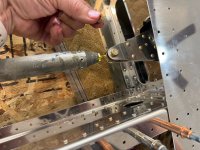
While work slowed this week due to life, I did get through Section 28: Aileron bellcrank and pushrod assembly as far as parts allowed. The lack of back ordered parts is starting to be a barrier. Up through page 28-8, things were straight forward and somewhat interesting. New to me (and Paul) was using holes in the forward wing spar to adjust the jam nuts on the aileron-mixer pushrod. Clever! Certainly nothing like this on our RV-3B.
View attachment 107401
Clever, those Van's folks! Two holes drilled into the forward wing spar are used to adjust the jam nuts on the aileron-mixer pushrod. Two other pairs of holes in the spar were used to adjust the length of other pushrods.
On page 28-9, things got a little wonky. The diagram is fine but the numbers called out in the text are confused. It is easy to figure out but Van’s needs to correct the text instructions. Pages -10 and -11 were fine but basically the same confusing instructions and drawings were used for the other end of the pushrod on page -12. Again, very easy to figure out. Pages -13 through -15 went smooth but I hit a problem with the lack of a part on page -16, which impacted later pages, as well. Page 28-18 was fine, although I added some electrical tape on the rib holes to protect the pushrod from being scratched. I plan to remove it later, when the pushrod is attached at each end.
On page 28-19, there were significant issues with the numbers in the instructions and on the lower diagram. The upper diagram seemed almost right (missed one washer call-out) but, it took awhile to figure out. I send the information to Van’s and even talked to one of their people so we will hopefully see revised drawings/instructions soon. If you are a first-time builder and don’t have an experienced builder handy to help puzzle it out, it may be time to put down the tools until new KAIs are released for this Section. I was able to complete this page (after confirmation by Paul that I had things in their proper place) but the remaining pages will wait until back ordered parts come in.
View attachment 107402
Putting the lower washer and nut onto the bolt holding the fuel tank end of the aileron pushrod to the bellcrank would be very difficult to impossible in place. But, the hole that the pushrod passes through can be used to pull the bellcrank out for installation.
Looking ahead, the lack of back ordered parts looks like it will be harder to carry on so I am now switched to prepping the parts that I do have. Removing plastic, quick deburring holes, deburring edges, and removing red ink. I thought about jumping to Section 34: Aileron but we see this morning that Van’s has told us to hold off on that section until they send out a new page 34-8. If I run out of things to do before the parts come, I'll probably start assembling some small pieces for the right wing that don't require the long spar. So, there might not be any new reports from me for a while.
I put it in another thread: https://vansairforce.net/threads/part-replacement-announcement.240677/One question - you said "we see this morning that Van’s has told us to hold off on that section until they send out a new page 34-8" - where are you seeing Van's say that?

Sorry Louise.....One more table question. How long would be minimum? I can see you and Paul have a huge table!Looks like around 3 feet/1meter is great. the minimum is probably about 27”.
After less than a week of building, the wing (no tips) takes up 14’. But then there is pretty much no space to build new pieces. So, another table or maybe a total of 20’ is about right. Yep, Paul built a ridiculously long workbench when we built the Sonex e-Xenos. Long wings on that sucker.Sorry Louise.....One more table question. How long would be minimum? I can see you and Paul have a huge table!
Gary
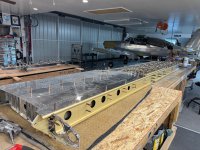
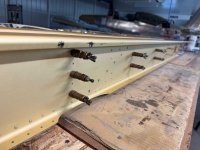

would it be easy to lose track of which way is up and put the spar in upside down, or can it go only one way?UPDATE AND MISCELLANEOUS PROGRESS. STARTING SECTION 29
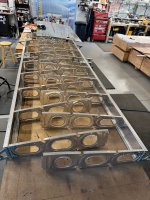
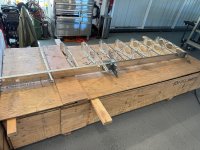
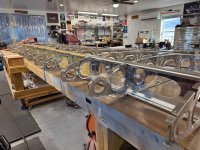
I took a bit of a divergence from plowing through the build in a linear manner when some missing parts threw up roadblocks. I spent much of a couple of days mostly prepping pieces for future work. Lots of mindless deburring. I then realized that it might be an easy and quick victory to built the right wing structure through Section 25 (except a couple spots where pieces are still missing). Where to build it with the left wing structure pretty much taking up much of the work bench? It turns out that it is easy to interweave the ribs and build it. Our bench is about 36” (just under a meter) wide and it was perfect for building the second wing structure in mirror image. Being able to look across the table to see the mirror image of where I was headed made completing the task fast. The only problem is where to store it until ready to further progress on the right wing. For now, it sits on top of the original “large” crate that still contains the skins.
View attachment 108092View attachment 108093
Left: Both the (on left) and left (on right) wing structures are nearly completed and shown interleaved on the work bench where they were both built; Right:
Once completed, the right wing structure was light enough to easily (and carefully) carry over to the original large crate for storage.
I then returned to the left wing and started on Section 29. The first page of Section 29 (page 29-6) was confusing to me. There are two different “As”, two different “Bs”, and two different “Cs”. Note that the text does NOT refer to the “Detail” designation. The boxed-in letters refer to the boxed-in letters within the Detail drawings. It sure would have been easier to interpret if the Detail drawings used X, Y, and Z designations.
View attachment 108094View attachment 108095
Left: Wing spar is now attached to the tank assembly and each of the wing ribs by Clecos; Right: Three of the ribs had to be held by extended Clecos. The KIAs call for “long-reach spring Clecos” but we only have wing-nut fasteners. We will see if this causes any issues. So far, it looks like I might get by with only six “long-reach” Clecos.
The next steps are to rivet the spar on and attach nose ribs (Section 29).
The spar is very asymmetric so I doubt that you could put it on wrong. But, nonetheless, I am following the always prudent practice of waiting for a second set of eyes to look it over before riveting. Paul will be home later today to inspect before I rivet.would it be easy to lose track of which way is up and put the spar in upside down, or can it go only one way?
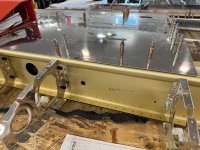 Apparent missing rivet from the bottom row of the main spar. Position is shown by the edge of the tank skin in upper right. I've got a note into Van's but I'm curious if anyone else is missing a rivet here. Might it actually serve a later purpose? This LE rib on the left is also the most difficult to rivet (see below).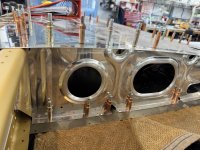

Apparent missing rivet from the bottom row of the main spar. Position is shown by the edge of the tank skin in upper right. I've got a note into Van's but I'm curious if anyone else is missing a rivet here. Might it actually serve a later purpose? This LE rib on the left is also the most difficult to rivet (see below).
- It appears that my main spar is missing one rivet. I expect that it isn’t a big deal and await Van’s solution. Maybe put a pulled rivet at the site? Hope to hear from them soon.
Thanks. Interesting.That hole is also open in my spar.
A little bit but not much. I have found places where it seemed someone previously had reverse fluted!Is rib fluting no longer required?
I have been so buried in other things that I haven't been able to get started on any real work, but when I casually took a look at the ribs my thought was that fluting would take them the wrong direction from the few that I grabbed.Is rib fluting no longer required?

That’s interesting. When I sight down the line of rivet holes on my ribs or even use a straight edge, most are not lined up.A little bit but not much. I have found places where it seemed someone previously had reverse fluted!

Based on the historical part production for all other models, I would fully expect what you have seen when assessing the parts.That’s interesting. When I sight down the line of rivet holes on my ribs or even use a straight edge, most are not lined up.
I have to do a small amount of fluting on all of my ribs to straighten them out.
Unless I’m doing something wrong… this is my 1st build.
My guess would be that what looked like reverse flutes was actually small puckers in the flange that occurred when the rib was formed. They will always protrude outward as if someone had fluted it the wrong direction.A little bit but not much. I have found places where it seemed someone previously had reverse fluted!
I haven't done anything on Section 21. The KAIs weren't even available before I mounted the left tank. Certainly no plans to use "slosh", though.Did you slosh the tanks in section 21?
I haven't done anything on Section 21. The KAIs weren't even available before I mounted the left tank. Certainly no plans to use "slosh", though.
What Rian said during the webinar made me comfortable that they checked out the tanks to my satisfaction and I don't think this step is necessary for those of us with "quick-built" tanks.Sorry, maybe wrong terminology. They say to slosh the tanks with avgas to clear any debris. The time to do that would be before mounting the spars; certainly not going to do it after!
My concern is doing this then leave empty tanks with fumes in my workshop for the duration. Probably not going that route…
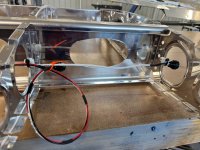
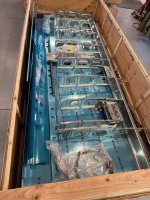
If you are building in a 2-car garage or similar cramped space, this is going to be a tough space-management challenge. We have a large workshop (albeit, with two airplanes being built concurrently) and figuring out space is a challenge. Good luck!

I have hangars at 2 airports and a large shop just a mile from my house, but the building has to happen in my jammed up garage in order to maintain steady progress.
Hi Louise,SECTION 30: W-15516 – Wire harness and systems – Revision 2
SECTION 31: Skins -- Starting
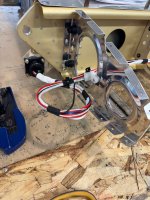
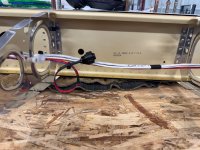
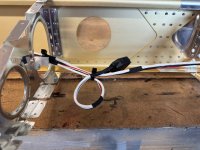
Today’s work was short (time wise), easy, and a bit confusing. It started with riveting (with pull rivets) a small piece on the wing root end then putting the left wing wire harness through all the ribs. The root end is secured to the newly installed flange with bolts, washers, and nuts, using new tools for this project. A ground wire is bolted onto the inboard-most rib. Then, the wire buddle is secured with tie-wraps to the nylon holders on each rib. The tricky part is correctly interpreting page 30-08. It calls for numerous “service loops” and I interpreted that to mean the entire wire bundle was to be looped. That wasn’t going to work. So, my personal mentor came over and suggested that they really just wanted the pigtail ends looped. That worked at sites C and D, but what about site E? This is the odd one. First, the text calls it out but neither drawing shows a loop at “E” and there is no pigtail at this site. Then, in the next bay, there is a pigtail but it is shown attached to the currently not-in-the-works “Land/taxi light heat sink”. So, two questions…Is the loop called out at “E” really supposed to be at “F”? And, Why is the Land/Taxi light heat sink shown at this time? We decided to ignore the “E” loop and make one at the “F” site. I don’t know if this is correct. I have a note into Van’s asking to confirm or correct.
View attachment 108503 View attachment 108504
Service loops. On the left is the major service loop used to control slack along the entire wire bundle. The ground wire (black) was too tight in this photo and was adjusted the next morning. On the right is our interpretation of what the service loop should be at site C.
View attachment 108505 View attachment 108506
More service loops. Site D on the left. On the right is site F. Since we didn't clearly understand what was supposed to be done here, I put a loop on the pigtail for the light and held it with bright orange to show that this was a temporary/tentative loop.
Otherwise, this was a very quick section to complete.
The next day (yesterday) was a massive reset day. With the left wing taking up an entire 14’ of work bench and having to share the remaining space with Paul, I had to get creative with space to work on the skins as their large area demands are next. I took the wing parts that had been stored on the shelf under part of the work bench and put them in two piles on the floor of the adjacent hangar. One pile of left (port) and one for right (starboard). Then I opened the large crate which stored the wing skins. I took the wing skins out. Right side into the right-side pile. Left side skins were stripped of blue plastic on one of the tank crates, relabeled with a Sharpie, and put in temporary storage. Once all the left skins were “stripped”, I put them on the shelf under the work bench and then added the remaining left wing parts. All the right-wing parts went into the large crate, including the skeleton I have already built. Now I have the large crate and a tank crate to use as my work bench. Lesson learned? If you possibly can, kept the crates as additional work space. The acreage that you need for this project is far beyond previous RVs, especially the RV-3B that I previously helped build.
View attachment 108507
Storage in the large crate of the right wing parts and assemblies as I move forward on the left wing.
If you are building in a 2-car garage or similar cramped space, this is going to be a tough space-management challenge. We have a large workshop (albeit, with two airplanes being built concurrently) and figuring out space is a challenge. Good luck!
Not yet.Hi Louise,
Have you run into any need for an Offset Rivet Set? My kit is going to be on its way and some of my tools have been "loaned" to others over the years.
Thanks
Gary
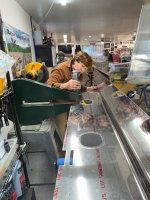
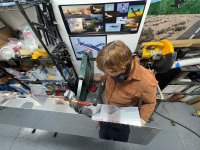
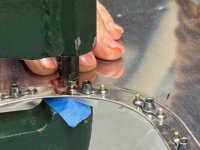
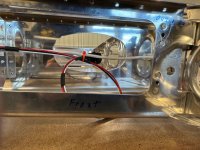
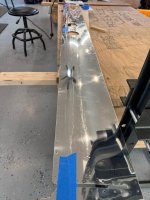
With the resources you have at hand you probably aren't looking to add more tools, but you describe a scenario where the Numatix squeezer would be a great solution. The portion of the squeezer that you hold is small and light, and both hands are free to manipulate the squeezer head and/or parts since you don't have to work an awkward switch.Although most of the holes are pre-dimpled, I struggled to find a consistently successful way to squeeze the 240 AN426AD3-3.5 rivets to install the nut plates. Shooting in this tight space didn’t seem reasonable and I think my problems with squeezing results from my relatively small (and, probably, weak) hands being unable to control both the pneumatic and the manual squeezer. But, thanks to Paul’s well-equipped shop, “Big Mama” came to the rescue.
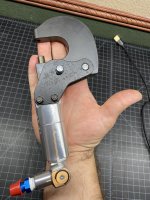
Hmm. I have a birthday coming up soon!With the resources you have at hand you probably aren't looking to add more tools, but you describe a scenario where the Numatix squeezer would be a great solution. The portion of the squeezer that you hold is small and light, and both hands are free to manipulate the squeezer head and/or parts since you don't have to work an awkward switch.View attachment 109193

TOOLS..........The Perfect Birthday present! Are you listening Paul?Hmm. I have a birthday coming up soon!
Have you seen the price!!!!!!!TOOLS..........The Perfect Birthday present! Are you listening Paul?

Have you seen the price!!!!!!!
Just watched a quick video on the Numatx squeezer. Doesn’t look like you adjust the throw for different length rivets. How do you adjust how much it squeezes, adjust the hydraulic pressure?With the resources you have at hand you probably aren't looking to add more tools, but you describe a scenario where the Numatix squeezer would be a great solution. The portion of the squeezer that you hold is small and light, and both hands are free to manipulate the squeezer head and/or parts since you don't have to work an awkward switch.View attachment 109193
Just watched a quick video on the Numatx squeezer. Doesn’t look like you adjust the throw for different length rivets. How do you adjust how much it squeezes, adjust the hydraulic pressure?
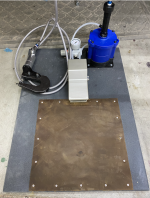
Open on mine as well.That hole is also open in my spar.
FYI. Paul figured out the right answer as we both know that he can't resist an excuse to buy tools and it would end up ours at best (and "his" more). So, he suggested that we buy it for Valentine's Day.With the resources you have at hand you probably aren't looking to add more tools, but you describe a scenario where the Numatix squeezer would be a great solution. The portion of the squeezer that you hold is small and light, and both hands are free to manipulate the squeezer head and/or parts since you don't have to work an awkward switch.View attachment 109193
 We both love it and the remaining nut plates breezed by. Thanks, Nate, for the suggestion. Pricey but it really IS the answer to squeezing rivets if you don't have gorilla hands!



