Van's Air Force

The definitive Van's Aircraft support community! Buying, building or flying an RV? Join our exclusive family of mentors and enthusiasts!

Broken Pitot Tube FF-01202-1 (in flight)

Amadeus

Well Known Member
Sponsor
While in a level cruise this afternoon, 118kt indicated, headwind of 16kt, left crosswind of 3kt, "airspeed, airspeed" screamed in the headset followed by "autopilot is being engaged" as the Garmin Electronic Stability and Protection system (ESP) turned on and pushed over the nose to begin a descent in order to increase airspeed from the now indicated 19kt. A quick scan showed a headwind of 73kt and a right crosswind of 49kt. Obviously something was blocking the pitot tube or a pitot hose disconnected.

Other than the repeated need to disconnect autopilot (ESP was continually and repeatedly trying to take over the flight and push down the nose) I referred to my iPad connected to a Stratus 2 for GPS groundspeed. I used the previously known actual winds to calculate my actual airspeed and returned to my home airport. Upon exiting the aircraft I noticed the pitot tube was sticking out of the spinner by an extra inch to inch and a half than normal. I was able to push the pitot tube in and out and spin it freely. I removed the top cowling and could see that the rear end of the pitot tube was still extended through the FF-1201 Pitot Block and the FF-1217 hose connection (and FF-1216 hosing) was still intact. None of this rearward apparatus moved as I pushed, pulled and twisted the portion of the tube extending through the spinner. Apparently the FF-01202-1 pitot tube was now two pieces instead of one.

Has anyone else had FF-01202-1 break?

Has anyone a clue what could've caused this break while in flight? There is no wear on the tube from the S-1207 Bushing. The tube slides and spins freely within and through the S-1207 Bushing. The tube did not seize at this passthrough point causing the break.

One lesson learned is that I need to familiarize myself with the procedure to quickly disable Garmin ESP. I could just leave it off all the time but I find the feature to be of value other than when the pitot tube breaks.

Another lesson learned is that despite having a wonderful dual G3X Garmin avionics package it is wise to have the backup iPad/Stratus system on and working every flight, local or cross country.

Sidenote: Vans has the FF-01202-1 currently unavailable/on back order. Not sure how long I will be AOG waiting for this part. Has anyone converted a flying E-LSA RV12iS to having a heated pitot on the wing? If I need to do a repair anyway maybe it's time for a winter project!
 
Last edited:
Holy cow. that sounds like an eventful day.

I cant speak to your question about the pitot tube specifically, but this is a great example of why there should be a way to quickly and permanently kill Otto if he goes rogue. On all the Cessnas with ESP, the autopilot breaker is the only one that has a quick pull collar on it for this very reason. On my plane I put a guarded toggle above the a/p controller in the stack that serves the same function.

Glad you're on the ground safe and sound. Thanks for sharing this.
 
That was a difficult experience for sure. Glad you made it back. I'm pretty sure you can temporarily disarm ESP by holding the Autopilot Disconnect switch, however that is just temporary. An example might be when you want to do steep turns and stalls. If you want to disarm it for the rest of the flight, as probably your case, you'll need to access the AFCS page. You touch the Autopilot Status bar, then the AFCS page shows up, then disable ESP. I think it reenables once power is cycled.
 
Just a reminder that the AP DISC button will inhibit all ESP activity, and will do so for the rest of the flight if held for 5 seconds.
Exactly the information I was going to look up in the manual! THANK YOU!

I would disconnect using AP DISC then it would re-engage, disconnect, re-engage, disconnect, re-engage. I lost count of how many times this occurred before it stopped re-engaging but I was really concerned about it doing it again under 500' AGL on final.
 
Exactly the information I was going to look up in the manual! THANK YOU!

I would disconnect using AP DISC then it would re-engage, disconnect, re-engage, disconnect, re-engage. I lost count of how many times this occurred before it stopped re-engaging but I was really concerned about it doing it again under 500' AGL on final.
You have to hold it for 5 seconds……
 
Did your AOA work?
Yes, but not accurately. It was a clear and sunny VFR day and even though I could see that I was in level flight at an iPad reported groundspeed of 115kt the AOA was screeching with all colors (green, yellow and red) of chevrons on display.
 
Glad that all turned out well -- sounds scary. I built my -12iS with an under-the-wing heated pitot, so I have the original FF-01202-1 left over. You're welcome to it if you want. Send me a DM if you're interested.
 
Glad that all turned out well -- sounds scary. I built my -12iS with an under-the-wing heated pitot, so I have the original FF-01202-1 left over. You're welcome to it if you want. Send me a DM if you're interested.
DM sent.

The only scary part was the worry that ESP might try to put me nose down when on short final.

Now if this were to occur when visibility wasn't clear/10 miles.....
 
I had a broken pitot tube on my RV-12 and it was pretty much a non event. A friend had pitot tube break on his RV-12 and the loose tube inched forward out of the spinner. The extended tube whipped around and became eccentric. It made an explosion noise as it left the spinner taking the front 2” of the spinner with it. Luckily it didn’t damage the prop. Both of us installed E-Props with outboard ball bearing to support the the carbon fiber pitot tube. Outstanding design…
 
I had a broken pitot tube on my RV-12 and it was pretty much a non event. A friend had pitot tube break on his RV-12 and the loose tube inched forward out of the spinner. The extended tube whipped around and became eccentric. It made an explosion noise as it left the spinner taking the front 2” of the spinner with it. Luckily it didn’t damage the prop. Both of us installed E-Props with outboard ball bearing to support the the carbon fiber pitot tube. Outstanding design…
So that's 3 RV12s that this has happened to that we know of just from this thread? That's fascinating. Has anybody gotten to the root cause and a remedy? Or even what to look for in an inspection?

If a pt. 23 plane had that kind of failure percentage it seems like the feds would be throwing out an AD at this point.
 
So that's 3 RV12s that this has happened to that we know of just from this thread? That's fascinating. Has anybody gotten to the root cause and a remedy? Or even what to look for in an inspection?

If a pt. 23 plane had that kind of failure percentage it seems like the feds would be throwing out an AD at this point.
Since I am in the middle of my pitot install, there are a few very critical steps for this assembly that if not followed 100% might result in premature failure.

I do love the E-Prop design but there is no reason the factory solution should not be adequate given many have no issue at all.
 
If you want to disarm it for the rest of the flight, as probably your case, you'll need to access the AFCS page. You touch the Autopilot Status bar, then the AFCS page shows up, then disable ESP.

That's one of the ways to do it, but there are other options. Quoting from the current pilot's guide: (revision Z)
The pilot can interrupt ESP by pressing and holding the Autopilot Disconnect / Control Wheel Steering (AP DISC/CWS) switch. Upon releasing the AP DISC/CWS switch, ESP force will again be applied.

In installations with 'Engage AP VIA CWS' disabled, if the AP Disconnect switch is held for more than 5 seconds, ESP will be disarmed, and a 'ESP OFF' CAS message will be displayed. ESP will not be re-armed upon subsequent autopilot engagement, but can be manually re-armed in the AFCS menu.

If a remote switch is configured for ESP Inhibit, ESP will be inhibited when the switch input is active. A CAS message will be displayed to indicate this state.
 
“… there is no reason the factory solution should not be adequate given many have no issue at all…”
I’m not sure I agree. If 3 have failed out of what, maybe 900 planes? What would we be thinking if 150 pitot tubes fling themselves off a 172? That would be approximately the same ratio.

I dunno maybe I’m being too critical. But it Just seems like a problem this significant that’s not a one off should be addressed. I mean vans issued a service letter to have people check for blue vinyl left in fuel tanks and those are okay if built as designed as well.
 
Perhaps part of the answer is in the part number itself. FF-01202-1, the dash 1 on the end indicates a changed part from the original part FF-01202. I don't know when that change occurred but it infers 2 different pitot tubes exist and we don't know for sure what version each of the 3 breaks were. Of course perhaps the answer is to find out from Van's if the wing mounted tube used on the '26 SLSA is available as a replacement kit. May be why the original tube is no longer available. Probably don't need the extra alternator if the pitot heat is not used / wired.
 
We also had a pitot tube break in-flight on at least one of our two flight school planes. And we have replaced at least one bushing and another tube due to wear.

I keep a spare tube and bushing and can ship NDA if the other guy who offered can’t come through.

The silicone tube at the rear is available from Van’s, but with the inconsistent shipping and minimum order surcharge, it pushes me to buy small things other places:

Pure Silicone Tubing - 1/4" ID x 3/8" OD - High Temp Kink-free Hose Tube 500F (5 Feet)​

 
My 2010 RV 12 had one break as well but was a non event, old one was aluminum, new one is stainless steel
 
My 2010 RV 12 had one break as well but was a non event, old one was aluminum, new one is stainless steel
I was amazed at the quality of the machining on the newer style stainless pitot! Very precise!
 
Since I am in the middle of my pitot install, there are a few very critical steps for this assembly that if not followed 100% might result in premature failure.

This was my reaction as well. For one example, I spent a lot of time getting the spinner and pitot alignment just right. I have seen a few planes where is was clear that the builder did not consider this to be important.

I’m not sure I agree. If 3 have failed out of what, maybe 900 planes? What would we be thinking if 150 pitot tubes fling themselves off a 172? That would be approximately the same ratio.

I dunno maybe I’m being too critical. But it Just seems like a problem this significant that’s not a one off should be addressed. I mean vans issued a service letter to have people check for blue vinyl left in fuel tanks and those are okay if built as designed as well.

Two things can be true at same time. A lot of builders don't follow instructions 100%, I have seen this while performing inspections as well as casual observation. Things can be assembled in a way that increases the risk of failure. Meanwhile, an alternative design or revised part could reduce the sensitivity to error.

As part of the repair process for the pitot, I would recommend close inspection of the spinner attachment holes/plates and triple checking the spinner alignment per the KAI for errors. Be very picky about it. It may be fine, but this is worth a close look to rule it out as a factor.
 
I spent a lot of time getting the spinner and pitot alignment just right.
Good going. Even a very small amount of misalignment will cause vibration that will eventually cause EVERY aluminum pitot tube to eventually break if enough hours are flown. The pitot tube through the spinner seemed like a good idea at first. When people ask what that tube is for, I tell them it is a 22 caliber machine gun. :)
Since the spinner location of the pitot tube causes safety issues, maybe the pitot tube should be moved to the wing. The pitot tube could be located near the AOA port in the wing.
 
Good going. Even a very small amount of misalignment will cause vibration that will eventually cause EVERY aluminum pitot tube to eventually break if enough hours are flown. The pitot tube through the spinner seemed like a good idea at first. When people ask what that tube is for, I tell them it is a 22 caliber machine gun. :)
Since the spinner location of the pitot tube causes safety issues, maybe the pitot tube should be moved to the wing. The pitot tube could be located near the AOA port in the wing.

The latest model of the tube is stainless. 👍
 
Why does this sound like another great idea, 737-MAX? (Mechanical sensor fails, airplane reacts by trying to crash itself).
 
Why does this sound like another great idea, 737-MAX? (Mechanical sensor fails, airplane reacts by trying to crash itself).
This was my hangar mate's first thought, as well. Automation wanting to put the aircraft into a nose down configuration despite me disconnecting multiple times.

The broken pitot on a clear calm day was basically a non event. Had I been flying with steam gauges and looking out at the wide blue wonder it may have even taken a few minutes to notice. However, when flying with modern glass avionics the audible warnings and immediate autopilot activation is hard to miss.

After four years flying with a G3X I should've known already that a five second hold on the A/P Disconnect would solve the ESP from repeating its "increase airspeed" procedure. This was all on me for lack of knowledge for functionality of onboard systems. I will never possess a "Matt Burch" level of understanding but I WILL be reviewing the user guides again for a refresher.
 
Im not a 12 flyer so please take this with salt, but there should be an AP Master (or at very least a prominently located breaker) that can depower the servos with a single switch. I can't imagine not having that as a backup.
 
Im not a 12 flyer so please take this with salt, but there should be an AP Master (or at very least a prominently located breaker) that can depower the servos with a single switch. I can't imagine not having that as a backup.
My stock-built RV-12 ULS does have a dedicated AP power switch, but the OP has Garmin (mine's Dynon), so maybe the power panel differs.
 
While in a level cruise this afternoon, 118kt indicated, headwind of 16kt, left crosswind of 3kt, "airspeed, airspeed" screamed in the headset followed by "autopilot is being engaged" as the Garmin Electronic Stability and Protection system (ESP) turned on and pushed over the nose to begin a descent in order to increase airspeed from the now indicated 19kt. A quick scan showed a headwind of 73kt and a right crosswind of 49kt. Obviously something was blocking the pitot tube or a pitot hose disconnected.

Other than the repeated need to disconnect autopilot (ESP was continually and repeatedly trying to take over the flight and push down the nose) I referred to my iPad connected to a Stratus 2 for GPS groundspeed. I used the previously known actual winds to calculate my actual airspeed and returned to my home airport. Upon exiting the aircraft I noticed the pitot tube was sticking out of the spinner by an extra inch to inch and a half than normal. I was able to push the pitot tube in and out and spin it freely. I removed the top cowling and could see that the rear end of the pitot tube was still extended through the FF-1201 Pitot Block and the FF-1217 hose connection (and FF-1216 hosing) was still intact. None of this rearward apparatus moved as I pushed, pulled and twisted the portion of the tube extending through the spinner. Apparently the FF-01202-1 pitot tube was now two pieces instead of one.

Has anyone else had FF-01202-1 break?

Has anyone a clue what could've caused this break while in flight? There is no wear on the tube from the S-1207 Bushing. The tube slides and spins freely within and through the S-1207 Bushing. The tube did not seize at this passthrough point causing the break.

One lesson learned is that I need to familiarize myself with the procedure to quickly disable Garmin ESP. I could just leave it off all the time but I find the feature to be of value other than when the pitot tube breaks.

Another lesson learned is that despite having a wonderful dual G3X Garmin avionics package it is wise to have the backup iPad/Stratus system on and working every flight, local or cross country.

Sidenote: Vans has the FF-01202-1 currently unavailable/on back order. Not sure how long I will be AOG waiting for this part. Has anyone converted a flying E-LSA RV12iS to having a heated pitot on the wing? If I need to do a repair anyway maybe it's time for a winter project!
I had one break on me and had the exact same indications on the Garmin display. Also the stall beep wouldn't stop. Wing mounted stall warning was silent of course. Landing was a non-event, I made sure to carry extra speed (seat of the pants indications) on approach and just floated it out.

My previous training in the military had multiple scenarios with variations of "unreliable airspeed". Aside from obvious "software" troubleshooting, our emergency procedures essentially boiled down to "fly normal approach with normal descent and power settings based on aircraft weight". The book had N1 and VSI charts if at night or in IMC conditions, but VMC conditions were of course much easier to deal with, much like your own situation.

I had deliberately disabled ESP after phase 1 and I tested that it functioned normally because i really didn't like the sensation it gave when "fighting me". It is pretty easy to disable via the Configuration page. And in a worst case scenario, the LVL function on your autopilot controller should at the very minimum give you flight director guidance to wings level, an in the best case, level the plane for you without any inputs.

When I examined the tube it was obvious I had installed the tube with a "side load" via overtightening the set screw that screws in to the top of the plastic block. When I repaired it made sure the tube was as free as possible while still remaining firmly in place.

It seemed to be a mild emergency all things considered, but man I realize now that if that tube had popped out and flew back in the prop it most certainly would have ruined it. So i have some more respect for how lucky i was!
 
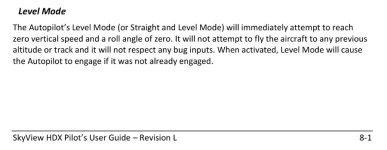
One note on the wings level function through the autopilot, (at least on Dynon), there is no pitch input. If you are out or trim from having picked up some speed from your "event" prior to hitting the level function, expect some phugoid zoomies.
 
One note on the wings level function through the autopilot, (at least on Dynon), there is no pitch input. If you are out or trim from having picked up some speed from your "event" prior to hitting the level function, expect some phugoid zoomies.
?????????

AP level.jpg
 
Glad that all turned out well -- sounds scary. I built my -12iS with an under-the-wing heated pitot, so I have the original FF-01202-1 left over. You're welcome to it if you want. Send me a DM if you're interested.
So my pitot tube just broke, I would like to buy the one you have if it’s still available?
 
So my pitot tube just broke, I would like to buy the one you have if it’s still available?
Have you been successful in locating a pitot tube?

Temperatures here have not been above freezing for two weeks and I am in an uninsulated/unheated hangar. While waiting for favorable conditions to install the pitot tube I have been researching the E-Prop (comes with the carbon fiber roller bearing pitot tube and aluminum pitot block to replace the nylon FF-1201 Pitot Block) and will have the FF-1202 Pitot Tube that CTCole graciously had available if I go with the E-Prop. If so it will be same price: just shipping cost.
 
Back
Top