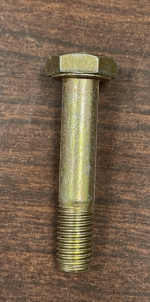
Correction: -14A was tooInteresting. I also noticed in Mike Bullock’s post regarding this connection that he found the -14 was too long so he switched to a -13 which he said “was perfect”
long so switched with -13A


Correction: -14A was tooInteresting. I also noticed in Mike Bullock’s post regarding this connection that he found the -14 was too long so he switched to a -13 which he said “was perfect”

Interesting. I also noticed in Mike Bullock’s post regarding this connection that he found the -14 was too long so he switched to a -13 which he said “was perfect”
Maybe - Maybe not; the correct length in practice will be determined by the amount of grip showing beyond the hole. As this structure is loaded in shear, you cannot have ANY threads "inside" the loaded area (i.e. inside the hole). The excess grip & thread should be taken up with washers, so you can tighten the nut down, achieve the required torque and still be turning the nut on threads and not bottomed out on the bolt grip.Correction: -14A was too
long so switched with -13A
Got it. ThanksMaybe - Maybe not; the correct length in practice will be determined by the amount of grip showing beyond the hole. As this structure is loaded in shear, you cannot have ANY threads "inside" the loaded area (i.e. inside the hole). The excess grip & thread should be taken up with washers, so you can tighten the nut down, achieve the required torque and still be turning the nut on threads and not bottomed out on the bolt grip.

and, as @Ironflight and others have suggested, this is a good preflight activity, along with checking the throws, "short shake" the stick and see if it shakes back..Got it. Thanks
I appreciate the suggestion very much and I’ll follow through for my ACI in MarchIt's possible that this is the only anomaly on this plane, and that it was found before it created a larger problem. Let's hope that this is the case, and I think we are collectively glad that you brought this to light. There have been many good questions and good discussion points. But I would strongly suggest that the OP find an RV-7 builder or an EAA Technical Counselor near you that's willing to give everything a good, thorough looking over. A condition inspection is a great time to do this and look at all the pushrods, connections, and other fasteners to ensure they're correct (even if this means going behind an A&P). Having the right type of hardware in the right spot is critical to long life (both yours and the plane). While he or she is walking you through their inspection, it's a great opportunity for you to ask questions and learn.
We were all new to aircraft building and maintenance at one time, so this isn't intended as a condemnation of your technical knowledge. But there's only so much the collective knowledge base on the forum can do with a handful of pics and videos. For the price of a hamburger and a little fuel to get an experienced person to your home field, I'll bet you can accelerate your learning curve and give you the confidence and knowledge you need to ensure your plane is being maintained correctly.
Can you explain this “short shake” in more detail?and, as @Ironflight and others have suggested, this is a good preflight activity, along with checking the throws, "short shake" the stick and see if it shakes back..
I did a pre-buy on an RV-6 that had this exact same issue. It was evident from this issue and a dozen or so others, that the builder/pilot didn't care enough to follow the plans, or maintain the aircraft correctly.
Grab the stick and give it a short duration, high amplitude shake (1/4 - 1/2 the total available "throw") -- if everything is tight, you shouldn't feel or hear anything. I will bet you a beer that if you do this with your airplane in pitch, you will hear/feel a thunk as the heavier elevator (typically the left one) stops moving after the other one.Can you explain this “short shake” in more detail?

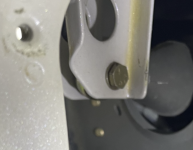
The builders had torque-striped the nyloc nut and it had not moved since installation. Rather than washers, the lower spacers appear to be bushings. I tried to tighten the nyloc nut but it bottoms out before it puts any torque on the horns (bolt still turns freely after tightening all the way). Thoughts?
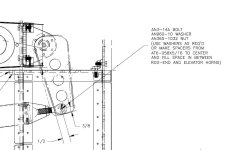
...and the travel stop isn't a bulkheadYep. A fabulous example of why torque seal application by the builder is often a lie. IF used at all, it should be reserved for a qualified inspector.
5/16" diameter bushings are called out in the plans, however dumb it may be.
Note the 14A callout. Before anyone changes to a -13, re-read Mr. Decker 's post above. The correct length wouldn't have any threads in the joint, but rather would be long enough to move the root thread outside the horn, with a washer stack as needed to ensure the nut does not bottom.
View attachment 106547
Now, at great risk of being pilloried, I will admit to having a very close personal relationship with the wife of a builder who took a look at that particular joint many moons ago, said "No way", and installed an MD4616M, i.e. with an AN4-14A and -4 washers.
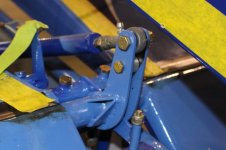
If we were to be really sinful, the right way to do this kind of joint can be seen in an example from custom Pitts. The horn loads involved in tying the elevators together are separated from the pushrod shear.
View attachment 106554

All factory Pitts from the S1S to the S2B have a !/2" thick aluminum block between the horns and two additional AN3 bolts thru the spacers and horns. The Pitts rode end bearing is not a tight fit between the horns. That photo is very different than Pitts plans for S1S.Yep. A fabulous example of why torque seal application by the builder is often a lie. IF used at all, it should be reserved for a qualified inspector.
5/16" diameter bushings are called out in the plans, however dumb it may be.
Note the 14A callout. Before anyone changes to a -13, re-read Mr. Decker 's post above. The correct length wouldn't have any threads in the joint, but rather would be long enough to move the root thread outside the horn, with a washer stack as needed to ensure the nut does not bottom.
View attachment 106547
Now, at great risk of being pilloried, I will admit to having a very close personal relationship with the wife of a builder who took a look at that particular joint many moons ago, said "No way", and installed an MD4616M, i.e. with an AN4-14A and -4 washers.
If we were to be really sinful, the right way to do this kind of joint can be seen in an example from custom Pitts. The horn loads involved in tying the elevators together are separated from the pushrod shear.
View attachment 106554


While loss of any of the above is serious, I'm not sure they rise to the level of a "Jesus bolt", and, off hand, I'm not sure my RV has one. Compared to, for example, my former airplane, a 182, where there are 4 bolts (top, bottom, left and right sides) that attach the wing struts to the wing and the fuselage. Failure of one of these bolts is guaranteed to result in the loss of a wing. Fortunately, they are also one of the most over-engineered things I've seen on a GA aircraft.Meet Jesus Bolts to regularly check more frequently in my opinion:
Note: Some of these I do every flight some a few times a year
1. Elevator Horn (Remove inspection panel for access) (Few Times)
2. Flap attach bolts (The ones that go into the actual flaps) - (Lower your flaps and take a look, easy to see) (Every flight)
3. Aileron Bolts (Check the locking nut that goes into the push rod) (Every flight)
4. Aileron Bell crank (Open middle inspection panel on each wing). (Few Times)
4. Rudder Control Horn Attach Point (There are two, one for each cable) (Every Flight)
5. Throttle attach cable (Only when cowl is off)
Just my 2 cents,

If we were to be really sinful, the right way to do this kind of joint can be seen in an example from custom Pitts. The horn loads involved in tying the elevators together are separated from the pushrod shear.
View attachment 106554
...yet...I’ll play devils advocate and say this discovery shows that bolt is far from a Jesus bolt. Just about everything about that detail is wrong but it didn’t fall out of the sky.


… and it was discoverable in a basic preflight. Thousands flying and none have ever fallen out, Yet….. as bjdecker pointed out.I’ll play devils advocate and say this discovery shows that bolt is far from a Jesus bolt. Just about everything about that detail is wrong but it didn’t fall out of the sky.

“Exciting” yes - but unfortunately also short!I will be the first to confess I cannot recall checking for differential movement in my elevators during a pre-flight. Very good suggestion!
If that bolt fell out it would be an exciting ride, that's for sure.


Anyone have comments on the proper torque question post #42?

Thanks, wanted to make sure the thoughts were correct.You tighten those bolts to the values in chapter 5. They clamp the inner race of the bearings and allow the outer race to be free.

Yep. If you freeze frame the video you will see at the end that the bolt is indeed too long and only has one washer.Agreed and appears to have been installed from the original build incorrectly. How many CI's inspections did this pass? (Airframe is 13 years old) Pre-purchase inspection? This seems to emphasize that if you purchase an experimental, please pay the extra few % and get a valid pre-purchase, please.

Or drill out one size larger provided a new bearing can be found to fit the larger bolt.Hopefully not already mentioned. I only did a quick scan of the thread.
The bolt length is only part of the problem, at this point. The holes in the horn proper are no longer acceptable. Proper spacers and torque would help but ultimately the installation shouldn’t be relying on friction to maintain position.
The horn material is too thin to bush properly. Hate to say it but the horns should be replaced or possibly weld filled (or weld doublers added) and re-drilled/reamed.
Good luck.
Or drill out one size larger provided a new bearing can be found to fit the larger bolt.
that is wear that caused the hole to grow in size. You can see the black everywhere that is a byproduct of that wear. Tough to tell from pics if it is too excessive. First blush it will probably be ok, but really need to get a caliper in there and see what the hole diameter is.It does look like the elevator horns, connecting to the elevator push-rod, may have been drilled a bit too large.
Actually, this hit me last night when I should have been sleeping.Or drill out one size larger provided a new bearing can be found to fit the larger bolt.

Interesting idea, and what it indicates is that there are probably a lot of solutions, most of which have been seen by the factory. That's why we pay them -Shoulder washers. ...
Offered as a possible suggestion. Fire away. Comments would be appreciated. PULL!
 - to be a central source of best practices for unusual situations like this.
If properly designed and torqued, there is no reason that some slop between the hole and shank creates a problem holding the joint in its place. Take your typical front lower control arm on a car. The hole is at least 2X bigeer than the bolt to allow for alignment adjustment. Everything holds its place via tension from the bolt. That takes the vehicle weight and a multiplier of 2 or 3 times that for impact loads, like pot holes and is under constant movement. If the designer was relying on something other than tension to hold position, they would specify reaming and call out tolerances for bolt size and hole size, as we see in the wing spar bolts. Also see this in the nose gear leg attach, where tension doesn't hold the joint and the proper fitting is doing all the work. Not an ME and don't know the principals, but see this in practice a lot. Have no idea how this joint was designed, so can't say what is required. Only saying you can't assume close fitting is required.Actually, this hit me last night when I should have been sleeping.
Shoulder washers. It's doubtful you can find some that would work as supplied; but, with a little modification (most likely shortening the stem) they probably could fit just fine. Buy them from an aviation supply house vs. other. Material will determine if this is a potential short-time, long-time or permanent solution Ream the hole to a close tolerance fit; zero or slight interference would be even better.
Offered as a possible suggestion. Fire away. Comments would be appreciated. PULL!
Edit = If they can't be found, it would probably be easier to have some machined versus a weld fill. @PhatRV 's suggestion would be easiest if such could be found. In all cases, ensure proper ED is maintained.
Usually I agree with your wisdom, Sir. Not this time. While I obviously don't have the design details of either, on the surface you're comparing an OEM's specifically engineered joint to what is an most probably just an application. If assumptions were made for the latter, every effort should be made to return the boundary conditions to those where the engineer applied such. Don't get hung up on the "reaming" wording. My point was to get the fastener/hole tolerances back to original and from the video, I'm guessing that's not possible. As for joint application in shear, the load and the area in bearing are the only parameters. Friction adds margin. It is not (typically) considered except for specifically engineered solutions.If properly designed and torqued, there is no reason that some slop between the hole and shank creates a problem holding the joint in its place. Take your typical front lower control arm on a car. The hole is at least 2X bigeer than the bolt to allow for alignment adjustment. Everything holds its place via tension from the bolt. That takes the vehicle weight and a multiplier of 2 or 3 times that for impact loads, like pot holes and is under constant movement. If the designer was relying on something other than tension to hold position, they would specify reaming and call out tolerances for bolt size and hole size, as we see in the wing spar bolts. Also see this in the nose gear leg attach, where tension doesn't hold the joint and the proper fitting is doing all the work. Not an ME and don't know the principals, but see this in practice a lot. Have no idea how this joint was designed, so can't say what is required. Only saying you can't assume close fitting is required.
So what are the tolerances? Your average bolt is a good .003" smaller than nominal and the average joe can easilly go .010 - .015 over through sloppy drilling. It would seem to me that .015 clearance with constant motion back and forth would wear the hole much larger over time, what prevents that? Perfect example here, where the hole grew substasntially by banging back and forth 1000's of times, due to no tension on bolt. Not really arguing beyond my training here, but I see all sorts of highly loaded structures where there is a good amount of slop between hole and bolt. Clearly there is more to this than just really close fitting fasteners. If that were the case, the designers would have to provide those tolerances.My point was to get the fastener/hole tolerances back to original and from the video, I'm guessing that's not possible. As for joint application in shear, the load and the area in bearing are the only parameters. Friction adds margin. It is not (typically) considered except for specifically engineered solutions.
Outside of the force being applied, what makes this any different than the multitude of other push rods and bearings installed in exactly the same way? I think there are a dozen or so associated with the ailerons and elevators.So what are the tolerances? Your average bolt is a good .003" smaller than nominal and the average joe can easilly go .010 - .015 over through sloppy drilling. It would seem to me that .015 clearance with constant motion back and forth would wear the hole much larger over time, what prevents that? Perfect example here, where the hole grew substasntially by banging back and forth 1000's of times, due to no tension on bolt. Not really arguing beyond my training here, but I see all sorts of highly loaded structures where there is a good amount of slop between hole and bolt. Clearly there is more to this than just really close fitting fasteners. If that were the case, the designers would have to provide those tolerances.
To be clear, I am not suggesting that what the OP ius dealing with is acceptable; Only that I am not necessarilly assuming it is bad. Better understanding of joint design is necessary to determine that.
Seriously?So what are the tolerances? Your average bolt is a good .003" smaller than nominal and the average joe can easilly go .010 - .015 over through sloppy drilling. It would seem to me that .015 clearance with constant motion back and forth would wear the hole much larger over time, what prevents that? Perfect example here, where the hole grew substasntially by banging back and forth 1000's of times, due to no tension on bolt. Not really arguing beyond my training here, but I see all sorts of highly loaded structures where there is a good amount of slop between hole and bolt. Clearly there is more to this than just really close fitting fasteners. If that were the case, the designers would have to provide those tolerances.
To be clear, I am not suggesting that what the OP ius dealing with is acceptable; Only that I am not necessarilly assuming it is bad. Better understanding of joint design is necessary to determine that.
Outside of the force being applied, what makes this any different than the multitude of other push rods and bearings installed in exactly the same way? I think there are a dozen or so associated with the ailerons and elevators.

How can you tell that's not grease from years of lubricating the rod-end bearing?.that is wear that caused the hole to grow in size. You can see the black everywhere that is a byproduct of that wear. Tough to tell from pics if it is too excessive. First blush it will probably be ok, but really need to get a caliper in there and see what the hole diameter is.
I don’t think i will ever understand how folks will take on building a plane without understanding how threaded fasteners work. In prebuys, I routinely see bearing bolts loose, allowing rotation on the bolt itself.
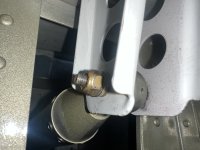
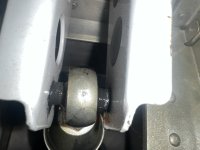
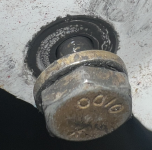




Will a close tolerance bolt fit the rod end bearing?? I believe the proper repair for this is to have step bushings made with flanges, at least 1/2" diameter x .080 wide for the flanges and 1/4 od x 3/16 id x long for the portion that will fit inside the horn. x being the thickness of the horn. Weld the large flange to the outside of the horns with the small diameter inside an enlarged hole in the horns. This will maintain the proper relationship for the original rod end bearing and bolt The original holes should be line drilled and reamed to 1/4".Just an FYI -- the corresponding close-tolerance bolt designation for an AN3-14A is AN173-14A, assuming the RV-7A uses the AN3-14A. Cost is $0.86 per bolt at Aircraft Spruce and Specially. If it were me and my airplane, I would fix this before flying again -- from one engineer to another.
The reason for a washer under the head of a bolt is to prevent point loads from the sharp corners of the bolt head causing stress risers. AN hardware have a raised shoulder milled into the underside of the head to keep the points off of the base material. Sort of a built in washer.Slightly off-topic but while we're talking bolts, a question I've had since starting my project is why don't we put washers under the head of a bolt? When i was restoring my jeep I was taught to put a washer under the head and nut. The plans don't show washers so I haven't been putting any on. Or am I wrong?
Thanks!The reason for a washer under the head of a bolt is to prevent point loads from the sharp corners of the bolt head causing stress risers. AN hardware have a raised shoulder milled into the underside of the head to keep the points off of the base material. Sort of a built in washer.
Well, standard AN (Army-Navy) aircraft bolts feature a built-in "washer-like" surface on the underside of the bolt head. By using additional unnecessary washers on the head-end of AN bolts, you're just adding more weight to the aircraft.Slightly off-topic but while we're talking bolts, a question I've had since starting my project is why don't we put washers under the head of a bolt? When i was restoring my jeep I was taught to put a washer under the head and nut. The plans don't show washers so I haven't been putting any on. Or am I wrong?
Yes -- an AN173 close tolerance bolt will fit through a standard 3/16-inch (#10) rod-end bearing hole, typically with a zero-clearance or light interference fit. And, for the cost of only $0.86, why not give it a try. In addition, you don't want the bolt to rotate inside the rod-end bearing anyway -- right.Will a close tolerance bolt fit the rod end bearing??
Slightly off-topic but while we're talking bolts, a question I've had since starting my project is why don't we put washers under the head of a bolt?

Generally speaking, if you are going to turn the BOLT instead of the NUT, you put a washer under the head of the bolt to prevent galling (even with the machined-in “turning surface”). Not all bolts on an aircraft are AN or Mil Spec - Lycoming uses other types of hardware for instance.Slightly off-topic but while we're talking bolts, a question I've had since starting my project is why don't we put washers under the head of a bolt? When i was restoring my jeep I was taught to put a washer under the head and nut. The plans don't show washers so I haven't been putting any on. Or am I wrong?

Agreed 100% !! (And Vans does use AN bolts for this application, (AN3-12A I think)) It's just my OCD I like the way the bolt head looks with a dedicated washer underneath but probably not needed ! (Tell my OCD this but sometimes not enough thread showing and then I need to live with no washer)Well, standard AN (Army-Navy) aircraft bolts feature a built-in "washer-like" surface on the underside of the bolt head. By using additional unnecessary washers on the head-end of AN bolts, you're just adding more weight to the aircraft.