Van's Air Force

The definitive Van's Aircraft support community! Buying, building or flying an RV? Join our exclusive family of mentors and enthusiasts!

RV-15 N115LP - Wings

Louise Hose

Well Known Member
Sponsor
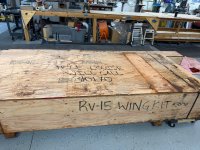
We opened the four crates and took everything out Saturday evening after arriving home from Aurora. The inventory began this yesterday morning. One or two neighbors were helping with occasional assistance from Paul. It took about 4.5 hours to do the inventory and organize storage. No surprise that more parts were missing than the factory had listed on the backorder list, so it was important to inventory promptly and let them know.

DriveHome-2-WillamettePass.jpgCrateInShop-BigUnopened.jpg
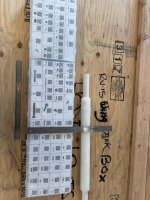
One of the VERY nice things about this kit is that sub-kits were wrapped together in plastic wrap. (Maybe this has been a thing for a while, but you must remember that the only RV that I’ve previously built was a -3B!) This presents a little bit of a dilemma as one has to take the plastic wrap off the bundle to properly inventory. We then re-wrapped the sub-kit in a messier bundle but still together. When I started to work on the first steps of building, this approach probably saved at least a half hour because all the parts for Rear Spar Assembly were together and I didn’t have to gather them. (I made sure the inventory showed where each sub-kit is stored, as well.) BTW, random Post It notes showed inside the sub-kit wrapping showing missing part numbers commonly didn’t align with the inventory, but I pretty much ignored the Post Its and will rely on the inventory. Also of note, we didn’t see any damage or suspect pieces during the inventory.
Subkit-2.jpg
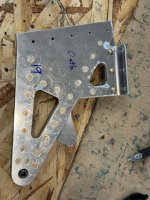
Things went so fast that I even removed the blue plastic coating from all the pieces in the first build, Section 22. Of course, you need to re-label each piece. Since the instructions use the “item no.” instead of the lengthier part number, I am trying to put the item number on the naked pieces. (See the Sample Assembly Plans at https://www.vansaircraft.com/wp-con...-15-Wing-Kit-Sample-Assembly-Instructions.pdf.) I think this will avoid constantly having to check the parts list to figure out which part is called for. We’ll see. (NOTE: This was NOT a good idea. I switched to putting an abbreviated form of the part number on each piece, which has worked well on subsequent subkits.)

After posting that I received no assembly instructions in the crates, Vans let me know that the “sample” instructions posted on the web (see above) are good to go…and so am I. I will be out in the shop later this morning, after it warms up a bit, and start deburring, priming, and assembling! Stay tuned.
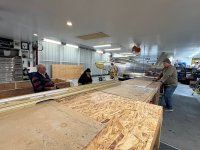
BreakTime.jpg
 
Last edited:
Thanks for the report Louise. It's helpful to see how other builders are labeling, organizing and storing parts. If you have a chance to come up for air, it will be good to learn more about your methodology on this. I pushed back my shipment until mid-February, so have a bit more time to ponder the finer points of staying organized and being able to find things when I need them.
 
Things View attachment 106518went so fast that I even removed the blue plastic coating from all the pieces in the first build, Section 22. Of course, you need to re-label each piece. Since the instructions use the “item no.” instead of the lengthier part number, I am trying to put the item number on the naked pieces. (See the Sample Assembly Plans at https://www.vansaircraft.com/wp-con...-15-Wing-Kit-Sample-Assembly-Instructions.pdf.) I think this will avoid constantly having to check the parts list to figure out which part is called for. We’ll see.

In reading this I'm wondering if I'm looking at the sample plans wrong and missing something. Don't the 'item numbers' get changed on each page? By example there are 4 ribs in the first section labelled 15, but on the page where they are attached they have become item #2. On previous and following pages, item #2s are other parts.
 
In reading this I'm wondering if I'm looking at the sample plans wrong and missing something. Don't the 'item numbers' get changed on each page? By example there are 4 ribs in the first section labelled 15, but on the page where they are attached they have become item #2. On previous and following pages, item #2s are other parts.
That is why I am putting item numbers on the naked parts when I unwrap a sub-kit package. We'll see how it works. I think/thought the numbers are stable throughout a subkit build, but I may be proven wrong. I'll post either way.
 
Thanks for the report Louise. It's helpful to see how other builders are labeling, organizing and storing parts. If you have a chance to come up for air, it will be good to learn more about your methodology on this. I pushed back my shipment until mid-February, so have a bit more time to ponder the finer points of staying organized and being able to find things when I need them.
An advantage of kits coming out in three parts is that this wing kit isn't really all that space demanding. We had cleared more space than we need. The wing tanks are staying in their crates for now along with some parts dedicated to the wing tanks. The two wing tank boxes stacked make a nice, flat space for staging things and such. The skins were put back in the big crate for now. We have a large shelf under the primary work bench and it holds all the subkits with plenty of room to spare. The shelves that Paul kindly cleared for me aren't currently needed.
 
Last edited:
How many tackle boxes are there? When you get a chance, could you provide the measurements of one?
 
Hey Louise,

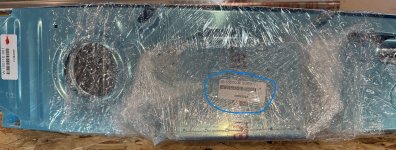
Are they still using those self destructing tamper proof paper part labels?
 
Pointed my phone at Louise's picture, and confirmed: straight to the order page for that item.

This will be true for all products that are currently on the webstore. There are a number of new part numbers that are not on the front end (yet) but the QR codes being sent in the next batch will be correct for the actual part, only a front-side redirect will take you to the base level Hardware category until those parts are live. Once they're live, we'll remove the redirect and you can get to the actual part on the site.
 
Are you using this thread for your official build log or are you using another site? Look forward to seeing the specifics on your priming. Thanks for sharing.
 
In reading this I'm wondering if I'm looking at the sample plans wrong and missing something. Don't the 'item numbers' get changed on each page? By example there are 4 ribs in the first section labelled 15, but on the page where they are attached they have become item #2. On previous and following pages, item #2s are other parts.
You are right, Nate. I had hoped that the numbers assigned in the initial drawing (Page 22-03) would stick but they don't. Changes pretty much every page. Sigh. So, I'll continue to play around until I settle on a number management system that works for me. Having the "Item Number" from 22-03 on the part and then keeping that page (and 22-02) handy has been working okay so far, but I do wish they had stuck with the 22-03 numbers or the part numbers.
 
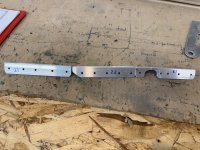
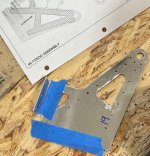
First rivet! Pages 22-01 thru 22-07 completed. There was significant deburring to do on the parts for Section 22 to meet my standards and I had one neighbor, a Sonex builder and owner, come by to help with this task. Thanks, Rob! I only used self-etching primer on the three non-Alclad parts. No plans to prime the Alclad parts. After a late lunch, assembly began. The very first rib turned out to be the mirror image of the correct part. Thankfully, I caught it after only one Cleco was put in. Logic suggested that the correct rib might be in the right-wing subkit, and it was. Back to removing plastic coating and deburring the correct part. It would have been a very easy mistake to make as only the flange direction was different. In fact, when I showed it to the other two in the shop, it took a minute or three to convince them that the part was the wrong one! Always check carefully before riveting. Vans has done a heroic job of getting these kits out but, not surprisingly, there will be errors in these first kits out the door. Their process isn't as refined as LEGO's.
Non-Alclad_Parts.jpg010525-Deburring-RobLouise-2.jpg
Left: The three non-Alclad parts to be primed. Right: Yep, I may be building in the best "build-assist" center in the world!​

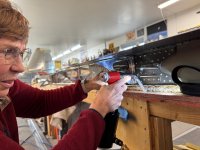
1st_Rivet.jpgEndOf_010525.jpg

Left: First rivet pulled. Right: Progress at the end of the day.

Once all parts were prepared, the pages flew by and the first nine rivets were set. Unfortunately, time was up and other tasks called. But, it feels good to be started.
 
Wow, the hardware kit with a pic, part#, and the QR code that actually goes somewhere! Amazing.

Repeat offender thinking I had built my last RV, now wondering if I'm fooling myself.
I haven't even finished my first RV but the thought of building a high wing RV with pulled rivets is tempting!
 
You are right, Nate. I had hoped that the numbers assigned in the initial drawing (Page 22-03) would stick but they don't. Changes pretty much every page. Sigh. So, I'll continue to play around until I settle on a number management system that works for me. Having the "Item Number" from 22-03 on the part and then keeping that page (and 22-02) handy has been working okay so far, but I do wish they had stuck with the 22-03 numbers or the part numbers.

Dang, I was hoping I was just having one of those mental blocks and not seeing the light. Oh well, just something to get used to keeping an eye on or maybe Van's could rethink this naming convention since the KAI's are still a work in process. Renaming parts on each page seems like something to avoid, but maybe there is a compelling reason to do it that way.
 
I have a new question that you may be able to help with since you have the kit parts in hand.

There are a few places where the recommended process is to buck rivets. Of course this is common in the RV world but is a little bit unexpected. It's hard to tell from looking at the KAI sample whether this will really be necessary or not. I can think of 2 reasons that this version of the docs would recommend bucking, that would be limited access with a squeezer yoke or default guidance that #4 rivets are difficult to squeeze and the traditional 'minimal tool' set would have a basic manual squeezer. It looks like the sample plans could be consistent with either scenario. The bucked rivets are #4, in what look like potentially long reach or limited access locations.

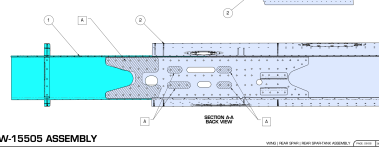
Here is an example location, with the rivets going into locations A. Those inboard locations are covered by the tank skins that seems like they would obstruct a squeezer yoke. But, there are also cutouts in the spar nearby that may allow a squeezer to pass through and get the job done.

I'm a -12 builder where it was not necessary anywhere in the entire kit. I have access to some hand-me-down bucking tools and just enough experience to get by with an oddball need here there, but I'm trying to decide if I should do some tool shopping and get in some extra practice.


Screenshot 2026-01-06 at 8.04.24 AM.png
 
Thanks for that quick comparison to the RV-3B! Since I'm still building mine, it's nice to have.

When I was mentoring a high school's RV-12iS, we used the same idea for a log, check the instruction and date it. We did implement one rule, though, someone other than the builder had to do the checking and initializing. But those were high school kids.

Dave
 
I have a new question that you may be able to help with since you have the kit parts in hand.

There are a few places where the recommended process is to buck rivets. Of course this is common in the RV world but is a little bit unexpected.

Yeah, I'll let you know when I get there. Since we have the tools, I plan to do everything as Vans suggests unless a real barrier arises.

UPDATE on 1/25/26: There are definitely places where shooting and bucking are necessary but I can only think of two places so far. One is during Section 29 and the other was earlier on the spar and may depend on how deep of yoke you have. You will need access to a gun and bucking bar, but maybe borrowing occasionally will be adequate.

Louise
 
Last edited:
Squeezing rivets begins: Section 22, p.8-13

Building time was very short today...a couple of hours. Most of the work was squeezing rivets. Yep, solid rivets. For many of them, I used a longeron yoke, but they could be shot instead.

AileronBracket-Left.jpgOutboard aileron bracket assembly complete. Lots of squeezed rivets!

I discovered a disadvantage to the hardware-bin approach. Paul often jokes that Vans is a traditional Dutch company. If the inventory says there will be 10 rivets, there will be 10 rivets. Never nine. Never 11. Well, that seems to be the rule with these hardware bins. If the plan calls for 10 rivets, and the inventory calls for 10 rivets, there are 10 rivets. Problem is, I’m far from perfect and already had to drill out a couple of rivets today. There are no extras for replacement. But, our shop has loads of extra rivets, screws, nuts, washers, etc., etc., so I don’t expect it to be a problem.

Onward tomorrow!
 
Last edited:
I discovered a disadvantage to the hardware-bin approach. Paul often jokes that Vans is a traditional Dutch company. If the inventory says there will be 10 rivets, there will be 10 rivets. Never nine. Never 11. Well, that seems to be the rule with these hardware bins. If the plan calls for 10 rivets, and the inventory calls for 10 rivets, there are 10 rivets. Problem is, I’m far from perfect and already had to drill out a couple of rivets today. There are no extras for replacement. But, our shop has loads of extra rivets, screws, nuts, washers, etc., etc., so I don’t expect it to be a problem.

Onward tomorrow!
This was something I had to get used to on the RV-12. When I built my 7 it seamed like they sent enough hardware and rivets to build two of them. The 12 is very much like what you describe. Unfortunately for me, I let allot of my extra hardware go with the RV7 and have had to replenish my spare stock and a much higher cost these days vs when I bought all of that stuff way back there.
 
The very first rib turned out to be the mirror image of the correct part. Thankfully, I caught it after only one Cleco was put in. Logic suggested that the correct rib might be in the right-wing subkit, and it was. Back to removing plastic coating and deburring the correct part. It would have been a very easy mistake to make as only the flange direction was different. In fact, when I showed it to the other two in the shop, it took a minute or three to convince them that the part was the wrong one! Always check carefully before riveting. Vans has done a heroic job of getting these kits out but, not surprisingly, there will be errors in these first kits out the door. Their process isn't as refined as LEGO's.
Louise,
Was your 1st part that was wrong in your 1st attempt at assembly W-15014C-002 FLAP TRACK COVE RIB OTBD?
That was the part that didn't match the plans for me. I found the one that matched in the right wing sub kit also.
I'm hoping that the part orientation on the plans are correct. Otherwise it could be a huge can of worms down the road...
 
Louise,
Was your 1st part that was wrong in your 1st attempt at assembly W-15014C-002 FLAP TRACK COVE RIB OTBD?
That was the part that didn't match the plans for me. I found the one that matched in the right wing sub kit also.
I'm hoping that the part orientation on the plans are correct. Otherwise it could be a huge can of worms down the road...
That be the one. Yep, I'm hoping/trusting that the orientation on the drawing is correct. I note that the drawings in the early pages remains the same much later in the documentation, so fingers crossed. I guess it isn't surprising that it happened twice (or, maybe, four or six times!).

Louise
 
Sections 22 and 23 completed

SECTION 22
Yesterday, I completed Section 22. Along the way, I squeezed solid rivet, shot solid rivets, and pulled rivets. Probably didn’t need a squeezer but I did need a gun, bucking bar, countersink for -4 rivets, and deburring supplies/equipment. The edges definitely needed deburring. One side of the holes benefitted from a quick, light spin with the deburr tool, but that’s a choice. All rivets could be done solo, but it always goes quicker and easier with a separate bucker. We now have a pretty long, sorta flimsy piece on the work bench and I’m glad I have a very long work bench to place it and still have room for other work.

S22_Completed.jpg

I was pretty pleased yesterday when I walked in with only three pages left on Section 22 until I went to pull out the solid rivets for the final step. It calls for AN470AD4-5.5 solid rivets but they are backordered. I thought, no problem, Paul has loads of rivets. But, he doesn’t have 5.5s. I tried -6. Definitely too long. I tried -5. Maybe? I called Paul over from his F-1 project and he agreed that -5 was just a bit too short. Sigh. Where’s the rivet cutter? As I hadn’t cut a rivet in about 15 years, he did the first one then I did 29 more on the assumption that I will need them eventually for the right wing. A couple cut rivets needed a quick sanding at the tip to slide in but Section 22 was saved and completed. I also needed to squeeze a bellcrank assembly without crushing the bearing. Paul to the rescue again suggesting I use large-diameter washers on each side to protect the bearing inside their inner hole. On to Section 23!

CuttingRivet.jpgSqueezingBellCrank.jpg
Cutting a -9 rivet down to -5.5 to replace back-ordered parts. Using large-diameter washers to squeeze bell-crank assembly in our vice.

HighlightingHoles.jpgCoveringHole1.jpg
Many times on this project, only some holes in a piece are called out for countersinking and/or riveting. Thus, I either cover the holes to NOT be worked on with painter's tape or circle the ones to be worked on with a note to "Do". Experienced builders know this trick but newbies might want to pay attention.

SECTION 23
First, I believe there is an error in the current (as of today) “ASSM PARTS LIST” on page 23-2. It calls for W-15011C-001, a right-wing part in the right wing subkit. I ignored this part and didn’t need it. Something for the Vans people to correct/delete. The four other pieces were quick to deburr and even quicker to assemble. Quick victory!

This was the first time that I had encountered using an “opps” rivet on a nutplate. After consultation with Paul and a few spins with the deburring tool, the one nutplate was installed. Section 23 was completed in under 1.5 hours with most of the time deburring.
S23_Completed.jpgCompleted Section 23.
 
SECTION 24: W-15503

Prepped the day before, Section 24 went smoothly and quickly today. One observation that I have made is that there is a slight inconsistency in how the sub-kits are packaged. So far, easy to figure out. In Section 23, the parts list on page 23-02 has both the right and left wing rib listed. This makes sense as the same instructions will be used for the right wing, as well. And, the right-side rib was packaged in a separate right wing sub-kit. However, in Section 24, which only has two new and relatively small pieces to add, lists both the left and right wing pieces on page 24-02. However, in this case, both the right and left pieces are packaged in one sub-kit package. Left and right are not distinguished. Easy enough to figure out, but it did stop forward movement for a minute or two. I just took the left side pieces out and re-wrapped the right-side pieces.

Otherwise, more shooting and pulling and a pretty quick victory. I then opened Sub-kit 15504 and prepped the pieces and started on that assembly.
 
Wow, the hardware kit with a pic, part#, and the QR code that actually goes somewhere! Amazing.

Repeat offender thinking I had built my last RV, now wondering if I'm fooling myself.
For those of us that built in the 90’s and 00’s the current instructions and system is only a dream! I swear I spent half the time figuring out the next step.
 
For those of us that built in the 90’s and 00’s the current instructions and system is only a dream! I swear I spent half the time figuring out the next step.
I thought the -7 kit was a big step up from the -6 (and it was) and I had it easy, but the -15 is next level.

Only thing that stands out so far is that the tackle box should have some extra of each fastener.
 
Sections 24-26
Boy, this wing kit goes together fast! I was able to complete Sections 24-26 in about four or five hours today. There was quite a bit of shooting after the pre-built tank assembly came out. While I could have solo shot the solid rivets, it was easier and went very quickly to call Paul over to both ensure I had things Clecoed together properly (sure didn't want to screw this junction up!) and make the riveting cleaner. I will note that the edges of the tank assembly were beautifully deburred! I don't think they did the holes, but the holes are quite clean and deburring them may verge of obsessive.

Things went so quickly that I even had time to prep the parts for Section 27 and start that step. However, it looks like progress may slow/stop as Section 27 calls for 3 pieces on back order. No problem, however, there are plenty of parts to prep...remove blue plastic cover, re-mark, deburr edges, (in my case) lightly deburr holes, remove red ink stamps, and then repack them for later use. So far, I think I have spent more time on these tasks than Clecoing and riveting! Getting ahead on the rest of the pieces will make assembly of the rest of the left wing and the right wing fly by unbelievably fast!

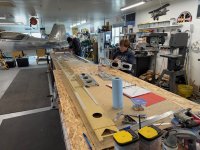
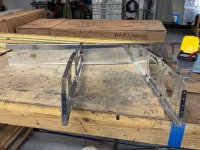
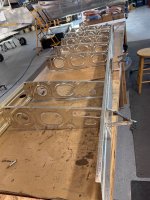
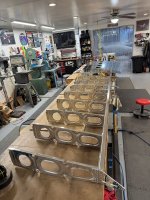
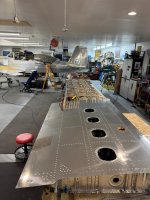
The most notable observation at this point is that the assembled wing is now 14 feet (4.2 meters) long! I am VERY fortunate to have a long work bench that allows for the one wing to sit securely on the bench AND provide substantial room on each end for my and Paul's continuing projects.

AssemblyWithTank-1.jpg
View from outboard end.AssemblyWithTank-2.jpg
View from inboard end. Paul's F-1 Rocket project in the background.
 
Does it look like the fuel tank could easily be built with flush, solid rivets? I know “easily” is in the eye of the builder.
 
Sections 22 and 23 completed

SECTION 22
Yesterday, I completed Section 22. Along the way, I squeezed solid rivet, shot solid rivets, and pulled rivets. Probably didn’t need a squeezer but I did need a gun, bucking bar, countersink for -4 rivets, and deburring supplies/equipment. The edges definitely needed deburring. One side of the holes benefitted from a quick, light spin with the deburr tool, but that’s a choice. All rivets could be done solo, but it always goes quicker and easier with a separate bucker. We now have a pretty long, sorta flimsy piece on the work bench and I’m glad I have a very long work bench to place it and still have room for other work.

View attachment 106853

I was pretty pleased yesterday when I walked in with only three pages left on Section 22 until I went to pull out the solid rivets for the final step. It calls for AN470AD4-5.5 solid rivets but they are backordered. I thought, no problem, Paul has loads of rivets. But, he doesn’t have 5.5s. I tried -6. Definitely too long. I tried -5. Maybe? I called Paul over from his F-1 project and he agreed that -5 was just a bit too short. Sigh. Where’s the rivet cutter? As I hadn’t cut a rivet in about 15 years, he did the first one then I did 29 more on the assumption that I will need them eventually for the right wing. A couple cut rivets needed a quick sanding at the tip to slide in but Section 22 was saved and completed. I also needed to squeeze a bellcrank assembly without crushing the bearing. Paul to the rescue again suggesting I use large-diameter washers on each side to protect the bearing inside their inner hole. On to Section 23!

View attachment 106852View attachment 106854
Cutting a -9 rivet down to -5.5 to replace back-ordered parts. Using large-diameter washers to squeeze bell-crank assembly in our vice.

View attachment 106856View attachment 106859
Many times on this project, only some holes in a piece are called out for countersinking and/or riveting. Thus, I either cover the holes to NOT be worked on with painter's tape or circle the ones to be worked on with a note to "Do". Experienced builders know this trick but newbies might want to pay attention.

SECTION 23
First, I believe there is an error in the current (as of today) “ASSM PARTS LIST” on page 23-2. It calls for W-15011C-001, a right-wing part in the right wing subkit. I ignored this part and didn’t need it. Something for the Vans people to correct/delete. The four other pieces were quick to deburr and even quicker to assemble. Quick victory!

This was the first time that I had encountered using an “opps” rivet on a nutplate. After consultation with Paul and a few spins with the deburring tool, the one nutplate was installed. Section 23 was completed in under 1.5 hours with most of the time deburring.
View attachment 106851Completed Section 23.
The Couple that builds together, definitely has more fun!😁
 
Hey guys - this thread is in the “My Project” forum, a place for folks to document what they are doing on their build. Totally OK to ask the builder (in this case Louise) a question on her build - but once it heads off in the direction of general comments or questions on the design, it would be better if you start a thread in the “RV-15” forum so folks can discuss it without gunking up a person’s thread (which is sort of a build log).

In the old forum software, a moderator could mark a bunch of posts and easily move them all en-masse to a new thread - we apparently can’t do that anymore, or I’d take care of it. And I don’t really want to delete anyone’s posts - so going forward, how about starting new threads for questions that would be more appropriate for Vans?

Paul
 
Hey guys - this thread is in the “My Project” forum, a place for folks to document what they are doing on their build. Totally OK to ask the builder (in this case Louise) a question on her build - but once it heads off in the direction of general comments or questions on the design, it would be better if you start a thread in the “RV-15” forum so folks can discuss it without gunking up a person’s thread (which is sort of a build log).

In the old forum software, a moderator could mark a bunch of posts and easily move them all en-masse to a new thread - we apparently can’t do that anymore, or I’d take care of it. And I don’t really want to delete anyone’s posts - so going forward, how about starting new threads for questions that would be more appropriate for Vans?

Paul
Thank you, Paul. Someone had warned that using the My Project forum would end up highjacked with lots of unrelated discussion and they were obviously right. I won't continue if the unrelated clutter continues because it so degrades the value of the thread that I'm trying to break into easily identifiable Section discussions for future builders. Thank you for your considerations.
 
SECTION 27 partial: W-15506

I finally hit a roadblock with this section. Key pieces are backordered so I was only able to work through page 27-7 but several observations might be of interest. I have reported what I think are mistakes to Vans already.

  • On page 27-6 (downloaded 1/10/26), parts W-150148-001 and -002 are reverse of how they should install. It will be obvious.
  • There are several little issues with the Cherry Max rivets.
  • They provide for 78 and call for 39 during this step. We had one malfunction and one ruined by apparent “operator error”. Now, we will not have enough of them (although Paul has four more in his stock, if the attrition rate doesn’t increase). I suggest that the next time you (the RV-15 builder) make an order to Aircraft Spruce (or wherever), you have them throw in a few of these rivets.
  • My kit provided CR3213-4-3s and the inventory listed -4-3s but page 27-7 calls out -4-2s, which do not seem provided. What makes this particularly odd is that the thickness of 10 of the holes has an additional layer so one would expect those 10 rivets to be half-size longer. (I understand that Cherry Maxs don’t come in half sizes.) After consulting my in-shop “build assist” mentor and checking lengths on both, he concluded that the -4-3s will be appropriate for all 39 holes.
  • I have used it before on this project but this area really needs the Close-quarter Rivet Pulling Wedge (available at Cleaveland Tools) for some on these spots.
  • On my inventory sheet, it shows that there are two W-15033-01s on backorder but Section 27 calls for two on each side…two on the right and two on the left. Look for FOUR of them when backorders are filled.
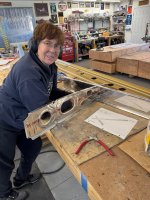
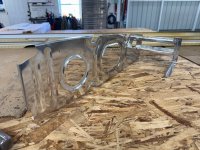
Using wedge to pull rivet.jpgHow and where the Close-quarter Rivet Pulling Wedge was useful. In reality, Marc held the handle of the wedge and stabilized the wing while I pulled the trigger and pulled the flange away from the puller.

I did have time to prep Section 28 and it looks like I’ll be able to do some work on it today.

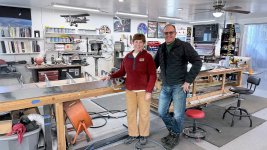
The highlight of today, however, was a visit from Marc Ausman and his friend. Marc (MCA) is a soon-to-be fellow RV-15 builder and wanted to check out the kit. Thanks for lunch, Marc!

LouiseMarc.jpgNewbiePullingRivet.jpg
L: Louise and Marc look over the project. R: Newbie friend of Marc pulls his first rivet.
 
Vans specifically says CherryMax rivets cannot be pulled at an angle with a wedge in section 5 of the KAI.
 
Last edited:
Interesting! After hearing some suggestions and discussion, all I will say is that the factory and shop heads all look good and I feel confident that the wings are not going to fall off because we used the wedge on about 15 of these 39 Cherry Max rivet. As for hand squeezers with short lever arms, you've got to be kidding! Not something I'm capable of doing. When we started a pulled rivet plane several years back, I told Paul I wasn't participating unless we got pneumatic (or, I suppose, electric) pullers. Using the pullers posted would have been a deal-breaker for me.
 
Last edited:
Vans specifically says CherryMax rivets cannot be pulled at an angle with a wedge in section 5 of the KAI.
Understandable, but they certainly didn't design this in a way that's possible (especially the lower rivet on the flap track bracket). Maybe someone has ideas?
 
SECTION 27 partial: W-15506

I finally hit a roadblock with this section. Key pieces are backordered so I was only able to work through page 27-7 but several observations might be of interest. I have reported what I think are mistakes to Vans already.

  • On page 27-6 (downloaded 1/10/26), parts W-150148-001 and -002 are reverse of how they should install. It will be obvious.
  • There are several little issues with the Cherry Max rivets.
  • They provide for 78 and call for 39 during this step. We had one malfunction and one ruined by apparent “operator error”. Now, we will not have enough of them (although Paul has four more in his stock, if the attrition rate doesn’t increase). I suggest that the next time you (the RV-15 builder) make an order to Aircraft Spruce (or wherever), you have them throw in a few of these rivets.
  • My kit provided CR3213-4-3s and the inventory listed -4-3s but page 27-7 calls out -4-2s, which do not seem provided. What makes this particularly odd is that the thickness of 10 of the holes has an additional layer so one would expect those 10 rivets to be half-size longer. (I understand that Cherry Maxs don’t come in half sizes.) After consulting my in-shop “build assist” mentor and checking lengths on both, he concluded that the -4-3s will be appropriate for all 39 holes.
  • I have used it before on this project but this area really needs the Close-quarter Rivet Pulling Wedge (available at Cleaveland Tools) for some on these spots.
  • On my inventory sheet, it shows that there are two W-15033-01s on backorder but Section 27 calls for two on each side…two on the right and two on the left. Look for FOUR of them when backorders are filled.
View attachment 107080How and where the Close-quarter Rivet Pulling Wedge was useful. In reality, Marc held the handle of the wedge and stabilized the wing while I pulled the trigger and pulled the flange away from the puller.

I did have time to prep Section 28 and it looks like I’ll be able to do some work on it today.

The highlight of today, however, was a visit from Marc Ausman and his friend. Marc (MCA) is a soon-to-be fellow RV-15 builder and wanted to check out the kit. Thanks for lunch, Marc!

View attachment 107082View attachment 107081
L: Louise and Marc look over the project. R: Newbie friend of Marc pulls his first rivet.
Did your kit come with a separate inventory list, or did you have to look through each page of the plans?

My kit will be here wednesday and I am trying to get prepared!
 
Understandable, but they certainly didn't design this in a way that's possible (especially the lower rivet on the flap track bracket). Maybe someone has ideas?
I am only guessing, but it is probably related to the rivet pulling tool being used. There are a lot of different tools that have varying levels of clearance. The prototype build was very likely done using the rivet tool that has been recommended for many years to RV – 12 builders. It provides considerably more clearance than the typical Stanley/generic riveting tool. I haven’t looked through the plans for that detail… Do they recommend any specific rivet puller tool?

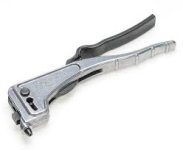
Here is one that has been popular with RV – 12 builders.
The crazy cost is unfortunate and occurred. When the company that owns the pop rivet brand purchased the rights to the tool quite a few years ago.
When the RV – 12 was first introduced this tool could be purchased for about $50

 
Last edited:
I am only guessing, but it is probably related to the rivet pulling tool being used. There are a lot of different tools that have varying levels of clearance. The prototype build was very likely done using the rivet tool that has been recommended for many years to RV – 12 builders. It provides considerably more clearance than the typical Stanley/generic riveting tool. I haven’t looked through the plans for that detail… Do they recommend any specific rivet puller tool?

Here is one that has been popular with RV – 12 builders.
The crazy cost is unfortunate and occurred. When the company that owns the pop rivet brand purchased the rights to the tool quite a few years ago.
When the RV – 12 was first introduced this tool could be purchased for about $50

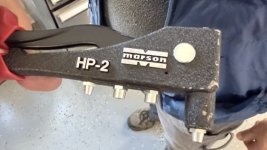
Scott, in hindsight we probably should have used this tool instead of the pneumatic puller. Paul had it in his extensive tool collection, and requires less clearance than the other pullers, even the one that has the pivot head.
IMG_6438.jpeg

(Paul - are we still in scope here?)
 
Scott, in hindsight we probably should have used this tool instead of the pneumatic puller. Paul had it in his extensive tool collection, and requires less clearance than the other pullers, even the one that has the pivot head.
View attachment 107090

(Paul - are we still in scope here?)
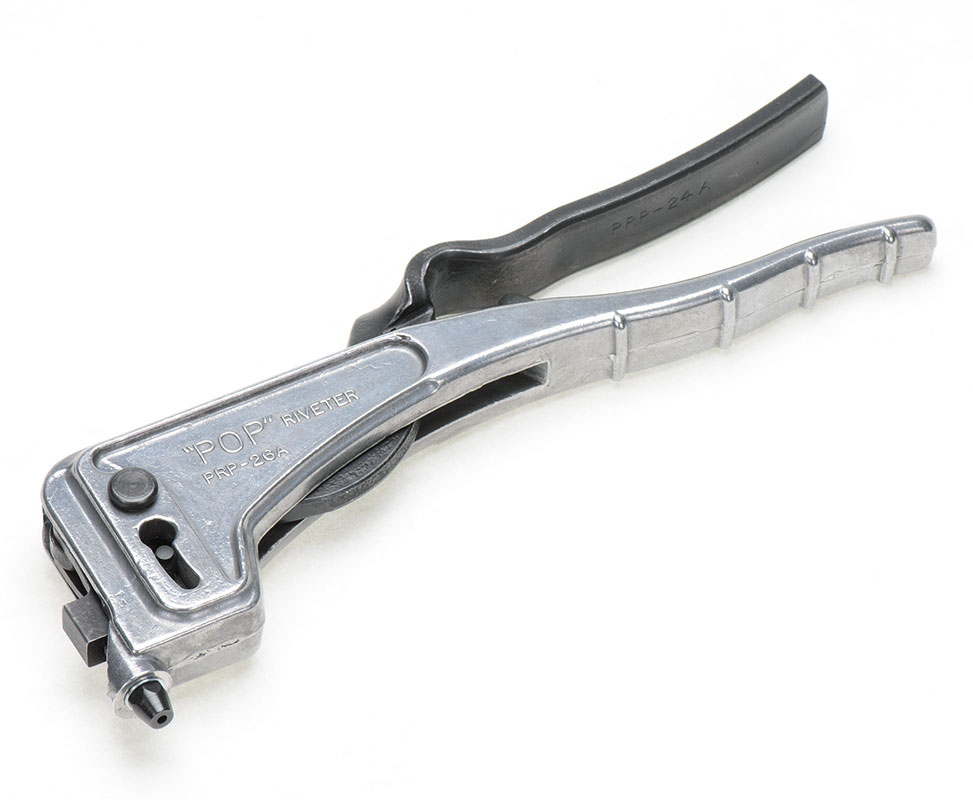
Not cheap but worth every penny…
POP® RIVETER, CLOSE QUARTERS from Aircraft Tool Supply
PRP-26A.jpg
 
Vans specifically says CherryMax rivets cannot be pulled at an angle with a wedge in section 5 of the KAI.
Well I talked with the fellow who pretty much wrote Section 5, and what you have to realize is that it was written for the widest audience - and that there are very few absolutes in this world. The important thing is that Cherry’s have to be pulled STRAIGHT - Cherry says you can’t pull them at an angle. And properly used, the whole purpose of the wedge too is to make an angled pull “look” straight to the rivet. The caveat is that you have to know what you are doing and make really certain that the wedge is being used properly. You might take a half hour of examining options and lining things up before you pull the trigger - that is what experince tells you, and I have pulled thousands of CherryMax’s. I was comfortable in this place using the wedge, and after examining both ends of the resulting pull, the rivets set perfectly. But no - inexperienced users probably shouldn’t try it without lots of practice.

To Marc’s question on the Marston - if I thought it had been the right thing to use in that spot, we’d have used it. I had already looked at it before you got there, and nope - it wasn’t going to solve the problem. I am betting that Scott is right that the factory used the PRP-26 in that spot because they had one. The Marston solves 95% of the close-quarter riveting problems in building most airplanes - but not all. It’s often a trade between skills with what you have (and doing mockups and practice) and buying a different tool.

So caveats apply - if you’re going to pull these with a wedge, I would only do it if you have done many, many CherryMaxs before and understand them. I was watching over shoulders in this case, and Louise had plenty of experience to do them right.

Paul
 
Hi Louise,
What would you recommend for width on the work table for the wings. Keep up the great work/info
Thanks
 
Back
Top