

If you didn’t see it in other threads, here’s the link to download a 97-page sample of what you can expect:
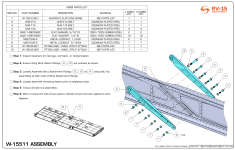
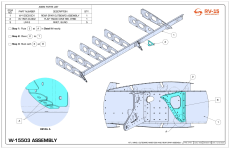



I'll be looking at that part a little bit cross-eyed for a while. I'm coming from the RV-12 build which also had very thorough KAI which was generally really good. For my brain, I feel better seeing actual part numbers, they kinda stick in my brain from page to page and things track. This method of everything getting a new number, starting at 1, on each page will break that continuity. I'm sure it will just be an adjustment to get used to.Looks a bit "Ikea like" to me. I like when the part numbers are identified on the drawing next to the part versus the box up in the corner.


Just like every other RV ever built. Including the one you’re building now.The aileron spherical bearings (item 1) are going to be a PITA if they ever need to be replaced, they are captured by the side brackets (items 3 and 4) which are riveted together with the middle brackets (item 2)

Just like every other RV ever built. Including the one you’re building now.

I'm trying to save up money to order."So easy a Caveman could do it."
 Gotta finish the Pietenpol first. Also letting my buddies be the guinea pigs... Also, Carey would prefer a 10
Just like every other RV ever built. Including the one you’re building now.
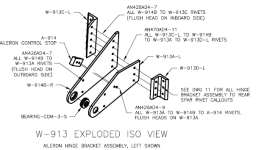
In my entire career working with RVs, I have only had to replace one one time.View attachment 106249
Yes, you are correct (2 plate mount on mine, 3 plate mount on RV-15). Am I correct in assuming that in both cases the bracket(s) must be completely de-riveted to replace the spherical bearing?
I think it is related to flap deployment.can anyone tell me the function of the "mixer box"? Where does it get the name?
TIA


Van's neglected to mention about a thing called Section 5. It has most of the information you will need to know about working with aluminum and rivets and pretty much everything you need to know about building your kit.Sorry for the nube question..just getting my kit inventoried and starting to look at the manual
In some places the plans specify a rivet direction, in many they don’t
Based on a brief search through the forums,
(for example Thread 'AN470 rivet direction')
I think I got that unless otherwise directed in the plans, or there are access issues, the factory rivet head should go on:
The side with the thinnest material
The visible side
The side with the easiest access
The side that is easiest to drill out later
The front or top sides
Are there any other considerations and is there any significant priority to the options in the above list that would make one a higher priority choice than another?
If the plans specify an orientation, there is generally a reason for it. So, the plan specified orientation trumps all others. From there, convention says the manufactured head goes on the thinner material, top, or forward. There is no strength difference for a properly driven rivet in any orientation.Sorry for the nube question..just getting my kit inventoried and starting to look at the manual
In some places the plans specify a rivet direction, in many they don’t
Based on a brief search through the forums,
(for example Thread 'AN470 rivet direction')
I think I got that unless otherwise directed in the plans, or there are access issues, the factory rivet head should go on:
The side with the thinnest material
The visible side
The side with the easiest access
The side that is easiest to drill out later
The front or top sides
Are there any other considerations and is there any significant priority to the options in the above list that would make one a higher priority choice than another?
They actually went way above just mentioning it.Van's neglected to mention about a thing called Section 5.
Section 5 is great reading, thanks!The problem is they don’t include section 5 in the plan set. You have to go look for section 5 on the Van’s website. At least that’s what I had to do.

The direction of the rivet is not important for structural strength. The direction is important from the perspective of interference such as the control arm for the aileron. Usually in the construction drawing, it will specify the direction to countersink so when the control arms slide against each other, they won't hit a shop rivet head.Section 5 is great reading, thanks!
I couldn’t find anything specific on rivet direction, and actually I couldn’t find it in 43.13 either, although it is probably in one or the other somewhere.
I did find this reference with some interesting tidbits specific to riveting:

The problem is they don’t include section 5 in the plan set. You have to go look for section 5 on the Van’s website. At least that’s what I had to do.
I'm building an RV-3B, and you're absolutely right!The detail is overwhelming when you compare with any page that Van's sent out with the RV6A.
Looking at Strut attach W-15511, there are 6 pages. A builder of a 3,4 or 6 would have been happy with page 5 only.
There is a chart in the previously referenced to section 5, that lists recommended torque values for common fasteners.I'm building an RV-3B, and you're absolutely right!
Although I was surprised to see that the proper torque wasn't specified. But it's not in the RV-3B plans either, of course.
Dave

The RV-15 kit plans for sections 23-27 (along with section 5 and index) are now posted in the web store, at least they are for me. These files show the same date of 12/30/25 as the sample plans posted earlier, but the version shows as R0 in the web store where it was R1 in the samples.
Who's good at those puzzles where you find any differences between two matching pictures.
When do you plan to post plans Sections 10-21for those who are looking to do their own fuel tank assembly?Good catch. We'll take a look and make sure the plans posted inside the webstore login are correct. Lots of moving parts 'round here!



