

Van's Air Force
You are using an out of date browser. It may not display this or other websites correctly.
You should upgrade or use an alternative browser.
You should upgrade or use an alternative browser.
E-Props
- Thread starter n233va
- Start date


I ordered direct, they were very easy to deal with.Anyone know of a USA Distributor for E-Props? Specifically a 3 blade for the 912 ULS.
Anne LAVRAND
[email protected]
President / Sales Manager
HELICES E-PROPS - SAS ELECTRAVIA
E-PROPS PROPELLERS (https://www.e-props.fr/) : Ultra-Light Carbon Propellers for Aviation
195 Rte de l'Aviation - ZI Aérodrome Sisteron - 04200 Vaumeilh - France
Tel: +33(0)4 92 34 00 00
*** E-PROPS : Light is Right ***

A world famous Paramotor pilot Tucker Gott is a US distributor. I doubt he keeps what we need in stock but he can get em.Anyone know of a USA Distributor for E-Props? Specifically a 3 blade for the 912 ULS.
[email protected]

This is where I purchased my E-Prop from:Anyone know of a USA Distributor for E-Props? Specifically a 3 blade for the 912 ULS.
Larry Mednick
President,
813-810-9262
Evolution Aircraft Inc.
www.EvolutionTrikes.com

I bought from Larry as well. LOVE this prop.This is where I purchased my E-Prop from:
Larry Mednick
President,
813-810-9262
Evolution Aircraft Inc.
www.EvolutionTrikes.com
I just finished my RV-12iS and took it to Wayne Lohmeyer of Custom Aviation Services LLC to have the Rotax oil nozzle bulletin inspection completed. He is located near Houston. He can order and install E-props and has done RV-12's. Wayne is a Certified Rotax mechanic and I used him for another Rotax issue on my 912ULS powered Kitfox and was very satisfied with his work.
Me too. Great price and service. I had what later turned out to be a non-issue and they promptly sent me another prop. He usually has RV-12 props in stock.This is where I purchased my E-Prop from:
Larry Mednick
President,
813-810-9262
Evolution Aircraft Inc.
www.EvolutionTrikes.com
I know that the e-props haven’t been used on the RV( particularly the 12) very long, but can anyone report how they have stood up to chips and any other abrasions. I know Piper J3 flys his out of a grass strip. I’m really contemplating getting one, but they aren’t painted and look like the skinny blades would be subject to abrasions?
I have been flying mine for just over a year (about 70 hours) and it still looks new. The titanium leading edge protection should handle most abrasive sources. About all I ever see are bug remains, which are cleaned off with water after every flight.I know that the e-props haven’t been used on the RV( particularly the 12) very long, but can anyone report how they have stood up to chips and any other abrasions. I know Piper J3 flys his out of a grass strip. I’m really contemplating getting one, but they aren’t painted and look like the skinny blades would be subject to abrasions?

How finicky is it to set the blade angles? The only thing I don't like about the Sensenich prop is that it's adjustable. Since the optimum blade angle has been pretty well defined by Van's test engineers (and the subject beaten to death on this forum), I'd rather have a fixed pitch prop that didn't need to have the blades removed every year to verify bolt torque and then spend an hour getting them exactly set again.
Took me 30-40 minutes to adjust blade angles each time I did it. Not difficult at all. I actually enjoyed playing with blade angles.
Does anyone have a current price for the Eprop?Took me 30-40 minutes to adjust blade angles each time I did it. Not difficult at all. I actually enjoyed playing with blade angles.
Thanks,
Mitch
N44PL
I went through Larry. It was $2500 OTD about a year ago. Not sure what it is now.
This is way higher than the quotes I have received.2025 price catalog on Eprops home site list it at 5,470 euros. Or about $6500 Usd.
The current price for the 12 direct on their website is $2895 EUR, $3409 USD.
Absolutely no way these are worth $6500 USD.
Last edited:
I suspect the published retail euro price is MSRP in spades, lots of negotiation room. Not sure how tariff may play here, on shore stock inventory may be considerably cheaper than new replacement stock. just shows it is worth calling around and due diligence in shopping.This is way higher than the quotes I have received.

Piper J3
Well Known Member
I bought my E-Prop right after Sun-n-Fun last year and was able to still get discount show price of $2500 incl taxes and DHL shipping (6 days from France to my door). Ordered from Evolutiontrikes. Installation and setting blade pitch is simple. I operate from grass strip and no abrasion in 65 hours.
I’m getting 100-150 fpm additional climb w/ 5200 RPM @ full throttle. Initial climb rate is 1300 fpm… I never saw anything like that w/ 2-blade Sensenich. Nose is 3" higher above horizon in climb and pulls very strong. I see additional 5 mph in cruise. Blade pitch set to 26.0° appears to be spot-on. The prop also adds some aerodynamic braking and helps slow the airplane on final approach to landing. Prop is dynamically balanced at the factory and is very smooth operation. Entire prop including hub and hardware weighs 4.5 lbs. I thought engine shut off quickly with 2-blade Sensenich prop… this prop has so little moment of inertia that it stops immediately. The E-Prop has a carbon fiber pitot tube that runs in a ball bearing completely unsupported by the spinner. In fact, you can run prop and pitot tube without installing spinner.
Most airplane fixed-pitch props are pitched for Climb, Cruise, or Combination Climb/Cruise. The carbon fiber E-Prop is ground adjustable fixed-pitch, but the prop tips flex in flight depending on prop loading. In climb… the prop is loaded heavily and the tips flatten out a little bit and prop behaves like excellent climb prop. When you pitch-over into cruise flight the prop unloads and prop tips revert back to static pitch setting and you then have excellent cruise performance.
I’m getting 100-150 fpm additional climb w/ 5200 RPM @ full throttle. Initial climb rate is 1300 fpm… I never saw anything like that w/ 2-blade Sensenich. Nose is 3" higher above horizon in climb and pulls very strong. I see additional 5 mph in cruise. Blade pitch set to 26.0° appears to be spot-on. The prop also adds some aerodynamic braking and helps slow the airplane on final approach to landing. Prop is dynamically balanced at the factory and is very smooth operation. Entire prop including hub and hardware weighs 4.5 lbs. I thought engine shut off quickly with 2-blade Sensenich prop… this prop has so little moment of inertia that it stops immediately. The E-Prop has a carbon fiber pitot tube that runs in a ball bearing completely unsupported by the spinner. In fact, you can run prop and pitot tube without installing spinner.
Most airplane fixed-pitch props are pitched for Climb, Cruise, or Combination Climb/Cruise. The carbon fiber E-Prop is ground adjustable fixed-pitch, but the prop tips flex in flight depending on prop loading. In climb… the prop is loaded heavily and the tips flatten out a little bit and prop behaves like excellent climb prop. When you pitch-over into cruise flight the prop unloads and prop tips revert back to static pitch setting and you then have excellent cruise performance.

scottmillhouse
Well Known Member
I switched Fall of 2024 and did a direct comparison between props then and also had a VAF group buy price with Larry that he honored for SNF too. Ask and he may still discount. Search my name for the comparison results.
As a follow up the climb and speed performance after over a year usage is as I reported or better at low altitudes and cooler temperatures. In the summer at altitude, say 7500 during cruise I have not seen the performance increase, perhaps due to the thinner air and the narrow blades not getting the same bite. Also I have noted an increase in fuel usage. You are running a higher manifold pressure as I am pitched and get better climb and top speed but pay with additional fuel. Still very satisfied with the swap.
As a follow up the climb and speed performance after over a year usage is as I reported or better at low altitudes and cooler temperatures. In the summer at altitude, say 7500 during cruise I have not seen the performance increase, perhaps due to the thinner air and the narrow blades not getting the same bite. Also I have noted an increase in fuel usage. You are running a higher manifold pressure as I am pitched and get better climb and top speed but pay with additional fuel. Still very satisfied with the swap.
I paid $3,100 through Larry at Evolution Trikes in October. That was with titanium hardware (tightening interval goes to 200 hours) and their little prop pitch tool, blade covers, and some spare hardware, delivered from France in a week. I carefully weighed everything and had a net weight loss of 6 pounds vs. the Sensenich 2-blade. I ran through the climb and cruise testing from Van's PAP again. Cruise indicates 3-4 knots higher but CAS is 2 knots higher, and climb is the same. The beefy pitot tube has a different shape than Van's, which may account for the higher IAS. Easy to adjust the pitch after you have done it a couple of times. The factory site has a video and Larry's site does too. He was very helpful with my questions. Even without the same or better performance I would buy another one for the incredible smoothness. My only minor gripe is they advise against painting the blades, and the aft side of the prop disk is pretty shiny when the sun hits it just right.Does anyone have a current price for the Eprop?
Thanks,
Mitch
N44PL
Most airplane fixed-pitch props are pitched for Climb, Cruise, or Combination Climb/Cruise. The carbon fiber E-Prop is ground adjustable fixed-pitch, but the prop tips flex in flight depending on prop loading. In climb… the prop is loaded heavily and the tips flatten out a little bit and prop behaves like excellent climb prop. When you pitch-over into cruise flight the prop unloads and prop tips revert back to static pitch setting and you then have excellent cruise performance.
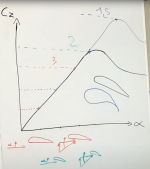
Just want to clarify - I see this ‘blade flex’ theory mentioned often on the internet, but this is not how e-Props' Extended Speed Range (ESR) feature works. If you’ve studied aerodynamics at an engineering level you will understand the relationship between wing loading, gust loading, coefficient of lift, angle of attack, etc... In a simplified explanation, refer to the image below where you will see a typical coefficient of lift curve (CZ in figure) increase with an increase in angle of attack (alpha in figure) until the airfoil stalls (top of the curve). An aircraft with a simple airfoil in level flight will typically be at the bottom of the CZ curve represented by the lowest dashed line. A sudden gust or vertical movement of air will suddenly change the angle of attack on the wing and potentially increase the lift by a factor of 3, for example. This represents the airfoil’s sensitivity to turbulence. This sensitivity can be mitigated by using an airfoil with a higher wing loading/angle of attack (further up the curve). Doing so, the same gust may result in an increase in lift by a factor of only 2, for example.
Propeller behavior is similar except that a prop will always be at its greatest angle of attack at zero airspeed (top of the curve) and that angle of attack will then decrease with an increase in forward airspeed. So, in the same way a wing is sensitive to sudden gust loads from rising/falling air, a propeller is sensitive to changes in forward airspeed. Of course, the lift produced by the prop is along the longitudinal axis and referred to as thrust.
What e-Props has done is reduced their propeller’s sensitivity to forward airspeed by increasing its airfoil lift loading as mentioned above. But what really sets them apart is they have further reduced their prop lift coefficient sensitivity by designing their own long, slender, low-drag, highly loaded airfoils that exhibit an aggressive curved-bottom surface in lieu of the archaic flat-bottomed airfoils other companies use (ref figure). This results in an ability to keep changes in the prop lift coefficient (related to changes in forward airspeed) to something closer to a factor of 1.5 with the company claiming that their fixed pitch props achieve performance similar to a constant speed prop up to about 250kph (~155mph).
It’s innovative engineering from France. I have one on my RV-12iS and have seen the same performance increase as others in this forum and couldn’t be happier. Another benefit is the incredible smoothness straight from the factory. I used to experience buzzing/vibration in my feet and on the instrument panel despite achieving 0.03ips during dynamic balancing of the 2-bladed stock propeller. But the e-Prop is perfectly smooth thanks to the balancing performed at the factory. The factory doesn't achieve balancing by simply matching blade weights, they do it by balancing/matching the distribution of mass along the length of the blades.
The prop also has a superior solution to the stock pitot tube bushing, as Jim S mentioned, has a TBO (inspection) of 4000 hours, and a 6-month money-back guarantee. There is a lot of info about the design, testing, and certification on their website.
Jérémie Buiatti, the principal engineer at e-Props, explains his design theory in the video at the bottom of this page: E-PROPS: the lighest Carbon-Titanium Propellers for Aircraft
The video is in French but you can change to English subtitles.
I purchased my prop in Dec 24 from:
Larry Mednick
Evolution Aircraft Inc.
Zephyrhills, FL
https://evolutiontrikes.com/
Tim M
Attachments

Thanks for the explanation! I just ordered a 76" three blade E-prop for my Rans S-7S with a 912 ULS, currently running a 68" three blade Sensenich.Just want to clarify - I see this ‘blade flex’ theory mentioned often on the internet, but this is not how e-Props' Extended Speed Range (ESR) feature works. If you’ve studied aerodynamics at an engineering level you will understand the relationship between wing loading, gust loading, coefficient of lift, angle of attack, etc... In a simplified explanation, refer to the image below where you will see a typical coefficient of lift curve (CZ in figure) increase with an increase in angle of attack (alpha in figure) until the airfoil stalls (top of the curve). An aircraft with a simple airfoil in level flight will typically be at the bottom of the CZ curve represented by the lowest dashed line. A sudden gust or vertical movement of air will suddenly change the angle of attack on the wing and potentially increase the lift by a factor of 3, for example. This represents the airfoil’s sensitivity to turbulence. This sensitivity can be mitigated by using an airfoil with a higher wing loading/angle of attack (further up the curve). Doing so, the same gust may result in an increase in lift by a factor of only 2, for example.
Propeller behavior is similar except that a prop will always be at its greatest angle of attack at zero airspeed (top of the curve) and that angle of attack will then decrease with an increase in forward airspeed. So, in the same way a wing is sensitive to sudden gust loads from rising/falling air, a propeller is sensitive to changes in forward airspeed. Of course, the lift produced by the prop is along the longitudinal axis and referred to as thrust.
What e-Props has done is reduced their propeller’s sensitivity to forward airspeed by increasing its airfoil lift loading as mentioned above. But what really sets them apart is they have further reduced their prop lift coefficient sensitivity by designing their own long, slender, low-drag, highly loaded airfoils that exhibit an aggressive curved-bottom surface in lieu of the archaic flat-bottomed airfoils other companies use (ref figure). This results in an ability to keep changes in the prop lift coefficient (related to changes in forward airspeed) to something closer to a factor of 1.5 with the company claiming that their fixed pitch props achieve performance similar to a constant speed prop up to about 250kph (~155mph).
It’s innovative engineering from France. I have one on my RV-12iS and have seen the same performance increase as others in this forum and couldn’t be happier. Another benefit is the incredible smoothness straight from the factory. I used to experience buzzing/vibration in my feet and on the instrument panel despite achieving 0.03ips during dynamic balancing of the 2-bladed stock propeller. But the e-Prop is perfectly smooth thanks to the balancing performed at the factory. The factory doesn't achieve balancing by simply matching blade weights, they do it by balancing/matching the distribution of mass along the length of the blades.
The prop also has a superior solution to the stock pitot tube bushing, as Jim S mentioned, has a TBO (inspection) of 4000 hours, and a 6-month money-back guarantee. There is a lot of info about the design, testing, and certification on their website.
Jérémie Buiatti, the principal engineer at e-Props, explains his design theory in the video at the bottom of this page: E-PROPS: the lighest Carbon-Titanium Propellers for Aircraft
The video is in French but you can change to English subtitles.
I purchased my prop in Dec 24 from:
Larry Mednick
Evolution Aircraft Inc.
Zephyrhills, FL
https://evolutiontrikes.com/
Tim M
Though I won't mind an increase in performance, I'm mainly trying if for the reduction in vibration that most users seem to report. It's a fairly inexpensive experiment either way.
Your video is one of the examples I was referring to when I mentioned seeing the 'blade flex' theory on the internet incorrectly trying to explain e-Props Extended Speed Range (ESR) feature.Here's an interesting take on how E-Props work:
He also has a nice video describing the engineering decisions that went into the 9-series Rotax.
My text above is based on a video from Jérémie Buiatti, the actual engineer at e-Props who designed the ESR effect inherent in their propeller designs. It is not related to blade flex.
Click on this link and watch his video at the bottom of the page: E-PROPS: the lighest Carbon-Titanium Propellers for Aircraft
The video is in French but you can change to English subtitles.
NORDO Industries LLC
Well Known Member
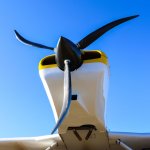
For those with O-360 engines, there is now an E-Prop for you. Per their site, 2-Blade 3500€ (USD$4071) recommended for higher-airspeed, 3-blade 4500€ (USD$5234) for lower airspeed/STOL. O-320 variant in the works.
Claimed increase of 5-7% cruise speed, 20-25% reduction in ground roll
Claimed increase of 5-7% cruise speed, 20-25% reduction in ground roll
