Van's Air Force

The definitive Van's Aircraft support community! Buying, building or flying an RV? Join our exclusive family of mentors and enthusiasts!

EarthX wants your opinion for a new RV-10 battery

Would you want a similar sized battery to the RG-25 and closer to the amp hour?


  • Total voters
    33

EarthX Lithium

Well Known Member
Ambassador
Advertiser
We have been exploring the idea of designing a new battery specifically for the RV-10 market and we want your input. The plans for this kit currently mentions the Concorde RG-25 battery and the tray is designed for that sized battery.

RG-25 Spec's

Weight 22.75 pounds

CCA 225

Capacity: 22Ah

Dimensions 190.5mm x 126.2mm x 172.9mm ( L x W X H)

Cost: $368 today on ACS


We are contemplating a new model with these spec’s:

Weight 6 pounds

CCA: 600

Capacity: 20Ah

Dimensions 166mm x 129mm x 168mm (L x W X H)

Cost: $679


(and of course the same BMS features of the other batteries)

Currently, many of you use the ETX900 or the ETX1200 to replace this battery.

ETX900 Spec's

Weight 4.9 pounds

CCA: 400

Capacity: 15.6Ah

Dimensions 166mm x 76mm x 168mm (L x W X H)

Cost: $449

ETX1200 Spec's

Weight 5.4 pounds

CCA: 600

Capacity: 20Ah

Dimensions 166mm x 76mm x 168mm (L x W X H)

Cost: $649

And another common choice you have is this battery:

Odyssey PC925 (ODS-AGM28L)

Weight 23.8 pounds

CCA 330

Capacity: 20Ah (1 Hr rate to compare apples to apples)

Dimensions 168mm x 175mm x 127mm ( L x W X H)

Cost: $279 today on Amazon
 
Last edited:
Your specs seem right for the 540-based airframe and should provide the capacity for the platform.

The BMS is a great idea and concept....
Except when you have a total electtical failure and are willing to sacrifice your battery during that IMC approach. Other batteries allow the pilot's discretion...this is the only part about a BMS that I don't like.
 
FWIW There is no battery provided with the RV-10 kit. The plans make mention of a Concorde RG-25, but I don't know of anyone who actually has one. Much of the fleet is running Odyssey 925s, 28 amp hours. Looking at the specs above, it looks like your new battery would have the same specs as the ETX-1200, but simply larger case? Mounting the smaller battery isn't generally a problem.
 
We are using the Odyssey PC-925 battery in our 540 powered RV-10. You might want to include that in your comparison study.
Thank you! Excellent point and I did miss doing that, but I have added that into my original post but the Odyssey spec's are:

Odyssey PC925 (ODS-AGM28L)

Weight 23.8 pounds

CCA 330

Capacity: 20Ah (1 Hr rate to compare apples to apples)

Dimensions 168mm x 175mm x 127mm ( L x W X H)

Cost: $279 today on Amazon
 
Your specs seem right for the 540-based airframe and should provide the capacity for the platform.

The BMS is a great idea and concept....
Except when you have a total electtical failure and are willing to sacrifice your battery during that IMC approach. Other batteries allow the pilot's discretion...this is the only part about a BMS that I don't like.
Hi Ralph, this has been a misunderstanding of the how the BMS works but it is an important subject to reiterate again on how it works for an alternator failure situation.

For clarity, when the battery is out of energy, lead acid or an EarthX, you will be out of power. The EarthX allows you to access 100% of the usable power, but at a voltage higher than 11V so you have no diming of power or electrical noise. This is the same as running out of fuel. The BMS does provide you an alert when you have used up 70% of your energy (lead acid cannot do that) and if you have continued to fly until the battery is out of energy, the BMS will protect the cells from damage. Again, at this point you have used up 100% of the usable power. Not all BMS's work this way which is why it is so important to know the design of it, but as we designed this for aircraft use, you will use 100% of the power before the BMS will protect the cells.

Example: Blaming the BMS at this point is the same as blaming your fuel gauge that said you were empty .....when you ran out of fuel.

I hope that helps clarify things.
 
I don't see the point. The 1200 has the same spec's other than its smaller size and slightly lower cost.
Thanks Kyle, and you are correct as it would essentially be the internals of the ETX1200, but in the "U" case for fitment. The tray for the RV-10 would work easier with the "U" sized case. Just researching if this is worth doing to help with an easy installation but I thank you for your feedback!
 
FWIW There is no battery provided with the RV-10 kit. The plans make mention of a Concorde RG-25, but I don't know of anyone who actually has one. Much of the fleet is running Odyssey 925s, 28 amp hours. Looking at the specs above, it looks like your new battery would have the same specs as the ETX-1200, but simply larger case? Mounting the smaller battery isn't generally a problem.
Thank you! The 28 amp hour rating for the Odyssey is for a 20 hour discharge rate. Just to compare apples to apples, aircraft batteries list 1 hour rates (1C), so the published 1C rate for the Odyssey is 20 amp hours.
 
The Odyssey, while slightly heavier doesn't shut itself off...
(Eye Roll)
Hi Ralph, this has been a misunderstanding of the how the BMS works but it is an important subject to reiterate again on how it works for an alternator failure situation.

For clarity, when the battery is out of energy, lead acid or an EarthX, you will be out of power. The EarthX allows you to access 100% of the usable power, but at a voltage higher than 11V so you have no diming of power or electrical noise. This is the same as running out of fuel. The BMS does provide you an alert when you have used up 70% of your energy (lead acid cannot do that) and if you have continued to fly until the battery is out of energy, the BMS will protect the cells from damage. Again, at this point you have used up 100% of the usable power. Not all BMS's work this way which is why it is so important to know the design of it, but as we designed this for aircraft use, you will use 100% of the power before the BMS will protect the cells.

Example: Blaming the BMS at this point is the same as blaming your fuel gauge that said you were empty .....when you ran out of fuel.

I hope that helps clarify things.

Good explanation.

Unfortunately, the majority (read: almost all) of users don't understand the difference between Voltage, Amps, Watts or the relationship thereof. The common misconception is that an almost dead LA/AGM/VLRA battery showing 8V after 10Ah is somehow better than a LiFePo+ "shutting off" after delivering 13.0V for 12Ah...

The electronics hanging off the buss get really "sick" at 10V, but staying "on" at 8V is somehow perceived as being better, or...usable? :/
 
A couple of thoughts on this:
1. Would the new model with the larger case have a way to vent the case overboard? I have been led to believe that it is not a good practice to vent the Li battery into the passenger compartment. (perhaps I am in error on this?)
2. The lighter weight of the Li battery is not necessarily a good thing with the RV-10. When lightly loaded, people often add weight into the baggage compartment to move the CG aft for better handling. By installing a light Li battery in the standard RV-10 battery location, you are moving the CG farther forward, which could require even more ballast be added into the baggage compartment.
Regards,
 
Snip
2. The lighter weight of the Li battery is not necessarily a good thing with the RV-10. When lightly loaded, people often add weight into the baggage compartment to move the CG aft for better handling. By installing a light Li battery in the standard RV-10 battery location, you are moving the CG farther forward, which could require even more ballast be added into the baggage compartment.
Regards,
But you can take the ballast out if you want to use the expanded rearward w/b capacity for actual cargo. You can’t take a heavy battery out.
Removing weight from an airplane is almost universally a good thing. Removing 20lb of battery weight in a RV10 translates directly to 20lb more useful load in any configuration other than front seats occupied only.
IMHO the fact that the battery is so far aft gives you more loading flexibility with a light battery. Not less.
 
The Odyssey, while slightly heavier doesn't shut itself off...
This has been a widely misunderstood issue with a EarthX battery. Yes, they will shut themselves off. Every other year I measure my batteries ampacity (I have 2 in each of my RV's) and when one doesn't retain 80% of its rated ampacity I replace. A few years ago, testing a battery that was going to be replaced (4 years old FWF and exposed to temps 140-150 F max temps) I drained it using a 10 amp draw and at 10.8 volts it shut down. My guess is my avionics would have stopped working a few minutes later so by not shutting down would have had an extra minute or two. I was able to remove the discharge and recharge the battery with an Optimate charger. Since you should know almost immediately if you lose an alternator and do not have a working back-up (at this point you should have a minimum of an hour flying time, more if load shedding depending) on the battery lasting a few more minutes while flying a IFR arrival procedure seems not worth the risk. :unsure:

Sure, the battery might have lasted a few more minutes (or seconds), is that really worth it? For me it's not and love these batteries.
 
Last edited:
2. The lighter weight of the Li battery is not necessarily a good thing with the RV-10. When lightly loaded, people often add weight into the baggage compartment to move the CG aft for better handling. By installing a light Li battery in the standard RV-10 battery location, you are moving the CG farther forward, which could require even more ballast be added into the baggage compartment.
Regards,
Show me the W&B of a RV-10 that does not need lighter "something" without exceeding the Vans recommended 2,700 max gross weight limits. Even with Earth X batteries I have issues keeping max gross weight under this full fuel w/o extended range tanks. With more than 2 people I can always remove my 2-25 lbs. of ballast in the baggage compartment. Can't remove heavy batteries in the tailcone quite as easy. :unsure:
 
A couple of thoughts on this:
1. Would the new model with the larger case have a way to vent the case overboard? I have been led to believe that it is not a good practice to vent the Li battery into the passenger compartment. (perhaps I am in error on this?)
2. The lighter weight of the Li battery is not necessarily a good thing with the RV-10. When lightly loaded, people often add weight into the baggage compartment to move the CG aft for better handling. By installing a light Li battery in the standard RV-10 battery location, you are moving the CG farther forward, which could require even more ballast be added into the baggage compartment.
Regards,
Thank you Dave and you bring up a great point, would you (Van's peeps) want a vented version? This would add about $100 to the cost. I can say the non-vented version (ETX900) mostly used in the RV-10 over the vented version (ETX900-VNT) is purchased by 95% more. It does not appear to be a popular choice. And as far as removing 20 pounds from the plane......people will pay thousands and thousands of dollars to do this regardless of the make and model. It is always advantageous to do this.
 
FWIW There is no battery provided with the RV-10 kit. The plans make mention of a Concorde RG-25, but I don't know of anyone who actually has one. Much of the fleet is running Odyssey 925s, 28 amp hours. Looking at the specs above, it looks like your new battery would have the same specs as the ETX-1200, but simply larger case? Mounting the smaller battery isn't generally a problem.
I modified my tray to support 2 680’s (36 ah capacity) and doubt i am the only one who did, as it adds more options for backup strategies.
 
Last edited:
Show me the W&B of a RV-10 that does not need lighter "something" without exceeding the Vans recommended 2,700 max gross weight limits. Even with Earth X batteries I have issues keeping max gross weight under this full fuel w/o extended range tanks. With more than 2 people I can always remove my 2-25 lbs. of ballast in the baggage compartment. Can't remove heavy batteries in the tailcone quite as easy. :unsure:
My 10 is 2000#s with full fuel. Will admit that i set gross at 2800 and will go over the 2700, though have never gone near the 2800. I have never gotten that close to the aft cg limit, as i made efforts to keep weight forward. I have had no issues fitting 4 people with baggage, though not carrying 200+ pound folks. With lighter batteries i would need even more ballast solo. As it is, i need 35 - 40 pounds to stay inside cg.
 
Last edited:
My 10 is 2000#s with full fuel. Will admit that i set gross at 2800 and will go over the 2700, though have never gone near the 2800. I have never gotten that close to the aft cg limit, as i made efforts to keep weight forward. I have had no issues fitting 4 people with baggage, though not carrying 200+ pound folks. With lighter batteries i would need even more ballast solo. As it is, i need 35 - 40 pounds to stay inside cg.
Sorry, I was not willing to exceed Vans design gross weight limit of 2,700 lbs., you can of course. 🤫 2,000 lbs., full fuel leaves one 600 lbs. of passenger and pilot including 100 lbs. of baggage for 4 people. (Using Vans design max gross weight) 150 lbs. average per pilot and passengers seems not a great plan and one early on decided would not violate. The other issue is 2,000 lbs. full fuel is probably on the light side given builders are adding other accessories (A/C, built in O2 system, maybe ballistic shoot, etc.) and that takes most over the 2,000 lbs. full fuel. So, I saved 25 lbs. on the prop and 20 lbs. of batteries, glad I did. The holidays seem to add gross weight to my airframe. 🎅
 
Last edited:
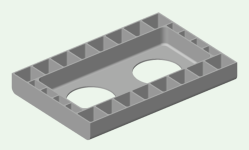
Rather than a special battery, why not just provide a spacer - something like this sketch:
1765433403590.png
This would fit an ETX900 or an ETX1200 and it would probably add less weight and cost than a special battery. Even better, provide it as a model that peeps can print for themselves. The same concept would extend to lots of other aircraft too.

With a special RV-10 battery, you might find that the volumes are too low for companies to stock it. It then becomes special order and incurs a price premium and/or longer lead time. Another thing to consider would be what proportion of RV-10s have a standard battery tray, as quite a lot seem to be modified.
 
2. The lighter weight of the Li battery is not necessarily a good thing with the RV-10. When lightly loaded, people often add weight into the baggage compartment to move the CG aft for better handling. By installing a light Li battery in the standard RV-10 battery location, you are moving the CG farther forward, which could require even more ballast be added into the baggage compartment.
Regards,
Beat me to it.
 
I fly a 10 and am building a 10. All of this is a bit of gobblygook to me so call me agnostic.

What I will be looking at as I build is ease of connecting a trickle charger and/or ground power. I recall some of the trickle chargers are batter specific.
 
Rather than a special battery, why not just provide a spacer - something like this sketch:
View attachment 104426
This would fit an ETX900 or an ETX1200 and it would probably add less weight and cost than a special battery. Even better, provide it as a model that peeps can print for themselves. The same concept would extend to lots of other aircraft too.

With a special RV-10 battery, you might find that the volumes are too low for companies to stock it. It then becomes special order and incurs a price premium and/or longer lead time. Another thing to consider would be what proportion of RV-10s have a standard battery tray, as quite a lot seem to be modified.
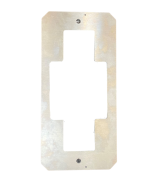
I love 3-D-printed stuff, but took the quick and simple approach for the base—plywood. The bigger issue to me is the top. With the terminals on the centerline, one has to be very careful with the hold down bar. When I asked in a different thread what others had done, someone replied with a pic of a 3-D-printed “cap”. Probably not worth a case redesign, but offset terminals (Like the RG-25) would be nice.
 
Your specs seem right for the 540-based airframe and should provide the capacity for the platform.

The BMS is a great idea and concept....
Except when you have a total electtical failure and are willing to sacrifice your battery during that IMC approach. Other batteries allow the pilot's discretion...this is the only part about a BMS that I don't like.
In practice this is not really an issue. The voltage/SOC curve of these batteries is like a vertical cliff on the bottom end and if the BMS gets down to shutoff, very little energy remains in the battery that you can't use. Even with a lead acid battery, avionics gets wonky when the voltage starts to fall off.
 
I love 3-D-printed stuff, but took the quick and simple approach for the base—plywood. The bigger issue to me is the top. With the terminals on the centerline, one has to be very careful with the hold down bar. When I asked in a different thread what others had done, someone replied with a pic of a 3-D-printed “cap”. Probably not worth a case redesign, but offset terminals (Like the RG-25) would be nice.
Yes- all of this.

I replaced an Odyssey PC925 with an EXT900 in my Rocket when the Odyssey was dying. I’ve been (intermittently) working to modify a 3D printed base and cap to position the EXT900 perfectly so the battery can either be centered in the battery tray (with the terminals shielded from the crossbar that holds it down), or slightly offset, so the crossbar doesn’t get near the terminals.

I’d have welcomed a “plug and play” battery tray adapter that I could order from EarthX. An even more appealing option (for me) would be a battery with a footprint closer to the PV925 that has even more Ah capacity than the EXT900 (maybe 25-30 at the 1C rate), and still saved a bunch of weight compared to the PC925.

I’ve contemplated buying a second EXT900 and wiring the two batteries in parallel to get extra capacity.
Maybe EarthX could develop an “EXT1800” that’s essentially 2 x EXT900s side-be side in one big case, with offset terminals to facilitate using the conventional bar across the top to secure the battery.
That would
1.) Fill the tray nicely
2.) Provide 31.2 Ah
3.) weigh roughly 10 lb.

That would be a win on all fronts for my use case.
 
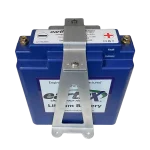
Thank you all, this is great input and we appreciate you taking the time to respond. We do have a lightweight hold down bracket that works great for the RV-10 installation Hold Down Bracket that is a solution too. But what I am hearing is the physical size of our battery is not a deterrent and if and when someone varies from what is provided from Van's, you are able and willing to modify as needed. Thanks again! We do appreciate you.
 

Attachments

  • RV10 Bracker top iso with battery.webp
    RV10 Bracker top iso with battery.webp
    344.4 KB · Views: 39
Yes- all of this.

I replaced an Odyssey PC925 with an EXT900 in my Rocket when the Odyssey was dying. I’ve been (intermittently) working to modify a 3D printed base and cap to position the EXT900 perfectly so the battery can either be centered in the battery tray (with the terminals shielded from the crossbar that holds it down), or slightly offset, so the crossbar doesn’t get near the terminals.

I’d have welcomed a “plug and play” battery tray adapter that I could order from EarthX. An even more appealing option (for me) would be a battery with a footprint closer to the PV925 that has even more Ah capacity than the EXT900 (maybe 25-30 at the 1C rate), and still saved a bunch of weight compared to the PC925.

I’ve contemplated buying a second EXT900 and wiring the two batteries in parallel to get extra capacity.
Maybe EarthX could develop an “EXT1800” that’s essentially 2 x EXT900s side-be side in one big case, with offset terminals to facilitate using the conventional bar across the top to secure the battery.
That would
1.) Fill the tray nicely
2.) Provide 31.2 Ah
3.) weigh roughly 10 lb.

That would be a win on all fronts for my use case.
Well......we do have what you seek already in the ETX1600 battery. It is 32Ah, weighs 8.9 pounds, has similar dimensions and is in essence 2 ETX900's in one package. :)
 
Well......we do have what you seek already in the ETX1600 battery. It is 32Ah, weighs 8.9 pounds, has similar dimensions and is in essence 2 ETX900's in one package. :)
Thanks, Kathy. That battery certainly does meet the weight and Ah specs that I described, and I’ll certainly consider it when buying my next battery.
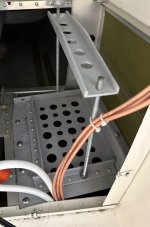
The challenge is the terminal location- with the terminals on the centerline, the usual method of securing the battery into the “stock” tray puts the crossbar right across the terminals. I’ve improvised my installation by putting a piece of rigid, flame-resistant insulation on the middle 60% of the crossbar to keep the ends off the terminals. But a battery very much like the EXT1600 that has terminals that are offset or on the side (like traditional aircraft batteries) would be “plug and play”.
Photo attached to show the battery tray that (I think) many of our planes are build with.
I know that EarthX is probably not going to tailor a battery to my specific needs, but I can imagine that something like the EXT1600 with offset terminals would make it quite appealing to RV owners who’d rather not have to adapt their airplanes to accommodate an EarthX battery.
 

Attachments

  • IMG_1765.jpeg
    IMG_1765.jpeg
    276.7 KB · Views: 24
A picture is worth a thousand words, thank you! This looks very similar to an Aviat Pitts installation, and we do have a hold down bracket for our battery that works it. We do not offer it as a standalone product, (but maybe we should). It goes in the STC installation kit for the Aviat. We have the terminals down the center so that we did not need to have "left" or "right" polarity batteries, which doubles the sku's, and if you turn the batteries 180's degrees, one battery works for any polarity installation.
 

Attachments

  • 900-HDB.png
    900-HDB.png
    360.3 KB · Views: 33
I have two of your ETX900s in my RV-10 and personally this is perfect for an electrically driven panel. I would also be worried that the volume does not justify a specialty model aimed at the RV-10.
 
I have two of your ETX900s in my RV-10 and personally this is perfect for an electrically driven panel. I would also be worried that the volume does not justify a specialty model aimed at the RV-10.
Chris,

If I ever did EarthX, it would be two ETX900s as you are doing.

I’m using two PC-625 batteries and the ETX900 reserve capacity best matches. The form factor does as well. The ETX680 falls a little short on amp-hrs for my application.

If the price of PC-625s continue to skyrocket, the option of using a couple of ETX900s will become more attractive…..
Carl
 

Attachments

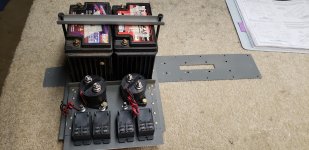
  • 20210708_180227.jpeg
    20210708_180227.jpeg
    1.9 MB · Views: 30
Chris,

If I ever did EarthX, it would be two ETX900s as you are doing.

I’m using two PC-625 batteries and the ETX900 reserve capacity best matches. The form factor does as well. The ETX680 falls a little short on amp-hrs for my application.

If the price of PC-625s continue to skyrocket, the option of using a couple of ETX900s will become more attractive…..
Carl
Do you and/or Chris care to share how you have this wired?
Are those 2 starter solenoids, one for each battery?
I’d like the extra capacity for peace of mind, but would prefer a simple, parallel wired setup- but something tells me that it wouldn’t really be that “simple” in practice.
 
Do you and/or Chris care to share how you have this wired?
Are those 2 starter solenoids, one for each battery?
I’d like the extra capacity for peace of mind, but would prefer a simple, parallel wired setup- but something tells me that it wouldn’t really be that “simple” in practice.
Here is a simplified line diagram. It may look not so simple, but consider this approach eliminates all back batteries in an IFR bird. The backup batteries are replaced by back modes of operation.
Carl
 

Attachments

Chris,

If I ever did EarthX, it would be two ETX900s as you are doing.

I’m using two PC-625 batteries and the ETX900 reserve capacity best matches. The form factor does as well. The ETX680 falls a little short on amp-hrs for my application.

If the price of PC-625s continue to skyrocket, the option of using a couple of ETX900s will become more attractive…..
Carl
Hi Carl and this is a great safety and educational opportunity. This is a very important topic, and I apologize for the length of this post but it is important.

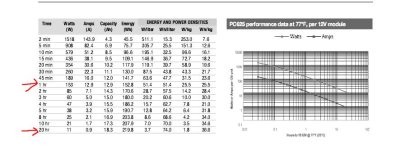
It is critical information to know the difference between a 20-hour discharge rate (C20) vs. an one-hour discharge rate (C1). The Odyssey batteries provide the 20 hour rate but you can find the one hour rate in their technical manuals (copied image below). The difference between the two rates is 18.3 Ah vs. 12.9 Ah. This is critical information as you need to know what amount of energy (Ah) you have to operate your equipment in the event of a charging system failure.

The published rate is for a new battery and at room temperature. It only gets less with time and the environment the battery is used in and why a capacity check is done annually as part of your annual inspection.

To use a metaphor, let’s pretend your fuel tank holds 50 gallons when your plane is brand new. You know how far you can go and when to refuel. Now pretend year 2, your fuel tank can only hold 47 gallons. You need to plan accordingly on how far you can go. Year 3 you can only hold 42 gallons, etc. Now I know your fuel tank does not change, but I am trying to use an example that really hits home and makes sense on how the capacity of a battery works.

When your battery is new, you know what the capacity is, and each year you test it so you know what it is over time and use at your annual. This is critical information IF YOU EVER EXPERIENCE a charging system failure in flight so you know how much “fuel” you have to operate your equipment before you run out. The other piece of information you need is how much energy your plane will use in this situation, when you shed to emergency loads, as this is just as important to know and the other side of the equation.

Again, to use the fuel metaphor, if you know how much fuel you burn (GPH), combined with airspeed, you know how far you can go. You need to know how much Ah you have, and how much you use, to know the time you have before you are out of energy. For simplicity, let’s pretend you have a 20 Ah battery (1C) rate. Now let’s pretend that in the event of a charging system failure, you need 10 Ah to operate your equipment per hour. So you have 2 hours of energy. Same scenario, let’s pretend you need 20 Ah to operate your equipment, then you have 1 hour of energy.

A 20 hour discharge rate (C20) means the battery is discharged slowly over 20 hours, while a 1 hour discharge rate (C1) means it is discharged quickly in just 1 hour. The same battery will show different usable capacities depending on which rate is used, because faster discharge reduces the effective capacity available.

Why is this so important? If you use the 20-hour rate, or 18.3 Ah of energy, this will be a serious problem as this is not the amount of energy you have to use. So when you compare apples to apples, which is the 1-hour discharge rate, the Odyssey PC625 is 12.9Ah, the ETX680 is 12.4Ah, the ETX900 is 15.6Ah. The more commonly used Odyssey is the PC680, is 12.3Ah. This is one of the reasons why the EarthX BMS is designed to provide you with a flashing LED on your panel or EFIS once you have used 70% of your energy. Same concept of a low fuel warning.

To summarize, you must know what the 1 hour rate is of your battery, regardless of the chemistry and brand. You must know what your specific aircraft needs in energy is in the event of a charging system failure so you know how long you have before you must land. If you made it this far in the post, thank you. This might be the difference between a scheduled landing of your choosing and one off airport, or worse.PC625 Discharge curve.JPG
 
I love 3-D-printed stuff, but took the quick and simple approach for the base—plywood. The bigger issue to me is the top. With the terminals on the centerline, one has to be very careful with the hold down bar. When I asked in a different thread what others had done, someone replied with a pic of a 3-D-printed “cap”. Probably not worth a case redesign, but offset terminals (Like the RG-25) would be nice.
This is the thread I mentioned. The pic is in Post #2. That’s 90 degrees to the way I oriented my battery, but the idea would be the same. I ended up just building up wood blocks (glued) that fit over the contours of the EarthX 900, with the hold down bar across that, but a 3-D cap would be much more elegant. In addition to raising the hold down barbwell above the terminals, I made the cutout in my base offset, so the battery is displaced a bit toward the port side of the tray. That way the hold down bar is offset from the terminals in addition to being elevated.

https://vansairforce.net/threads/rv-10-how-did-you-secure-your-earthx-battery.237340/
 
It is critical information to know the difference between a 20-hour discharge rate (C20) vs. an one-hour discharge rate (C1). The Odyssey batteries provide the 20 hour rate but you can find the one hour rate in their technical manuals (copied image below). The difference between the two rates is 18.3 Ah vs. 12.9 Ah.
I did not realize the difference is this large in the Lead acid batteries. Also I think you meant 1/20 C discharge rate for 20 hours. At 20C the battery would be depleted in 3 minutes?
 
To summarize, you must know what the 1 hour rate is of your battery, regardless of the chemistry and brand. You must know what your specific aircraft needs in energy is in the event of a charging system failure so you know how long you have before you must land. If you made it this far in the post, thank you. This might be the difference between a scheduled landing of your choosing and one off airport, or worse.View attachment 104559
Kathy,

Thanks for the note. Yes, I’m familiar with practical battery reserve capacity differences between EarthX and Odyssey. I do take into consideration my airplane’s power demand versus operating conditions. My tested design backup modes of operation provide for 2+ hours of full IFR flight capability following the worst practical system single point failure.

Carl
 
I did not realize the difference is this large in the Lead acid batteries. Also I think you meant 1/20 C discharge rate for 20 hours. At 20C the battery would be depleted in 3 minutes?
Correction, my mistake and I need to clarify: I did mean C20, as this means what the capacity would be if you discharged it over a 20 hour period. So if the C20 rate is 18.3Ah, that means it can deliver .915 amps per hour. Discharge current = 18.3 Ah/ 20 h = .915 A
C20 meaning:

  • A C20 discharge means the battery is discharged over 20 hours.
  • The discharge current is 1/20 of the rated capacity.
  • That’s the same as 0.05C (because 1÷20=0.051 \div 20 = 0.05).
 
Last edited:
Kathy,

Thanks for the note. Yes, I’m familiar with practical battery reserve capacity differences between EarthX and Odyssey. I do take into consideration my airplane’s power demand versus operating conditions. My tested design backup modes of operation provide for 2+ hours of full IFR flight capability following the worst practical system single point failure.

Carl
Perfect, this was just a perfect opportunity to provide information to those who may not know the differences and why it is so important to know and test your design and system. :)
 
I did mean C20, as this means what the capacity would be if you discharged it over a 20 hour period. So if the C20 rate is 18.3Ah, that means it can deliver .915 amps per hour. Discharge current = 18.3 Ah/ 20 h = .915 A
The larger the C number, the faster you are charging or discharging, so 1C is the capacity at a 1 hour rate or around 13 amps in the etx680 and .05C would be the capacity at a 20 hour discharge rate. I know you list a max charge rate and this is likely around 5C ( around 60 amps), not less than 1.
 
Do you and/or Chris care to share how you have this wired?
Are those 2 starter solenoids, one for each battery?
I’d like the extra capacity for peace of mind, but would prefer a simple, parallel wired setup- but something tells me that it wouldn’t really be that “simple” in practice.
My schematic is here: https://www.strikhedonia.com/wp-content/uploads/2021/09/Schematic_R14_P-Mag.pdf
Pictures of my install: https://www.strikhedonia.com/plugging-away-wiring/
 
Do you and/or Chris care to share how you have this wired?
Are those 2 starter solenoids, one for each battery?
I’d like the extra capacity for peace of mind, but would prefer a simple, parallel wired setup- but something tells me that it wouldn’t really be that “simple” in practice.
This is a little complicated, but a Z-14 gives one a lot of redundancy. (It's an 18-year-old drawing so could use some updates) Mine is a modified Z-14 for both airframes, one now 6 years and 750 hrs. (Electrically dependent engine)

 
This is a little complicated, but a Z-14 gives one a lot of redundancy. (It's an 18-year-old drawing so could use some updates) Mine is a modified Z-14 for both airframes, one now 6 years and 750 hrs. (Electrically dependent engine)

I’ve done 2 z14s as well. I like the redundancy and simplicity of operation.
Not really much to think about for abnormal operations.
With modern gear you can pretty much have 2 separate complete sets of avionics.

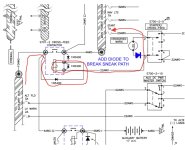
Don’t forget the sneak path fix if you use an idiot light for the xfeed. I just use the CAS on the 10. On my first plane pre EFIS CAS capability I scratched my head for a long time!

IMG_5325.jpeg
 
A UK -10 owner directed me to the Odyssey PC950 a few years back. I have been very pleased with it since installed. It is 20 lbs, 900 cca, 20ah at 34 amps, 60 min reserve. An easy mod to the existing battery tray. I have been using this for the past few years. Great cranking power. Earth X is a good option if you are weight conscious, but I personally feel the PC950 is more reliable since no BMS to contend with.
 
What I'd really have liked is not a single beefy battery matching the RG-25 - it's a battery that's exactly *half* the size of the Concord, such that two would fit where the Concord currently fits - then I could have dual battery (for redundancy, with dual busses) without needing a custom mount.
 
What I'd really have liked is not a single beefy battery matching the RG-25 - it's a battery that's exactly *half* the size of the Concord, such that two would fit where the Concord currently fits - then I could have dual battery (for redundancy, with dual busses) without needing a custom mount.
Thank you Rodrigo for that idea, and it is a good one. Based on the most popular battery purchases, 2 ETX900, maybe people are doing just as you mention and have 2 side by side in the current mount, but they change the orientation, so they fit. The RG25 is 190.5mm x 126.2mm x 172.9mm (L x W X H). The ETX900 is 166mm x 76mm x 168mm (L X W X H). They turn them 90 degrees. Maybe someone has a picture they could past as a picture is worth a 1,000 words. :giggle:
 
Thank you Rodrigo for that idea, and it is a good one. Based on the most popular battery purchases, 2 ETX900, maybe people are doing just as you mention and have 2 side by side in the current mount, but they change the orientation, so they fit. The RG25 is 190.5mm x 126.2mm x 172.9mm (L x W X H). The ETX900 is 166mm x 76mm x 168mm (L X W X H). They turn them 90 degrees. Maybe someone has a picture they could past as a picture is worth a 1,000 words. :giggle:
Sure, here's some pictures of mine - I basically cut out the original battery cradle and riveted two of your battery boxes where it used to be: https://photos.app.goo.gl/CVNwPYdCpRsVXxQ29
(The ground is connected through a #2 wire to the first battery, then bridged to the second battery by a copper bar)

I considered other mounting options, but this turned out to be the easiest that still kept the weight centered.
 
We have been exploring the idea of designing a new battery specifically for the RV-10 market and we want your input. The plans for this kit currently mentions the Concorde RG-25 battery and the tray is designed for that sized battery.

RG-25 Spec's

Weight 22.75 pounds

CCA 225

Capacity: 22Ah

Dimensions 190.5mm x 126.2mm x 172.9mm ( L x W X H)

Cost: $368 today on ACS


We are contemplating a new model with these spec’s:

Weight 6 pounds

CCA: 600

Capacity: 20Ah

Dimensions 166mm x 129mm x 168mm (L x W X H)

Cost: $679


(and of course the same BMS features of the other batteries)

Currently, many of you use the ETX900 or the ETX1200 to replace this battery.

ETX900 Spec's

Weight 4.9 pounds

CCA: 400

Capacity: 15.6Ah

Dimensions 166mm x 76mm x 168mm (L x W X H)

Cost: $449

ETX1200 Spec's

Weight 5.4 pounds

CCA: 600

Capacity: 20Ah

Dimensions 166mm x 76mm x 168mm (L x W X H)

Cost: $649

And another common choice you have is this battery:

Odyssey PC925 (ODS-AGM28L)

Weight 23.8 pounds

CCA 330

Capacity: 20Ah (1 Hr rate to compare apples to apples)

Dimensions 168mm x 175mm x 127mm ( L x W X H)

Cost: $279 today on Amazon
I am running one etx1200 and have a backup etx900.

I have two circuits that can run each battery as a main. And a third circuit as a backup on critical components. I like the idea of dual batteries in case I forget a master on. And with dual batteries I can fly along way with an alternator failure.

You can get a 3d printed tray and use the existing tie down bolt holes.

i would still buy two and not the single rv10 specific battery. Just a thought.
 
I just bought an EXT1200 for my RV10 after having great success with the one in my PA28. I was a little puzzled why anyone would want a physically larger battery pack for the sake of fitting it in the aft battery mount.

In fact, the whole draw to the ETX for me is both the size and weight, especially when both are easily compatible with putting it FWF, which is what I'm doing. I'm not sure how my W/B will look just yet, but I will have an MTV9 up front, and the weight of the battery is less than the weight delta between the recommended Hartzell prop and the MT (not to mention a few feet closer to the CG), so I can't imagine I'm doing something too silly.

I am using the insulated battery box with blast tube. I see moving the battery FWF to be advantageous for getting rid of the long/heavy 2AWG wire runs aft, to help W/B, and (least of all my concerns, honestly, but maybe worth noting) helping in a battery thermal runaway scenario (again, I highly doubt this will ever happen, and even if it does, I doubt it would be externally dangerous).

Is there something I am missing on this, or is most of the value for this new idea just in the prospect of easy retrofit into an RV10 which previously had a Pb battery?

I don't know if I'd have purchased a physically larger in size and capacity EarthX battery ("just because it fits drop in"). I have a backup alternator and a mechanically injected airplane, and two battery backups in my glass panel, so I think capacity isn't an issue for me. If I can't land by the time the normal ETX1200 dies, I put myself into an extremely bad situation.
 
I just bought an EXT1200 for my RV10 after having great success with the one in my PA28. I was a little puzzled why anyone would want a physically larger battery pack for the sake of fitting it in the aft battery mount.
...
I am using the insulated battery box with blast tube. I see moving the battery FWF to be

Do you have a specific location in mind and have you seen one installed there on a -10? The challenge is that the firewall and space behind the engine is absolutely packed with stuff. Fuel lines, oil lines, oil cooler, hose for the heating system, etc. For me, it was a chore getting everything in there AND leaving room to change the oil filter, access the mags, etc.
 
Back
Top