Van's Air Force

The definitive Van's Aircraft support community! Buying, building or flying an RV? Join our exclusive family of mentors and enthusiasts!

Some questions - climb and CHT.

JohnStirling

Well Known Member
Sponsor
Hello everyone.

I have a “new to me RV7a with an O360 and a fixed pitch prop (which I think is rather aggressive). It will TAS and 155 without an argument. However, I have noticed some things and I have some questions.


Last owner advised to climb at 120kts. Which means the climb rate is a little low. But any steeper than this and the CHTs hit 420 real quick.

Once levelled out, LOP will see hit cruise at 155 kts at about 2400RPM.

My questions are….

Normal for this prop setup?

Is it that I just have to sacrifice the climb rate for the better cruise speed?

Would cowl flaps, or other means help?

Of course there is the option of swapping to a CSU but that is $$$

Would love to hear your thoughts.

Cheers
J.
 
Look at your baffles to make sure they contain the cooling inlet air to force it through the cylinders. If you have a plenum, check it for leaks.
 
Look at your baffles to make sure they contain the cooling inlet air to force it through the cylinders. If you have a plenum, check it for leaks.
Agreed. Baffles are the first culprit and can always be improved. Timing of the mags would be next but don’t skimp on sealing up the leaks. Mine dropped 25 degrees in climb just from some liberal use of RTV.
 
What sort of FPM are you seeing at 120 KIAS?

Changing props might get you more FPM but it won't help your cooling at a given airspeed. If you want to climb at a slower airspeed, with whatever VS that gives you, there needs to be more cooling air through the engine or a more efficient use of what you've got now.

As recapen said, the first place to look is at the baffles. On something like a Cessna, they give up a bunch of drag to make sure they have an abundance of cooling air. RV's are tightly cowled with not a lot of air coming in the front so you need to make sure every molecule is going where you want it.

This question has been asked a lot. If you post some pictures of your baffles there are a lot of folks on here that can offer up an opinion on areas that might be improved or if you need to look somewhere else.
 
Do some testing. When I did phase I testing in my 6 (320 + FP Catto), I found the same Vy at both 100 and 140 MPH, though my prop is biased to the climb side). Obviously, I choose the 140 for Vy applications. 155 KTAS at 2400 LOP is probably over pitched by a bit. If you want to improve climb performance, will need to consider re-pitching that prop. You can discuss your perf numbers with a prop company to figure out the optimal pitch based upon your goals.

Generally speaking, a cruise pitch prop will deliver 2650-2700 at 8K and WOT ROP / best pwr. The sensi props have a 2600 limit, so they need to be a bit over pitched.
 
Last edited:
I've been chasing high CHTs for the three years I've had my RV7A (180hp, CS prop) in most ways you can imagine outside of adding cowl flaps/leuvres. I've just accepted the plane runs hot on climb out. Still climb at >1K fpm at gross @ 120kts.
 
Hello everyone.

I have a “new to me RV7a with an O360 and a fixed pitch prop (which I think is rather aggressive). It will TAS and 155 without an argument. However, I have noticed some things and I have some questions.


Last owner advised to climb at 120kts. Which means the climb rate is a little low. But any steeper than this and the CHTs hit 420 real quick.

Once levelled out, LOP will see hit cruise at 155 kts at about 2400RPM.

My questions are….

Normal for this prop setup?

Is it that I just have to sacrifice the climb rate for the better cruise speed?

Would cowl flaps, or other means help?

Of course there is the option of swapping to a CSU but that is $$$

Would love to hear your thoughts.

Cheers
J.
Is 120 IAS in climb about normal for a RV7? I thought the normal cruise TAS would be more like 160-165 KTAS
 
Agreed. Baffles are the first culprit and can always be improved. Timing of the mags would be next but don’t skimp on sealing up the leaks. Mine dropped 25 degrees in climb just from some liberal use of RTV.

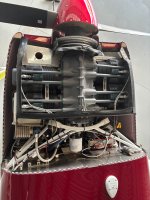
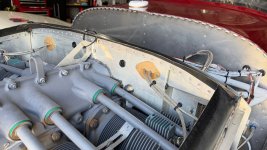
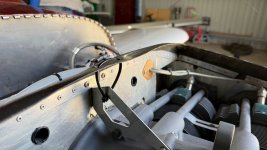
Thanks - I have been doing quite a bit of reading about the baffles, so will certainly look into them. This is the only photo I have for now (I will take the cowl off over the weekend and take some more.

I did notice the black strip tat the rear has a zip tie that appears to be holding it down??

At 120 it is about 750fpm from memory.
 

Attachments

  • 1762505614IMG_1035.jpeg
    1762505614IMG_1035.jpeg
    3 MB · Views: 209
Another influence to the CHT is the OAT. When the OAT is greater than. 90deg on take off, I need to pay attention to climbing speed in order to keep CHT below 400. On a warm day, I am happy to set the climb rate at 500-700 ft/min to cruising altitude after I was passing 5000 MSL at my local area so that I don’t worry about CHT when busy talking to ATC
 
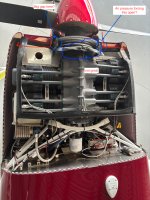
Okay- looking at your picture, you see how there are wear marks on the rubber baffle material where air loads have pushed it up into the inside of the cowl? Thats what you want to see. It appears to me that you have a pretty good interface all the way around with the exception of the area behind the starter ring gear where it look like there might be some room for improvement.

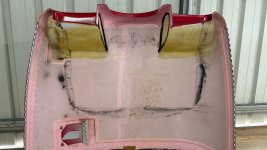
Also, the inside of your upper cowl is supposed to have ramps built into it to help direct the airflow. It wouldn't be unheard of for those to have never been installed, or if they are installed but don't have a good interface to the baffle rubbers for them to provide a significant leak path for air to go where it isn't doing any good.

Not saying that either of these are for sure your problem, just stuff to check
 
Replacing the black rubber with blue or orange silicone would be a good start. Lycoming recommendation for maximum engine life for high performance cruise is 435. No specified limit for climb. 400 is a conservative limit for break in until rings are seated and oil consumption stabilizes.
 
There are a multitude of threads on the VAF about baffling, baffle seals, plenums, etc. The link is what I've found to be one of the more informative ones; Dan Horton has some extremely helpful descriptions within this thread:

 
Thanks - I have been doing quite a bit of reading about the baffles, so will certainly look into them. This is the only photo I have for now (I will take the cowl off over the weekend and take some more.

I did notice the black strip tat the rear has a zip tie that appears to be holding it down??

At 120 it is about 750fpm from memory.
Show us a pic of the underside of top cowl. I’m betting you can find some leaks both at back corners and up front near inlets.
 
Yep! Will do that later today.
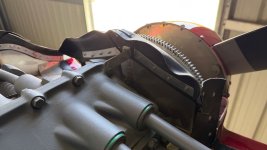
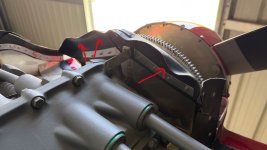
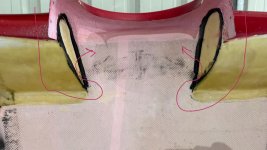
Hey- before you pull that top cowl off, you might want to take a look at the inboard corners of the inlets. In addition to what you've got going on top front with the baffle rubbers, it looks like you could be losing a bunch of air in the spots I've circled in blue. It can be going straight down into the lower cowl behind the ring gear there, or if the inner rubbers aren't sealing up against the face of the upper ramps it can be going inside the ramps and following the red arrow path to dump at the outboard fwd corners.
 

Attachments

  • 1762505614IMG_1035.jpeg
    1762505614IMG_1035.jpeg
    3.8 MB · Views: 154
No specified limit for climb.
As I read the 2007 manual for the O-360 76 series, the specified limit for climb would seem to be 500 degrees F, which Lycoming calls the “maximum redline cylinder head temperature.” Not sure if this is different for other/later models.
 
Hey- before you pull that top cowl off, you might want to take a look at the inboard corners of the inlets. In addition to what you've got going on top front with the baffle rubbers, it looks like you could be losing a bunch of air in the spots I've circled in blue. It can be going straight down into the lower cowl behind the ring gear there, or if the inner rubbers aren't sealing up against the face of the upper ramps it can be going inside the ramps and following the red arrow path to dump at the outboard fwd corners.


Hmm.. Yep! I see that. I will take a bunch of photos and send through.
 
I am convinced that the -7 is destined to have high CHT on climbs. Something with the cowl entry and exit areas during the climb angle of airflow.

You can do some/all of the baffle/sealing tips previously given. I found that will get you a few degree reduction. Finally is the Splat cowl flap option. (check other threads on that) I have two, and did the greatest reduction in CHTs (after doing all the other things).
 
Hello everyone.


Last owner advised to climb at 120kts. Which means the climb rate is a little low. But any steeper than this and the CHTs hit 420 real quick.
At what ambient temperature?
120... KNOTS... yeah, you shouldn't have to fly that speed, unless it is 110F ambient or something.
 
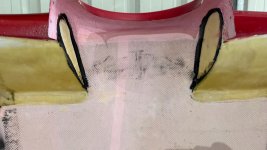
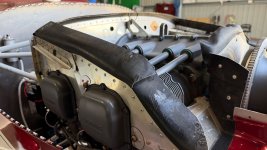
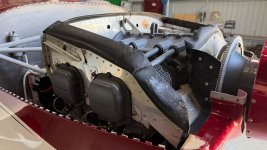
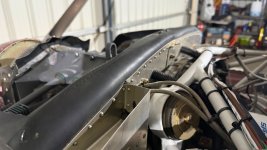
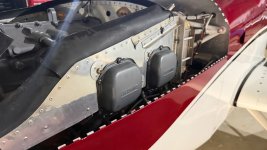
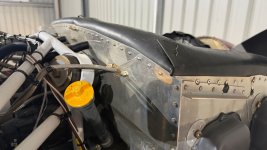
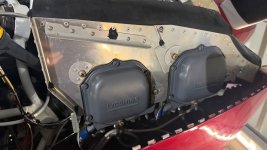
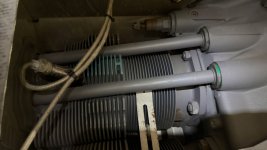
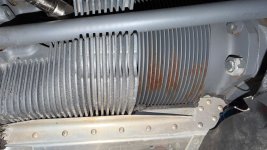
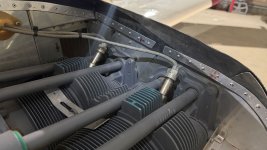
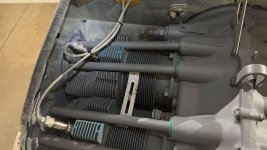
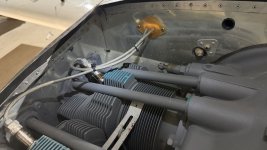
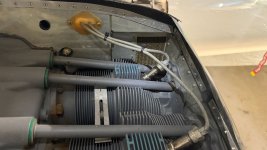
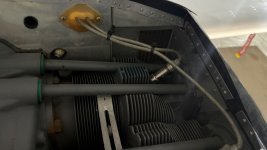
OK. Some photos lads.

I pushed my hands inside the front inlets and felt around. Everything appears to be good. No big gaps.

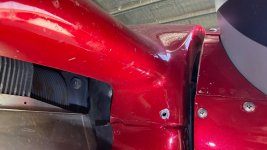
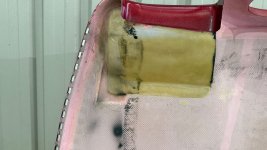
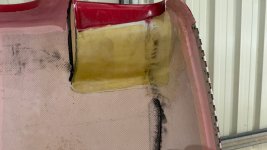
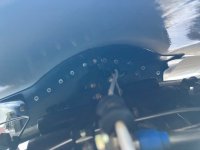
I had a look inside the oil hatch and can see light at the very top centre of the cowl (see photo) right where you see that Zip Tie. ( not sure on its purpose)

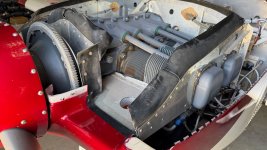
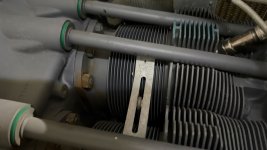
I also see some discolouration around the Pax side front cylinder. Not sure what the cause of that is. ( see last image)

There is 2 x ports that run conduit to the magnetos.

OH... And those Piano Wires are DIABOLICAL!! Surely there is a better way!
 

Attachments

  • IMG_5193.jpeg
    IMG_5193.jpeg
    622.6 KB · Views: 205
  • IMG_5194.jpeg
    IMG_5194.jpeg
    1.7 MB · Views: 196
  • IMG_5195.jpeg
    IMG_5195.jpeg
    1.3 MB · Views: 182
  • IMG_5196.jpeg
    IMG_5196.jpeg
    1.1 MB · Views: 154
  • IMG_5197.jpeg
    IMG_5197.jpeg
    1.1 MB · Views: 158
  • IMG_5198.jpeg
    IMG_5198.jpeg
    1.6 MB · Views: 163
  • IMG_5199.jpeg
    IMG_5199.jpeg
    1.6 MB · Views: 157
  • IMG_5200.jpeg
    IMG_5200.jpeg
    876 KB · Views: 147
  • IMG_5201.jpeg
    IMG_5201.jpeg
    1.2 MB · Views: 145
  • IMG_5202.jpeg
    IMG_5202.jpeg
    1.2 MB · Views: 145
  • IMG_5203.jpeg
    IMG_5203.jpeg
    1.1 MB · Views: 142
  • IMG_5204.jpeg
    IMG_5204.jpeg
    1,010.7 KB · Views: 181
I am convinced that the -7 is destined to have high CHT on climbs. Something with the cowl entry and exit areas during the climb angle of airflow.

You can do some/all of the baffle/sealing tips previously given. I found that will get you a few degree reduction. Finally is the Splat cowl flap option. (check other threads on that) I have two, and did the greatest reduction in CHTs (after doing all the other things).
I've seen good results installing Van's own lower cowl louvers. FAR cheaper than the cowl flaps. But let's fix what we can before pulling out the big hammers.
 
I did all of the mentioned above. It all helped a little but didn’t cure the issue. It wasn’t till I added the cowl flaps (2) that ended my battle with high cht’s. I can now climb
Its very easy to install and wire it.
 
OK. Some photos lads.

I pushed my hands inside the front inlets and felt around. Everything appears to be good. No big gaps.

I had a look inside the oil hatch and can see light at the very top centre of the cowl (see photo) right where you see that Zip Tie. ( not sure on its purpose)

I also see some discolouration around the Pax side front cylinder. Not sure what the cause of that is. ( see last image)

There is 2 x ports that run conduit to the magnetos.

OH... And those Piano Wires are DIABOLICAL!! Surely there is a better way!
The area near the ring gear is not good at all. That black rubber fabric reinforced baffle material is just too stiff. See other thread on how Dan Horton has used the more flexible silicone stuff. Also looks like there is no good seal between the inboard top of the inlet to the cowl to prevent air from just going into the ring gear area.

Get a flashlight under the engine and shine it up. Look at the cylinder base areas. There are many spots but the rear base of #4 is nearly always missed. A hole you can put a finger through if it isn't done right and RTV'd.
 
So - What is the purpose of the Cable Tie? It almost looks like it will prevent the rubber from pushing onto the cowl under pressure??
 
So - What is the purpose of the Cable Tie? It almost looks like it will prevent the rubber from pushing onto the cowl under pressure??
Probably when new the baffle material had not yet taken a set, so this was a kludge to get it to fold over. Now that it has taken a set, you could remove it (imho)
 
If you can, show us pictures of your two inner-cylinder baffles (between the cylinders on the bottom) and where/how the baffles wrap around your cylinders.

As far as the piano hinges go, clean and lubricate the pins every time you remove/reinsert them. They should slide in with relative ease.
 
If you can, show us pictures of your two inner-cylinder baffles (between the cylinders on the bottom) and where/how the baffles wrap around your cylinders.

As far as the piano hinges go, clean and lubricate the pins every time you remove/reinsert them. They should slide in with relative ease.

Here are a few more for you.
 

Attachments

  • IMG_5224.jpeg
    IMG_5224.jpeg
    1.2 MB · Views: 71
  • IMG_5223.jpeg
    IMG_5223.jpeg
    1.1 MB · Views: 67
  • IMG_5222.jpeg
    IMG_5222.jpeg
    1.1 MB · Views: 54
  • IMG_5221.jpeg
    IMG_5221.jpeg
    1.3 MB · Views: 50
  • IMG_5220.jpeg
    IMG_5220.jpeg
    937.3 KB · Views: 50
  • IMG_5219.jpeg
    IMG_5219.jpeg
    991.9 KB · Views: 54
  • IMG_5218.jpeg
    IMG_5218.jpeg
    1.4 MB · Views: 56
  • IMG_5217.jpeg
    IMG_5217.jpeg
    1.3 MB · Views: 52
  • IMG_5216.jpeg
    IMG_5216.jpeg
    1.4 MB · Views: 53
  • IMG_5215.jpeg
    IMG_5215.jpeg
    1.3 MB · Views: 52
  • IMG_5214.jpeg
    IMG_5214.jpeg
    897 KB · Views: 49
  • IMG_5213.jpeg
    IMG_5213.jpeg
    909.8 KB · Views: 65
I'm not a big fan of connecting the baffle fabric at the corners. My opinion is that either it will be too tight - and never push up and seal properly... or be too loose and create a big pucker elsewhere.

Do you have full CHT monitoring so you can tell us the CHT per cylinder?
 
regarding one of my previous comments, there's no way that air is going laterally through the ramps because the builder glassed in the outboard ends. However, looking at the witness marks on the upper cowl photos, in addition to the overall poor fit against the center fwd cowl, it looks like the rubbers probably aren't laying flat enough at the inboard edges of the ramps to prevent air from just going around the ends of the baffling, through the cavity on the inboard ends of the ramps and escaping into the lower cowl up front. I've attempted to illustrate what I mean below.

However you slice it, there's gains to be had by thoughtfully reworking the baffles. Whether it's enough to get you where you want to be remains to be seen, but it's a place to start. If you get them nice and tight, then louvers or cowl flaps are a possibility, as is adjusting the size of the discharge opening at the aft end of the lower cowl, which would have the same effect.
 

Attachments

  • IMG_5197.jpeg
    IMG_5197.jpeg
    1.6 MB · Views: 44
I'm not a big fan of connecting the baffle fabric at the corners. My opinion is that either it will be too tight - and never push up and seal properly... or be too loose and create a big pucker elsewhere.

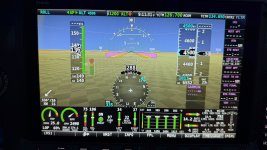
Do you have full CHT monitoring so you can tell us the CHT per cylinder?
Yes I do.

This was yesterday in a quick flight, at cruise. 150 odd.
 

Attachments

  • IMG_5185.jpeg
    IMG_5185.jpeg
    2.3 MB · Views: 139
Pretty even CHTs. Surprised to see near 400 in cruise flight.
Would be interesting to see the CHT balance in your 120 kt climb
 
You get the best vertical speed (ft/min) at both 100 and 140 MPH at full power?
Yes. Can’t really explain why. All the testing was done on the same day. Full power starting from same altitude and done from 80 - 140 mph, in increments of 10. The 100 was expected, as i had seen that from other posts, but for experimentation, chose to see what happened at other speeds. 100 and 140 gave the same time for the 1000’ climb test.

Quite possible that I got numbers written down wrong, but have used 140 for a lot of hours and get climb rates that seem in line with other 6’s with a320 and fp. I use a catto.
 
There are at least 4 basic items that need to be considered to keep CHT’s below 380F -
Timing - has to be done correctly.
Fuel Flow - carby or injected there is a specific flow rate at max power at sea level.
Baffles - comments below. Btw, there is a ‘technique’ to installing the baffle seals & it’s not the way I’ve seen it done in many aircraft.
Climb speed - enough has been said about that however, generally ~ 120kts or more works - prolonged low speed WILL increase temps.
Any one of the above, in an out of ‘spec’ condition will, & can have, a real impact on temps. It’s not rocket science 😉.
Ps - I’ve never seen the need, with Vans aircraft, for cowl flaps or plenums. Just saying - YMMV.
PPS- from my experience most people who say they’ve sealed the baffles fully, haven’t, despite using a light to show the ‘holes’.
 
Last edited:
I have records in my logs showing timing has been set to 25. Carby O360 with 275 hours on it.
I'd still check that. Obviously, you do have issues with the baffles near the ring gear. I'd also post pictures of the baffles where the wrap the underside of the cylinders and the intercylinder baffles (factory installed) between the cylinders and visible from under the engine. Those can be mis-fitted and can leak even if fitted properly. Some RTV can help with leaks around those.
 
I have records in my logs showing timing has been set to 25. Carby O360 with 275 hours on it.
What is the full model number of the carb? Google up "Mooney Mod".

When you said the cylinders are not balanced in climb, two are hotter... WHICH two? Rears I bet.

Re the comment about 120kts climb needed, I can easily climb out at 120 mph. [About 105 kts]
 
This is my opinion. You can listen to it, or ignore it. Either is your prerogative.

You are over thinking these temperature issues. 400-450 deg CHTs do NOT hurt your engine. Obsessing over keeping them below 400 is causing you great concern that is unwarranted. The picture of your instrumentation in post #38 shows CHT numbers that look fairly normal. You have a carb. It is going to be difficult to get all 4 cylinder’s CHTs to be as close as an engine with fuel injection. 385, 389, 398, 392 CHTs are all actually pretty tight for cruise, especially for a carbed engine. Plus, they are NOT running hot for running the engine pretty hard at 4500 ft.

On climb out, those temperatures may climb above 400 deg but don’t lose sleep over worrying about them. If they climb up to 420, or such, know that when you level off in cruise they will settle back down. I might suggest doing some configuration on your instrument to place the fuel burn (gal/hr or lt/hr) to show on your engine display. I did not see that anywhere on your display in post #38. That will be helpful information for your analysis of engine performance more so than the nm/lt you are currently displaying.

As others have posted, perhaps you can clean up your baffling some and see improvement but what you show is not a real problem. Keep flying and keep learning about your engine. You are asking questions and many are giving you good advice. Learn from the questions, and the subsequent responses, but don’t over think it all. As time behind the stick progresses you will become more familiar with how your plane performs and less baffled (I think there is a pun there somewhere) by unknowns.

Live Long and Prosper!
 
I have a plenum so baffle leaks are not an issue and any gaps sealed with RTV. Like you, I have a CS prop. The two things I do on climb out to keep CHTs under 400 is pull back the prop to 2600 when I get to 500 AGL and climb at around 120kts.
 
Do some testing. When I did phase I testing in my 6 (320 + FP Catto), I found the same Vy at both 100 and 140 MPH, though my prop is biased to the climb side). Obviously, I choose the 140 for Vy applications. 155 KTAS at 2400 LOP is probably over pitched by a bit. If you want to improve climb performance, will need to consider re-pitching that prop. You can discuss your perf numbers with a prop company to figure out the optimal pitch based upon your goals.

Generally speaking, a cruise pitch prop will deliver 2650-2700 at 8K and WOT ROP / best pwr. The sensi props have a 2600 limit, so they need to be a bit over pitched.
The Sensenich prop on a 360 doesn’t have that 2600 rpm limit.. that’s only for the 320 engine/prop combo.
 
You are over thinking these temperature issues. 400-450 deg CHTs do NOT hurt your engine. Obsessing over keeping them below 400 is causing you great concern that is unwarranted.
This. If anyone has data suggesting that 400-450 in a climb is bad in any way, I’ve never seen it. Lycoming certainly doesn’t think it’s a problem, at least per the O-360 manual I’ve got.

That manual is dated 2007. Did they change this guidance perhaps? Trying to figure out where the 400 and 380 “limits” came from.
 
Yes. Can’t really explain why. All the testing was done on the same day. Full power starting from same altitude and done from 80 - 140 mph, in increments of 10. The 100 was expected, as i had seen that from other posts, but for experimentation, chose to see what happened at other speeds. 100 and 140 gave the same time for the 1000’ climb test.

Quite possible that I got numbers written down wrong, but have used 140 for a lot of hours and get climb rates that seem in line with other 6’s with a320 and fp. I use a catto.
Vy is the speed with the minimum total drag, sum of parasite and induced drag. Can an RV have two different speeds with the same total drag? That is a very interesting aerodynamics question!
 
Back
Top