Van's Air Force

The definitive Van's Aircraft support community! Buying, building or flying an RV? Join our exclusive family of mentors and enthusiasts!

New Electronic Magneto System

ariel_arielly

Active Member
Patron
Hi.
Recently, the Right magneto "went to sleep - for ever....". Since my -8 was equipped with the Lasar System, and this system is no longer supported, I thought which kind of Magneto to use.
I could replace only the defected R Magneto or to change the whole system.
And I decided to use two electronic Magnetos: for the R Mag - Surefly SIM4 (non impulse) and for the L Mag - Surefly SIM4P (impulse).
And this decision challenged me regarding power supply for those magnetos.
I came to a solution and I want to ask your opinion about my solution.
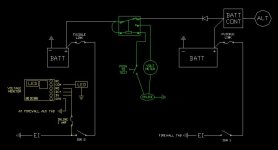
Attached are a simplified diagram of the electrical system and the second is the DC combiner to overcome missing aircrafts power during flight.
I'll be happy to read your comments.
Thank you,
Ariel Arielly
RV8A #80295
4X-OAA
 

Attachments

The "DC Combiner" is undesirable.

Simplify. All that's needed is one diode. No PCB. Independent systems.

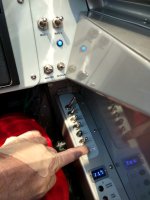
The voltage monitor ensures the small battery is being charged; it flashes an LED and sounds an audible beep if IGN2 supply voltage drops below normal alternator output voltage. As a bonus, it also makes it hard to walk away from the airplane with the ignition switches ON.

The NC relay allows checking the IGN2 battery voltage at any time, under load. Checks the monitor at the same time. Just push the button.

The battery feeds are fusible links.

Dual EI Wiring w Warning.jpg

Inflight IGN2 Volts 600w.jpg
 
Last edited:
Do what Dan said.

I’d add you that you consider getting a much better backup battery, and overlay procedure for operation. A few simple examples:
- Verify backup battery operation on each start.
- Verify (via testing) how long the engine will run on just the backup battery.
- Replace the backup battery periodically (based on calendar), replace the backup and main battery if it is ever abused (e.g. run flat). An abused battery now has an unknown reserve capacity - even if you manage to breathe life back into it.
- Engine jump starts and launching into the ether are forbidden (you have no clue the health of either battery after a jump start).

Carl
 
The "DC Combiner" is undesirable.

Simplify. All that's needed is one diode. No PCB. Independent systems.

The voltage monitor ensures the small battery is being charged; it flashes an LED and sounds an audible beep if IGN2 supply voltage drops below normal alternator output voltage. As a bonus, it also makes it hard to walk away from the airplane with the ignition switches ON.

The NC relay allows checking the IGN2 battery voltage at any time, under load. Checks the monitor at the same time. Just push the button.

The battery feeds are fusible links.

View attachment 103203

View attachment 103202
Nice! But, what about "One Point of Failure"?
 
The single diode merely provides charge current to Batt2.

I'm a big believer in defining the open-or-short failure mode for every wire. Can you define a failure mode which would result in loss of engine power within 3 hours?
 
The single diode merely provides charge current to Batt2.

I'm a big believer in defining the open-or-short failure mode for every wire. Can you define a failure mode which would result in loss of engine power within 3 hours?
Yes. Back up battery short. Relay in activate position. And human error with operation of many switches....
 
Yes. Back up battery short. Relay in activate position. And human error with operation of many switches....

That's rather non-specific.

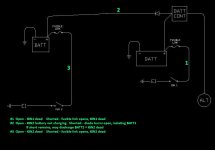
Here is the system stripped of the test and monitor functions, which are largely benign.

The primary battery, master contactor, and alternator B lead are conventional.

The ignition functions only have three active feeds. Those feeds can only have two failure conditions, shorted or open. So, make a list. Examine each as a short or open and predict the result. The loss of one ignition is not a critical failure.

I have ignored the grounds, but obviously a short is meaningless and an open would shut down the respective ignition.

You mentioned "relay in activate position". No, the relay coil is not powered in normal flight. It's a standard 5-pin 30 amp automotive relay. Power to IGN2 is via terminals 30 (common, power in ) and 87a (normally closed). Failure of the NC contacts is simply an "open" as defined below. The relay coil is only powered for system test of the BATT2/IGN2 side.

"Many switches"? There are two ignition switches, which are either ON or OFF.

ScreenHunter_3042 Nov. 28 09.42.jpg

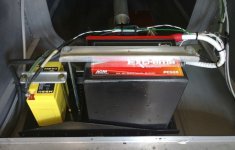
Physical arrangement. #1 and #3 necessarily route through the airframe from the rear battery set to the ignition switches. However, the batteries, fusible links, isolation diode, master contactor and BATT2 feed are grouped together, with short wire lengths and no airframe passages.

Again, can you identify a specific "one point of failure" which results in a loss of engine power?

Batteries.jpg
 
Back
Top