Van's Air Force

The definitive Van's Aircraft support community! Buying, building or flying an RV? Join our exclusive family of mentors and enthusiasts!

9A Aileron rigging question

Gnvflyer

Well Known Member
Patron
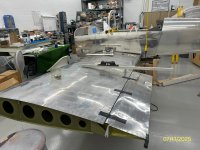
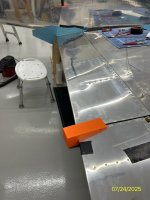
Helping a friend rig his 9A ailerons. We used the special bell crank holder aluminum piece to set the bell crank to aileron pushrods, but after we finished, I noticed something odd.

With one aileron set within the limits of the rib tooling hole stick, if I take the stick off and put it on the other wing, that aileron (the other one) is not within the adjustment limits on the stick.

Should we now make them both align by adjusting one of the stick to bell crank pushrods?

Been a couple years since I did mine and can't remember what I did.

Thanks for any help.
 
Yep.
Hopefully I remember correctly...
Lock the stick neutral with the bellcrank jig. One each side makes it easier.
Adjust the control rods from weldment to bellcrank till holes align and secure with hardware. Spin both rods to the stop and make sure they can't fall off. If it falls off, buy longer bearings.
Lock both ailerons using the tooling hole home made device.
Adjust aileron rod bearings as needed to align all the holes. Same procedure to test length.
Remove the jigs.
 
Yes, the bellcrank fixture holds the bellcrank in the proper neutral position. The tooling-hole board sets the aileron at proper neutral position.
So, if the aileron is in the wrong position, you need to adjust the length of the bellcrank-to-aileron pushrod.
Then check the bellcrank to stick pushrods. I use two of the bellcrank fixtures so that the whole system is locked in neutral. Makes it easier for me anyway.
 
I have a-7. I received guidance from a member here after figuring out that the aircraft was not really rigged correctly. (The ailerons didn’t match the wingtips).

I first I mapped the wings for sweep, incidence, and verified the wings for twisting. Then I mapped how each flap matched against the wings every 2 inches working aft on top and bottom.

For my aircraft the real issue was the left flap was actually made so it was hanging 1/4 inch lower in the trailing edge than it should be, and the ailerons were mis-rigged to make it less bad.

From what I learned, I was worth spending the time to verify the wing sweep, incidence and twist.

If you know all that. It is easy to position the flaps identically on both sides and match the ailerons to the flaps working outboard.

If you do that, the bell crank rig will help you adjust the length of all the pushrods so that the control stick is centred upright and the aileron trailing edges are aligned with the flaps.

I suppose you could jump to the chase and try that first.
 
Last edited:
I have a-7. I received guidance from a member here after figuring out that the aircraft was not really rigged correctly. (The ailerons didn’t match the wingtips).

I first I mapped the wings for sweep, incidence, and verified the wings for twisting. Then I mapped how each flap matched against the wings every 2 inches working aft on top and bottom.

For my aircraft the real issue was the left flap was actually made so it was hanging 1/4 inch lower in the trailing edge than it should be, and the ailerons were mis-rigged to make it less bad.

From what I learned, I was worth spending the time to verify the wing sweep, incidence and twist.

If you know all that. It is easy to position the flaps identically on both sides and match the ailerons to the flaps working outboard.

If you do that, the bell crank rig will help you adjust the length of all the pushrods so that the control stick is centred upright and the aileron trailing edges are aligned with the flaps.
Although this might have worked in your case, note that the order is aileron first, THEN flap. Align the aileron using the tooling holes and lock it in position, then set up the bellcranks and pushrods using the bellcrank jig. THEN align the flaps to the aileron, while the ailerons are still locked in place. Finally, wingtips to aileron.

This is per the instructions.
 
Although this might have worked in your case, note that the order is aileron first, THEN flap. Align the aileron using the tooling holes and lock it in position, then set up the bellcranks and pushrods using the bellcrank jig. THEN align the flaps to the aileron, while the ailerons are still locked in place. Finally, wingtips to aileron.

This is per the instructions.
This is true. But what is the plan if you know that you have a problem and don’t know how to solve it?

The original builder followed the directions exactly and they had a problem that they didn’t know they had. They ended up miss rigging the aircraft to fly less badly and I had to figure it out.

The Vans instructions are great if everything is perfect.
 
This is true. But what is the plan if you know that you have a problem and don’t know how to solve it?

The original builder followed the directions exactly and they had a problem that they didn’t know they had. They ended up miss rigging the aircraft to fly less badly and I had to figure it out.

The Vans instructions are great if everything is perfect.
Agreed, but I don't understand "left flap was actually made so it was hanging 1/4 inch lower in the trailing edge than it should be". Could you not have shortened the flap pushrod that amount, by adjusting the rod end?

In any case, I was simply pointing out the proper order for others...I've seen a number of posts where someone does this backwards, by starting with the flaps, and that's incorrect.
 
Agreed, but I don't understand "left flap was actually made so it was hanging 1/4 inch lower in the trailing edge than it should be". Could you not have shortened the flap pushrod that amount, by adjusting the rod end?

In any case, I was simply pointing out the proper order for others...I've seen a number of posts where someone does this backwards, by starting with the flaps, and that's incorrect.
In my case, the left flap wasn’t built exactly like the right. By measuring EVERYTHING and mapping out the distance between the extended line of the wing and how from that line the flap is I was. I was able to determine that the left flap was .250 lower than the right.

To make the left flap match the right. I had to remove a chunk of the metal that would normally pull up flush up against the bottom of the fuselage. If I had lowered the right flap to match the left and matched the ailerons working outboard. Both of the ailerons would be mismatched to the wingtips.

The original builder was obviously chasing his tail. He had a right wing heavy situation that he couldn’t resolve following Vans instructions and ended up mis-rigging the ailerons so it would fly less bad.
 
Last edited:
Yes, the bellcrank fixture holds the bellcrank in the proper neutral position. The tooling-hole board sets the aileron at proper neutral position.
So, if the aileron is in the wrong position, you need to adjust the length of the bellcrank-to-aileron pushrod.
Then check the bellcrank to stick pushrods. I use two of the bellcrank fixtures so that the whole system is locked in neutral. Makes it easier for me anyway.
+1

The bell crank does the mixing, so with the BC locked, you adjust the aileron pushod to put the aileron in the nuetral position. So, nuetral BC should equal neutral aileron. If you adjust the stick pushrod instead, the you risk one or both of the aileron pushrods is off and the BC not in its neutral when the aileron is. This will degrade the benefits of the design. You want to insure that aileron travel always starts moving away from neutral at the center of the mixing ratio. the system is asymmetrical aileron throws, with the differential using BC for mixing. The stick control rod only needs adjusting so that both ailerons are neutral at the same point in travel. Asymmetry there just puts the stock off center, as ailerons always find their own nuetral in the air.

6 and 10;are this way, so assume 9 is the same.
 
Last edited:
In my case, the left flap wasn’t built exactly like the right. By measuring EVERYTHING and mapping out the distance between the extended line of the wing and how from that line the flap is I was. I was able to determine that the left flap was .250 lower than the right.

To make the left flap match the right. I had to remove a chunk of the metal that would normally pull up flush up against the bottom of the fuselage. If I had lowered the right flap to match the left and matched the ailerons working outboard. Both of the ailerons would be mismatched to the wingtips.

The original builder was obviously chasing his tail. He had a right wing heavy situation that he couldn’t resolve following Vans instructions and ended up mis-rigging the ailerons so it would fly less bad.
1. The wingtips are never right. Never. Never use the wingtips as any kind of reference. Make THEM match the ailerons. (split the TE and up the sides and re-glass)
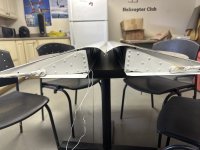
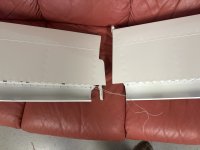
2. On both 8's I've built, with the wings (I use Starrett machinist levels) and ailerons rigged properly (tip rib tooling holes), flaps aligned to the ailerons, the flap fairings were off quite a bit. I had to fabricate new ones to maintain edge distance to the pre-punched fuselage holes. And also had to bend up the flap skin under the belly. If I had just attached the flap fairings, lined up the flaps to them, I would have had reflex in both the flaps and ailerons. Lots of folks do it that way, which is backwards. I had a heavy wing, but it was an aileron TE radius issue, not a rigging issue.

Photos are Thing 1, which is a QB wing, but Excelsior was a SB and matched in this aspect.
 

Attachments

  • DateStamper_0313.JPEG
    DateStamper_0313.JPEG
    541.4 KB · Views: 51
  • DateStamper_0317.JPEG
    DateStamper_0317.JPEG
    445.8 KB · Views: 51
1. The wingtips are never right. Never. Never use the wingtips as any kind of reference. Make THEM match the ailerons. (split the TE and up the sides and re-glass)
2. On both 8's I've built, with the wings (I use Starrett machinist levels) and ailerons rigged properly (tip rib tooling holes), flaps aligned to the ailerons, the flap fairings were off quite a bit. I had to fabricate new ones to maintain edge distance to the pre-punched fuselage holes. And also had to bend up the flap skin under the belly. If I had just attached the flap fairings, lined up the flaps to them, I would have had reflex in both the flaps and ailerons. Lots of folks do it that way, which is backwards. I had a heavy wing, but it was an aileron TE radius issue, not a rigging issue.

Photos are Thing 1, which is a QB wing, but Excelsior was a SB and matched in this aspect.
I have been an A&P for over 25 years working mostly on transport category aircraft.

I purchased a previously flying project with a series of problems from the widow of the builder.

One of the known issues was that it flew with a heavy right wing. Another was, as built, there were zero lights or wires on the aircraft for lighting whatsoever. There were other issues like a wooden prop with a split, a day VFR only panel, and more.

I purchased a set of the new VXI wingtips with all the bitchin lighting. While I was trying to fit the new wingtips on the wings with the bell crank jig installed, and I figured out pretty quickly that I had issues when I couldn’t follow either the Aerolleds VXI wingtip installation instructions or Van’s instructions.

I spoke with the builders son and he was able to verify that at some point, the ailerons had been miss rigged to make the right wing heavy issue less bad.

Van’s instructions are great when everything is perfect. If they aren’t, you have to have a plan to measure and verify so your fix isn’t just a wild guess.

I asked questions here and Carl Froehlich here on VAF was kind enough to provide some guidance.

After reinstalling the wings and spending a couple days documenting everything, verifying angles with a digital inclinometer, straightness, with a 4 foot straight edge, and mapping out the actual distances from the extended line of of the wing to the surface of the flight controls with calibrated tools. It became apparent that the left flap was the culprit, and hadn’t been made quite right.

If you slap a straight edge on the last rib on the wing and line it up with the holes and make the trailing edge of the aileron match, then adjust the flaps to match the aileron you are making a series of assumptions that may not be true.

After going deep down this rabbit hole. I am quite certain that this issue is resolved.

 
I still don't understand how you build a flap that's not right. In both the OP's and rockyfatcat's descriptions, they have a "not built right" flap. Not built right *how*, exactly?

These are prepunched kits, right? So what went wrong, exactly?
 
+1

The bell crank does the mixing, so with the BC locked, you adjust the aileron pushod to put the aileron in the nuetral position. So, nuetral BC should equal neutral aileron. If you adjust the stick pushrod instead, the you risk one or both of the aileron pushrods is off and the BC not in its neutral when the aileron is. This will degrade the benefits of the design. You want to insure that aileron travel always starts moving away from neutral at the center of the mixing ratio. the system is asymmetrical aileron throws, with the differential using BC for mixing. The stick control rod only needs adjusting so that both ailerons are neutral at the same point in travel. Asymmetry there just puts the stock off center, as ailerons always find their own nuetral in the air.

6 and 10;are this way, so assume 9 is the same.
This is very helpful, thank you.
 
+1

The bell crank does the mixing, so with the BC locked, you adjust the aileron pushod to put the aileron in the nuetral position. So, nuetral BC should equal neutral aileron. If you adjust the stick pushrod instead, the you risk one or both of the aileron pushrods is off and the BC not in its neutral when the aileron is. This will degrade the benefits of the design. You want to insure that aileron travel always starts moving away from neutral at the center of the mixing ratio. the system is asymmetrical aileron throws, with the differential using BC for mixing. The stick control rod only needs adjusting so that both ailerons are neutral at the same point in travel. Asymmetry there just puts the stock off center, as ailerons always find their own nuetral in the air.

6 and 10;are this way, so assume 9 is the same.
So, how would you proceed if you set all the pushrods so that the outboard ailerons lined up with the wing chord at the same time using the bell crank positioning tool, the inboard ailerons both lined up with the outboard flaps while the flaps are in the fully up position...but when you fly, one aileron is slightly up and one aileron is slightly down (in relation to the flaps) in level flight?
 
So, how would you proceed if you set all the pushrods so that the outboard ailerons lined up with the wing chord at the same time using the bell crank positioning tool, the inboard ailerons both lined up with the outboard flaps while the flaps are in the fully up position...but when you fly, one aileron is slightly up and one aileron is slightly down (in relation to the flaps) in level flight?
Setup is always static and recommend using tooling holes to identify aileron neutral position, then match flaps to them. Ailerons find there happy place in flight based upon various dynamic variables. That is a whole different subject and not related to the rigging discussed in this thread. Do some searching. Also note that sometimes flaps are can move up and down a bit (i.e. not ridged in attachment) and therefore will move a bit from your setup position when in flight, due to dynamic forces. Best to be consistent in manipulating their position within any slop/flex when adjusting them. IIRC, they want to pull up against their travel in flight.
 
Last edited:
Setup is always static and recommend using tooling holes to identify aileron neutral position, then match flaps to them. Ailerons find there happy place in flight based upon various dynamic variables. That is a whole different subject and not related to the rigging discussed in this thread. Do some searching. Also note that sometimes flaps are can move up and down a bit (i.e. not ridged in attachment) and therefore will move a bit from your setup position when in flight, due to dynamic forces. Best to be consistent in manipulating their position within any slop/flex when adjusting them. IIRC, they want to pull up against their travel in flight.
Assym ailerons in flight can be normal or a sign of other issues. For example, If I fly solo, the weight imbalance causes the plane to want to roll left. My trim causes a small left down/right up aileron position to counteract that. Again, a whole different discussion. Ail pivot point height (i.e. issues at the ail hinge) can cause other issues that push the ail balance to something other than neutral in flight. On my 6, I used a small wedge / trim tab to address a heavy wing. Therefore I usually have a very slight assym of ailerons when the plane is balanced.
 
Last edited:
......

If you slap a straight edge on the last rib on the wing and line it up with the holes and make the trailing edge of the aileron match, then adjust the flaps to match the aileron you are making a series of assumptions that may not be true.

After going deep down this rabbit hole. I am quite certain that this issue is resolved.

Sure, there are assumptions, like that the wing has no twist. Measure the incidence at multiple locations along the span and you will see some variation. So, in my case, I picked a nominal location. But, the tooling hole reference is specified by the designer, so that is what to use.
Some twist in the flaps does not generally cause much of an issue other than some impact on the location of the flap fairing. The aileron TE radius causes more heavy wing issues than any other variable. And since the introduction of pre-punch parts, the vertical location of the aileron hinges is no longer creating build variations for that legacy issue.

When chasing my heavy wing, I thought maybe the tips were creating a rolling force, so I removed them and flew it "tip-less". No change. A subtle difference in aileron TE radius was the culprit.

Since our ailerons are mechanically connected to each other, in flight, aerodynamic balance can cause the "one up, one down" situation, but as others have noted, that is a different topic than static rigging. (and how the TE radius comes into play)

Glad you have it resolved!
 
I still don't understand how you build a flap that's not right. In both the OP's and rockyfatcat's descriptions, they have a "not built right" flap. Not built right *how*, exactly?

These are prepunched kits, right? So what went wrong, exactly?
image.jpgimage.jpg
The parts look good but in order to bring the left flap up enough for it to match the other side I had to remove some metal
 
If the flaps are identical and properly built, and you have to remove material from one to get them to match, then it's the *fuselage*, not the flaps, that's built unsymmetrically.
You can see in the picture how much material I had to remove so the flap was in trail to the wing at the correct angle.

The-7 flap lower surface inboard edge is supposed to be flush with the fuselage when not deployed.

I guess it is possible that the fuselage was somehow wonky and that prevented the flap from getting to the correct position relative to the wing.

By mapping the wings and the flight controls, was able to determine that the left flap was hanging. .250 lower.

My point was that following the instructions is great if everything is correct. But if you do, you are making a series of assumptions that may not be true. With the help from another member here I was given the guidance to finger out why the original builder had a heavy wing issue.
 
I think most people who have this sort of flap issue (doesn't sit flat against fuselage when retracted) put a joggle in the lower flap skin rather than remove material.

*My* point was that you didn't figure out the actual cause of the misalignment.
 
I think most people who have this sort of flap issue (doesn't sit flat against fuselage when retracted) put a joggle in the lower flap skin rather than remove material.

*My* point was that you didn't figure out the actual cause of the misalignment.
Both flaps used to sit flat and flush against the fuselage. The left flap wasn’t correctly in trail with the rest of the wing.

Mapping out the wing found that the left flap was low by a 1/4 inch. That’ll cause a right wing heavy condition all day every day.
 
I don't disagree. But I still don't understand WHY it was low. You keep saying "the left flag was low", "the left flap was actually made so it was hanging 1/4 inch lower", etc. But what about it was "made" incorrectly? "the left flap wasn’t built exactly like the right." WHAT WASN'T the same? That's all I'm asking.
 
I'm actually pretty curious about this myself, if more details can be provided. I'm working on a right wing heavy condition, on the order of ~50lbs or so, post condition inspection. Largest change: new nose gear strut fairing, which may have a slight twist to it-I'm re-tweaking rudder trim as well, so this is my first part to address.
 
I'm actually pretty curious about this myself, if more details can be provided. I'm working on a right wing heavy condition, on the order of ~50lbs or so, post condition inspection. Largest change: new nose gear strut fairing, which may have a slight twist to it-I'm re-tweaking rudder trim as well, so this is my first part to address.
Fly without the fairing and see what happens. If the roll moment is still there, it isn't the fairing.
 
Back
Top