Van's Air Force

The definitive Van's Aircraft support community! Buying, building or flying an RV? Join our exclusive family of mentors and enthusiasts!

Carbon Fiber Roll Bar? (WD-814-PC)

inktomi

Well Known Member
Sponsor
I'm thinking about making a carbon fiber version of the roll bar, out of interest and to save weight. I'm curious what you all think of this, as experts. Please correct me where I'm wrong..

The roll bar is there to protect us in the case of a crash, or in case of nosing over and ending up inverted.

Since it's steel, it can deform and in doing so absorb lots of energy.

Carbon fiber composite could be made as strong as, or even stronger, than the steel it replaces. However! It won't deform, when it reaches it's load limit it'll just break. That's not great.

In the case of nosing over and ending up inverted (I'm thinking, maybe slamming on the brakes?), I don't think the energy would be enough to cause the bar to deform or the composite to break.. but maybe it would?

In the case of an inverted crash.. that doesn't seem survivable with or without the roll bar.

What do you all think? Is this a crazy idea better left unimplemented? Or is it something that could actually work and not be totally unsafe?
 
I don't think it will take that much effort to build a prototype and drop test your composite roll bar to see if it survives the worst case scenario. Composite can take a high amount of impact load. Can it perform better than the current roll hoop of the RV8? Let us know
 
Do some research on racing car rollover bars. I think the top levels (Forumula 1) have carbon fiber rollover bars. As you have noted, carbon fiber structures generally break rather than bend. The addition of kevlar weave in the layup may help. I'll suggest this is an expensive and time consuming project to save a little weight. Lots of other ways to save weight.
 
A well designed carbon fiber roll bar could easily exceed the existing steel roll bar in strength. It is true steel bends without breaking, whereas the carbon part will have a yield that is almost at the ultimate strength, therefore breaking rather than bending. Once the steel roll bar has reached yield, it is now compromising pilot protection. Sounds like a fun project, but how will you know the ultimate stregth of your custom designed roll bar? Testing?
 
This kind of engineering is way over my head. However, it was my understanding that in crash protection you want energy absorption, not impact resistance. Think airbag vs steering wheel. As a piece of steel yields and deforms, it absorbs decelleration energy that would otherwise be transferred to the occupant. I suspect the carbon fiber piece yields very little and will absorb energy right up to failure point and then violently release it back to the structure as it cracks. I would not replace a deformable crash protection structure with something that doesn't yield, but cracks instead without fully understanding the engineering involved.

To me, this feels a bit like replacing an airbag with a wood block. No offense intended with that comment, just trying to simplify my thoughts. Very possible that the roll bar is designed purely for impact resistance and not designed for energy absorption, like longitudinal crash protection. Again, way over my pay grade, but worthy of investigation.
 
Last edited:
In the amatuer racing world, we see lots of carbon car bodies, but only steel cages are allowed. When you get into the top tiers like F1, you start to see full carbon cages that are integrated into the entire structure, not just as a bolt-on.

I think your weak point won't be the bar itself, it'll be the point where the carbon bar meets the flat brackets you'll have to bolt through. You'll need to put some serous thought into gusseting that whole area.

Having first hand experience with lots of caged car wrecks, I personally would never trade steel for carbon. Even if the bar can withstand an ultimate load over and above steel, it will just transfer the entire load to the airframe instead of absorbing some of the impact. Now you need to upsize the attachment bolts so it doesn't just rip the thing off, and think about where that load goes into the airframe.
 
Stick with the steel roll bar and find something else to use you creative energies on with carbon fiber.

Carbon fiber structures can be very crash worthy. Energy absorption is more through progressive crushing than yielding. But it requires a good understanding of the loading conditions and materials to properly design.

Plus it is highly dependent on resin properties and manufacturing methods. Wet layup and room temp cure resins are a quite different than preppreg systems with controlled resin content, toughened resins, and elevated vacuum bag oven/autoclave cure. Lots of variable to get right to build a comparable roll bar.

The simplicity and functionality of the steel roll bar is going to be very hard to beat for an unknown benefit (without a lot of effort).
 
Carbon fiber structures can be very crash worthy. Energy absorption is more through progressive crushing than yielding. But it requires a good understanding of the loading conditions and materials to properly design.

Plus it is highly dependent on resin properties and manufacturing methods. Wet layup and room temp cure resins are a quite different than preppreg systems with controlled resin content, toughened resins, and elevated vacuum bag oven/autoclave cure. Lots of variable to get right to build a comparable roll bar.

The simplicity and functionality of the steel roll bar is going to be very hard to beat for an unknown benefit (without a lot of effort).
My $.02. The purpose of a roll bar is not to absorb energy, but to preserve the occupant space from intrusion. The rollbar doesn’t take direct impact loads. It protects the occupant space (head and spine) on flip overs. It must remain rigid throughout the expected loads to preserve the limited space between the occupants heads and the canopy or ground. Deflection of carbon would be minimal and preserve the space. The downside of carbon, would be that if it is overloaded to failure, it splinters. If the occupants were still alive, the splinters can cause injury. One technique to minimize that problem is to use hybrid carbon/ kevlar materials. The kevlar will help contain the splintering.
 
This has been great to read through!

I don't plan on doing this myself to be honest. I would work with a composite shop able to do the proper vacuum bagging and heat curing, so I do think that part of it would be done properly.

The unknown is the design. I like the idea of putting in a layup of kevlar to contain splinters. I'm sure it's not a 1:1 trade of the steel peice to a composite part, like identified I'd need to ensure that the underlying structure and the attachment bolts are not the weak point.

The roll bar only bolts into the longerons, and some thin aluminum superstructure. I'd love to see some crash photos to see where this breaks, I bet the longeron / bolts give before the tubular steel but that's just a hunch.
 
It looks to me like you would have to consider a system, not just the component. The way the roll bar integrates in the current systems means that where you connect the roll bar to the base plate probably won’t behave the same as steel will. From what I see you would probably need to consider a roll cage, not just a roll bar. There is no doubt you can attach a carbon roll bar by adding metal base plates/tubes. Modern supercars do this at every point that requires bolted connections. That test model will probably be as interesting as your “crush” model.

Good luck.
 
I suppose another idea that would work, maybe a little better, would be argon TIG welded titanium. I will have to think about this some more..
 
I put 5 layers of carbon fiber on the front half bottom of my nose wheel pant with the hope if the wheel rolled under, the wheel pant would skid along the asphalt. I do have the Anti Splat Lip Skid under it. As I was sanding it making is smooth for paint I noticed it sanded pretty easily and figured I should have used Kevlar since it is better for abrasion. For a Roll Bar that could be skidding along asphalt, maybe a final layer of Kevlar would be a good idea?

One thing for sure, a carbon fiber roll bar would look really cool.
 
I went back and forth with Gemini on this over lunch working out the details. Here's what it came up with as the weak point.. I'm curious what you all think. How realistic is surviving a crash that would impart this much force? 🤔

The Proposal:​

A hybrid composite roll bar, professionally fabricated (vacuum-bagged and oven-cured), with a layup something like this:
  • Core: Multiple layers of carbon fiber, with the fiber orientation optimized for maximum compressive strength (to act as a "pillar").
  • Outer Layer: A hybrid Carbon/Kevlar co-weave fabric.

The "Pros" / Intended Rationale:​

  1. Weight: A significant weight savings, which would help my forward CG.
  2. Stiffness: The carbon fiber would be incredibly stiff, far more so than the steel.
  3. Vibration Damping: The hybrid composite layup (and the Kevlar specifically) would be excellent at damping the high-frequency airframe and prop-wash "buzz" that the steel bar might transmit into the fuselage.

The "Cons" / Critical Engineering Problems:​

This is where the idea seems to break down, and what I'd like to discuss.
  1. Failure Mode (Pillar vs. Rope): A roll bar is a compressive part. My understanding is that Kevlar has almost zero compressive strength (it's a "rope," not a "pillar"). This means 100% of the crash load would be on the brittle carbon fiber layers. When the carbon shatters, the Kevlar would just act as a "bag" to catch the pieces, but the bar itself would have already failed and folded.
  2. The Real Failure Point (The Attachments): This seems to be the real deal-breaker. The roll bar bolts into the thin aluminum longerons and skin. This means the attachments are the weak link, not the bar itself.
    • The 4130 steel bar is "soft" and ductile. In a crash, it acts as a "shock absorber," flexing and deforming to dampen the peak shock load. This protects the aluminum attachments from being torn out.
    • A super-stiff composite bar would act as a "hammer." It would transfer 100% of the instantaneous, un-dampened shock load directly to the attachments, all but guaranteeing they would tear out of the airframe.
 
A great CF project...
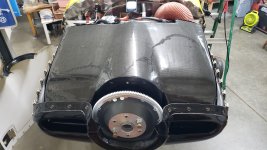
All the fiberglass parts for each model from Cowl to Rudder including the plenum. I know the windshield and canopy fairings are unique to each build so maybe they aren't part of the package.
Points if they all fit!
Lots of weight reduction.
CF where it shows, FG where it doesn't.
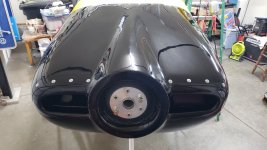
I would have loved a kit. I still dream of remaking all the FB parts with CF. It looks so cool.

I bought a FB plenum from a vendor and could have layed up two in the time it took to make it fit. In the end, I turned it into a CF plenum.
20240702_160320.jpg

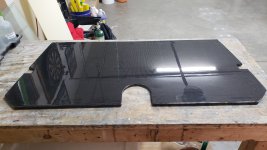
This is a shelf for the baggage area. Wt about 2lbs. One layer each side over 3/8 foam. I think I could stand on it.
20250418_210028.jpg

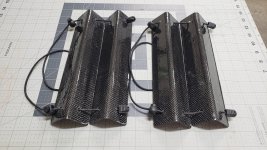
Set of CF chocks.
20250218_094738.jpg
 

Attachments

  • 20240702_160636.jpg
    20240702_160636.jpg
    2.7 MB · Views: 14
I went back and forth with Gemini on this over lunch working out the details. Here's what it came up with as the weak point.. I'm curious what you all think. How realistic is surviving a crash that would impart this much force? 🤔
Realistically, if your carbon fiber roll hoop is as strong as the steel hoop in an extreme drop test, and it is lighter, then I would choose the composite. I don't want the roll hoop to get crushed, bent, or deformed and ended up squashing the pilot. I want it to stay ridgidly in place to give the pilot room to egress. There is no designed crumble zone in the airplane. I just want the cockpit to remain in shape to give me a fighting chance to egress, assuming I survive the crash.
Walter Extra had designed his early Extra aerobatic airplane with steel space frame. His newer design is fully composite because it is a lot stronger than the steel space frame.
 
Realistically, if your carbon fiber roll hoop is as strong as the steel hoop in an extreme drop test, and it is lighter, then I would choose the composite. I don't want the roll hoop to get crushed, bent, or deformed and ended up squashing the pilot. I want it to stay ridgidly in place to give the pilot room to egress. There is no designed crumble zone in the airplane. I just want the cockpit to remain in shape to give me a fighting chance to egress, assuming I survive the crash.
Walter Extra had designed his early Extra aerobatic airplane with steel space frame. His newer design is fully composite because it is a lot stronger than the steel space frame.
There is no doubt that the carbon fiber roll bar might be able to take a bigger impact before breaking but you might need to also redesign the structure in order for it to perform properly. I think your time would be better put into building the plane as designed and getting it into the air. Have a look at all of the accidents and see how many of the present steel roll bars have failed and caused the death of the occupants.
 
I was trying to find NTSB reports of RV-8s that ended up inverted actually! I wanted to see the failure mode, if there were photos.
 
I'd love to see some crash photos to see where this breaks, I bet the longeron / bolts give before the tubular steel but that's just a hunch.
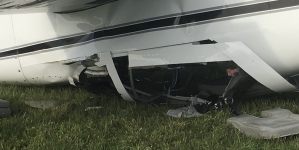
This is my friend's RV6 that nosed over landing on a grass strip. I saw this in real time and would guess that it was doing about 30-40 kts when it nosed over.

Obviously quite a bit different than your RV8, but in this case the bar didn't squash as much as you'd expect. Instead, there was compression damage to the longerons and side skins where the roll bar crumpled the sides of the airplane downward toward the seat pans.
 

Attachments

  • Screenshot 2025-11-11 at 6.26.51 PM.png
    Screenshot 2025-11-11 at 6.26.51 PM.png
    3.4 MB · Views: 60
For me - I'd use steel every day.

I'm a bit rusty now, but from my bit of experience with auto crash testing, even after yield - steel continues to absorb energy. This effectively reduces the peak crash g-forces (we usually tried to keep under 80g for most of the event, small spikes might be tolerated for just a few milliseconds.)

If you consider the roll bar just a static stand, make it as stiff as you like. But if it plays part in a dynamic rollover event then that deflection/energy absorption is a good thing. (up to the point the occupant is directly impacted) The area under the load deflection curve represents the energy absorbed.
 
I do agree that some amount of give is a good thing in the roll bar, up to the point where it gives enough that its surface is below your head. That's a major downside to a composite bar, as it won't give at all - the entire amount of force will go into the longerons.

I think when it comes down to it, there are too many unknowns really. I can't just copy the existing bar, it won't work like that. I need to design a new structure using the strengths of the composite material and matching the external dimensions of the existing bar - then do analysis on the design to understand how load is transmitted through to the longerons. This is more than I can really do, but still, this was a great thought experiment and I found the discussion here really interesting!
 
Last edited:
Some feedback on your proposal:

Don’t use all uni-directional fiber orientation to obtain maximum compression strength. Uni layups splinter easily under bending loads and the crash loads are not going to be purely compression. Instead throw in some 45’s and 90’s to tailer the strength to meet the crash loads.

Nothing bonds well to Kevlar. It will be an added complexity with marginal if any benefit for a properly designed roll bar, and more weight. A non-unidirectional layup won’t splinter like has been suggested.

The CG moment of the roll bar is pretty small. Any weight savings will not have much of an effect on CG. How much does the steel one weigh?

As mentioned before, how the roll bar attaches to the fuselage will be critical. Bolted joints need extra consideration with composites. Breaking off at the attachment won’t provide any protection.

Question: Are you thinking about a solid laminate structure?
 
First, how much does the steel roll bar weight? Next, figure out the dollar and time value of a pound saved. I expect that you'll quickly determine that a high-risk part like this isn't worth it, and that items such as Wirejock built are far more beneficial.

It's been posited here that some give or energy absorption is desirable in a roll bar. It isn't. the only purpose of a roll bar is to maintain the occupant space. Since energy absorption requires deflection, that's precisely what we don't want.

The few photos I've seen of crash-damaged fuselages show fairly significant momentary structural distortion of parts of the fuselage. Sometimes that's hard to determine because crashes can cause gross buckling of the fuselage structure that rebounds and leaves, as evidence, only local yielding. But in at least one case that we discussed on VAF, that caused fatalities. A steel crash cage was recommended for that type of accident by one of the investigating entities. See the PDF.

While the topic of weight savings is very important, let's not lose sight of the value and cost of it. Here's a quick example. In my RV-3B project, I'm saving close to a pound simply by replacing the AN-365 nuts with the MS21042 nuts; the specification says they can be used as replacements. More savings come from using the thin washers instead of the standard ones where possible, and ensuring that my screws and bolts are no longer than necessary.

Dave
 

Attachments

I did know about the MS21042 trick, and have been doing that for some of the bolts as well. I'm currently trying to find a source for titanium bolts to use on the interior cover panels and access panels. They're not easy to source!

I agree, the value for CG movement on the roll bar might be there. I did not get so far into the design as to decide solid/hollow structure. For weight, it would probably be hollow.

I know Solid Works can do FEA. I've never used it though. It would be interesting to see what sort of results we'd get from a carbon roll bar.
 
Yes Solidworks can do FEA. But there is a STEEP learning curve unless you are practiced in manual analysis (as a sanity check) and some other FEA program. The meshing is automatic which makes it easy for the beginner, but this also has pitfalls in disguising hot spots (high stress areas) with a coarse mesh. I don't know how or if SW FEA handles composite structures so be very careful here. I think you are going down a rabbit hole with the concept as well as the analysis.
 
There's a reason Nascar still uses a steel frame and roll cage.

Nascar is decades behind. All the driver protection in Indycar and F1 is made from carbon fiber.

The engine air inlet scoop behind the driver's cockpit doubles as a roll bar. Made from very heavy carbon layups and as you can see here supports the weight of the car.

1763165420716.png
 
Burt Rutan designed a composite roll bar for the Long-Eze. The write-up is 18.5 megs and 34 pages long. The design and construction are complex. I don't know if it was ever tested. I looked at the write-up when I was thinking about the roll bar for my RV-3B project and explored an interesting alternative and rejected both. Ultimately I decided that one of the two options in the RV-3B plans set was a better choice.

In this decision, consider that I was an aerospace structures engineer, then recently retired, and enjoy (back then, anyway) composites. Also, I was primarily building my RV-3B to have an enjoyable project and was willing to take more time than most builders. Even so, I was reluctant to embark on a project which would have certainly taken very considerable time and resources to test and validate.

Dave
 
Doesn’t the 10 have an integrated fiberglass rollover structure?
Yes, but not a roll bar; more like the roof / pillars on you car. There are very thick layups in what you would call the A and B pillars in a car plus one across the windshield opening which is also supported by a steel bar
 
Nascar is decades behind. All the driver protection in Indycar and F1 is made from carbon fiber.

The engine air inlet scoop behind the driver's cockpit doubles as a roll bar. Made from very heavy carbon layups and as you can see here supports the weight of the car.
I don't think that Nascar is decades behind. In Indy and F1 those cars are super small and light with pretty much everything hanging out in the breeze so carbon makes sense no matter the cost and effort to develop it. Nascar on the other hand has an abundance of space inside the cars for a steel cage, and at this point there's zero advantage to making them lighter, so the cost benefit equation doesn't warrant a conversion to the shiniest newest thing.

This is a prime example of the cost benefit analysis that people have brought up. i.e. there's savings to be had in less critical areas that don't break the bank by requiring a major redesign of a critical safely feature.
 
Burt Rutan designed a composite roll bar for the Long-Eze. The write-up is 18.5 megs and 34 pages long. The design and construction are complex. I don't know if it was ever tested. I looked at the write-up when I was thinking about the roll bar for my RV-3B project and explored an interesting alternative and rejected both.
I considered and rejected that design for my own Long EZ. Using the canopy as the mold was particularly off putting. I wouldn't be surprised if the one in the instructions was the only one ever built, I've never seen one in the wild. What was the alternative you explored? Something you designed, or something already out there?

I know Solid Works can do FEA. I've never used it though. It would be interesting to see what sort of results we'd get from a carbon roll bar.
One of the many issues will be what you use as material properties for your carbon roll bar. Don't assume that whatever Solidworks has as "carbon fiber" is representative of what you can manufacture.

As another datapoint, consider that Formula SAE, an engineering competition for undergraduate engineers, allows the chassis to be made from composites, and has specific instances where aluminum may be substituted (at a larger size, with calcs to prove equivalency) for steel to save weight, but mandates that the main rollover hoop be made of steel tube regardless of the materials used for the rest of the chassis.
 
Back
Top