


Van's Air Force

The definitive Van's Aircraft support community! Buying, building or flying an RV? Join our exclusive family of mentors and enthusiasts!

Archer VOR antenna + AeroLEDS

DavidP2020

Well Known Member
Patron
I am installing an Archer VOR antenna in the wingtip of my RV-10. I have AeroLED Pulsar position/strobe lights and AeroLED AeroSun VX lights. These are two separate modules and wiring harnesses.

I know the strobe light harness needs to be routed along the antenna per the instructions. Does the landing/taxi harness need to routed this way too? I have the wig-wag function if that is relevant.
 
I am installing an Archer VOR antenna in the wingtip of my RV-10. I have AeroLED Pulsar position/strobe lights and AeroLED AeroSun VX lights. These are two separate modules and wiring harnesses.

I know the strobe light harness needs to be routed along the antenna per the instructions. Does the landing/taxi harness need to routed this way too? I have the wig-wag function if that is relevant.
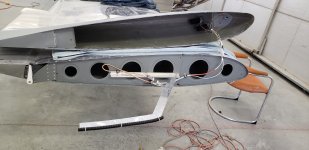
I do not recommend routing nav/strobe or landing/taxi light wires along the antenna. No upside and possible down sides for RFI getting into your radio.

I make my own wingtip antennas and mount them on the outboard wing rib, not the wingtip. The wingtip just fits over the antenna. Flying on four RVs and all work well.
Carl
 

Attachments

  • 20200403_135130.jpeg
    20200403_135130.jpeg
    1.6 MB · Views: 163
I am installing an Archer VOR antenna in the wingtip of my RV-10. I have AeroLED Pulsar position/strobe lights and AeroLED AeroSun VX lights. These are two separate modules and wiring harnesses.

I know the strobe light harness needs to be routed along the antenna per the instructions. Does the landing/taxi harness need to routed this way too? I have the wig-wag function if that is relevant.
That archer guy was a pretty competent Antenna designer IIRC. I would follow his guidance, if possible. Pretty sure he understood those wires give off EMI and must have decided it was beneficial and not detrimental.
 
I do not recommend routing nav/strobe or landing/taxi light wires along the antenna. No upside and possible down sides for RFI getting into your radio.

I make my own wingtip antennas and mount them on the outboard wing rib, not the wingtip. The wingtip just fits over the antenna. Flying on four RVs and all work well.
Carl
Carl,

The Bob Archer instructions say to route lighting wires along the angled portion of the antenna between the parallel parts of the antenna. (see attachments). Possibly this is to prevent the light power wires from crossing the parallel antenna parts. Are your light power wires routed in a way to avoid crossing the antenna parts?

Upon rereading, I see this in the instructions: "Make sure that the wing tip light wires follow the leading edge of the antenna out to the lights through the provided clamps and DO NOT! DO NOT! DO NOT! Take a short cut with the wires across the antenna enroute from the end of the wing to the wing tip light. Separate the wires from the antenna."

This leads me to think the answer to my questions is that BOTH the lighting harnesses should be routed along the angled portion of the antenna between the parallel parts.
 

Attachments

That archer guy was a pretty competent Antenna designer IIRC. I would follow his guidance, if possible. Pretty sure he understood those wires give off EMI and must have decided it was beneficial and not detrimental.
Larry,

I agree. On further review, the instructions don't say "strobe" alone, so it looks like any light power wires should avoid crossing the antenna parts, and should run along the connector per the instructions.
 
I had the same questions. I ran shielded power wires for the lights and as Carl said I routed the power wires forwards along the rib, and separated as far away from the antenna as I could.
 
Carl,

Upon rereading, I see this in the instructions: "Make sure that the wing tip light wires follow the leading edge of the antenna out to the lights through the provided clamps and DO NOT! DO NOT! DO NOT! Take a short cut with the wires across the antenna enroute from the end of the wing to the wing tip light. Separate the wires from the antenna."
This above the operative phrase as it assumes you are mounting the antenna crammed forward near the lights. I will fully agree that doing it as they say in the instructions is better than doing the shortcut discussed. As with any quarter wave antenna, the base (the part grounded to the airframe) is the high current part of the antenna. The tip (the part at the end away from the base) is the high voltage part. The high volagae part will be more sensitive to RFI.

My practice is to provide physical separation, so the not as good, but better than the short cut instruction is not applicable.

Some will say that mounting the antenna away from the front of the wingtip as I describe degrades the antenna. I note that I have 100nmi VOR range and LOC/GS reception well outside useful range, so I consider this a non-argument.

Side note. The Archer Antenna fits all the RV wingtips. The wingtips have changed over the years and I believe most now provide room to extend the antenna further away from the wing end rib. This aspect is a significant gain (in my opinion) to performance. This is why I custom make my antennas to take advantage of the available space. But, I have the needed antenna analyzer to properly tune the antenna. If you don’t just stick with what they send you.

Carl
 
This above the operative phrase as it assumes you are mounting the antenna crammed forward near the lights. I will fully agree that doing it as they say in the instructions is better than doing the shortcut discussed. As with any quarter wave antenna, the base (the part grounded to the airframe) is the high current part of the antenna. The tip (the part at the end away from the base) is the high voltage part. The high volagae part will be more sensitive to RFI.

My practice is to provide physical separation, so the not as good, but better than the short cut instruction is not applicable.

Some will say that mounting the antenna away from the front of the wingtip as I describe degrades the antenna. I note that I have 100nmi VOR range and LOC/GS reception well outside useful range, so I consider this a non-argument.

Side note. The Archer Antenna fits all the RV wingtips. The wingtips have changed over the years and I believe most now provide room to extend the antenna further away from the wing end rib. This aspect is a significant gain (in my opinion) to performance. This is why I custom make my antennas to take advantage of the available space. But, I have the needed antenna analyzer to properly tune the antenna. If you don’t just stick with what they send you.

Carl
Carl,

Thanks for the thorough explanation. I will carefully consider your idea on placement and be careful with my wire runs.
 
This above the operative phrase as it assumes you are mounting the antenna crammed forward near the lights. I will fully agree that doing it as they say in the instructions is better than doing the shortcut discussed. As with any quarter wave antenna, the base (the part grounded to the airframe) is the high current part of the antenna. The tip (the part at the end away from the base) is the high voltage part. The high volagae part will be more sensitive to RFI.

My practice is to provide physical separation, so the not as good, but better than the short cut instruction is not applicable.

Some will say that mounting the antenna away from the front of the wingtip as I describe degrades the antenna. I note that I have 100nmi VOR range and LOC/GS reception well outside useful range, so I consider this a non-argument.

Side note. The Archer Antenna fits all the RV wingtips. The wingtips have changed over the years and I believe most now provide room to extend the antenna further away from the wing end rib. This aspect is a significant gain (in my opinion) to performance. This is why I custom make my antennas to take advantage of the available space. But, I have the needed antenna analyzer to properly tune the antenna. If you don’t just stick with what they send you.

Carl
+1. As Carl says, it’s best (and easiest) to just route all other cables/wires as far away as possible. e.g., route wires along the leading edge, move antenna away (aft). Note the most forward leg is not very close to the front of the wingtip. Reception is fine.
 
Would there be a measurable advantage to running the longitudinal run of the light power wires inside of the last rib?
 
Would there be a measurable advantage to running the longitudinal run of the light power wires inside of the last rib?
That routing is in fact what I did. But I never tried any alternative, so I cannot say that there is any advantage. In Carl’s photo you can see he used a clamp to keep these wires against the end rib and away from the antenna. I’d be surprised if this was appreciably better (or worse) than coming out the most forward lightening hole.
 
For those that are following the instructions to mount the antenna to the wingtip, did you install a connector at that location for removal of the wingtip?
 
For those that are following the instructions to mount the antenna to the wingtip, did you install a connector at that location for removal of the wingtip?
I did not. Instead, I left a foot or so of extra length in the coax, which I shoved back into the wing. When removing the tip, the extra length allows me to rotate the tip upside down, and lay it on top of the wing. Easy to disconnect the coax wires at the antenna, if I want to put the tip elsewhere for a while. However, if I was starting over, I’d use Carl’s method of riveting on a length of aluminum angle, and attaching the antenna there. Then the wing tip comes off, antenna is left behind. IMHO every connector is a future failure point, so I try to minimize them.
 
I did some experimenting with VSWR (using a nanoVNA, if you're at all signals nerdy you need one, but you already would know).
In short, the other metal close to the antenna makes a big difference. Position of the wires inside the first rib even matters a bit.
The Bob Archer plans are the way to run all nearby wires, or you will be coupling your radio signal into the lighting wires in a bad way.
Caveat: Not yet flying, not yet testing with a real VOR or COM radio. Yes I also did a near-vertical Bob Archer COM on the other side, may not use it or may keep it as a backup. Also note: For my application, to minimize VSWR over the band it was necessary to add extra length to the long limb of both antennas, almost an inch, which I did with pull rivets. Perhaps the non-flat geometry in the wingtip makes a difference, or the size of the wing skin. I'm not sure why.
 
Last edited:
I did some experimenting with VSWR (using a nanoVNA, if you're at all signals nerdy you need one, but you already would know).
In short, the other metal close to the antenna makes a big difference. Position of the wires inside the first rib even matters a bit.
The Bob Archer plans are the way to run all nearby wires, or you will be coupling your radio signal into the lighting wires in a bad way.
Caveat: Not yet flying, not yet testing with a real VOR or COM radio. Yes I also did a near-vertical Bob Archer COM on the other side, may not use it or may keep it as a backup. Also note: For my application, to maximize VSWR over the band it was necessary to add extra length to the long limb of both antennas, almost an inch, which I did with pull rivets. Perhaps the non-flat geometry in the wingtip makes a difference, or the size of the wing skin. I'm not sure why.
VSWR, S11 were as wrong as a soup sandwich with the original SA-001. That's probably why he has you run "extra metal" all over the place.

I made a new one with a different size and spacing of the C-match and "long leg" and was able to get the VSWR down to <1.5:1 for 108 - 116 MHz with a 15ft section of RG-400, and about 48 Ohms impedance.

In practice, station reception of +100NM on the "unmasked" side of the aircraft, 50 to 70 or so on the "masked" side.

Dimensions & drawing are in Aeroelectric 13-16, Figure 13-12.
 

Caveat: Not yet flying, not yet testing with a real VOR or COM radio. Yes I also did a near-vertical Bob Archer COM on the other side, may not use it or may keep it as a backup. Also note: For my application, to maximize VSWR over the band it was necessary to add extra length to the long limb of both antennas, almost an inch, which I did with pull rivets. Perhaps the non-flat geometry in the wingtip makes a difference, or the size of the wing skin. I'm not sure why.
I’m sure you meant to ‘minimize’, not ‘maximize’, the VSWR (1:1 being perfect). Also, I think you meant the com antenna’s leading edge was as vertical as possible. But that isn’t close to ‘near vertical’, there’s no where near the space needed inside a tip.
 
I followed Carl's recommendations of just mounting the wingtip antenna to the last rib. I put mine about I'm the middle of the rib....then you can take off the wingtip without having to mess with wire loops or disconnecting wires etc. I also made the antenna as large as possible to take advantage of all the space available, and have also gotten reception of up to 110 nm out of the VOR frequency if it isi close to my tuned target of 112.5.....range drops for the frequencies at the bottom and top end of the freq. range. Like others have said you will need to have someone that has the right equipment to hrlp tune the homemade antenna.

I did not get any extra general radio interference but when the VOR is on, but when I turn on the wig wash landing lights I can now hear them flashing.......the one advantage of that is that I know that the wig wags lights are working.....this is more likely as a result of where my wig wags flasher relay original location is.

Paul
 
Back
Top
