Van's Air Force

The definitive Van's Aircraft support community! Buying, building or flying an RV? Join our exclusive family of mentors and enthusiasts!

brake problem

bobnoffs

Well Known Member
i have had a matco parking brake in the last 2 planes i built and never had a problem in 350 hrs. until now. of course this started right after the last condition inspection so that must mean something.
twice after landing the parking brake was partially on and pulling the plane according to which brake was applied the most when the parking brake went on. i know for sure the brake was off at the takeoff roll because i looked at it right before takeoff. this is also on my before flight checklist. it feels as smooth operating it as it ever did. anyone ever had one ''loosen up'' and go on by itself. it isn't reachable with the harness on. i will secure it before the next flight, just wondered if anyone has had the same.
 
What is the observed position of the associated actuating knob?

This is potentially very dangerous especially for aircraft requiring differential braking for steering. Imagine an intended tap of the brake resulting in a continuous pull.

Don't mean to start a primer war style debate but ask yourself if the PB is truly required or contrarily more trouble than it's worth.

Can't speak for your hardware (whatever it is); but there's been occurrences where use of PBs have caused leaks or even ruptured lines from utilizing them on hot ramps; takes very little fluid expansion to send pressures through the roof. Not saying I'm right but I've probably only used PBs a few times in the last 30 years. I carry a couple of small sets of Al angle "chokes".

Something to think about is all.
 
Maybe this is why Piper uses a parking brake that is not between the master cyl and the wheel.

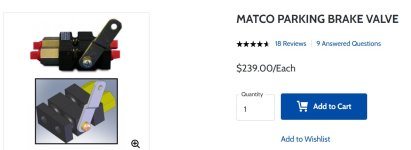
I never did like the idea of a parking brake being a valve that blocks the flow of fluid.

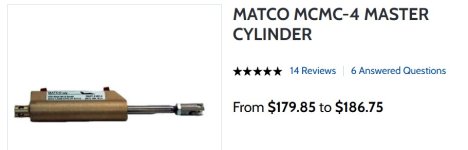
A master cyl is cheaper than a parking brake, and won't have any of the issues of a valve brake.
Install it in the SINGLE line from the fluid reservoir to the FIRST brake master. Make a cam lever
with a spring in line with the application cable to keep constant pressure on the brakes when applied
and allow expansion of fluid (like noted above).
matco PB.jpgmaster cyl.jpg
 
when i took off the lever was full off. when i landed it had moved about 1/4 of its total travel. i was surprised how much braking 1/4 travel was. and yes, it creates a dangerous situation.
 
when i took off the lever was full off. when i landed it had moved about 1/4 of its total travel. i was surprised how much braking 1/4 travel was. and yes, it creates a dangerous situation.
I am using a locking T-handle to actuate my RV-12 parking brake valve and to make sure it holds pressure when activated. Only problem I have ever had was the cable coming out of the b-nut when I tried to release the brake one time.
 
when i took off the lever was full off. when i landed it had moved about 1/4 of its total travel. i was surprised how much braking 1/4 travel was. and yes, it creates a dangerous situation.
I don't know what hardware you've got but I'm gonna make some blanket statements, FWIW.

The "parking brakes" I'm familiar with are not a brake. They are just shuttle type, close tolerance, isolation valve. Pump-up the brake pressure with the pedals and close the iso valve so the fluid can't flow back out of the calipers. Actuation of the PB in itself shouldn't do anything.

All that said, the valve/PB shouldn't be applying any force to the control cable. To start with, I would check the control cable rigging. Make sure the isolation isn't effected until the last bit of travel. At the other end of control cable travel, verify the valve is in its full open position and the actuator knob rest easily in it's corresponding position i.e. make sure the cable/armor itself isn't storing any energy.

Let us know what you find.
 
Last edited:
I don't know what hardware you've got but I'm gonna make some blanket statements, FWIW.

The "parking brakes" I'm familiar with are not a brake. They are just plunger type, close tolerance, isolation valve. Pump-up the brake pressure with the pedals and close the iso valve so the fluid can't flow back out of the calipers. Actuation of the PB in itself shouldn't do anything.

All that said, the valve/PB shouldn't be applying any force to the control cable. To start with, I would check the control cable rigging. Make sure the isolation isn't effected until the last bit of travel. At the other end of control cable travel, verify the valve is in its full open position and the actuator knob rest easily in it's corresponding position i.e. make sure the cable/armor itself isn't storing any energy.

Let us know what you find.
Bob--see if the cable sheath is moving in a adel clamp. If so, secure it. If not, then I think I'd change to a twist lock vernier cable.
 
the parking valve is located on inside top of the tunnel, passenger side of an rv12. bolts attaching it are thru the tunnel so only the lever of the brake sticks thru the tunnel. along the slot the lever travels is mounted a piece of angle alum. to protect the lever from accidentally being bumped. nothing touching, rubbing. i think i will mechanically attach the lever to the alum. angle to ''lock'' it in place. but then there's the screw that attaches the lever to the valve...........? if i detach the lever from the valve body is there any way in the world the valve could open itself then? i feel a trip coming into the tunnel. nuts, i hate going there.
 
got to the airport to take a closer look at my parking brake problem. took several close looks but then i saw it. the bolts attaching the pb to the tunnel cover had not been tightened after the condition inspection. i did taxi the plane after the inspection and the problem did occur but at that point i dropped the ball and never caught the loose bolts then. something to be learned from this
 
got to the airport to take a closer look at my parking brake problem. took several close looks but then i saw it. the bolts attaching the pb to the tunnel cover had not been tightened after the condition inspection. i did taxi the plane after the inspection and the problem did occur but at that point i dropped the ball and never caught the loose bolts then. something to be learned from this
Bob----VERY glad you found the problem. Seemingly little things can create potential disasterous situations.
 
Back
Top