Van's Air Force

The definitive Van's Aircraft support community! Buying, building or flying an RV? Join our exclusive family of mentors and enthusiasts!

Why don't I get a mag drop on Lightspeed plasma 3?

FORANE

Well Known Member
The Lightspeed plasma manual states that no significant mag drop may be expected when running on the LS alone. When doing a mag check I get zero drop running on LS alone. This was true when I had a Bendix mag opposite the LS. It is also true now with an E-mag opposite the LS. When running on the Bendix mag alone or with the E-mag alone I do get a mag drop of 150 or so.

Why is this? My P lead is intact. Is the LS providing a better spark than the Bendix mag and the E-mag? Is it due to timing advance on the LS?
 
I saw basically no drop when running on the LS only. (Slick mag and LS)
The magic of electronic ignition I guess.
 
The Lightspeed plasma manual states that no significant mag drop may be expected when running on the LS alone. When doing a mag check I get zero drop running on LS alone. This was true when I had a Bendix mag opposite the LS. It is also true now with an E-mag opposite the LS. When running on the Bendix mag alone or with the E-mag alone I do get a mag drop of 150 or so.

Why is this? My P lead is intact. Is the LS providing a better spark than the Bendix mag and the E-mag? Is it due to timing advance on the LS?
Timing advance on the Light Speed.
 
That means the LS is running quite a bit of advance at your rpm/map during the test. Normally two plugs fire and the two combustion processes meet in the middle. Once you get far enough advanced on one ignition, the first combustion process is mostly complete before the second plug fires, therefore no impact when you shut it down.

Your ignition should NOT be that far advanced at 1800 rpm. Suggest getting a timing light on it ti confirm setup, as well as reviewing your advance tables.
 
We typically see 20 rpm drop when turning the Bendix mag off. An unrecognized warning flag was when we started getting NO drop when turning the mag off. The lightspeed had gone into a failure mode giving excessive advance.

1) pull out a timing light and check the lightspeed as per that manual
2) disconnect the lightspeed manifold pressure line (plug the engine side) and do a mag check. You should see drops on both left and right.
 
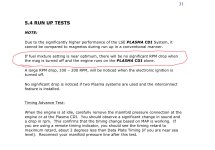
Hmmm, so zero drop isn't ok but 20 drop is ok? I may have missed a small drop of 20; will have to go back and confirm once the current maintenance being done is completed (broken fuel sensor being replaced). The manual states:
If fuel mixture setting is near optimum, there will be no significant RPM drop when
the mag is turned off and the engine runs on the PLASMA CDI alone.

We typically see 20 rpm drop when turning the Bendix mag off. An unrecognized warning flag was when we started getting NO drop when turning the mag off. The lightspeed had gone into a failure mode giving excessive advance.

1) pull out a timing light and check the lightspeed as per that manual
2) disconnect the lightspeed manifold pressure line (plug the engine side) and do a mag check. You should see drops on both left and right.
ok, I recently bought this plane and the previous owner advised it was normal and expected to see no drop when running on the Lightspeed alone. My installation has the Hall Effect Sensor Module.
 
Hmmm, so zero drop isn't ok but 20 drop is ok?

The “zero drop” behavior is likely caused by advance. This CAN be normal, but understand that the Lightspeed uses a GM based MAP sensor, and the failure mode of that device is to default to full advance regardless of MAP. A timing light to verify operation is a good idea. Also, rather than look at RPM at the runup, look for an EGT change between dual and single ignitions. You may not see or hear the RPM change, but you will certainly see the EGT rise on a single ignition.
 
ok, so another question. I have seen a timing light used on a car engine but don't own one and have never used one personally. With my E-mag timing is done by confirming the light on the E-mag illuminates at the correct flywheel clocking location; no timing light is used. My Lightspeed has the Hall Effect sensor; can I not just use its light to confirm timing the same as I do with the E-mag?
 
In practice, there is a less than 30RPM drop when turning off the magneto and running on the LSE.

There are two reasons for this:
1. The LSE spark is advanced at low RPM/MAP -- something on the order of 35° BTDC.
2. The LSE spark is much "hotter" and longer duration than a magneto.

Both of the above combine to make a more efficient combustion event.
Instead of just looking/listening for the RPM drop, keep an eye on the EGTs -- you will see them rise when you run on just the Mag or LSE.

ok, so another question. I have seen a timing light used on a car engine but don't own one and have never used one personally. With my E-mag timing is done by confirming the light on the E-mag illuminates at the correct flywheel clocking location; no timing light is used. My Lightspeed has the Hall Effect sensor; can I not just use its light to confirm timing the same as I do with the E-mag?

Change to the Mini-Sensor/Magnet ring configuration for the LSE -- far more robust and not prone to timing failures, leaks, etc. like the Hall Effect unit.
 
Hmmm, so zero drop isn't ok but 20 drop is ok? I may have missed a small drop of 20; will have to go back and confirm once the current maintenance being done is completed (broken fuel sensor being replaced). The manual states:
What is OK is a judgement call. Lot of detail involved on how much advance to use and at what configurations. Even more detail in how to deal with that when using two plugs. Then there is the testing for easilly catching a failed ignition, as described above.

My comment should have been that 0 drop is not standard instead of wrong. I don't recommend it, but it is not necessarilly bad, though it might be in some cases.
 
Last edited:
ok, so another question. I have seen a timing light used on a car engine but don't own one and have never used one personally. With my E-mag timing is done by confirming the light on the E-mag illuminates at the correct flywheel clocking location; no timing light is used. My Lightspeed has the Hall Effect sensor; can I not just use its light to confirm timing the same as I do with the E-mag?
The short answer is no. NEVER assume the LightSpeed LED indication is correct. It is correct ONLY if the LightSpeed does not have a failed MAP (or some other problem in the LightSpeed box).

A owner of a new RV-7 with ~100 hours (dual LightSpeed) was getting ready to chop holes in his cowl to solve a high CHT issue. He never put a timing light on the engine. Got the light out and found timing at 40+ degrees regardless of MP or RPM. Both boxes went back to Klaus for overhaul. When they came back (and verified with a timing light) they operated normally.

Carl
 
In practice, there is a less than 30RPM drop when turning off the magneto and running on the LSE.

There are two reasons for this:
1. The LSE spark is advanced at low RPM/MAP -- something on the order of 35° BTDC.

Yes, at idle, excessively so in my opinion. However, not at 1800 for a runup. As several folks have already pointed out, no drop at 1800 suggests a possible failure of the MAP sensor, which defaults the system to full advance all the time. It's a known issue with Lightspeed. Bad juju, for obvious reasons.

Lightspeed owners should be doing a timing light check at every annual.

2. The LSE spark is much "hotter" and longer duration than a magneto.

Naa. Output of a magneto varies as a function of rotation speed. At cranking RPM the Lightspeed will delivery more, like any battery power system. At 1800 either will be more than adequate, especially if mixture is near stoich where only about 0.2mJ is needed.

A CDI ignition is characterized by rapid voltage rise time and very short duration. To compensate, a CDI may be designed for multiple sparks all in a row, in an attempt to match the far longer duration of a typical inductive ignition. The OP didn't say which Lightspeed model he is using, but multispark is the key difference between a Plasma II and a Plasma III.

Both of the above combine to make a more efficient combustion event.

The proof is in the advertising ;)
 
Of interest is the behaviors or MAG checks on engines with one mag and one pMag. When turning off the pMag there is little RPM drop, Turning off the mag there is a larger drop.

So why?

Again this is all about timing. The mag has a fixed timing of 25 degrees. The pMag, while it can advance timing a little beyond 25 degrees in normal operation has retarded timing at low RPM. If doing a MAG check at 1700 - 1800 RPM the mag will have more advanced timing then the pMag, so the engine will have a larger RPM drop when you trun off the mag as compared to the pMag.

Carl
 
Same here, almost no RPM drop with Mag off.
I typically run a very lean mixture on the ground and usually have to enrich a bit for run up.
While the LSE does not seem to care too much for mixture settings, the mag most definitely does.
In addition, a run up at 1700 RPMs or 1800 RPMs produces a different picture for RPM drop.
For a properly adjusted mixture and 1800 RPMs on run up, I see 10 to 20 RPM drop with LSE only and about 150 with the mag only.
I do an occasional Cruise power mag/ignition check and in that scenario I see no noticeable drop with mags off and about 50 RPMs less with Mag only.
Set up is LSE Plasma 3 with Crank pick up sensor and Slick mag with impulse coupling on the left or correctly stated, Slick mag drives the bottom plugs
and LSE fires the top automotive plugs.
 
Same here, almost no RPM drop with Mag off.
I typically run a very lean mixture on the ground and usually have to enrich a bit for run up.
While the LSE does not seem to care too much for mixture settings, the mag most definitely does.
In addition, a run up at 1700 RPMs or 1800 RPMs produces a different picture for RPM drop.
For a properly adjusted mixture and 1800 RPMs on run up, I see 10 to 20 RPM drop with LSE only and about 150 with the mag only.
I do an occasional Cruise power mag/ignition check and in that scenario I see no noticeable drop with mags off and about 50 RPMs less with Mag only.
Set up is LSE Plasma 3 with Crank pick up sensor and Slick mag with impulse coupling on the left or correctly stated, Slick mag drives the bottom plugs
and LSE fires the top automotive plugs.
That strikes me as a large drop on mag only. My drop (Bendix + Lightspeed) is about 100. Has the mag had 500 hour service? Bendix or Slick?
 
Yes, at idle, excessively so in my opinion. However, not at 1800 for a runup. As several folks have already pointed out, no drop at 1800 suggests a possible failure of the MAP sensor, which defaults the system to full advance all the time. It's a known issue with Lightspeed. Bad juju, for obvious reasons.

Lightspeed owners should be doing a timing light check at every annual.


Naa. Output of a magneto varies as a function of rotation speed. At cranking RPM the Lightspeed will delivery more, like any battery power system. At 1800 either will be more than adequate, especially if mixture is near stoich where only about 0.2mJ is needed.

A CDI ignition is characterized by rapid voltage rise time and very short duration. To compensate, a CDI may be designed for multiple sparks all in a row, in an attempt to match the far longer duration of a typical inductive ignition. The OP didn't say which Lightspeed model he is using, but multispark is the key difference between a Plasma II and a Plasma III.


The proof is in the advertising ;)
Fair points...

Proof is in the data; if you are using LSEs you should instrument the RPM and timing data -- A far better "canary in a coal mine" than the once a year timing light test.

https://apps.savvyaviation.com/flights/shared/flight/9907127/eb63c55f-b0aa-4b59-b3d8-1df02ec31910 ("mag" check at 09:01")

At low RPM the advance is ~34°
At ~2000 RPM the advance moves to ~30° (see Ign L and Ign R, 08:58")
The dual lightspeed units will advance the timing ~5° when interconnected and one is disabled ("mag" check - the spike @ 09:05 and 09:08)

Note, the RPM drop was negligible during this "mag" check due to sample rate/display rate; it was detectable audibly, and a slight rise in EGT's. (the RPM glitch at 09:09" is a bug in the Plasma III unit, not real).
 
That strikes me as a large drop on mag only. My drop (Bendix + Lightspeed) is about 100. Has the mag had 500 hour service? Bendix or Slick?
It is a newly overhauled Slick and has about 100 hours since it was installed. Total hours on the LSE/engine is 800hrs plus.
I have never checked the Lightspeed for timing except once when it was first installed, it stays put and has no wear points.
It runs smooth and strong, no need to mess with it.
The magneto however, can be off just a tad and your drop will be more or less depending on advance or retard of the "error"
A poorly adjusted mag can give you a 250rpm drop with the LSE off.
I think a better indication of ignition health is a cruise power check and there it should be minimal with a slight rise in EGTs.
 
What I didn’t see in a quick scan of the thread =

In our power plants with (any) two ignition devices, there should be a 80 or so rpm drop during a run-up check if both are set to data plate timing. The large bore needs both flame fronts to “compete” the relatively slow deflagration event across the wide bore. Less is indication of a problem as many have already said, period. I’ve gotten a kick out of the boast “my airplane has zero rpm drop….” Same can be said about the “my engine only uses a quart of oil every xx hours.” Good chance the upper cylinder isn’t getting proper lubrication for any excessive cases stated here and other places.

In both cases, excessively less doesn’t necessarily mean better.
 
Last edited:
What I didn’t see in a quick scan of the thread =

In our power plants with (any) two ignition devices, there should be a 80 or so rpm drop during a run-up check if both are set to data plate timing. The large bore needs both flame fronts to “compete” the relatively slow deflagration event across the wide bore. Less is indication of a problem as many have already said, period. I’ve gotten a kick out of the boast “my airplane has zero rpm drop….” Same can be said about the “my engine only uses a quart of oil every xx hours.” Good chance the upper cylinder isn’t getting proper lubrication for any excessive cases stated here and other places.

In both cases, excessively less doesn’t necessarily mean better.
Yes, hence my comments about managing advance with two plugs. Sadly, the only real way to determine what is optimal is observing results on a dyno. However, the general wisdom in the porsche community (the older boxer engines are fundamentally identical to the Lyc's) was that balanced advance between the ignitions netted the best power on dyno runs. chamber design can influence this stuff, but the porsches chambers are similar to the lycs and very symmetrical. Its possible thye AV cylinders like something different. Never seen the chamber in one of those.
 
The Lightspeed plasma manual states that no significant mag drop may be expected when running on the LS alone. When doing a mag check I get zero drop running on LS alone. This was true when I had a Bendix mag opposite the LS. It is also true now with an E-mag opposite the LS. When running on the Bendix mag alone or with the E-mag alone I do get a mag drop of 150 or so.

Why is this? My P lead is intact. Is the LS providing a better spark than the Bendix mag and the E-mag? Is it due to timing advance on the LS?
Per the manual, and Claus, there should be no significant drop. I see about ~10 RPM drop on mine.
 

Attachments

  • IMG_1400.jpeg
    IMG_1400.jpeg
    264.6 KB · Views: 15
I just went out for a test flight to confirm the RPM drop with either mag or LSE off.
My EI-MVP-50 engine monitor provides more data than I want to bother you with but confirms what the LSE manual describes.
A run up at 1800 RPMs, mixture set where the engine sounds good (a bit lean) I can confirm what I said above.
Mag off, 160 RPM drop, LSE off, 18 RPM drop and no rise in EGTs.
Flight at 8500 feet, full throttle, 2300 RPM, 63% HP, leaned to make the engine sound good (a bit on the lean side of peak).
A mag test in flight with a constant speed prop is a bit tricky as the governor will try to keep the rpm constant. A momentary drop is noticeable but very difficult to detect in a sea of engine data, the most noticeable being a rise in EGTs.
There is only one rpm or flight parameter where a fix timed magneto will or can fire in unison with any electronic ignition and that would be at typical cruise settings.
As expected, mag off, drops the rpms about 10 to 20 RPMs and the same is true for turning the LSE off. With the LSE on and mag off, the engine sounds a bit smoother but the difference is almost imperceptible. EGTs rise about 50 F for both events.
From what I can see, the OP has a perfectly normal and functioning ignition set up and no cause for concern.
 
That strikes me as a large drop on mag only. My drop (Bendix + Lightspeed) is about 100. Has the mag had 500 hour service? Bendix or Slick?
Question - I am running a Slick Mag and LightSpeed. The slick Mag was just replaced at 1000 hours. During run-ups (O-360 AIA timing set to 20 BTDC matching engine plate) at 1800 RPM, I get a drop of 10-20 when the running on the Lightspeed alone. When I switch to the new Slick Mag alone, I see a drop of 150 -170 (the 1000 hour Slick Mag I replaced did the same thing). My A&P checked wires and plugs during the Slick Mag replacement - no issues. He said the 150 + drop was normal for this configuration. I also called Claus and he said to expect a larger drop during runups than when running dual Slick Mags. The A&P mechanic also mentioned that the Bendix + Lightspeed combo typically have less of a drop during runups - about a 100 drop. Does anyone else have additional datapoints on a Slick Mag + Lightspeed combo? Any other thoughts?
 
Question - I am running a Slick Mag and LightSpeed. The slick Mag was just replaced at 1000 hours. During run-ups (O-360 AIA timing set to 20 BTDC matching engine plate) at 1800 RPM, I get a drop of 10-20 when the running on the Lightspeed alone. When I switch to the new Slick Mag alone, I see a drop of 150 -170 (the 1000 hour Slick Mag I replaced did the same thing). My A&P checked wires and plugs during the Slick Mag replacement - no issues. He said the 150 + drop was normal for this configuration. I also called Claus and he said to expect a larger drop during runups than when running dual Slick Mags. The A&P mechanic also mentioned that the Bendix + Lightspeed combo typically have less of a drop during runups - about a 100 drop. Does anyone else have additional datapoints on a Slick Mag + Lightspeed combo? Any other thoughts?
I had a Slick (frankenSlick) + my Lightspeed originally. The "frankenSlick" was my rebuild to make it opposite rotation to work on the H2AD. I was not happy with how much mag drop I was getting on the Slick alone and swapped it for the Bendix 1200. I always attributed the large drop to my work, but maybe Slick mags just don't put out as much oomph as the Bendix.
 
Question - I am running a Slick Mag and LightSpeed. The slick Mag was just replaced at 1000 hours. During run-ups (O-360 AIA timing set to 20 BTDC matching engine plate) at 1800 RPM, I get a drop of 10-20 when the running on the Lightspeed alone. When I switch to the new Slick Mag alone, I see a drop of 150 -170 (the 1000 hour Slick Mag I replaced did the same thing). My A&P checked wires and plugs during the Slick Mag replacement - no issues. He said the 150 + drop was normal for this configuration. I also called Claus and he said to expect a larger drop during runups than when running dual Slick Mags. The A&P mechanic also mentioned that the Bendix + Lightspeed combo typically have less of a drop during runups - about a 100 drop. Does anyone else have additional datapoints on a Slick Mag + Lightspeed combo? Any other thoughts?
I explained the reason for asymmetrical drops in post #4
 
Question - I am running a Slick Mag and LightSpeed. The slick Mag was just replaced at 1000 hours. During run-ups (O-360 AIA timing set to 20 BTDC matching engine plate) at 1800 RPM, I get a drop of 10-20 when the running on the Lightspeed alone. When I switch to the new Slick Mag alone, I see a drop of 150 -170 (the 1000 hour Slick Mag I replaced did the same thing). My A&P checked wires and plugs during the Slick Mag replacement - no issues. He said the 150 + drop was normal for this configuration. I also called Claus and he said to expect a larger drop during runups than when running dual Slick Mags. The A&P mechanic also mentioned that the Bendix + Lightspeed combo typically have less of a drop during runups - about a 100 drop. Does anyone else have additional datapoints on a Slick Mag + Lightspeed combo? Any other thoughts?

Welcome to the wonderful world of RV's. You wont find a better resource for learning about your aircraft.

I do wonder why your engine is timed at 20° -- do you have higher than normal compression pistons? (i.e. 9 or 10:1 instead of the "normal" 8.5:1). Or is your engine an IO-360-A1A (your post said O-360)?

From the experience of a long time operator of LS/Plasma3 and Slicks, a drop of 100+ RPM when running on the Slick alone is perfectly normal. @lr172 Larry did a good job of explaining why this is the case at the beginning of this thread.
 
Back
Top