
Here is the school.... https://www.reedleycollege.edu/acad...nufacturing-pathway/aviation-maintenance.htmlMy name is Jason,
I’m an A&P / IA and also serve as a DME. I work at an FAA Part 147 AMT school where we’ve been training A&Ps since 1948. I have been teaching aircraft maintenance for 16 years.
From what I’ve seen, there’s a real lack of Light Sport Repairman (LSR) training opportunities not just in California, but nationwide. With MOSAIC coming online, I think the gap will only grow, particularly with more EAB owners wanting to perform their own condition inspections.
Our mission as a school has always been twofold:
While A&P certification remains the gold standard, the cost and time commitment can be a barrier. LSR certification could serve as an entry-level pathway, something that supports current owners while also opening the door for new technicians to step into aviation and, potentially, move on toward an A&P.
- Support the local community with training that’s relevant and accessible; leading to a well paying job or an opportunity to transfer to a University.
- Support the aviation industry by preparing new people to enter the workforce and to ensure the industry is staffed with well qualified professionals.
Central California for us means the Fresno area (specifically, Reedley, CA), which makes training accessible from a wide portion of the state. Hot summers and mild winters.

Van's Air Force
You are using an out of date browser. It may not display this or other websites correctly.
You should upgrade or use an alternative browser.
You should upgrade or use an alternative browser.
MOSAIC Repairman Certificate classes
- Thread starter IBRNGAS
- Start date


BE CAREFUL:
One small factor no one is talking about is that even after you take the course and receive your "repairman certificate" you will not be able to sign off your E-AB aircraft unless the Operating Limitations for that aircraft allow it. Currently there is no wording in E-AB Op Lims to allow these sign-Offs.
Current Op Lims only allow condition inspections to be conducted by "An experimental aircraft builder certificated as a repairman for this aircraft under §65.104", certificated mechanic, etc. The Light- Sport Repairman classes do not fall under §65.104.
Obviously, there will have to be new wording from FAA, but as DARs, we will be the last to know! Keeping my ear to the ground.
One small factor no one is talking about is that even after you take the course and receive your "repairman certificate" you will not be able to sign off your E-AB aircraft unless the Operating Limitations for that aircraft allow it. Currently there is no wording in E-AB Op Lims to allow these sign-Offs.
Current Op Lims only allow condition inspections to be conducted by "An experimental aircraft builder certificated as a repairman for this aircraft under §65.104", certificated mechanic, etc. The Light- Sport Repairman classes do not fall under §65.104.
Obviously, there will have to be new wording from FAA, but as DARs, we will be the last to know! Keeping my ear to the ground.
Can the operating limitations be revised without DAR input after the initial airworthiness process?BE CAREFUL:
One small factor no one is talking about is that even after you take the course and receive your "repairman certificate" you will not be able to sign off your E-AB aircraft unless the Operating Limitations for that aircraft allow it. Currently there is no wording in E-AB Op Lims to allow these sign-Offs.
Current Op Lims only allow condition inspections to be conducted by "An experimental aircraft builder certificated as a repairman for this aircraft under §65.104", certificated mechanic, etc. The Light- Sport Repairman classes do not fall under §65.104.
Obviously, there will have to be new wording from FAA, but as DARs, we will be the last to know! Keeping my ear to the ground.
They will need to be amended by the FSDO or a DAR.Can the operating limitations be revised without DAR input after the initial airworthiness process?
I live in Sacramento and will take the 2 day class. Please keep us informed!My name is Jason,
I’m an A&P / IA and also serve as a DME. I work at an FAA Part 147 AMT school where we’ve been training A&Ps since 1948. I have been teaching aircraft maintenance for 16 years.
From what I’ve seen, there’s a real lack of Light Sport Repairman (LSR) training opportunities not just in California, but nationwide. With MOSAIC coming online, I think the gap will only grow, particularly with more EAB owners wanting to perform their own condition inspections.
Our mission as a school has always been twofold:
While A&P certification remains the gold standard, the cost and time commitment can be a barrier. LSR certification could serve as an entry-level pathway, something that supports current owners while also opening the door for new technicians to step into aviation and, potentially, move on toward an A&P.
- Support the local community with training that’s relevant and accessible; leading to a well paying job or an opportunity to transfer to a University.
- Support the aviation industry by preparing new people to enter the workforce and to ensure the industry is staffed with well qualified professionals.
Central California for us means the Fresno area (specifically, Reedley, CA), which makes training accessible from a wide portion of the state. Hot summers and mild winters.
Thanks so much.

Is the FAA saying this?They will need to be amended by the FSDO or a DAR.
If not, you may well be right, but it doesn’t strike me as an obvious conclusion. I don’t see why the operating limitations necessarily “win” when they conflict with a regulation—but perhaps that’s an airplane regulation thing?
Operating Limitation DEFINITELY override regulations.Is the FAA saying this?
If not, you may well be right, but it doesn’t strike me as an obvious conclusion. I don’t see why the operating limitations necessarily “win” when they conflict with a regulation—but perhaps that’s an airplane regulation thing?
BE CAREFUL:
One small factor no one is talking about is that even after you take the course and receive your "repairman certificate" you will not be able to sign off your E-AB aircraft unless the Operating Limitations for that aircraft allow it. Currently there is no wording in E-AB Op Lims to allow these sign-Offs.
Current Op Lims only allow condition inspections to be conducted by "An experimental aircraft builder certificated as a repairman for this aircraft under §65.104", certificated mechanic, etc. The Light- Sport Repairman classes do not fall under §65.104.
Obviously, there will have to be new wording from FAA, but as DARs, we will be the last to know! Keeping my ear to the ground.
This claim is different than anything I read on Mosaic.
After taking the class one becomes a certificated mechanic.
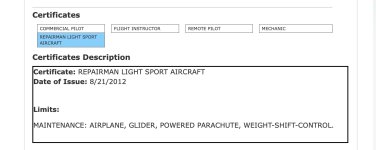
Last edited:
Amateur Built Operating Limitations
Amateur Built Operating Limitations
www.faa-aircraft-certification.com

Amateur Built Operating Limitations
Amateur Built Operating Limitationswww.faa-aircraft-certification.com
Two things….
1) That link is nearly an example of what E_AB Ops Limitations look like, or looking like at one time - it is not the current template for Operating limitations from the FAA Guidance document (8130.2K). Don’t believe everything you find on the internet, and when it comes to regulations, go to the source!
2) What governs the operation of a particular E-AB aircraft are THAT AIRCRAFT’S Ops Lims - they are generated specifically for each aircraft and reflect the guidance current at the time of issuance. If you get amended Ops Lims, they will be amended to the current guidance. Current guidance is just Ike Mel said - it includes ops Lim (18) that requires a rep[airman certificated under 65.104 or an A&P.
Paul
Two things….
1) That link is nearly an example of what E_AB Ops Limitations look like, or looking like at one time - it is not the current template for Operating limitations from the FAA Guidance document (8130.2K). Don’t believe everything you find on the internet, and when it comes to regulations, go to the source!
2) What governs the operation of a particular E-AB aircraft are THAT AIRCRAFT’S Ops Lims - they are generated specifically for each aircraft and reflect the guidance current at the time of issuance. If you get amended Ops Lims, they will be amended to the current guidance. Current guidance is just Ike Mel said - it includes ops Lim (18) that requires a rep[airman certificated under 65.104 or an A&P.
Paul
Does that nearly identical Op lims say anything along the lines of what Mel said?
If there is some standard Op lime that is current for EAB, how about posting them, I can't find them. For your point #1 above, is there something significantly different pertinent to this discussion and if so what is it?
Your statement #2 comes across as a bit garbled to me. Are you writing that you AGREE that those that take the LSRM or LSRI classes will need to have the Op Lims changed?
My operating limitations are in part attached. Item 26 says...or an appropriately rated FAA certificated mechanic
I say, after the class, that I will be both appropriately rated and certificated under the Mosaic rules and do not need to get my Op Lims changed.
Attachments
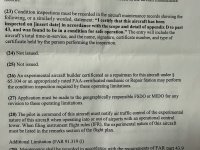
There’s essentially a “catalog” of Ops Lims in the guidance document (8130.2K) that a DAR uses to build Operating Limitations when inspecting an issuing an AWC for an aircraft - you can search for the pdf of that document and go to Appendix D for the table. Just be advised that it has all sorts of limitations which don’t pertain to E-AB…the Ops Lims I issue to an F-5 Fighter in the Experimental - Exhibition category are very different from those I issue for an E-AB, but they came from the same table.
I agree with Mel that the FAA has yet to catch the 8130.2 document up with Mosaic - it’s a huge change that touches many documents and rules, some of which they haven’t gotten to yet. And as Mel says, the LSRM certificates do not currently fall under 65.104. You can interpret it any way you like, but the only interpretation that matters is the FAA’s.
I agree with Mel that the FAA has yet to catch the 8130.2 document up with Mosaic - it’s a huge change that touches many documents and rules, some of which they haven’t gotten to yet. And as Mel says, the LSRM certificates do not currently fall under 65.104. You can interpret it any way you like, but the only interpretation that matters is the FAA’s.
There’s essentially a “catalog” of Ops Lims in the guidance document (8130.2K) that a DAR uses to build Operating Limitations when inspecting an issuing an AWC for an aircraft - you can search for the pdf of that document and go to Appendix D for the table. Just be advised that it has all sorts of limitations which don’t pertain to E-AB…the Ops Lims I issue to an F-5 Fighter in the Experimental - Exhibition category are very different from those I issue for an E-AB, but they came from the same table.
I agree with Mel that the FAA has yet to catch the 8130.2 document up with Mosaic - it’s a huge change that touches many documents and rules, some of which they haven’t gotten to yet. And as Mel says, the LSRM certificates do not currently fall under 65.104. You can interpret it any way you like, but the only interpretation that matters is the FAA’s.
Do AP certificates fall under 65.104 and if not why are they able to perform the condition inspection?
I think you and Mel are respected thought leaders in experimental aviation and VAF but are muddying up the waters with this idea of needing operating limitations changed.
Repairman does not equal Mechanic. I've never seen the word "Mechanic" on a "Repairman Certificate". It IS, however, on a "Mechanic Certificate".After taking the class one becomes a certificated mechanic.
No; A&P Certificates fall under "FAA - Certificated Mechanic". A&P certificates contain the word "Mechanic".Do AP certificates fall under 65.104 and if not why are they able to perform the condition inspection?

Is the point that with mosaic the term “appropriate rated mechanic” applies? Vs repairman in 65.104? Seems that it depends on the interpretation of appropriate rated mechanic, which of course isn’t defined at this point with an interpretation by the faa, so that’s why it’s a grey area currently?
Is the point that with mosaic the term “appropriate rated mechanic” applies? Vs repairman in 65.104? Seems that it depends on the interpretation of appropriate rated mechanic, which of course isn’t defined at this point with an interpretation by the faa, so that’s why it’s a grey area currently?
My point is that three months after Mosaic was made public, with zero discussion previously here or in the Mosaic documents that I read, someone says that one needs to get the operating limitations for the plane changed in order to do the inspection, with the emboldened BE CAREFUL, and that this does not pass my sniff test.

I’m going to the class next weekend. I’ll ask them this question.My point is that three months after Mosaic was made public, with zero discussion previously here or in the Mosaic documents that I read, someone says that one needs to get the operating limitations for the plane changed in order to do the inspection, with the emboldened BE CAREFUL, and that this does not pass my sniff test.
They said you just need to take the class documents to the FSDO.I’m going to the class next weekend. I’ll ask them this question.

No. I took the Rainbow class last weekend. They absolutely told us that we’d need to get the operating limitations amended, along with getting the Repairman-Inspection Certificate from the FSDO. So there are two parts to get to the “I can do the Condition Inspection on my EAB airplane” solution.They said you just need to take the class documents to the FSDO.
No. I took the Rainbow class last weekend. They absolutely told us that we’d need to get the operating limitations amended, along with getting the Repairman-Inspection Certificate from the FSDO. So there are two parts to get to the “I can do the Condition Inspection on my EAB airplane” solution.
What about LSRM?
JasonDRV4Me
Member
We are moving forward slowly. The FAA still needs to finalize AC65-32B. That is the primary guidance on how to put the new training program together. The college has approved the concept and has allowed the faculty to begin developing course outlines and materials. We have an advisory board meeting in a few weeks, so we will also need their endorsement. The new AMT program review was submitted with the expansion into LRS training. The Corse Outlines of Record for two of the courses are approved by our curriculum committee and the Board of Trustees. There are a LOT of parts involved in this sort of thing at a college, so it will take some time. But, so far so good. I will post updates periodically.I live in Sacramento and will take the 2 day class. Please keep us informed!
Thanks so much.
The regs differentiate between repairman and mechanic. To my knowledge only A&Ps and avionics techs are given the title “mechanic.” Maybe there are others. The lightsport guys and builders get the lesser rank of repairman. A repairman is NOT synonymous with mechanic in the regs. So, based upon my reading of those regs, your lsri or lsrm rating (a repairman) wouldn’t match the requirement you posted from your OL. Not an expert, but read those areas not long ago when researching this.My operating limitations are in part attached. Item 26 says...or an appropriately rated FAA certificated mechanic
.
Last edited:
I’m sorry - Mel and I HAVE been in this business a very long time, and neither of us has anything to gain by “muddying the waters”. I am not a pot stirrer, and I don’t write things just to poke people - or the bear. The FAA processes are more complex and intertwined than you might think they are, and I have sat through many meetings where disconnects have been identified and people given actions to fix them…and it takes time to get that right. There are people that think that an FAA official snaps their fingers and everything changes - but it doesn’t work that way. The working troops in the field need clear guidance that isn’t in conflict. And it will get there. We’ve had at least two or three memos issued since last October fixing problems with 8130.2K…I expect this will be fixed in a similar fashion, but it won’t be until everyone gets back to work for sure.Do AP certificates fall under 65.104 and if not why are they able to perform the condition inspection?
I think you and Mel are respected thought leaders in experimental aviation and VAF but are muddying up the waters with this idea of needing operating limitations changed.
But yeah, go ahead and sign off your condition inspection any way you like - I know of several people with no repairman certificates or Mechanic's licenses that sign off airplanes they didn’t build every year. Or they just fly them without a logbook entry. That doesn’t make it legal - they just haven’t gotten caught.

QuickBuild_SlowPilot
I'm New Here
Totally agree. Van’s would be the perfect group to lead the charge on MOSAIC training. Surprised no one’s set it up yet.

My insurance broker, a friend since 2003, is still going have to see what gotcha items on a claim have been omitted so they can avoid a payout.I’m sorry - Mel and I HAVE been in this business a very long time, and neither of us has anything to gain by “muddying the waters”. I am not a pot stirrer, and I don’t write things just to poke people - or the bear. The FAA processes are more complex and intertwined than you might think they are, and I have sat through many meetings where disconnects have been identified and people given actions to fix them…and it takes time to get that right. There are people that think that an FAA official snaps their fingers and everything changes - but it doesn’t work that way. The working troops in the field need clear guidance that isn’t in conflict. And it will get there. We’ve had at least two or three memos issued since last October fixing problems with 8130.2K…I expect this will be fixed in a similar fashion, but it won’t be until everyone gets back to work for sure.
But yeah, go ahead and sign off your condition inspection any way you like - I know of several people with no repairman certificates or Mechanic's licenses that sign off airplanes they didn’t build every year. Or they just fly them without a logbook entry. That doesn’t make it legal - they just haven’t gotten caught.
Not his choice, it’s the folks paying the claims trying to weasel out of cutting a check…
I suspect there are all sorts of things in ops limits that don’t mesh well with later regs. The older op limits linked to above, for example, provide that:What governs the operation of a particular E-AB aircraft are THAT AIRCRAFT’S Ops Lims - they are generated specifically for each aircraft and reflect the guidance current at the time of issuance.
“17. The pilot in command of this aircraft must hold an appropriate category/class rating.”
Under the old rules, did a sport pilot have a category and class rating? It doesn’t look like it. But I suspect sport pilots have long been flying otherwise appropriate EABs with these op limits and none of us has ever given it a second thought.
Or maybe someone has? Assuming I’m right about the disconnect (big assumption), is there an FAA ruling on this wildly inconsequential potential issue? It honestly wouldn’t surprise me.

What would (mildly) surprise me is if the FAA decides that all of our op limits need to be changed to make MOSAIC work the way it’s supposed to. That’s a ton of busy work. If anything, I’d expect some sort of pronouncement from on high.
But I’ve been surprised by the FAA’s approach to things before.


After spending years doing owner assisted annuals on previous type certified aircraft, and doing conditions inspections on the RV-9A I built and completed 21-yeas ago with my repairman's certificate, I have found that most maintenance items and condition inspections are highly hands-on activities, where the skills and tricks can take some time to master. Not a bad idea to get someone with an A&P or Repairman's certificate to assist on your first few CI's and also on maintenance items you haven't performed yet.Anyone who comes up with an online version of the “two day inspection course” will have a ton of customers.
There is an argument that this interpretation is not correct, specifically for Ops Limits which state the following: "An experimental aircraft builder certificated as a Repairman for this aircraft under §65.104, or an appropriately rated FAA certificated mechanic, may perform the condition inspection required by these operating limitations.” as many do.BE CAREFUL:
One small factor no one is talking about is that even after you take the course and receive your "repairman certificate" you will not be able to sign off your E-AB aircraft unless the Operating Limitations for that aircraft allow it. Currently there is no wording in E-AB Op Lims to allow these sign-Offs.
Current Op Lims only allow condition inspections to be conducted by "An experimental aircraft builder certificated as a repairman for this aircraft under §65.104", certificated mechanic, etc. The Light- Sport Repairman classes do not fall under §65.104.
Obviously, there will have to be new wording from FAA, but as DARs, we will be the last to know! Keeping my ear to the ground.
I caveat my post by saying that I am not a lawyer, or ASI. The below is just opinion.
As I read this section of the Ops Limits, there is a significant difference between ‘may’ as used in the quoted example, and ‘must’ as used elsewhere in the FARs. These two words have different implications and are not interchangeable.
I read the above Ops Limit quoted above as providing inclusive examples of who may conduct the inspection to satisfy the Ops Limits, not an exclusive list of who must conduct the inspection.
Pages 431 and 432 of MOSAIC support this, which I'll quote below:
"Currently, operating limitations issued to EAB aircraft provide that an appropriately rated mechanic, a repair station, or the holder of a repairman certificate (experimental aircraft builder) issued in accordance with § 65.104 may perform a condition inspection on an EAB aircraft. Only the primary builder of the EAB aircraft is eligible for a certificate issued under § 65.104, and the certificate is limited to performing the annual condition inspection on that specific aircraft (by aircraft make, model, and serial number). When an EAB aircraft is sold by the original builder, the builder's repairman certificate (experimental aircraft builder) privileges are still valid for the aircraft (by make, model, and serial number); however, the new owner does not have the option to get a repairman certificate (experimental aircraft builder) because the new owner is not the builder of the aircraft. This results in the new owner lacking eligibility for a repairman certificate (experimental aircraft builder) and having to obtain the services of a certificated mechanic or repair station to perform the required condition inspection on their EAB aircraft.
FAA agrees with commenters' suggestions and finds there is a safety benefit in permitting additional properly trained and certificated repairmen to perform condition inspections on EAB aircraft because it will be easier for owners to find qualified personnel to conduct required inspections. Therefore, this final rule expands the privileges of a light-sport repairman certificate under § 65.109 to allow a certificate holder, with either rating (inspection or maintenance), to perform the annual condition inspection on an EAB aircraft issued an experimental airworthiness certificate under § 21.191(g).
The changes adopted in § 65.109(a) and (b) of this final rule do not impose additional restrictions but rather expand the privileges of a light-sport repairman. Specifically, § 65.107(c) will allow a light-sport repairman with an inspection rating to perform the annual condition inspection on an EAB aircraft that is owned by the repairman and that is in the same category of aircraft for which the certificate holder was trained.271 In addition, § 65.109(b) will permit a light-sport repairman with a maintenance rating to perform the annual condition inspection on an EAB aircraft that is in the same category of aircraft for which the certificate holder was trained.
To emphasize, this final rule expands light-sport repairman privileges only to aircraft issued an experimental airworthiness certificate under § 21.191(g) (operating EAB aircraft) and the condition inspection required on those aircraft…”
FAA agrees with commenters' suggestions and finds there is a safety benefit in permitting additional properly trained and certificated repairmen to perform condition inspections on EAB aircraft because it will be easier for owners to find qualified personnel to conduct required inspections. Therefore, this final rule expands the privileges of a light-sport repairman certificate under § 65.109 to allow a certificate holder, with either rating (inspection or maintenance), to perform the annual condition inspection on an EAB aircraft issued an experimental airworthiness certificate under § 21.191(g).
The changes adopted in § 65.109(a) and (b) of this final rule do not impose additional restrictions but rather expand the privileges of a light-sport repairman. Specifically, § 65.107(c) will allow a light-sport repairman with an inspection rating to perform the annual condition inspection on an EAB aircraft that is owned by the repairman and that is in the same category of aircraft for which the certificate holder was trained.271 In addition, § 65.109(b) will permit a light-sport repairman with a maintenance rating to perform the annual condition inspection on an EAB aircraft that is in the same category of aircraft for which the certificate holder was trained.
To emphasize, this final rule expands light-sport repairman privileges only to aircraft issued an experimental airworthiness certificate under § 21.191(g) (operating EAB aircraft) and the condition inspection required on those aircraft…”
———-
In summary, as I interpret this, I suggest the following:
1) As worded in the example, EAB Ops Limits provide inclusive examples of who may perform the conditional inspection, not an exclusive list of who must.
2) The MOSAIC NPRM makes clear the FAA’s intent to expand who may conduct that inspection via the creation of FAR 65.109.
3) The privileges of an LSR-I and LSR-M clearly state they are qualified (as appropriate to their rating)
————
Please don’t take anything I said as a statement of fact. This is just my opinion.
I did have an in-person meeting at my local FSDO last week. I shared the above interpretation with the Inspector, who agreed with it, and stated that once MOSIAC goes into effect, an LSRI/M may conduct the Annual Conditional Inspection on an E-AB whose Ops Limits are worded as such in my example previously posted.
Note that there are plenty of examples of ASIs/FSDOs contradicting each other.
Clarification is needed, however.
I think my thoughts as posted above provide an adequate framework to demonstrate that no conflict exists between the ‘may’ wording of the Ops Limits, and the expanded LSR privileges once MOSAIC goes into effect.

I got into the world of writing operating limitations (8130.2K) when I insisted on including ~20 airports in my operational limits last February. FSDO in Florida and FDSO in Virginia had two very different views on how to write these and I did not want to give my insurance carrier an out by saying I was not covered because I landed at an airport or maybe tried to land at an airport not specified. The best explanation I received from FSDO was "every FSDO is like its own FAA and can interpret regs differently". I asked doesn't the S in FSDO stand for standards and was politely told "may not". It will be interesting when someone actually tries to get and receives a Repairmen's Certificate under the new Mosaic rules that was not the original builder.Note that there are plenty of examples of ASIs/FSDOs contradicting each other.
For now, I would listen to what Mel and Ironflight recommend and be careful with insurance carriers by getting too far in front of this.
That's fine. Then you go with that.There is an argument that this interpretation is not correct, specifically for Ops Limits which state the following: "An experimental aircraft builder certificated as a Repairman for this aircraft under §65.104, or an appropriately rated FAA certificated mechanic, may perform the condition inspection required by these operating limitations.” as many do.
I caveat my post by saying that I am not a lawyer, or ASI. The below is just opinion.
As I read this section of the Ops Limits, there is a significant difference between ‘may’ as used in the quoted example, and ‘must’ as used elsewhere in the FARs. These two words have different implications and are not interchangeable.
I read the above Ops Limit quoted above as providing inclusive examples of who may conduct the inspection to satisfy the Ops Limits, not an exclusive list of who must conduct the inspection.
Pages 431 and 432 of MOSAIC support this, which I'll quote below:
"Currently, operating limitations issued to EAB aircraft provide that an appropriately rated mechanic, a repair station, or the holder of a repairman certificate (experimental aircraft builder) issued in accordance with § 65.104 may perform a condition inspection on an EAB aircraft. Only the primary builder of the EAB aircraft is eligible for a certificate issued under § 65.104, and the certificate is limited to performing the annual condition inspection on that specific aircraft (by aircraft make, model, and serial number). When an EAB aircraft is sold by the original builder, the builder's repairman certificate (experimental aircraft builder) privileges are still valid for the aircraft (by make, model, and serial number); however, the new owner does not have the option to get a repairman certificate (experimental aircraft builder) because the new owner is not the builder of the aircraft. This results in the new owner lacking eligibility for a repairman certificate (experimental aircraft builder) and having to obtain the services of a certificated mechanic or repair station to perform the required condition inspection on their EAB aircraft.
FAA agrees with commenters' suggestions and finds there is a safety benefit in permitting additional properly trained and certificated repairmen to perform condition inspections on EAB aircraft because it will be easier for owners to find qualified personnel to conduct required inspections. Therefore, this final rule expands the privileges of a light-sport repairman certificate under § 65.109 to allow a certificate holder, with either rating (inspection or maintenance), to perform the annual condition inspection on an EAB aircraft issued an experimental airworthiness certificate under § 21.191(g).
The changes adopted in § 65.109(a) and (b) of this final rule do not impose additional restrictions but rather expand the privileges of a light-sport repairman. Specifically, § 65.107(c) will allow a light-sport repairman with an inspection rating to perform the annual condition inspection on an EAB aircraft that is owned by the repairman and that is in the same category of aircraft for which the certificate holder was trained.271 In addition, § 65.109(b) will permit a light-sport repairman with a maintenance rating to perform the annual condition inspection on an EAB aircraft that is in the same category of aircraft for which the certificate holder was trained.
To emphasize, this final rule expands light-sport repairman privileges only to aircraft issued an experimental airworthiness certificate under § 21.191(g) (operating EAB aircraft) and the condition inspection required on those aircraft…”
———-
In summary, as I interpret this, I suggest the following:
1) As worded in the example, EAB Ops Limits provide inclusive examples of who may perform the conditional inspection, not an exclusive list of who must.
2) The MOSAIC NPRM makes clear the FAA’s intent to expand who may conduct that inspection via the creation of FAR 65.109.
3) The privileges of an LSR-I and LSR-M clearly state they are qualified (as appropriate to their rating)
————
Please don’t take anything I said as a statement of fact. This is just my opinion.
I did have an in-person meeting at my local FSDO last week. I shared the above interpretation with the Inspector, who agreed with it, and stated that once MOSIAC goes into effect, an LSRI/M may conduct the Annual Conditional Inspection on an E-AB whose Ops Limits are worded as such in my example previously posted.
Note that there are plenty of examples of ASIs/FSDOs contradicting each other.
Clarification is needed, however.
I think my thoughts as posted above provide an adequate framework to demonstrate that no conflict exists between the ‘may’ wording of the Ops Limits, and the expanded LSR privileges once MOSAIC goes into effect.
Personally I have had this discussion with SEVERAL FSDO inspectors and SEVERAL DARs, all quite experienced, and literally NOT ONE of them agree with your interpretation. As Ironflight said, the only interpretation that counts is FAA's; and that's from the Washington level, not the local FSDO.
Last edited:
Good observation!Repairman does not equal Mechanic. I've never seen the word "Mechanic" on a "Repairman Certificate". It IS, however, on a "Mechanic Certificate".
It doesn't say you've magically become an aircraft mechanic--you are just certified to inspect the aircraft you built. However as the builder and repairman, this implies you keep the aircraft in a "condition for safe operation", which generally means you either learn how to become an airplane mechanic or find someone to help, especially if you intend on signing-off your own condition inspections. Back of my Repairman's Certificate Reads:
Builder's Name
XII RATINGS
REPAIRMAN EXPERIMENTAL AIRCRAFT BUILDER
XIII LIMITATIONS
INSPECTION CERTIFICATE FOR EXPERIMENTAL AIRCRAFT (Builder's Name)
MODEL RV-9A SERIAL NUMBER (Serial #) CERTIFICATE DATE 15 OCT 2004
Last edited:

FlyingBanker
Well Known Member
I’m hoping someone at EAA is pushing hard on the FAA (or at least will once the government is back open for business) to have guidance issued that will put to rest the need to have san update to the ops limits. A simple official guidance that says due to MOSAIC rule making the language in current ops limits will be deemed to include those certified as LSR-I’s are included in the authorization would seem to be a logical fix.
Maybe i am confused, but isn’t this 800 page document just a reponse to the notice of proposed rule making? While it clarifies their opinion, positions and their intent with the new rules, I believe it must still be codified into the regulations. Just reading it, you can tell it is just stating position, but is not a reg. So at some point, the lawyers and administrators need to change and add regs to put this into law. I would expect more clarity once that work is done and folks have to connect all the inter related languages. I suspect it is fully legal to work off this doc once we hit the date,just as we work off of FAA interpretations that never get codified.There is an argument that this interpretation is not correct, specifically for Ops Limits which state the following: "An experimental aircraft builder certificated as a Repairman for this aircraft under §65.104, or an appropriately rated FAA certificated mechanic, may perform the condition inspection required by these operating limitations.” as many do.
I caveat my post by saying that I am not a lawyer, or ASI. The below is just opinion.
As I read this section of the Ops Limits, there is a significant difference between ‘may’ as used in the quoted example, and ‘must’ as used elsewhere in the FARs. These two words have different implications and are not interchangeable.
I read the above Ops Limit quoted above as providing inclusive examples of who may conduct the inspection to satisfy the Ops Limits, not an exclusive list of who must conduct the inspection.
Pages 431 and 432 of MOSAIC support this, which I'll quote below:
"Currently, operating limitations issued to EAB aircraft provide that an appropriately rated mechanic, a repair station, or the holder of a repairman certificate (experimental aircraft builder) issued in accordance with § 65.104 may perform a condition inspection on an EAB aircraft. Only the primary builder of the EAB aircraft is eligible for a certificate issued under § 65.104, and the certificate is limited to performing the annual condition inspection on that specific aircraft (by aircraft make, model, and serial number). When an EAB aircraft is sold by the original builder, the builder's repairman certificate (experimental aircraft builder) privileges are still valid for the aircraft (by make, model, and serial number); however, the new owner does not have the option to get a repairman certificate (experimental aircraft builder) because the new owner is not the builder of the aircraft. This results in the new owner lacking eligibility for a repairman certificate (experimental aircraft builder) and having to obtain the services of a certificated mechanic or repair station to perform the required condition inspection on their EAB aircraft.
FAA agrees with commenters' suggestions and finds there is a safety benefit in permitting additional properly trained and certificated repairmen to perform condition inspections on EAB aircraft because it will be easier for owners to find qualified personnel to conduct required inspections. Therefore, this final rule expands the privileges of a light-sport repairman certificate under § 65.109 to allow a certificate holder, with either rating (inspection or maintenance), to perform the annual condition inspection on an EAB aircraft issued an experimental airworthiness certificate under § 21.191(g).
The changes adopted in § 65.109(a) and (b) of this final rule do not impose additional restrictions but rather expand the privileges of a light-sport repairman. Specifically, § 65.107(c) will allow a light-sport repairman with an inspection rating to perform the annual condition inspection on an EAB aircraft that is owned by the repairman and that is in the same category of aircraft for which the certificate holder was trained.271 In addition, § 65.109(b) will permit a light-sport repairman with a maintenance rating to perform the annual condition inspection on an EAB aircraft that is in the same category of aircraft for which the certificate holder was trained.
To emphasize, this final rule expands light-sport repairman privileges only to aircraft issued an experimental airworthiness certificate under § 21.191(g) (operating EAB aircraft) and the condition inspection required on those aircraft…”
———-
In summary, as I interpret this, I suggest the following:
1) As worded in the example, EAB Ops Limits provide inclusive examples of who may perform the conditional inspection, not an exclusive list of who must.
2) The MOSAIC NPRM makes clear the FAA’s intent to expand who may conduct that inspection via the creation of FAR 65.109.
3) The privileges of an LSR-I and LSR-M clearly state they are qualified (as appropriate to their rating)
————
Please don’t take anything I said as a statement of fact. This is just my opinion.
I did have an in-person meeting at my local FSDO last week. I shared the above interpretation with the Inspector, who agreed with it, and stated that once MOSIAC goes into effect, an LSRI/M may conduct the Annual Conditional Inspection on an E-AB whose Ops Limits are worded as such in my example previously posted.
Note that there are plenty of examples of ASIs/FSDOs contradicting each other.
Clarification is needed, however.
I think my thoughts as posted above provide an adequate framework to demonstrate that no conflict exists between the ‘may’ wording of the Ops Limits, and the expanded LSR privileges once MOSAIC goes into effect.

This is great information, thank you for sharing. For what its worth, the FSDO Inspector I met with stated that there was no need to modify the Operating Limitations to permit the expansion of the LSRM privileges once MOSAIC goes into effect based on the interpretation I posted. Obviously this contradicts the guidance you were provided. As others have posted, hopefully one of the many advocacy organizations is working to clarify this. Clearly, standardization is needed, and taking the conservative approach in how one interprets these makes sense. It would be great if the 'Washington Level' FAA could issue a document clarifying this internally to the FSDOs and publicly.That's fine. Then you go with that.
Personally I have had this discussion with SEVERAL FSDO inspectors and SEVERAL DARs, all quite experienced, and literally NOT ONE of them agree with your interpretation. As Ironflight said, the only interpretation that counts is FAA's; and that's from the Washington level, not the local FSDO.
Maybe i am confused, but isn’t this 800 page document just a reponse to the notice of proposed rule making? While it clarifies their opinion, positions and their intent with the new rules, I believe it must still be codified into the regulations. Just reading it, you can tell it is just stating position, but is not a reg. So at some point, the lawyers and administrators need to change and add regs to put this into law. I would expect more clarity once that work is done and folks have to connect all the inter related languages. I suspect it is fully legal to work off this doc once we hit the date,just as we work off of FAA interpretations that never get codified.
The 800 page document referenced does both.
The majority of it is the FAA's preamble stating their position and intent. However, it also includes the final codified regulations, which go into effect on October 23, 2025.
The actual published regulatory changes are towards the end of the document, allowing us to see what exactly the changes to the FARs include come October 23. The 800 page document published is not a 'Notice of Proposed Rulemaking' - it is the 'Final Rule'.
Once change relevant to this discussion is the creation of 65.109, which begins on page 705. I'll try and paste it here with decent formatting as best I can:
§ 65.109 Repairman certificate (light-sport): Privileges and limitations.
(a) The holder of a repairman certificate (light-sport) with an inspection rating may perform the annual condition inspection on an aircraft:
(1) That is owned by the holder;
(2) That has an experimental airworthiness certificate issued in accordance with § 21.191(g), (i), (k), or (l) of this chapter; and
(3) That is in the same category, and class as applicable, of aircraft for which the holder has completed the training course specified in § 65.107(c) of this part.
(b) The holder of a repairman certificate (light-sport) with a maintenance rating may (1) Approve for return to service an aircraft that has a special airworthiness certificate in the light-sport category under § 21.190 of this chapter, or any part thereof, after performing or inspecting maintenance (to include the annual condition inspection and the 100-hour inspection required by § 91.327 of this chapter), preventive maintenance, or an alteration (excluding a major repair or a major alteration on a product produced under an FAA approval);
2) Perform the annual condition inspection on an aircraft that has an experimental airworthiness certificate issued in accordance with § 21.191 (g), (i), (k), or (l) of this chapter; and
(3) Only perform maintenance, preventive maintenance, and an alteration on an aircraft that is in the same category, and class as applicable, of aircraft for which the holder has completed the training specified in § 65.107(d) of this part. Before performing a major repair, the holder must complete additional training acceptable to the FAA and appropriate to the repair performed
The above is part of the final rule of 65.109, and becomes effective on October 23rd, 2025.
This is spot on. A&P Mechanics are certificated under Subpart D of Part 65, titled "Mechanics", whereas LSR-Is and LSR-Ms are certificated under Subpart E of Part 65, titled "Repairman". A Repairman is not a Mechanic, which contributes to the question involving who may (versus who must) complete the annual conditional inspections on EABs.Repairman does not equal Mechanic. I've never seen the word "Mechanic" on a "Repairman Certificate". It IS, however, on a "Mechanic Certificate".
Regardless, the confusion amongst industry and the FAA on how to interpret the Operating Limitations as previously mentioned in this thread is out there, and can only be clarified by the FAA at a level above an individual FSDO, ASI, or DAR. We know that the FAA's intent is to allow Repairmen to perform conditional inspections, and that at the FAR level they may, come October 23rd.
How an owner/repairman/FSDO/ASI interprets these new rule changes with respect to an specific aircraft's operating limitations needs to be standardized and clarified by the FAA.
Thanks for clarifying that for me! Very glad someone read the whole thingThis is great information, thank you for sharing. For what its worth, the FSDO Inspector I met with stated that there was no need to modify the Operating Limitations to permit the expansion of the LSRM privileges once MOSAIC goes into effect based on the interpretation I posted. Obviously this contradicts the guidance you were provided. As others have posted, hopefully one of the many advocacy organizations is working to clarify this. Clearly, standardization is needed, and taking the conservative approach in how one interprets these makes sense. It would be great if the 'Washington Level' FAA could issue a document clarifying this internally to the FSDOs and publicly.
The 800 page document referenced does both.
The majority of it is the FAA's preamble stating their position and intent. However, it also includes the final codified regulations, which go into effect on October 23, 2025.
The actual published regulatory changes are towards the end of the document, allowing us to see what exactly the changes to the FARs include come October 23. The 800 page document published is not a 'Notice of Proposed Rulemaking' - it is the 'Final Rule'.
Once change relevant to this discussion is the creation of 65.109, which begins on page 705. I'll try and paste it here with decent formatting as best I can:
§ 65.109 Repairman certificate (light-sport): Privileges and limitations.
(a) The holder of a repairman certificate (light-sport) with an inspection rating may perform the annual condition inspection on an aircraft:
(1) That is owned by the holder;(2) That has an experimental airworthiness certificate issued in accordance with § 21.191(g), (i), (k), or (l) of this chapter; and(3) That is in the same category, and class as applicable, of aircraft for which the holder has completed the training course specified in § 65.107(c) of this part.(b) The holder of a repairman certificate (light-sport) with a maintenance rating may
(1) Approve for return to service an aircraft that has a special airworthiness certificate in the light-sport category under § 21.190 of this chapter, or any part thereof, after performing or inspecting maintenance (to include the annual condition inspection and the 100-hour inspection required by § 91.327 of this chapter), preventive maintenance, or an alteration (excluding a major repair or a major alteration on a product produced under an FAA approval);2) Perform the annual condition inspection on an aircraft that has an experimental airworthiness certificate issued in accordance with § 21.191 (g), (i), (k), or (l) of this chapter; and(3) Only perform maintenance, preventive maintenance, and an alteration on an aircraft that is in the same category, and class as applicable, of aircraft for which the holder has completed the training specified in § 65.107(d) of this part. Before performing a major repair, the holder must complete additional training acceptable to the FAA and appropriate to the repair performed
The above is part of the final rule of 65.109, and becomes effective on October 23rd, 2025.
This is spot on. A&P Mechanics are certificated under Subpart D of Part 65, titled "Mechanics", whereas LSR-Is and LSR-Ms are certificated under Subpart E of Part 65, titled "Repairman". A Repairman is not a Mechanic, which contributes to the question involving who may (versus who must) complete the annual conditional inspections on EABs.
Regardless, the confusion amongst industry and the FAA on how to interpret the Operating Limitations as previously mentioned in this thread is out there, and can only be clarified by the FAA at a level above an individual FSDO, ASI, or DAR. We know that the FAA's intent is to allow Repairmen to perform conditional inspections, and that at the FAR level they may, come October 23rd.
How an owner/repairman/FSDO/ASI interprets these new rule changes with respect to an specific aircraft's operating limitations needs to be standardized and clarified by the FAA.
 It will be intersting to see how this plays out with the conflict in the OL's that Paul and Mel pointed out. The above referenced regs clearly allow it, but the op lims clearly do not. Can only imagine how unenjoyable it must be to detangle this stuff.
It makes sense that a builder of an EAB with a Repairman's certificate is qualified to perform most of the maintenance as a result of the CI. That's because the builder understands aluminum sheet metal working, engine and systems installation and probably avionics, too. However, most first-time builders don't actually build-up or overhaul their own engines, so there's where calling for additional help may be needed until the new Repairman gains the necessary knowledge and skills. However, taking a weekend course for the CI process doesn't really provide these same skills.

Adding to the spirit of Mel and Paul's comments ...That's fine. Then you go with that.
Personally I have had this discussion with SEVERAL FSDO inspectors and SEVERAL DARs, all quite experienced, and literally NOT ONE of them agree with your interpretation. As Ironflight said, the only interpretation that counts is FAA's; and that's from the Washington level, not the local FSDO.
We must remember the old expression "Rome wasn't built in a day."
This thing we call "MOSAIC" has been years in the making to reach this stage.
Once it is "codified", the spirit, intent, and law (rule??) of what it is about will have to be conveyed not just through notices but also through training within the FAA ranks.
As I understand it, some training has been planned or scheduled, but it is not occurring at the moment due to the government's status.
When things resume back to normal, hopefully, all the relevant FSDO people will get the official word.
THEN action can be taken.
I own an RV that I did not build, one that I "co-built", and one that I am building. So I have signed up for the classes.
Yet, my personal expectation is that it may be as late as next year before I can exercise any new privileges.
Having gone for over 20 years, I am willing to wait another 20 weeks.
With tongue in cheek ... "The good news is that they told us about MOSAIC being real at Airventure. The bad news is that they told us about MOSAIC being real at Airventure."
I built my slow-build day-VFR RV9A and have the repairman rating for that airplane. I assembled the ECI kit engine, (back when ECI sold engine kits), rewired the panel for a G3X system, changed from light bulbs to FlyLeds and performed all other maintenance and condition inspections for the last 17 years. The plane is nearing 1400 hours. I'm sure many of us builders here also fall into this category.I've owned my RV-8 for 5 years, unfortunately I'm not the original builder. However I have maintained military aircraft for over 35 years. So, when the new rules came out with MOSAIC it got me excited. Then I started to look for the classes, none to be found.
I think Van's Aircraft would be a terrific resource to host and maybe schedule these classes across the country. As Van's Aircraft owners we obviously trust them for aircraft components, who would be better to trust for our training
Does it bother anyone that you must find, travel, and pay for a 3-day class sign to off a condition inspection on another airplane you just purchased? I think that's something to be resolved in Mosaic 2.0.

I built my slow-build day-VFR RV9A and have the repairman rating for that airplane. I assembled the ECI kit engine, (back when ECI sold engine kits), rewired the panel for a G3X system, changed from light bulbs to FlyLeds and performed all other maintenance and condition inspections for the last 17 years. The plane is nearing 1400 hours. I'm sure many of us builders here also fall into this category.
Does it bother anyone that you must find, travel, and pay for a 3-day class sign to off a condition inspection on another airplane you just purchased?
I guess another way to look at this would be: Isn't it great that I can just do a long-weekend course instead of spending all the time go get an A&P certificate?
Last edited:
This reminds me of the little wording arguments about using simulators to maintain IFR proficiency. The FAA intended a pilot be able to complete their own proficiency without an instructor on an appropriate simulator - then spent 8 (?) years arguing it and we couldn't until the rule was finally changed. Until it happens for real, we just aren't allowed to know.
And let us know what the benefit is, please !!!!!It's 11 days until mosaic goes into effect.
This is what I am hearing. The FAA has the new order 8130.2L written.
It will be released with the new wording for operating limitations on Oct 22.
It will be possible to submit for updated operating limitations from the FAA website Airworthiness Certification - Applicant Portal.
I guess we'll all have to see how this works, when the time comes.
It will be released with the new wording for operating limitations on Oct 22.
It will be possible to submit for updated operating limitations from the FAA website Airworthiness Certification - Applicant Portal.
I guess we'll all have to see how this works, when the time comes.

A newly minted A&P told me what they said at the A&P school, "Getting an A&P license is 'a license to start learning' ".
Imagine a MOSAIC class certification will be the same thing.
Be careful, there is a contingent of posters on this forum that take offense to this concept and think A&P is the ultimate certification and that along with knowing everything there is to know, they never make mistakes.
Just as you speculate, the light sport repairman curriculum absolutely includes this. In addition there is extra emphasis on the requirement to only perform tasks you have trained/completed in the past and have documentation to support. As the fleet expands to include more complex aircraft and systems, additional training will be necessary to provide support.
Every license that I'm aware of is a "license to learn". All the way from a driver's license, up to and including an A&P CERTIFICATE.A newly minted A&P told me what they said at the A&P school, "Getting an A&P license is 'a license to start learning' ".
Imagine a MOSAIC class certification will be the same thing.
Another example is when I took a refresher motorcycle operator course, they ended it by saying, "You are now trained in operating a 250cc motorcycle within a parking lot! All other learning is on you."
Operating Limitation DEFINITELY override regulations.
I am trying to do my homework here to better understand this. Is there a regulation (or statute) that allows for the issuance of operating limitations? Is this regulation the authority for operating limitations overriding regulations?
thanks
