Van's Air Force

The definitive Van's Aircraft support community! Buying, building or flying an RV? Join our exclusive family of mentors and enthusiasts!

Garmin 300XL RNAV Approaches Missing Intermediate Fixes?

cgrossl

Well Known Member
Patron
Just wondering if anyone knows about this and can explain to me if its legal or not. I've reached out to Jeppesen as well.

So, I'm working on my instrument rating in my Fairchild (sorry not an RV, but there is lots of knowledge here) and it has a Garmin 300XL GPS connected to two AV30's with the AVHSI. It works great. I'm getting my databases from Jeppesen. Yes, this GPS is really old and it is non-waas, but it works great and I really don't want to spend $8k for a GNC355...as much as I'd like to have one.

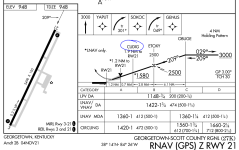
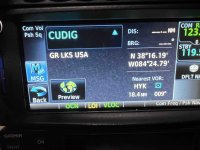
So...I've shot a bunch of RNAV approaches with this equipment and I've noticed that the database consistently leaves out the intermediate fix that is between the FAF and the runway. For example, at Georgetown Scott County airport, 27K, RNAV Z 21 approach, the database has the IAF's, the FAF ETOXY, but the intermediate fix, CUDIG is missing. Once I go past the FAF ETOXY, the next fix that the GPS displays is the end of the runway, RW21. Since CUDIG is charted with a crossing altitude, is this legal? Its easy enough to deal with, I just use the distance from the runway to CUDIG to identify the fix in a roundabout way, but I wonder if my examiner will accept this. My instructor is definitely irked with it and I am too....

I've asked Jeppesen the same question. I understand that space is limited on the 300XL's database cards so maybe that's why? But still, this doesn't seem quite right. Anybody know of something that says this is legal that I can show my examiner?
 
Just wondering if anyone knows about this and can explain to me if its legal or not. I've reached out to Jeppesen as well.

So, I'm working on my instrument rating in my Fairchild (sorry not an RV, but there is lots of knowledge here) and it has a Garmin 300XL GPS connected to two AV30's with the AVHSI. It works great. I'm getting my databases from Jeppesen. Yes, this GPS is really old and it is non-waas, but it works great and I really don't want to spend $8k for a GNC355...as much as I'd like to have one.

So...I've shot a bunch of RNAV approaches with this equipment and I've noticed that the database consistently leaves out the intermediate fix that is between the FAF and the runway. For example, at Georgetown Scott County airport, 27K, RNAV Z 21 approach, the database has the IAF's, the FAF ETOXY, but the intermediate fix, CUDIG is missing. Once I go past the FAF ETOXY, the next fix that the GPS displays is the end of the runway, RW21. Since CUDIG is charted with a crossing altitude, is this legal? Its easy enough to deal with, I just use the distance from the runway to CUDIG to identify the fix in a roundabout way, but I wonder if my examiner will accept this. My instructor is definitely irked with it and I am too....

I've asked Jeppesen the same question. I understand that space is limited on the 300XL's database cards so maybe that's why? But still, this doesn't seem quite right. Anybody know of something that says this is legal that I can show my examiner?
Interesting!

If you are just flying around, not shooting an approach etc., are you able to tell the unit to go direct CUDIG? This would tell us if CUDIG is in the database. If it isn’t, there’s your problem I would think. How to solve that problem,I have no idea.

I’m no expert, but I don’t see how you can legally shoot this LNAV approach without a certified IFR GPS navigator that displays CUDIG. And you can’t shoot an LPV of course because you’re non-WAAS.

BTW you can get a used 430W for much less than a new GNC 355. LPV approaches AND you would get a nav radio and ILS capability. And it will seem easy to use compared to that 300XL! Just saying. 😃
 
You should be able to identify the intermediate fix in some way with whatever RNAV unit you are using since it normally is a step down with an altitude. What does the TSO say on the unit itself? Are you expected to identify it using distance like you would with a DME range for a non precision localizer approach? If the TSO spells out how it handles this then it would be legal. If it doesn’t then you are just guessing if it’s legal. You could contact your FSDO or a TERPS guy at the Flight Technologies and Procedures Division of the FAA.
 

See page 43/91, or the screenshot for one country's, New Zealand, take on the 300 XL until Bob Turner or another VAF guru gives a better answer.

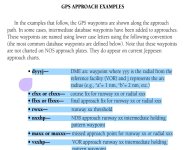
The manual only calls out the reverse case, where small/lowercase fixes are added as intermediate waypoints that will not match the plate/chart, to meet the procedure handling needs.

I would think as long as you can determine an instrument procedure's distance to altitude restriction points on your IFR navigator, as you describe, then that procedure would be acceptable.

You would not file a flight plan using CUDIG type waypoints nor would ATC send you there. Would an intermediate fix "like" CUDIG be part of a missed approach? If so, it should be in the database for use in at least that specific procedure.

The lateral course and track is not changing, so you don't have a lateral sequence issue. Is the 300XL good for all the SIDS and STARS you would also fly?

A good post using Dynon EFIS-


Attachments

  • Screenshot_20251001_112047_Chrome.jpg
    Screenshot_20251001_112047_Chrome.jpg
    127.2 KB · Views: 3
Last edited:
I’m no expert, but I don’t see how you can legally shoot this LNAV approach without a certified IFR GPS navigator that displays CUDIG.
I should add that no less an authority than… AI claims you CAN do this, but none of the references it cited discussed it. 🤣
 
Once I go past the FAF ETOXY, the next fix that the GPS displays is the end of the runway,
Is it possible that CUDIG isn’t being displayed on the map (perhaps due to screen limitations), but IS nevertheless in your flight plan (Route 0)?

Are you getting any kind of annunciation (e.g. to/from flip) when you pass over where CUDIG is supposed to be?
 
Tagging on, is CUDIG as a large font, databased fix, with or without background attributes like flyby, flyover or turn direction, replaced by a small font Garmin namef fix with the altitude constraint?

Reading the 300XL manual clip, attached, I am guessing the answer is no. If this is vertically just a manual "Dive and drive" 129 rig amd not a CDFA guided path, it'd be on you to keep doing what you are doing, using depicted distance to the next waypoint as you drive before next dive point. Or do your best to mimic CDFA. A designee, in the know, will expect you to know this distinction, IMHO.
 

Attachments

  • Screenshot_20251001_125741_Chrome.jpg
    Screenshot_20251001_125741_Chrome.jpg
    154.5 KB · Views: 6
Last edited:
So. CUDIG is an all caps fix. I have not tried hitting the direct to key and typing it in, but its a good idea to try. Below is the profile view of an example approach. But, from my experience, any RNAV approach that has an intermediate fix between the FAF and the runway is skipped. I think its a database issue, not a GPS issue. I have reached out to Jeppesen about it.

So, when I'm flying along on the approach, with the approach "active", after I pass ETOXY, the next waypoint that the GPS displays is RW21, not CUDIG. CUDIG is also NOT in route 0. What I've been doing is to make sure that see that when I'm 1.9nm from RW21 that I'm 1580' or above. But, while this works, I'm not sure it's legal. But, if its not legal, how does Jeppesen get away with providing gps databases for IFR gps's that doesn't include these intermediate fixes?

I've never tried to fly a SID or a STAR, but I've seen them in there. I'll have to check.

By the way, a 430w, would require me to cut an uncut, 80 year old panel and I really don't want to do that. The 355 is the same size as the 300XL....it's just expensive, especially for the type of flying that I do in this airplane. I'm well aware that this is not a good IFR platform. It's just what I have.

1759338405365.png
 
This is a vertical path on 3 degrees from ETOXY at 2500' to 30 feet above the threshold. Minimums per your spec/clearance, likely 1360'/412' HAT for you. CUDIG substituted by1.9 miles to the MAWP seems totally legit. VDP is at 1.2 to MAWP with RWY 21 at 948', so 1308' msl and all pretty on the PAPI 52' after minimums.

My proficient planning mins would be 600'&2NM. For non-waas alternates in IFR whether or not IMC, those are equally as important if not reserve impacting and weather variable.

AIM text that seems most useable if I had to sell it being acceptable to not have CUDIG named in my current IFR navigator database and using the 1.9 NM "ATD" Along Track Distance...


"Unnamed stepdown fixes in the final approach segment may or may not be coded in the waypoint sequence of the aircraft's navigation database and must be identified using ATD. Stepdown fixes in the final approach segment of RNAV (GPS) approaches are being named, in addition to being identified by ATD. However, GPS avionics may or may not accommodate waypoints between the FAF and MAP. Pilots must know the capabilities of their GPS equipment and continue to identify stepdown fixes using ATD when necessary."


A decent read- the nearest note is for unnamed alongtrack altitude constraints, as if CUDIG was only listed at 1.9 mm to MAWP at or above 1580'-

"Elsewhere in the AIM, paragraph 1−1−17 cautions that unnamed stepdown fixes in the final approach segment may not appear in the navigation database, so you may have to use along-track distance to confirm passing those waypoints—another reason to review approaches carefully during preflight planning."


Last edited:
Stepdown fixes in the final approach segment of RNAV (GPS) approaches are being named, in addition to being identified by ATD. However, GPS avionics may or may not accommodate waypoints between the FAF and MAP.
Heck, maybe it is legal then.

I mean, you absolutely have a way to identify CUDIG, and it’s the way you’ve been doing it:

lateral course guidance+distance=waypoint.

I suspect that getting this analysis approved by an examiner on the day of a checkride would be thrill-seeking. Best to work it out ahead of time!
 
Agreed, that's how I look at it , I would expect to then explain non-waas destination vs alternate planning and execution.

That 355 will eventually look cheaper once all the learning is complete.

Does the Firchild. aircraft have an ILS? I think the check ride needs a precision either LPV or ILS and two non precision/Non ILS, like a Localizer, ILS and a RNAV GPS to LNAV mins and a circle. Plus holding, missed approach, the whole ACS enchilda. How would you fly part panel? Are the AV30s on separate circuit breaksrs? Needle/ball/compass all useable?

The 355 I think lets you checkride aa an LPV precision, then two other non-ILS types.

 
Last edited:
Heck, maybe it is legal then.

I mean, you absolutely have a way to identify CUDIG, and it’s the way you’ve been doing it:

lateral course guidance+distance=waypoint.

I suspect that getting this analysis approved by an examiner on the day of a checkride would be thrill-seeking. Best to work it out ahead of time!
I think Moosepleit’s AIM quote says ‘yes’. I know that when shooting other approaches (VOR, ILS) where there is a DME fix, using gps in lieu of a DME such calculations (1.9 nm from MAP) are explicitly allowed. Honestly I thought they were not allowed for gps approaches (because the faa seems to like inconsistent rules!), but AIM says they’re okay. In addition, I think it is legal to shoot this approach without CUDIG if you use 1580’ as your MDA.
 
Does the Firchild. aircraft have an ILS? I think the check ride needs a precision and 2 non precision/Non ILS, like a Localizer, ILS and a RNAV GPS to LNAV mins in his case.

The 355 I think lets you checkride aa an LPV precision, then two other non-ILS types.

That’s a good question and answer. The check ride requires a precision approach, ILS or LPV to 300’ or lower minimums (strictly speaking an LPV is just barely outside the specifications for a ‘precision’ approach but the FAA test standards are careful to say ‘precision or LPV’). And the FAR re-write a few years ago clarified that the 2 non-precision approaches can both be gps-based, e.g., LNAV straight in and LNAV circle to land count as different approaches. So Moosepileit is correct: a single 355 (or any TSO’d WAAS gps) is all you need for the check ride; with the 300 xl you’ll need to find a way to do a precision approach.
 
Last edited:
Yes, I do have a single nav radio with glideslope, also hooked to the AV30's via the AVHSI....so I can also shoot an ILS or localizer or VOR. I use the 300XL as my DME when I'm using my nav radio as primary navigation source. With my GPS, I have to have a backup navigation source anyway because its not WAAS. I guess I could technically use my Nav radio for all three approaches if I wanted to.

I've got all the stuff needed as per 91.205. The needle and ball works fine, as does the old whiskey compass. Separate breakers for the AV30's. Its all there. During partial panel, they can only fail one of the AV30's so I just leave the AI as an AI, or I change the DG over to an AI as required. If the needle and ball fails, I just use the ball and the 2 minute turn marks on the AV30. Its not all that hard after you get used to it. No autopilot. Its a really basic IFR panel, but it works. Checkride is in a couple weeks.

Don't get me wrong, I'd love to have a 355 in there but the odds of me actually needing it are very low. This is a VFR aircraft in the real world. Maybe, I'll punch through a thin layer of clouds with it or worse comes to worse, I use the rating and the on board equipment to get me on the ground in a pinch. This is not an airplane that I want to be flying in bad weather.
 
…..During partial panel, they can only fail one of the AV30's so…
Is that true? I can imagine a DPE failing both, leaving you with ‘needle, ball, plus pitot static instruments and wet compass. That was pretty much standard with a ‘6 pack’ panel - fail all the vacuum driven instruments.
 
Is that true? I can imagine a DPE failing both, leaving you with ‘needle, ball, plus pitot static instruments and wet compass. That was pretty much standard with a ‘6 pack’ panel - fail all the vacuum driven instruments.
My understanding is that they can only fail one system. So for the vacuum powered dg and ai, they would fail the vacuum pump to take out both instruments. Failing one system won’t take out both av30’s. This is easy to say now I guess. In the real world, I don’t have much control over what the dpe actually does.

But, if they do fail both av30’s which would not be realistic, then yes, I’ll be on the needle, ball, and airspeed. The approach will have to be non gps. So be it.
 
So... The gurus at AOPA don't know what it is, and this is maybe the first time ever I've played stump the chump with them and won. I looked up the FAA Terminal Procedures Table of Contents, TPP-Legends.pdf on the web, and on page F1, right in the middle of the page is WUGOD with the same distance to runway information and no explanation as to what it is, either. I did find the website to make a chart inquiry and did. What with the government shutdown, no idea when I'll hear back, but I'll let everybody know when I hear something.
 
I have a nearly identical setup in my cherokee, but when I took my IFR checkride in it 2.5 years ago, I still had a vac driven AI/DG. I never gave it a 2nd thought about the legality of some step down fixes not being in the database. My examiner never said a word about it either. The ability to identify the fix by DME to the runway and on course was/is perfectly sufficient.
 
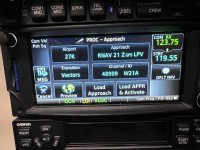
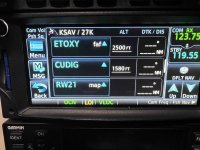
CUDIG is in the current GTN650 nav database, shows up on the Flight Plan page along with the FAF and MAP (2nd image). Clicking on the triangle by CUDIG brings up no clarifying information (3rd image).

IMG_5397 copy.jpgIMG_5398 copy.jpgIMG_5399 copy.jpg
 
FAA Response:

CUDIG is the LNAV stepdown fix. A stepdown fix assists in providing lower minimums. Instead of the minimums being based on the controlling obstacle between the final approach fix and the runway threshold/missed approach point, a stepdown fix can be placed after a higher obstacle which the stepdown fix crossing altitude will be based on, and the MDA based on a lower controlling obstacle between the stepdown fix and the runway threshold/missed approach point.

Primary order for RNAV procedures is FAA Order 8260.58.
 
For the record. I did my instrument checkride a couple days ago. I used along track distance to identify the stepdown fix and the examiner never said a word.

He did fail my attitude indicator AV30 and then when I switched my DG AV30 over to attitude/pfd mode...he failed it too. So I got to shoot a VOR-A approach using needle ball and airspeed. It wasn't pretty, but I guess I got it done good enough for him.
 
Back
Top