Van's Air Force

The definitive Van's Aircraft support community! Buying, building or flying an RV? Join our exclusive family of mentors and enthusiasts!

Picture request: flap position at the trailing edge in relationship to fuselage bottom.

aadamson

Well Known Member
Patron
Hi, I'm trying to make some determinations around rigging. Wondering if a flying RV14 could post a picture of their flap position at the trailing edge in relationship to fuselage bottom - when they are all the way up to the -3 degree reflex position. E.g. how much up are they from the fuse bottom, at the flaps trailing edge, in measurement. Not trying to use that as any form of right or wrong, just needing a comparative measurement to mine... (Which yeah, I'll see again this weekend, after a 29 day cruise to Alaska and Hawaii:))

TIA
 
DR. Thanks, that indeed helps, now just curious what the trailing edge measurement is in sample form.. :)

Also are the flaps flat on the bottom such that when in trailing form (not reflex), would they be straight with the bottom of the wing?
 
My experience is with the 10, but pretty much the same wing design. Unlike other models, the design stops the flap at the correct position when at the full up travel position. However, you do need to be sure there is nothing preventing the flap from reaching its natural stopping point. My wings were QB and there were parts that were making contact (buried up in the area where the back of the flap makes contact with spar, where it is hard to see) and requiring a lot of force to get to the full up position, if getting there at all. Can't remember what I did, but think it was a bit of filing and possibly bending of skin.
 
I'm no engineer but it surprises me that they don't show a nominal distance between the bottom of the fuselage and the bottom of the trailing edge of the flap. Does anyone have this distance for a properly rigged flap?
 
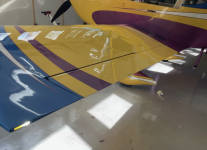
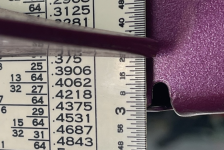
Wing Tip, - Aileron, - Flap (in reflex full up) level, 24/64 from bottom of flap to bottom of fuselage. Like I've said before 100's of hours at altitudes 8,000 ft to 14,000 ft all kinds of temps downloading .CSV logs and averaging TAS reflex vs in in-trail 0 on average performance difference. One long cross country (I was living half the year in Ohio and half in Florida so plenty of time to collect data in the air) I would get a difference of a knot or two and the next flight a knot or two the other way at best. Most flights less than half a knot difference. Some flights did one hour in trail and the next hour in reflex. There is a slightly noticeable pitch change and slight sight line change but that is it. A waste of a push so I took the pre-programmed 3 degrees out and made reflex -10 degrees first notch from full up, no speed restrictions. Use it if less than 120 knots. CAS alarm if I lower the flaps over 120 knots TAS.

Screenshot 2025-09-24 102611.pngScreenshot 2025-09-24 102643.pngu
 
Last edited:
Thanks, for the image/measurement. I'll circle back to this once I look hard at what I've got. Really not trying to get into the debate about performance, but since the rigging is based upon this as the first setting and because there are angles and arcs at play, I'd rather start from a known starting point so that all the throws are centered and where that should be.

If anyone one else were so inclined, I'd love a second measurement, just as a tie breaker :).
 
Thanks, for the image/measurement. I'll circle back to this once I look hard at what I've got. Really not trying to get into the debate about performance, but since the rigging is based upon this as the first setting and because there are angles and arcs at play, I'd rather start from a known starting point so that all the throws are centered and where that should be.

If anyone one else were so inclined, I'd love a second measurement, just as a tie breaker :).
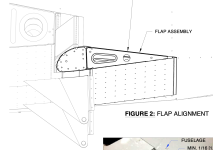
Measurements might be a little different. It has nothing to do with the flap location on the fuselage but the flap should go all the way up and stop dead against the spar, bang. This can/should be done when the wing is not attached. That is the starting point of the flap up, then ailerons then wingtip alignment. Note the majority of the time the flap upper and lower skins will need inboard trimming to align properly to the fuselage as the flap is raised. Hopefully others will chime in to better explain.
 
Resizing and measuring the drawing 41-08 -- the bottom of the flap trailing edge to the top of the "notch" in the adjacent fuselage skin measures ~0.3885"

Call it 3/8" and go fly....Oh yeah -- have whomever is flying off your Phase 1 40 hours/tasks continue to fly...
 
Super helpful. Thank you very much for all the help. Already flying, phase one done a while back. But I know the rigging is off some and my OCD is just killing me... Lol. I've had to work thru a small handful of wiring, alternator, configuration issues. Nothing drastic and pretty much what your expect as I didn't build the airplane. Rigging should be pretty easy to solve for, but does need a tweak or three to get it right. I have the jig for the aileron bellcrank and I 3d printed a spacer for the other end measurement, so I just need to center a few things up. And confirm a few others.
 
Wing Tip, - Aileron, - Flap (in reflex full up) level, 24/64 from bottom of flap to bottom of fuselage. Like I've said before 100's of hours at altitudes 8,000 ft to 14,000 ft all kinds of temps downloading .CSV logs and averaging TAS reflex vs in in-trail 0 on average performance difference. One long cross country (I was living half the year in Ohio and half in Florida so plenty of time to collect data in the air) I would get a difference of a knot or two and the next flight a knot or two the other way at best. Most flights less than half a knot difference. Some flights did one hour in trail and the next hour in reflex. There is a slightly noticeable pitch change and slight sight line change but that is it. A waste of a push so I took the pre-programmed 3 degrees out and made reflex -10 degrees first notch from full up, no speed restrictions. Use it if less than 120 knots. CAS alarm if I lower the flaps over 120 knots TAS.

View attachment 98049View attachment 98050u
Thanks!
 
To carry this forward one more step. Could you all tell me, when the flaps are in trail (not reflexed but at 0 degrees), does the trailing edge pretty much like up with the lower fuselage edge, e.g. narrowing the above measurement to approx 0 inches?
 
To carry this forward one more step. Could you all tell me, when the flaps are in trail (not reflexed but at 0 degrees), does the trailing edge pretty much like up with the lower fuselage edge, e.g. narrowing the above measurement to approx 0 inches?
No
 
As a follow up point of reference, it appears that the *vertical* measurement on both sides using the flaps trailing edge, measured above the bottom of the fuselage, when in reflex, is pretty much .5 inches - both sides agree and are the same. I'm guessing this is why you can *feel* a difference between reflex and zero degrees in my particular airplane. So now onto the rest of confirming rigging... I need to pick up some popsicle sticks and small clamps from Harbor freight such that I can camp the ailerons to the flaps at reflex and see where the starting point is...(with the flap all the way up to the stops)
 
Back
Top