Van's Air Force

The definitive Van's Aircraft support community! Buying, building or flying an RV? Join our exclusive family of mentors and enthusiasts!

Unusual Engine Behavior After Hot Start

mfleming

Well Known Member
Patron
Just recently I started having RPM surges while taxing after a hot engine restart. This does not clear up by running up the power (maybe full power but I haven't tried that).
Things I've checked:
  • Looked for intake leaks...nothing obvious
  • Looked at the #2 exhaust valve for being sticky (it was sticky 26 hrs ago - fixed)
  • Bottle tested the injectors, all good
Engine - IO-360-M1B, 250 hrs since new.

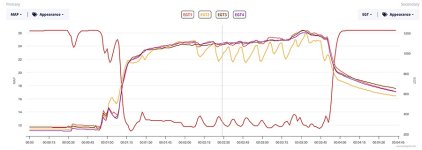
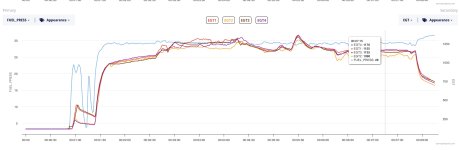
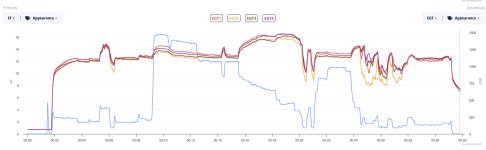
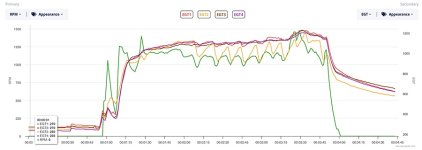
Here's an engine graph during the surging. One is with MAP/EGT and one with RPM/EGT
Here's a video of the engine analyzer during the surging...corresponds with the graphs.
RPM2.jpgMAP2.jpg
 
Do you turn on your boost pump and let cooler fuel get to the fuel lines beyond the spider valve? Does the surging eventually go away?
 
Do you turn on your boost pump and let cooler fuel get to the fuel lines beyond the spider valve? Does the surging eventually go away?
No I haven't, I was talking with a friend this morning about using the boost pump to see if it helps. BUT, what would that mean? Something must have changed for this surging to all of a sudden show up.
The surging continues as long as the engine is running.
 
No I haven't, I was talking with a friend this morning about using the boost pump to see if it helps. BUT, what would that mean? Something must have changed for this surging to all of a sudden show up.
The surging continues as long as the engine is running.
I’m thinking possibly being vaporizing fuel from hot days. I saw your video. If it continues then it probably isn’t vapor lock but to rule it out turning on the fuel pump and running it at 1200rpm will clear any fuel vapor from a hot start. I saw your video. Going full rich at a field elevation of 4200ft won’t help whatever situation you have.

Check the usual things like intake gaskets. I had to replace mine after less than 500 tach hours. I was looking at everything else when my engine was running a little rough. Turned out they were crispy from the Tannis heat system use during winter. Now I check them frequently. Cheap to replace.
 
Where's your MAP sensor located? #3 Primer port or the sump/plenum, or ???
I’m thinking possibly being vaporizing fuel from hot days. I saw your video. If it continues then it probably isn’t vapor lock but to rule it out turning on the fuel pump and running it at 1200rpm will clear any fuel vapor from a hot start. I saw your video. Going full rich at a field elevation of 4200ft won’t help whatever situation you have.

Check the usual things like intake gaskets. I had to replace mine after less than 500 tach hours. I was looking at everything else when my engine was running a little rough. Turned out they were crispy from the Tannis heat system use during winter. Now I check them frequently. Cheap to replace.
MAP comes off #3.
I haven't run the boost pump while it's surging yet. Why it's surging all of a sudden is what concerns me.
 
MAP comes off #3.
I haven't run the boost pump while it's surging yet. Why it's surging all of a sudden is what concerns me.
Is the engine still under warranty?
Was this a "Covid" engine by chance?

From the looks of it, I'd say you've got failed intake valve on #3, or something is happening with the lifter. But, that's just a guess...
 
Last edited:
Is the engine still under warranty?
Was this a "Covid" engine by chance?

From the looks of it, I'd say you've got failed intake valve on #3. But, that's just a guess...
Yes built during COVID.
Interesting, What makes you suspect the #3 intake valve?
 
Yes built during COVID.
Interesting, What makes you suspect the #3 intake valve?
...Or the lifter is going squirrely. Remember you need 3(4) things to make power - Fire, Fuel, Air, Compression.
The data shows that #3 isn't producing much exhaust. And there is a correponding MAP rise when the EGT on #3 drops out. Tells me that the #3 intake valve is open when it should be closed.

MAP (Manifold ABSOLUTE Pressure); When the engine is at idle, its pulling almost a vacuum (less than ambient pressure). If the vacuum is lost, say by an errantly open intake valve or an induction leak, you will see a rise in the MAP. The throbbing nature / pulsing observed on the MAP sense points that way.

P.S. On the COVID thing ... considering the disruptions to the supply chain, workforce, etc. and the fact that these engines are built by hand...well...Maybe a tech had a coughing jag and turned a wrench a little less or too much. That and you're running into issues at <300 hours --

How much is left on the warranty? Call Williamsport and raise h*ll...

P.P.S: Caveat emptor - It's been a loooong day, and I'm into my 2nd bourbon ;)
 
Last edited:
Is the engine still under warranty?
Was this a "Covid" engine by chance?

From the looks of it, I'd say you've got failed intake valve on #3, or something is happening with the lifter. But, that's just a guess...
Wouldn't you think a four cylinder Lycoming would run very rough in that case? Generally, this results in a real "shaker".
 
Maybe your spider valve is sticking open a little. Check to see if the barrel valve is moving freely under the diaphragm. It has to fall easily into the port.
 
Maybe your spider valve is sticking open a little. Check to see if the barrel valve is moving freely under the diaphragm. It has to fall easily into the port.
I was wondering about that. The spider valve is safety wired with a seal. I don't think I'm in warranty any more but I was going to call Avstar tomorrow.
A couple times recently the engine did diesel during shutdown now that I think of it.
 
SIMPLE THINGS FIRST

My IO540 and others will do this with hot fuel on a hot day with a heat soaked engine.

RUN YOUR BOOST PUMP. The reason for the surging is most likely from vapour bubbles in the fuel. If it still does it and is rough running then worry about stuck valves but that is a very very low chance. So do not stress just yet :-)

Stop mucking around with tings and then likely create another real problem.
 
Might be worth flying the Savvy Induction leak flight test profile to see if #2 misbehaves. The test is simple - climb to an altitude where you can run the engine at wide open throttle (achieves highest possible MAP) and let the engine parameters stabilize (1-3 minutes) . Then make about a 10" reduction in MAP. Hold altitude constant for the duration of the test. You should see all the EGTs decrease together. If any cylinder EGT stays higher than the rest, you've got an induction leak to hunt down.
 
Might be worth flying the Savvy Induction leak flight test profile to see if #2 misbehaves. The test is simple - climb to an altitude where you can run the engine at wide open throttle (achieves highest possible MAP) and let the engine parameters stabilize (1-3 minutes) . Then make about a 10" reduction in MAP. Hold altitude constant for the duration of the test. You should see all the EGTs decrease together. If any cylinder EGT stays higher than the rest, you've got an induction leak to hunt down.
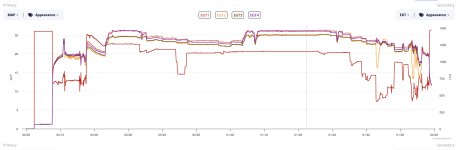
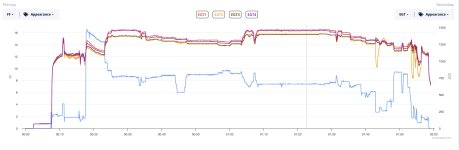
This isn't the Savvy flight profile but the flight immediately before the OP graph. The EGTs stay together during leaning.
You can see on the big power reductions the #2 EGT dropping off while the others hold their own.

flight_MAP.jpgflight_ff.jpg
 
SIMPLE THINGS FIRST

My IO540 and others will do this with hot fuel on a hot day with a heat soaked engine.

RUN YOUR BOOST PUMP. The reason for the surging is most likely from vapour bubbles in the fuel. If it still does it and is rough running then worry about stuck valves but that is a very very low chance. So do not stress just yet :-)

Stop mucking around with tings and then likely create another real problem.
I haven’t run the boost pump while it’s surging and it’s on my list during next engine run but why after 250 hrs would it start surging??
If it needs the boost pump to clear the vapors maybe the engine driven pump is going out!? Something changed!!
Edit: also, the telltale #2 EGT dropping down during the surge is happening at low power settings in flight.
 
Do you turn on your boost pump and let cooler fuel get to the fuel lines beyond the spider valve? Does the surging eventually go away?

How would turning on the boost pump get cooler fuel to the lines beyond the spider?

Turning it on would increase the pressure of the fuel between the electric pump and the servo, which might cause bubbles of boiled fuel to condense back to liquid. But it won't make the fuel cool, and the pressure of anything past the servo is going to be unchanged by running pumps anyway, so if it was hot enough to make bubbles form before it'll be hot enough after.

I've always wondered about this advice. I can understand how turning on a pump could cause cooler fuel to circulate if it was a regulated fuel system with a return line like cars typically use, but our fuel systems are dead-head, which means you're going to get the same fuel no matter how many pumps you turn on. So what's the theory here?

- mark
 
Michael,
Did you look at fuel pressure ? The AvStar systems on an M1B in an RV7 build latent heat quickly on shut down, and with the mixture at ICO - the fuel pressure builds quickly to greater than 45psi thus overloading the fuel servo next time you start the engine. Always a great idea to check fuel pressure before cranking or opening throttle/mixture - if FP is high, then best to open mixture & throttle relieving the pressure, then go to a normal flooded hot start procedure. AvStar knows of this issue & that is their recommendation. I have the exact same setup in a tail dragger - experienced issue - the procedures does help when FP very high prior to a restart hot.
 
I haven’t run the boost pump while it’s surging and it’s on my list during next engine run but why after 250 hrs would it start surging??
If it needs the boost pump to clear the vapors maybe the engine driven pump is going out!? Something changed!!
Did ANYTHING else happen out of the ordinary during your hot restart - like a cough or backfire or run away rpms.... could have blown a diaphragm in the servo or generated FOD fowling the impact pressure probes (4) at inlet.
AND I'll ask when was the last time you peeked through the servo (borescope) to see if you have a big puddle of wet fuel residue in intake plenum, Sniffle drain valve is poorly placed for tail draggers in these manifolds and significant amount of fuel CAN & DOES occasionally build up.
 
Last edited:
Michael,
Did you look at fuel pressure ? The AvStar systems on an M1B in an RV7 build latent heat quickly on shut down, and with the mixture at ICO - the fuel pressure builds quickly to greater than 45psi thus overloading the fuel servo next time you start the engine. Always a great idea to check puel pressure before cranking of opening throttle/mixture - if FP is high, then best to open mixture & throttle relieving the pressure, then go to a normal flooded hot start procedure. AvStar knows of this issue & that is their recommendation. I have the exact same setup in a tail dragger - experienced issue - the procedures does help when FP very high prior to a restart hot.

If the fuel pressure is high due to boiling after shutdown, the diaphragm in the spider opens, and it'll relieve the pressure as the fuel gurgles through the injector nozzles. It shouldn't build up excessively.

- mark
 
If the fuel pressure is high due to boiling after shutdown, the diaphragm in the spider opens, and it'll relieve the pressure as the fuel gurgles through the injector nozzles. It shouldn't build up excessively.

- mark
I'm speaking of fuel pressure at inlet to servo, not the output.... with excessive inlet pressure the servo loses the ability to regulate properly causing all kinds of weird problems. What I'm talking about has NOTHING to do with down stream of servo. Heat builds up from firewall forward in fuel lines & mech fuel pump etc.
 
How would turning on the boost pump get cooler fuel to the lines beyond the spider?

Turning it on would increase the pressure of the fuel between the electric pump and the servo, which might cause bubbles of boiled fuel to condense back to liquid. But it won't make the fuel cool, and the pressure of anything past the servo is going to be unchanged by running pumps anyway, so if it was hot enough to make bubbles form before it'll be hot enough after.

I've always wondered about this advice. I can understand how turning on a pump could cause cooler fuel to circulate if it was a regulated fuel system with a return line like cars typically use, but our fuel systems are dead-head, which means you're going to get the same fuel no matter how many pumps you turn on. So what's the theory here?

- mark
This link explains it a little better.

 
Michael,
Did you look at fuel pressure ? The AvStar systems on an M1B in an RV7 build latent heat quickly on shut down, and with the mixture at ICO - the fuel pressure builds quickly to greater than 45psi thus overloading the fuel servo next time you start the engine. Always a great idea to check fuel pressure before cranking or opening throttle/mixture - if FP is high, then best to open mixture & throttle relieving the pressure, then go to a normal flooded hot start procedure. AvStar knows of this issue & that is their recommendation. I have the exact same setup in a tail dragger - experienced issue - the procedures does help when FP very high prior to a restart hot.
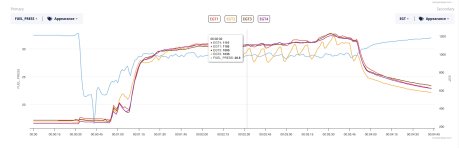
Here's the idle surging with fuel pressure mapped.FP.jpg
 
Did ANYTHING else happen out of the ordinary during your hot restart - like a cough or backfire or run away rpms.... could have blown a diaphragm in the servo or generated FOD fowling the impact pressure probes (4) at inlet.
AND I'll ask when was the last time you peeked through the servo (borescope) to see if you have a big puddle of wet fuel residue in intake plenum, Sniffle drain valve is poorly placed for tail draggers in these manifolds and significant amount of fuel CAN & DOES occasionally build up.
Nothing out of the ordinary during the hot start except I have to find the sweet spot for the mixture until it catches. It has dieseled during shutdown after surging though, which makes me wonder if the spider diaphragm shaft is sticking.

I tried to get a borescope in there yesterday but my flexible borescope is loaned out to a friend. I did think it acted like it was slurping raw fuel during the surging. BUT, the telltale drop in the #2 while surging also happens at idle power in the air.
 
First, rpm drop is just as sharp as the egt decline. This points to the combustion process stopping completely for a time, then starts again. A moderately rich or lean mixture wouldn’t cause the synchronized and significant drop in rpm, nor would an induction leak. Imo, it needs to be failing to combust consistently for a period, then a return to normal for a period, then repeat.

Many things can cause combustion to cease, but top of the list here is fuel and spark. A loss of compression would also do this, but would have to be valve related and rare to see that happen in such a rythmic fashion.

Second, is the highly rythmic nature of the condition. Peaks and valleys are almost identical in height and the frequency is very consistent. This narrows things down a lot. Compression issues, like valves or rings are pretty unlikely with these symptoms imo.

Third, it is exclusively occurring on one cylinder, so that removes the servo, the spider, fuel pressure, vapor lock,etc. that stuff rarely happens exclusively on one cylinder and almost never creates a rhythm like that.

So, we are looking for issues that come and go in well defined cycles. And only on one cylinder. Some kind of issue downstream from the spider is possible, but struggle to imagine what could do that. My primary attention would be on ignition. Also struggle to see what could be going wrong with both plugs at the same time though. Maybe ignition switch or p lead wires?

Given there are no logical answers here, it is probably worth doing a dynamic compression test for valve issues. Not the leak down test that aviation likes so much. Will need a traditional auto compression tester and heed to pull the schrader valve out of it so you get unique readings for each stroke, not cumulative. Will need to crank for a good 30 seconds and you are watching for a bunch of strokes with good compression and a bunch of strokes with little to no compression. That would point to a valve or valve train problem.

Good luck.
 
Last edited:
. I did think it acted like it was slurping raw fuel during the surging. BUT, the telltale drop in the #2 while surging also happens at idle power in the air.
Please elaborate. Shooting excessive fuel into the cylinder would cause it to stop combusting untill it going back to normal. Maybe you can give us a chart with egt rpm and ff. That would help to include or exclude that.
 
Last edited:
The video really helps... it shows the slow up & down of the engine speed. I wouldn't describe this as surging. The EGT for #2 rhythmically moves with the engine speed. Other cylinders are stable EGT. That all points to something completely unique to #2. Which, IMHO, tosses out any sort of boiling fuel issues... in the lines up to the spider.

So that leaves: the #2 injector, the spider, the #2 fuel line, and the #2 cylinder itself.

I chased a poor idle issue for a long time and eventually found a small bit of FOD in the spider that was partly blocking the V slot.
 
First, rpm drop is just as sharp as the egt decline. This points to the combustion process stopping completely for a time, then starts again. A rich or lean mixture wouldn’t cause the synchronized and significant drop in rpm. Imo, it needs to be failing to combust consistently for a period, then a return to normal for a period, then repeat.

Many things can cause combustion to cease, but top of the list here is fuel and spark.

Second, is the highly rythmic nature of the condition. Peaks and valleys are almost identical in height and the frequency is very consistent. This narrows things down a bit. Compression issues, like valves or rings are pretty unlikely

Third, it is exclusively occurring on one cylinder, so that removes the servo, the spider, fuel pressure, vapor lock,etc. that stuff rarely happens exclusively on one cylinder and almost never creates a rhythm like that.

So, we are looking for issues that come and go in well defined cycles. Some kind of issue downstream from the spider is possible, but struggle to imagine what could do that. My primary attention would be on ignition. Also struggle to see what could be going wrong with both plugs at the same time though.

Given there are no logical answers here, it is probably worth doing a dynamic compression test for valve issues. Will need a traditional aut compression tester and heed to pull the schrader valve out of it so you get unique readings for each stroke, not cumulative. Will need to crank for a good 30 seconds and you are watching for a bunch of strokes with good compression and a bunch of strokes with little to no compression. That would point to a valve train problem.

Good luck.
Interesting - But why does it only show up after a hot start?? Here's a graph with no surging from a ground run after the hot engine sat for about 1.5 hrs. The previous ground run graph was captured after I shut the engine down from this run and immediately restarted.

FP_no surge.jpg
 
The video really helps... it shows the slow up & down of the engine speed. I wouldn't describe this as surging. The EGT for #2 rhythmically moves with the engine speed. Other cylinders are stable EGT. That all points to something completely unique to #2. Which, IMHO, tosses out any sort of boiling fuel issues... in the lines up to the spider.

So that leaves: the #2 injector, the spider, the #2 fuel line, and the #2 cylinder itself.

I chased a poor idle issue for a long time and eventually found a small bit of FOD in the spider that was partly blocking the V slot.
I did a bottle flow test and they all flowed evenly. But this problem only surfaces when the engine hot started...if it's cold started or even warm started, it's fine. Although the #2 EGT drops below the rest in flight if the throttle is pulled back to idle.
Hopefully tomorrow I'll pull the spider apart and eliminate debris as a cause.
 
.

I chased a poor idle issue for a long time and eventually found a small bit of FOD in the spider that was partly blocking the V slot.
Yes, but that typically effects idle only. Op says he then runs up to high power and the problem remains.
 
Interesting - But why does it only show up after a hot start?? Here's a graph with no surging from a ground run after the hot engine sat for about 1.5 hrs. The previous ground run graph was captured after I shut the engine down from this run and immediately restarted.

View attachment 97894
Yes, clearly there is a problem that comes and goes, vut it is a problem nonetheless. Get your detective hat hat out. Which of the things that could gobwrong are more likely to happen after a hot start or just hot. Pretty sure the hot start itself is not causing this, though it may make a different problem happen that otherwise wouldn’t happen.
 
You can also check the valves on #2. If the guides are severely worn, the valve can stick open for a while.
The #2 exhaust guide was just reamed 26 hrs ago...the valve was sticky.
Troubleshooting this issue, I pulled the #2 exhaust rocker arm and spring off and the valve was silky smooth and passed a wobble test.
The engine only has 250 hrs since new :- o
EDIT: the engine is talking to me, I just need to figure out what it's saying!
 
Last edited:
I did a bottle flow test and they all flowed evenly. But this problem only surfaces when the engine hot started...if it's cold started or even warm started, it's fine. Although the #2 EGT drops below the rest in flight if the throttle is pulled back to idle.
Hopefully tomorrow I'll pull the spider apart and eliminate debris as a cause.
Debris there doesn’t match the symptoms. It can’t be stuck in the #2 slot, as it typically runs fine. It can’t be floating around in the spider, otherwise it wouldn’t always hit number 2. Lastly debris will never produce a perfect sinusoidal wave like that.
 
Many things can cause combustion to cease,
Based on #2 EGT, I didn't see combustion cease. The EGT value on #2 decreases from 1130 to about 940 degrees. So, how can you eliminate a mixture issue on the #2 cylinder? it looks very clearly like some type of mixture (overly lean or rich) issue on #2 is changing.
 
Last edited:
I ran the engine up to about 2200 RPM and the problem remains...haven't tried full power.
Same difference. A common problem is that debris gets stuck in the bottom of the v slot. This makes for idle problems but not mid to high power problems.
 
It takes time for the egt to fall. It stops combusting and the egt starts to fall, but then starts combusting again before it drops to far. The rpm is the tell. It is dropping almost 200 rpm. You don’t get that much of an rpm drop from one cylinder going lean, but still combusting. Same with the map
Can you feel the roughness? If one cylinder stops combusting, you feel the roughness. If it just goes lean, you can barely tell.
 
It takes time for the egt to fall. It stops combusting and the egt starts to fall, but then starts combusting again before it drops to far. The rpm is the tell. It is dropping almost 200 rpm. You don’t get that much of an rpm drop from one cylinder going lean, but still combusting. Same with the map
Not like this--by dropping quickly and re-stabilizing at around 940. Check it out sometime with a spare EGT probe and a gas torch--response is quick and continuous!
 
Here's a graph inflight where I flew approach speed with the throttle pulled back to an idle. and then again on approach, I pulled the throttle back to an idle. the #2 EGT act suspicious.

FF_inflight idle test.jpg
 
Here's a graph inflight where I flew approach speed with the throttle pulled back to an idle. and then again on approach, I pulled the throttle back to an idle. the #2 EGT act suspicious.

View attachment 97895
Yes, i see that you have an idle issue on #2 and when you pull back to idle #2 goes lean. That is a separate issue that may or may not be related to the problem we are discussing. On that plot above, there was no rpm surging, correct? You have stated that once this starts, it continues with power increase all the way to 2200. Therefore this problem is NOT an idle problem or at least not solely an idle problem.
 
Disagree. You can see a sharp v on the egt plot. It goes immediately from falling to rising with no stabilization.
Simply look at the EGT for #2 on the video itself--it certainly does. And, if combustion stops, a 4-banger gets very rough! And, lets not forget what Delta Romeo said on the last thread he had to shut-down.
 
I don’t see a video. The chart in post 1 shows a sharp V and looks very much like a cylinder dropping out for a second or two. The roughness would come and go quickly, so not your typical 3 cylinder engine scenario.
Ok found the video and agree it is still combusting. But it is going severely lean so power is falling way off on that cylinder.
 
Yes, i see that you have an idle issue on #2 and when you pull back to idle #2 goes lean. That is a separate issue that may or may not be related to the problem we are discussing. On that plot above, there was no rpm surging, correct? You have stated that once this starts, it continues with power increase all the way to 2200. Therefore this problem is NOT an idle problem or at least not solely an idle problem.
I haven’t seen it surge when the rpm is above an idle. I was trying to say by increasing the rpm, the surging reappeared at idle.

Click this VIDEO to view.
 
I haven’t seen it surge when the rpm is above an idle. I was trying to say by increasing the rpm, the surging reappeared at idle.

Click this VIDEO to view.
Misunderstood that from your post. That changes everything. Debris in the v slot in the spider is high on the list then. But still question whether that can create a rhythmic oscillation. issue seems fuel related.
 
Last edited:
Ok found the video and agree it is still combusting. But it is going severely lean so power is falling way off on that cylinder.
Thermodynamically, the heat energy is dropping to 83-percent relative to other cylinders. My idle EGT is typically 950 degrees F on all cylinders.
 
One last thing to consider. #2 can be going too rich or too lean, causing the EGT drop. Very possible your mixture is too rich at idle and something is causing it to briefly go further rich on #2; Not uncommon on hot starts. Or it is so close to the edge of TOO rich that it only takes a small change for power to fall off, starting the cycle.

Given this happens hot, which likes leaner mixtures, I would adjust your idle mixture leaner (best to follow the proper idle mixture setting process). Getting this correct should make everything more tolerant of the periods of extra richness happening during the heat soaked periods. May also address the #2 behavior when pulling to idle in the air. I would still pull the cover off the spider, paying close attention to the V slot feeding #2. Be carefull, as there is a spring under the cap and can fall if not carefull.
 
Last edited:
One last thing to consider. #2 can be going too rich or too lean, causing the EGT drop. Very possible you mixture is too rich at idle and something is causing it to briefly go further rich on #2; Not uncommon on hot starts. Or it is so close to the edge of TOO rich that it only takes a small change for power to fall off, starting the cycle.

Given this happens hot, which likes leaner mixtures, I would adjust your idle mixture. Getting them to the right area should make everything more tolerant of the periods of extra richness.
What's causing the MAP to pulse?
 
How well does it idle with the cowling off when hot? I suspect it'll be much smoother than with the cowling on.
 
Back
Top