Van's Air Force

The definitive Van's Aircraft support community! Buying, building or flying an RV? Join our exclusive family of mentors and enthusiasts!

Parasitic drain on battery

lndwarrior

Well Known Member
Engine is an O-235 with B&C 40 amp alternator, B&C LR3 regulator, EarthX 680 battery.

My battery drains down significantly if left unflown for two weeks or more.

I've done the battery post to battery terminal test with no detectable voltage.

I've checked every single fuse with a multimeter for and voltage with the master off. No detectable voltage.

I talked to B&C and they had me verify that I had both ground wires connected off the LR3. One was disconnected but the other was still grounded. In this case, B&C designed the backup ground just for this reason.

B&C said, if at least one ground was installed there was no way a parasitic draw could occur thru the regulator or alternator.

So, everything I know has been checked but the problem persists.

The only other electrical device is an aleats-on USB port but it is not plugged into anything.

I bought a new EarthX battery thinking maybe the battery was bad. But after leaving the new battery in the plane for a month it.
too went dead. In the meantime I charged the removed battery and it has held a charge for more than a month.

Batteries have always been charged with the recommended Optimate lithium battery charger.

So, it doesn't seem it's the battery and I can't get any sign of voltage drawn from the test across the battery terminal and the bat negative wire.

Any idea what i am missing or what assumptions I made are incorrect?

Thx!
 

Attachments

  • 17581449816712354637188444845928.jpg
    17581449816712354637188444845928.jpg
    2 MB · Views: 32
Engine is an O-235 with B&C 40 amp alternator, B&C LR3 regulator, EarthX 680 battery.

My battery drains down significantly if left unflown for two weeks or more.

I've done the battery post to battery terminal test with no detectable voltage.

I've checked every single fuse with a multimeter for and voltage with the master off. No detectable voltage.

I talked to B&C and they had me verify that I had both ground wires connected off the LR3. One was disconnected but the other was still grounded. In this case, B&C designed the backup ground just for this reason.

B&C said, if at least one ground was installed there was no way a parasitic draw could occur thru the regulator or alternator.

So, everything I know has been checked but the problem persists.

The only other electrical device is an aleats-on USB port but it is not plugged into anything.

I bought a new EarthX battery thinking maybe the battery was bad. But after leaving the new battery in the plane for a month it.
too went dead. In the meantime I charged the removed battery and it has held a charge for more than a month.

Batteries have always been charged with the recommended Optimate lithium battery charger.

So, it doesn't seem it's the battery and I can't get any sign of voltage drawn from the test across the battery terminal and the bat negative wire.

Any idea what i am missing or what assumptions I made are incorrect?

Thx!
Remove the USB port.
 
The only other electrical device is an aleats-on USB port but it is not plugged into anything.
If you mean that you have a USB port connected to the battery, but nothing plugged into the USB port - then it will likely still be drawing some current to power its internal circuitry, because it's not just a "dumb" device like a cigarette lighter socket.

(edit: beaten by Brian!)
 
Im an idiot...

For the possible benefit of future builders/owners I will explain my stupidity.

First I thought that a small USB current draw could not drain my battery.

Second, when I checked for parasitic draw I only checked for voltage. I did not check for amperage (I know, but I already admitted I'm an idiot...). So, I erroneously concluded there was no parasitic draw from the battery based on voltage alone.

So, I just checked for amperage draw by disconnecting the negative cable and putting the meter set for miiliamps and read 11 milliamps with everything off in the aircraft.

Then I pulled the USB fuse and measured zero milliamps.

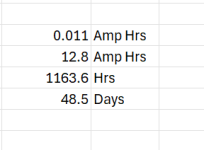
Then I went to the Google and asked how long would it take for an 11 ma draw to drain my battery and it suggested 10 to 20 days. This tracks roughly to my experience with draining my batteries.

It seems the mystery has been solved and my status as an idiot has been confirmed...

Thx for the multiple people who responded and make me reconsider my erroneous understanding of USB connectors.
 
Brian, this is off the top of my head, but I believe the 680 is rated at 12.8-amp hrs., now I know you don't want to discharge completely but a full discharge is ~ 48.5 days? Been a long time since I had a EE class and that was only because I had to.

Screenshot 2025-09-17 174816.png
 
Im an idiot...

For the possible benefit of future builders/owners I will explain my stupidity.

First I thought that a small USB current draw could not drain my battery.

Second, when I checked for parasitic draw I only checked for voltage. I did not check for amperage (I know, but I already admitted I'm an idiot...). So, I erroneously concluded there was no parasitic draw from the battery based on voltage alone.

So, I just checked for amperage draw by disconnecting the negative cable and putting the meter set for miiliamps and read 11 milliamps with everything off in the aircraft.

Then I pulled the USB fuse and measured zero milliamps.

Then I went to the Google and asked how long would it take for an 11 ma draw to drain my battery and it suggested 10 to 20 days. This tracks roughly to my experience with draining my batteries.

It seems the mystery has been solved and my status as an idiot has been confirmed...

Thx for the multiple people who responded and make me reconsider my erroneous understanding of USB connectors.

You are not an idiot.

You have good form coming back and explaining the solution!
 
Engine is an O-235 with B&C 40 amp alternator, B&C LR3 regulator, EarthX 680 battery.

My battery drains down significantly if left unflown for two weeks or more.

I've done the battery post to battery terminal test with no detectable voltage.

I've checked every single fuse with a multimeter for and voltage with the master off. No detectable voltage.

I talked to B&C and they had me verify that I had both ground wires connected off the LR3. One was disconnected but the other was still grounded. In this case, B&C designed the backup ground just for this reason.

B&C said, if at least one ground was installed there was no way a parasitic draw could occur thru the regulator or alternator.

So, everything I know has been checked but the problem persists.

The only other electrical device is an aleats-on USB port but it is not plugged into anything.

I bought a new EarthX battery thinking maybe the battery was bad. But after leaving the new battery in the plane for a month it.
too went dead. In the meantime I charged the removed battery and it has held a charge for more than a month.

Batteries have always been charged with the recommended Optimate lithium battery charger.

So, it doesn't seem it's the battery and I can't get any sign of voltage drawn from the test across the battery terminal and the bat negative wire.

Any idea what i am missing or what assumptions I made are incorrect?

Thx!
Checking voltage is no help. Pull the neg wire off the battery. Put meter in amp mode and put one lead on the battery and other on the terminal. That will tell you the size of the drain.
 
Personally, I won't put anything on a 'Hot battery bus', the only exception I can think of is the GTX335/345 with GPS which has a keep alive (fused .5 amp), it's current draw is down in the micro-amps region. Don't forget the reason for the master contactor is to be able to shut off all electrical power to the aircraft.
 
Last edited:
Personally, I won't put anything on a 'Hot battery bus', the only exception I can think of is the GTX335/345 with GPS which has a keep alive (fused .5 amp), it's current draw is down in the micro-amps region. Don't forget the reason for the master contactor is to be able to shut off all electrical power to the aircraft.
...But that's only for the GTX 345 w/GPS installations, reduces the TTFF when powering on. Not needed for the internal Non-GPS.

I guess they didn't have room to put in a small CR2016/32/45 clock battery...
 
Personally, I won't put anything on a 'Hot battery bus', the only exception I can think of is the GTX335/345 with GPS which has a keep alive (fused .5 amp), it's current draw is down in the micro-amps region. Don't forget the reason for the master contactor is to be able to shut off all electrical power to the aircraft.
I did build a hot battery bus into the RV-10. The only items on it are LED interior lights on switches mounted near the entry door and baggage door. I have found them highly useful. My thought is that I will notice the lights on when I walk away from the airplane. Haven't yet discharged a battery with them (fingers crossed!) My fail-safe system structure is that the hot battery bus is connected only to the #2 battery in a system designed with two isolated batteries.

No system is fool-proof, however, to a sufficiently talented fool! I have twice found a good way to discharge BOTH batteries in a two-battery isolated system. The two electronic ignitions are wired, according to recommended system architecture, directly to the battery terminals of each isolated battery, bypassing all busses and power distribution. That's desirable for fail-safe operation in flight.

Not fail-safe on the ground, however! The warning lights on the dual ignitions use the dark-cockpit philosophy. No red light with both ignitions off or both ignitions on. If one ignition is off or has failed, there is a red light over the operating ignition. I like the warning philosophy. A red light indicates a problem. However:

I have twice climbed out of the airplane and closed the doors with the ignitions still on (no red lights.) They draw a very small current when stationary, but it's a draw! Coming back home after a week at work, I found the batteries near dead. Dummy! I shut the engine down normally with the mixture lever, and for some reason forgot the ignitions.
 
I hope that at a minimum any hot wire off the battery is fused. I vehemently disagree with the LSE install instructions.
 
. The two electronic ignitions are wired, according to recommended system architecture, directly to the battery terminals of each isolated battery, bypassing all busses and power distribution. That's desirable for fail-safe operation in flight.
.
i have a separate bus for the ignition system on my 10, separate from the master. it is wired directly to the batteries, but also through a ign bus switch. I want the ability to easily kill power to everything but the ignition, as well as killing the ignition, but with Walt on not liking an unswitched connection directly to the battery. My ignition buss uses two relays and two switches. Both relays output onto the ign buss, but the inputs are battery specific. One switch (dp3t) is a L-R-Both switch (make before break arrangement allowing switching without interruption) and the other is the bus on off switch. This has redundancy in case a relay fails. Also have pullable breakers for each ei module.

I do the same arrangement for the master bus and the avionics bus. Each can be connected to either or both batteries. This allows me to put the ignition on one battery and everything else on another. One battery will run my ignition for two hours. Other combinations available to deal with both load shedding and isolation necessary with shorts/fires.
 
Last edited:
i have a separate bus for the ignition system on my 10, separate from the master. it is wired directly to the batteries, but also through a ign bus switch. I want the ability to easily kill power to everything but the ignition, as well as killing the ignition, but with Walt on not liking an unswitched connection directly to the battery. My ignition buss uses two relays and two switches. Both relays output onto the ign buss, but the inputs are battery specific. One switch is a L-R-Both switch (make before break arrangement allowing switching without interruption) and the other is the bus on off switch. This has redundancy in case a relay fails. Also have pullable breakers for each ei module.

I do the same arrangement for the master bus and the avionics bus. Each can be connected to either or both batteries. This allows me to put the ignition on one battery and everything else on another. One battery will run my ignition for two hours. Other combinations available to deal with both load shedding and isolation necessary with shorts/fires.
I don’t like unprotected wires (fused or unable to disconnect at the battery) in the cabin.
If you’ve never watched a 18/20/22ga tefzel wire short and the smoke it emits you should try it sometime, it might surprise you!
 
I don’t like unprotected wires (fused or unable to disconnect at the battery) in the cabin.
If you’ve never watched a 18/20/22ga tefzel wire short and the smoke it emits you should try it sometime, it might surprise you!
My relays are 6” from the battery and behind a bulkhead, so buss is switched before the cabin, just like the master buss. My wiring architecture is very similar to the master buss. That bus goes directly to two cb’s for the two ei system. So, yes there is an unprotected bus line going to the cb panel, but no different than the unfused master bus line going to the cb panel. At some point you have to accept that there will be buss lines unprotected. I take your point though and realize that i could have fused that buss line, as the load is known and predictable, unlike the master buss line. But fuses also create risks. A momentary short would blow the fue and now have no ignition, even if the short resolved itself with no damage. Trade offs.
 
My relays are 6” from the battery and behind a bulkhead, so buss is switched before the cabin, just like the master buss. My wiring architecture is very similar to the master buss. That bus goes directly to two cb’s for the two ei system. So, yes there is an unprotected bus line going to the cb panel, but no different than the unfused master bus line going to the cb panel. At some point you have to accept that there will be buss lines unprotected. I take your point though and realize that i could have fused that buss line, as the load is known and predictable, unlike the master buss line. But fuses also create risks. A momentary short would blow the fue and now have no ignition, even if the short resolved itself with no damage. Trade offs.
The master contactor, or a relay at the battery is considered "protection'. However, consider you have smoke in the cabin, what's going to be your plan of action to stop it? This is where CB or fuse can help as it automatically disconnects the offending circuit.
 
I don’t like unprotected wires (fused or unable to disconnect at the battery) in the cabin.
If you’ve never watched a 18/20/22ga tefzel wire short and the smoke it emits you should try it sometime, it might surprise you!
Oh, the ignition wiring is not an unswitched connection to the battery. It is Battery Terminals --> Circuit Breaker --> Switch --> Ignition.

One for each ignition to each battery.
 
Oh, the ignition wiring is not an unswitched connection to the battery. It is Battery Terminals --> Circuit Breaker --> Switch --> Ignition.

One for each ignition to each battery.
Where is the CB located?
 
The master contactor, or a relay at the battery is considered "protection'. However, consider you have smoke in the cabin, what's going to be your plan of action to stop it? This is where CB or fuse can help as it automatically disconnects the offending circuit.
Good advice. Part of the strategy in my architecture (3 busses - ign, avionics, master), was for exactly what you describe. If i have smoke, i can kill everything but the ignition. If i still have smoke, then i kill the ignition and deal with the consequences. Definitely a benefit to a fuse opening to stop it quickly, but there is no recovery path. On the slim chance the short resolved itself, I wanted the option to turn it bac on, at least for the ignition.

Tough choices with an electrically dependent aircraft.
 
Back
Top