Van's Air Force

The definitive Van's Aircraft support community! Buying, building or flying an RV? Join our exclusive family of mentors and enthusiasts!

Overhaul, rebuild, or buy new cross roads

Hello everyone, I’m hoping to get some advice and perspective on my situation. I’ll try to provide as much context as possible so you can see the full picture.

I’m not the builder of my RV, but I bought it after what I thought was a thorough pre-buy. It’s a beautifully built airplane — Oshkosh award-winning at one point, excellent riveting and paint, Garmin-upgraded panel — but since taking delivery it’s been one headache after another. The logs show a full engine overhaul in 2007 at 1790 hours, a teardown inspection in 2020 at 450 hours (new cam and top, cylinders honed), a cylinder replacement later that year at 466 hours, a full top overhaul in 2023 at 530 hours with new Superior Millennium cylinders, and then I purchased it in 2024 at 740 hours. The engine is an O-360-A1A, originally with a SureFly and Slick mag, 3878 carb, Van’s baffling, and a fixed-pitch Sensenich.

Immediately after purchase, I began fighting high CHTs. Even in January, I was seeing 430–450°F in climb and about 430°F in cruise. I climb at 120 KIAS and cruise at around 65% power (24–2600 RPM at 6–11,000 feet), but the temps were still excessive. I went down the checklist: air, fuel, timing. On the cooling side, I RTV’d and sealed everything, re-baffled the upper cowl, added a cowl flap, increased clearance behind #3, built custom air dams for #1 and #2, and more. That got me about a 20°F improvement. On the fuel side, I swapped the 3878 carb for a 4164, increasing takeoff fuel flow from 13–14 GPH to 14–14.5 GPH. This cooled climb temps by another 10–15°F, but it also meant i lost about 50-75RPM due to the more fuel i was throwing at it.

Timing became the next focus after both my mags failed in short succession. First the Slick died, then the SureFly. I replaced both with P-Mags, set them up with EICAD at –1.4 advance shift and max advance 26.6°, jumper out. This was the biggest improvement: climb temps dropped to about 400°F even in summer, and cruise settled around 360–370°F. I could also lean more aggressively, about 9.5 GPH at 50–100 ROP, though LOP is still not possible with the carb due to ~150°F EGT spread. Learned about just how advance the surfly goes and was happy to change it. I also installed a larger oil cooler, which brought oil temps from 215°F down to about 185°F. At this point I was finally somewhat comfortable, but still not thrilled — in climb I’d see 75–100°F CHT spreads until level-off, which I chalked up to carb distribution. In cruise everything tightened up to within 10°F.

Unfortunately, at my very first oil change since purchase (788 hours), the filter came back as a glitterbox — aluminum, not magnetic. A teardown revealed a piston pin rubbing the cylinder wall. The bottom end of the engine looks fine, but my crank is not compatible with a constant-speed prop. If I want to go that direction, I’ll need to exchange it.

Now I’m at a crossroads. I want a reliable engine, balanced CHTs, fuel injection, and a CS prop. The question is how to get there. Do I overhaul this engine despite its history, or bite the bullet and pursue a new one? Lead time on new engines looks to be 11–14 months. Would it make sense to go with a Superior XP-O kit and source a yellow-tag crank to save time? I want to stick with vertical induction to avoid having to get a new cowl unless somebody can convince me otherwise. Should I do a crank exchange and overhaul the rest of mine and purchase an overhauled BA? Anybody else done these upgrades?

As for props, I like the idea of strong climb performance but don’t want to give up top-end cruise. The new Hartzell composite two-blade — essentially the lightweight carbon BA clone — looks appealing except the price. Has anyone here run that setup, and what are your impressions? I plan to stick with standard compression cylinders for longevity, but I want to make sure whatever crank I use is properly matched to the prop I choose. Recommendations?

So those are my questions: Did anything I do possibly contribute to the wrist pin issue? With this engine’s history, would you trust an overhaul or walk away and start fresh? If fresh, which path would you take — new engine, XP-O kit, or something else? And finally, for those running the newer Hartzell composite ba clone, does anybody have a comparison in performance between that and the standard BA?


Thanks in advance for your time and thoughts.
 
Eatting pin caps is not a reason for overhaul or replacement imo. And no, you didn’t cause it; just a crappy design. Just pull the cylinders and replace the piston pins with the newer style pins with integrated caps. I had that issue on my 320 with the original style pins plus caps and replaced with newer style.
 
Eatting pin caps is not a reason for overhaul or replacement imo. And no, you didn’t cause it; just a crappy design. Just pull the cylinders and replace the piston pins with the newer style pins with integrated caps. I had that issue on my 320 with the original style pins plus caps and replaced with newer style.
Should add that you probably have the new style pins, given the cylinder replacement in 2020, but sometimes they shift and stick, causing the ends to scrap on the wall and make metal. It just happens sometimes. Again, just a poor design.

Because the pin end is aluminum, this wearing does no real damage to the cylinder wall if you replace it early. A borescope inspection will tell you which cylinder it is and if any wear to the wall occurred.
 
Should add that you probably have the new style pins, given the cylinder replacement in 2020, but sometimes they shift and stick, causing the ends to scrap on the wall and make metal. It just happens sometimes. Again, just a poor design.

Because the pin end is aluminum, this wearing does no real damage to the cylinder wall if you replace it early. A borescope inspection will tell you which cylinder it is and if any wear to the wall occurred.
It's had two tops. One in 2020 and one in 2023. 2020 was due to lack of flying. Then the previous owner attributed the 2023 overhaul to hi compression cylinders that were improperly honed. But talk is cheap. I guess my worry is if i go the route of fixing/replacing and cleaning the engine... is there anything in the bottom end that would cause the need for two tops to be done in 3 years followed by a pin to give 2 years after the latest top? Both tops had the work done by very reputable and well know shops. I want to make sure to find the root cause rather than chasing symptoms. How can I ensure this doesn't happen again if I choose to rebuild/fix?
 
It's had two tops. One in 2020 and one in 2023. 2020 was due to lack of flying. Then the previous owner attributed the 2023 overhaul to hi compression cylinders that were improperly honed. But talk is cheap. I guess my worry is if i go the route of fixing/replacing and cleaning the engine... is there anything in the bottom end that would cause the need for two tops to be done in 3 years followed by a pin to give 2 years after the latest top? Both tops had the work done by very reputable and well know shops. I want to make sure to find the root cause rather than chasing symptoms. How can I ensure this doesn't happen again if I choose to rebuild/fix?
Clearly a lot going on with that motor. Clearly the owner or the shops were doing something wrong. However, nothing on the bottom end would cause any of the issues you mentioned. Though given all the issues, I would carefully examine the cam andlifters while the cylinders were off. I get the desire to throw the whole thing in the trash heap and not necessarily trying to talk you out of that. Just detailing options.

I have personally seen big shops screw up the honing re-ring process causing a lack of break in and then major oil consumption. Sadly not all the reputable shops do good work every time.

Very possible that the mechanic ham fisted the pin removal process and nicked the pin bore, leading to the stuck pin and wear event. There are special tools to remove a stuck pin, but there is always an idiot out there that will bash it with a hammer.
 
Last edited:
It's had two tops. One in 2020 and one in 2023. 2020 was due to lack of flying. Then the previous owner attributed the 2023 overhaul to hi compression cylinders that were improperly honed. But talk is cheap. I guess my worry is if i go the route of fixing/replacing and cleaning the engine... is there anything in the bottom end that would cause the need for two tops to be done in 3 years followed by a pin to give 2 years after the latest top? Both tops had the work done by very reputable and well know shops. I want to make sure to find the root cause rather than chasing symptoms. How can I ensure this doesn't happen again if I choose to rebuild/fix?
As far as stuff in the sump, journals or elsewhere...pull the sump off and rinse EVERYTHING with Stoddard Solvent...clean is clean. Not that many places to hide.
A little aluminum is generally not a big issue, as long as you remedy it and it goes away. You can rinse Stoddard Solvent through the entire engine, I've done it many times and just run it till its clear...filter and examine the flushed yuck through a filter.

Now...Constant Speed is another thing...I love my CS prop and passed up on a number of airplanes that didn't have CS or a hollow crank, but there's plenty of others who feel the opposite, so all personal choice there.

Engines aren't cheap these days, but I'd be hard pressed to not want to fix the problems, run it awhile and offer it for sale, with disclosure of what's gone on and a couple clean oil samples...then go buy the engine you want.

But that's me...

S.
 
Now...Constant Speed is another thing...I love my CS prop and passed up on a number of airplanes that didn't have CS or a hollow crank, but there's plenty of others who feel the opposite, so all personal choice there.

Engines aren't cheap these days, but I'd be hard pressed to not want to fix the problems, run it awhile and offer it for sale, with disclosure of what's gone on and a couple clean oil samples...then go buy the engine you want.
+1
CSP make RVs perform like they should. An aircraft with a speed ratio such as an RV, close to 4:1, really deserves a CSP. 3 guys around here recently went from fixed pitch to CSP, and you wouldn't believe how large their smiles following that new first flight.
Now given your facts, I'd proceed as @justa6ereh suggests, and order one of those sweet Continental Titan in the meantime...
 
I think (my logic could be wrong), that installing a CS prop will get you back into the CHT limited climb problems.
Why? How? My thinking is:
The CS prop will allow more RPM at lower speed, which will mean the engine is making more power at a lower (climb) airspeed.
More power made equals more heat to dissipate.

Just my thought.
 
Hello everyone, I’m hoping to get some advice and perspective on my situation. I’ll try to provide as much context as possible so you can see the full picture.

I’m not the builder of my RV, but I bought it after what I thought was a thorough pre-buy. It’s a beautifully built airplane — Oshkosh award-winning at one point, excellent riveting and paint, Garmin-upgraded panel — but since taking delivery it’s been one headache after another. The logs show a full engine overhaul in 2007 at 1790 hours, a teardown inspection in 2020 at 450 hours (new cam and top, cylinders honed), a cylinder replacement later that year at 466 hours, a full top overhaul in 2023 at 530 hours with new Superior Millennium cylinders, and then I purchased it in 2024 at 740 hours. The engine is an O-360-A1A, originally with a SureFly and Slick mag, 3878 carb, Van’s baffling, and a fixed-pitch Sensenich.

Immediately after purchase, I began fighting high CHTs. Even in January, I was seeing 430–450°F in climb and about 430°F in cruise. I climb at 120 KIAS and cruise at around 65% power (24–2600 RPM at 6–11,000 feet), but the temps were still excessive. I went down the checklist: air, fuel, timing. On the cooling side, I RTV’d and sealed everything, re-baffled the upper cowl, added a cowl flap, increased clearance behind #3, built custom air dams for #1 and #2, and more. That got me about a 20°F improvement. On the fuel side, I swapped the 3878 carb for a 4164, increasing takeoff fuel flow from 13–14 GPH to 14–14.5 GPH. This cooled climb temps by another 10–15°F, but it also meant i lost about 50-75RPM due to the more fuel i was throwing at it.

Timing became the next focus after both my mags failed in short succession. First the Slick died, then the SureFly. I replaced both with P-Mags, set them up with EICAD at –1.4 advance shift and max advance 26.6°, jumper out. This was the biggest improvement: climb temps dropped to about 400°F even in summer, and cruise settled around 360–370°F. I could also lean more aggressively, about 9.5 GPH at 50–100 ROP, though LOP is still not possible with the carb due to ~150°F EGT spread. Learned about just how advance the surfly goes and was happy to change it. I also installed a larger oil cooler, which brought oil temps from 215°F down to about 185°F. At this point I was finally somewhat comfortable, but still not thrilled — in climb I’d see 75–100°F CHT spreads until level-off, which I chalked up to carb distribution. In cruise everything tightened up to within 10°F.

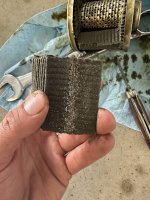
Unfortunately, at my very first oil change since purchase (788 hours), the filter came back as a glitterbox — aluminum, not magnetic. A teardown revealed a piston pin rubbing the cylinder wall. The bottom end of the engine looks fine, but my crank is not compatible with a constant-speed prop. If I want to go that direction, I’ll need to exchange it.

Now I’m at a crossroads. I want a reliable engine, balanced CHTs, fuel injection, and a CS prop. The question is how to get there. Do I overhaul this engine despite its history, or bite the bullet and pursue a new one? Lead time on new engines looks to be 11–14 months. Would it make sense to go with a Superior XP-O kit and source a yellow-tag crank to save time? I want to stick with vertical induction to avoid having to get a new cowl unless somebody can convince me otherwise. Should I do a crank exchange and overhaul the rest of mine and purchase an overhauled BA? Anybody else done these upgrades?

As for props, I like the idea of strong climb performance but don’t want to give up top-end cruise. The new Hartzell composite two-blade — essentially the lightweight carbon BA clone — looks appealing except the price. Has anyone here run that setup, and what are your impressions? I plan to stick with standard compression cylinders for longevity, but I want to make sure whatever crank I use is properly matched to the prop I choose. Recommendations?

So those are my questions: Did anything I do possibly contribute to the wrist pin issue? With this engine’s history, would you trust an overhaul or walk away and start fresh? If fresh, which path would you take — new engine, XP-O kit, or something else? And finally, for those running the newer Hartzell composite ba clone, does anybody have a comparison in performance between that and the standard BA?


Thanks in advance for your time and thoughts.
where are you based and what is the current state of the engine? you mentioned its torn down so are all the parts out in the open and your deciding what to do ?

Why not send all your parts out for inspections, buy the crank you wanted (constant speed) and have a overhaul shop put everything back together? your down time will be much shorter, and you will feel better knowing all parts have been inspected and you will have the support from an overhaul shop for any issues that may come up
 
Hello everyone, I’m hoping to get some advice and perspective on my situation. I’ll try to provide as much context as possible so you can see the full picture.

I’m not the builder of my RV, but I bought it after what I thought was a thorough pre-buy. It’s a beautifully built airplane — Oshkosh award-winning at one point, excellent riveting and paint, Garmin-upgraded panel — but since taking delivery it’s been one headache after another. The logs show a full engine overhaul in 2007 at 1790 hours, a teardown inspection in 2020 at 450 hours (new cam and top, cylinders honed), a cylinder replacement later that year at 466 hours, a full top overhaul in 2023 at 530 hours with new Superior Millennium cylinders, and then I purchased it in 2024 at 740 hours. The engine is an O-360-A1A, originally with a SureFly and Slick mag, 3878 carb, Van’s baffling, and a fixed-pitch Sensenich.

Immediately after purchase, I began fighting high CHTs. Even in January, I was seeing 430–450°F in climb and about 430°F in cruise. I climb at 120 KIAS and cruise at around 65% power (24–2600 RPM at 6–11,000 feet), but the temps were still excessive. I went down the checklist: air, fuel, timing. On the cooling side, I RTV’d and sealed everything, re-baffled the upper cowl, added a cowl flap, increased clearance behind #3, built custom air dams for #1 and #2, and more. That got me about a 20°F improvement. On the fuel side, I swapped the 3878 carb for a 4164, increasing takeoff fuel flow from 13–14 GPH to 14–14.5 GPH. This cooled climb temps by another 10–15°F, but it also meant i lost about 50-75RPM due to the more fuel i was throwing at it.

Timing became the next focus after both my mags failed in short succession. First the Slick died, then the SureFly. I replaced both with P-Mags, set them up with EICAD at –1.4 advance shift and max advance 26.6°, jumper out. This was the biggest improvement: climb temps dropped to about 400°F even in summer, and cruise settled around 360–370°F. I could also lean more aggressively, about 9.5 GPH at 50–100 ROP, though LOP is still not possible with the carb due to ~150°F EGT spread. Learned about just how advance the surfly goes and was happy to change it. I also installed a larger oil cooler, which brought oil temps from 215°F down to about 185°F. At this point I was finally somewhat comfortable, but still not thrilled — in climb I’d see 75–100°F CHT spreads until level-off, which I chalked up to carb distribution. In cruise everything tightened up to within 10°F.

Unfortunately, at my very first oil change since purchase (788 hours), the filter came back as a glitterbox — aluminum, not magnetic. A teardown revealed a piston pin rubbing the cylinder wall. The bottom end of the engine looks fine, but my crank is not compatible with a constant-speed prop. If I want to go that direction, I’ll need to exchange it.

Now I’m at a crossroads. I want a reliable engine, balanced CHTs, fuel injection, and a CS prop. The question is how to get there. Do I overhaul this engine despite its history, or bite the bullet and pursue a new one? Lead time on new engines looks to be 11–14 months. Would it make sense to go with a Superior XP-O kit and source a yellow-tag crank to save time? I want to stick with vertical induction to avoid having to get a new cowl unless somebody can convince me otherwise. Should I do a crank exchange and overhaul the rest of mine and purchase an overhauled BA? Anybody else done these upgrades?

As for props, I like the idea of strong climb performance but don’t want to give up top-end cruise. The new Hartzell composite two-blade — essentially the lightweight carbon BA clone — looks appealing except the price. Has anyone here run that setup, and what are your impressions? I plan to stick with standard compression cylinders for longevity, but I want to make sure whatever crank I use is properly matched to the prop I choose. Recommendations?

So those are my questions: Did anything I do possibly contribute to the wrist pin issue? With this engine’s history, would you trust an overhaul or walk away and start fresh? If fresh, which path would you take — new engine, XP-O kit, or something else? And finally, for those running the newer Hartzell composite ba clone, does anybody have a comparison in performance between that and the standard BA?


Thanks in advance for your time and thoughts.
I would never purchase a product from superior. they make inferior products and make up for it by not standing behind them
 
If I was in your place, I would call Jimmy at JB Aircraft Engines in Sebring, FL and tell him everything you’ve mentioned here (863) 655-5000). Possible cures might include shipping everything to him for a possible rebuild - with all perfect used parts, or new parts, with a guarantee, or possibly a trade in on a new Lyclone experimental engine, spec’d to your choices, and with a warranty. He does good work and stands behind it.
 
I think (my logic could be wrong), that installing a CS prop will get you back into the CHT limited climb problems.
Why? How? My thinking is:
The CS prop will allow more RPM at lower speed, which will mean the engine is making more power at a lower (climb) airspeed.
More power made equals more heat to dissipate.

Just my thought.
My experience with CS props is opposite...The engine rpm runs up to 2700 for takeoff...reducing the load on the engine, rather than to being lugged down at the beginning of a takeoff roll with a fixed pitch prop...the prop is moving significantly more air by virtue of increased rpm's and thrust which is directed as increased airflow over the cylinders...you accelerate more rapidly to launch airspeed and continue accelerating to best rate, which in my 6 is about 115 IAS, going up 2,000 fpm at that speed and 25 squared

CHT hovers around 385 through the initial couple thousand feet of climb...If climbing to 8500-9500 I do so at 140IAS around 1200 fpm advancing to WOT as we go up...and start leaning as the MP drops into a squared mode around 2400rpm. Temps reduce into the 350 range and once at altitude, leaning brings them back up around 390, at which point cruise is generally 185IAS and around 10gph with my O-360

I think you have more variables to adjust, to tailor your CHT/EGT as needed.

I hope that helps.

S
 
So the engine has been has been torn apart and inspected. The findings include the following.
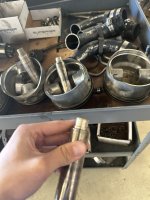
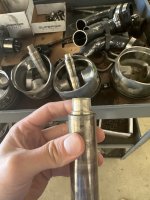
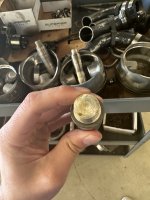
I had two wrist pins that walked. One badly that caused significant porting in the cylinder. The other cylinder also had some porting but was less prominent.
Case is good. However, as mentioned in this post my case had the holes that will need to be plugged for use of CS. https://vansairforce.net/threads/pl...om-fixed-pitch-to-constant-speed-prop.167258/
I was under the impression based on logbooks saying A1A that I had a hollow crank. This turned out to be false. Its an A4.
That being said the crank it self was good, cam was good. The other good news is that the shop I am using said they would do an even trade solid for hallow crank. (flight schools on the field could use the solid crank in case cessnas go down). The one he would trade would be a yellow tagged hallow crank. I could probably salvage two of the cylinders but at this point why not just purchase all new Lycoming cylinders to even everything out. So I can keep my case and exchange my crank. Shop will overhaul/replace connecting rods and bearings. Basically resulting in a zero timed engine. This seems like the obvious way to go I think. If I was keeping the FP prop I would simply replace the cylinders and clean the case... But for CS I need to exchange the crank, plug the hole etc to fit a CS. It makes sense just to zero time it for piece of mind.
Also, the turn around time on this is much quicker.

Now for the next question. Would you do 9.1 Cylinders? Currently has 8.5.
I was hesitant at first but believe i have been talked into it.
More compression=power=more heat. But my thought with the heat is that with the addition of CS.. the hub area or inlets will flow more airflow due to bigger AOA thus supply more cooling air. Also, because the prop is turning 2700 opposed to 2400 on climb...? Less wear on engine etc.
Anybody have experience with temp differences between FP and CS?
 
If I was in your place, I would call Jimmy at JB Aircraft Engines in Sebring, FL and tell him everything you’ve mentioned here (863) 655-5000). Possible cures might include shipping everything to him for a possible rebuild - with all perfect used parts, or new parts, with a guarantee, or possibly a trade in on a new Lyclone experimental engine, spec’d to your choices, and with a warranty. He does good work and stands behind it.
He was the one that did the most recent top overhaul. That being said, I need some other stuff done too. Need a hallow crank, hole plugged etc. Engine is already at another shop. So I am going to give somebody else the opportunity. Thanks for the recommendation.
 
If all of your options cost the same, which would you choose?
Keeping my case and exchanging my crank + new cylinders + overhaul/rebuild the rest.. 4-8 weeks 15-20k this was my quote
Overhaul from Barret, Penn Yan, Lycon etc 11 months 40k
New engine 45-60k 11-14months

I'm leaning toward the cheaper option currently.
 
So the engine has been has been torn apart and inspected. The findings include the following.
I had two wrist pins that walked. One badly that caused significant porting in the cylinder. The other cylinder also had some porting but was less prominent.
Case is good. However, as mentioned in this post my case had the holes that will need to be plugged for use of CS. https://vansairforce.net/threads/pl...om-fixed-pitch-to-constant-speed-prop.167258/
I was under the impression based on logbooks saying A1A that I had a hollow crank. This turned out to be false. Its an A4.
That being said the crank it self was good, cam was good. The other good news is that the shop I am using said they would do an even trade solid for hallow crank. (flight schools on the field could use the solid crank in case cessnas go down). The one he would trade would be a yellow tagged hallow crank. I could probably salvage two of the cylinders but at this point why not just purchase all new Lycoming cylinders to even everything out. So I can keep my case and exchange my crank. Shop will overhaul/replace connecting rods and bearings. Basically resulting in a zero timed engine. This seems like the obvious way to go I think. If I was keeping the FP prop I would simply replace the cylinders and clean the case... But for CS I need to exchange the crank, plug the hole etc to fit a CS. It makes sense just to zero time it for piece of mind.
Also, the turn around time on this is much quicker.

Now for the next question. Would you do 9.1 Cylinders? Currently has 8.5.
I was hesitant at first but believe i have been talked into it.
More compression=power=more heat. But my thought with the heat is that with the addition of CS.. the hub area or inlets will flow more airflow due to bigger AOA thus supply more cooling air. Also, because the prop is turning 2700 opposed to 2400 on climb...? Less wear on engine etc.
Anybody have experience with temp differences between FP and CS?
My 2 cents, keep the 8.5 compression, it will let you run mogas (or even automotive pump gas) if you choose at some point. 9:1 or higher will lock you into 100LL or whatever replacement the gummint finally authorizes.

If you are going to buy 4 new cylinders (and not a bad plan in my book) you might want to keep the two good cylinders, send them out for overhaul and store them in a bucket of oil in case you eat a cylinder at some point in the future - then you'll have a fast fix.
 
For more context. Here are pictures
 

Attachments

  • IMG_1358.jpeg
    IMG_1358.jpeg
    1.7 MB · Views: 114
  • IMG_1355.jpeg
    IMG_1355.jpeg
    1.3 MB · Views: 111
  • IMG_1354.jpeg
    IMG_1354.jpeg
    1.2 MB · Views: 107
  • IMG_1274.jpeg
    IMG_1274.jpeg
    1.7 MB · Views: 103
  • IMG_1275.jpeg
    IMG_1275.jpeg
    2.3 MB · Views: 122
where are you based and what is the current state of the engine? you mentioned its torn down so are all the parts out in the open and your deciding what to do ?

Why not send all your parts out for inspections, buy the crank you wanted (constant speed) and have a overhaul shop put everything back together? your down time will be much shorter, and you will feel better knowing all parts have been inspected and you will have the support from an overhaul shop for any issues that may come up
This is exactly what I am leaning toward doing. Cheaper option too. Just a bit on edge about giving an engine a 3rd/4th life and wanted advice on if i should go this route vs new. But after seeing exactly what happen, knowing the bottom is good I am increasingly leaning this way.
 
I'm curious about the P-mag timing. I'm no expert, but it sounds a bit advanced. Maybe someone else knows.
 
I'm curious about the P-mag timing. I'm no expert, but it sounds a bit advanced. Maybe someone else knows.
Programed with the EICAD software. Max advance set to 26.6. Advance shift (high power) advance shift -1.4
Which is actually pretty conservative. Almost no advance unless I messed this up.
 
Even in January, I was seeing 430–450°F in climb and about 430°F in cruise.
Okay even I think that’s worrisome in January.

This was the biggest improvement: climb temps dropped to about 400°F even in summer, and cruise settled around 360–370°F.
Perfectly fine.

Now I’m at a crossroads. I want a reliable engine, balanced CHTs, fuel injection, and a CS prop.
I don’t think balanced CHTs are a thing to shoot for. I don’t see the point. What am I missing?
 
... The engine rpm runs up to 2700 for takeoff...reducing the load on the engine, rather than to being lugged down ....
Screenshot from 2025-09-08 17-01-53.png

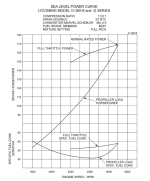
The HP will be greater at 2700 than at 2500. So, sorry to be picky, I don't agree with 'reducing the load'. If the HP is higher, the heat generated has to increase. If we aren't generating more power at the 2700 rpm allowed by the CS prop, it won't climb any faster than with a fixed prop.
 
View attachment 97036

The HP will be greater at 2700 than at 2500. So, sorry to be picky, I don't agree with 'reducing the load'. If the HP is higher, the heat generated has to increase. If we aren't generating more power at the 2700 rpm allowed by the CS prop, it won't climb any faster than with a fixed prop.
This has been demonstrated many times and after owning 6 RV's and a Rocket, I can attest and am happy to demonstrate that a CS prop definitely out climbs a fixed pitch one.

You are comparing only one variable of the equation. HP on a chart. These numbers are arrived at, with a test club prop on a test rig.
All you have to do is go run a side by side comparison with a FP plane, vs. CS plane. See which one, breaks ground quickest, which one hits best rate of climb airspeed quickest and which one makes it to a specified altitude quickest. That's rate.

IF...you don't over-rev your engine, with the FP...the Constant Speed will win every time. WAY back when I built my first RV-4, I had a 70-73 Pacesetter propeller...when I switched to the Hartzell, the argument ended...takeoff roll, shortened by 30 % distance, Rate of Climb increased by 400fpm, time to climb decreased and the only stat that didn't improve was top speed which stayed identical.

Now that's not to say the engine isn't making more heat...but the engine is also cooling at a higher rate, due to increased airflow and increased speed, earlier in the process of taking off.


Certainly not knocking FP props...just prefer my Hartzell...

S.
 
Now that's not to say the engine isn't making more heat...but the engine is also cooling at a higher rate, due to increased airflow and increased speed, earlier in the process of taking off.

Certainly not knocking FP props...just prefer my Hartzell...

Me too, but returning to your assertion...

FP or CS, if we assume climb at the same forward airspeed, available dynamic pressure due to that forward airspeed is obviously the same. Any cooling difference will likely be based on additional dynamic pressure from propeller outflow. How much is a function of blade chord and airfoil near the inlets, as well as inlet configuration. I've measured plenum Cp as high as 1.38 in a WOT climb at 100 KIAS with a Hartzell BA and relocated, low Vi/Vo inlets. 0.85 is a high normal in cruise, with limited difference between forward velocity and propeller outflow velocity.

There is quite a lot of variation in blade profiles near the root. We typically think of FP wood props having chunky sections near the roots, for good structural reasons. However, there are also some CS props out there with poor root profiles, so I would not make a blanket statement that CS props offer better cooling.

As for making more heat at higher RPM, yes. Cooling demand is proportional to mass flow, and we're operating air pumps. Spin 'em faster and they pump more.
 
This has been demonstrated many times and after owning 6 RV's and a Rocket, I can attest and am happy to demonstrate that a CS prop definitely out climbs a fixed pitch one.

You are comparing only one variable of the equation. HP on a chart. These numbers are arrived at, with a test club prop on a test rig.
All you have to do is go run a side by side comparison with a FP plane, vs. CS plane. See which one, breaks ground quickest, which one hits best rate of climb airspeed quickest and which one makes it to a specified altitude quickest. That's rate.

IF...you don't over-rev your engine, with the FP...the Constant Speed will win every time. WAY back when I built my first RV-4, I had a 70-73 Pacesetter propeller...when I switched to the Hartzell, the argument ended...takeoff roll, shortened by 30 % distance, Rate of Climb increased by 400fpm, time to climb decreased and the only stat that didn't improve was top speed which stayed identical.

Now that's not to say the engine isn't making more heat...but the engine is also cooling at a higher rate, due to increased airflow and increased speed, earlier in the process of taking off.


Certainly not knocking FP props...just prefer my Hartzell...

S.
I don't recall saying that a CS prop WOULD NOT climb faster than the usual FP prop. If I did, my mistake. My original point (much more elegantly stated by DanH) was regarding heat generation, assuming one would use the CS prop to enable a faster climb at same airspeed as before.
 
I don't recall saying that a CS prop WOULD NOT climb faster than the usual FP prop. If I did, my mistake. My original point (much more elegantly stated by DanH) was regarding heat generation, assuming one would use the CS prop to enable a faster climb at same airspeed as before.
I think you said the CS prop won't aid in cooling..and I have found that it does in most cases. Perhaps one of the biggest things I've noticed is my engine not getting as hot on the ground, with the Hartzell...as it did with FP...In the air, I've found it cools better for all the reasons I've listed.
 
I did almost exactly what you are contemplating, I majored my O-360 A4 to add a hollow crank and fuel injection at 500 hours since new. I went from an aluminum Sensenich to a Hartzell and from a carb to Bendix FI. I saw better take off and climb and more choices for cruise configurations. I saw no detrimental heat issues for oil or CHT temperatures. I have run this new configuration now for about 750 hours. I feel it gave me what I wanted and would do the same again.
 
I did almost exactly what you are contemplating, I majored my O-360 A4 to add a hollow crank and fuel injection at 500 hours since new. I went from an aluminum Sensenich to a Hartzell and from a carb to Bendix FI. I saw better take off and climb and more choices for cruise configurations. I saw no detrimental heat issues for oil or CHT temperatures. I have run this new configuration now for about 750 hours. I feel it gave me what I wanted and would do the same again.
 
Back
Top